
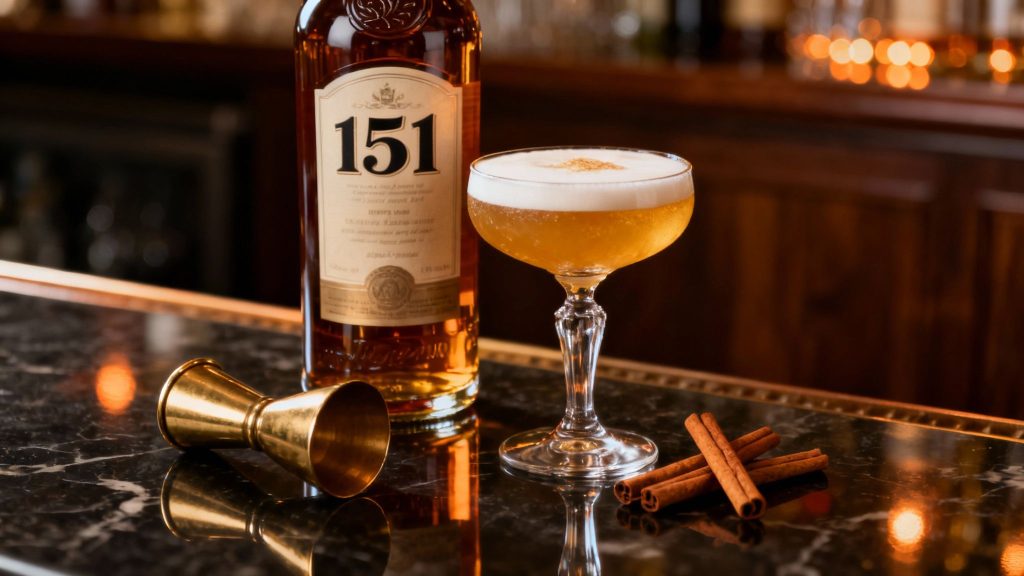
When one hears the term 151 rum, the first thought that often comes to mind is its formidable potency. That number is not merely for effect—it communicates the essential character of what is inside the bottle.
Unpacking the Power of 151 Rum
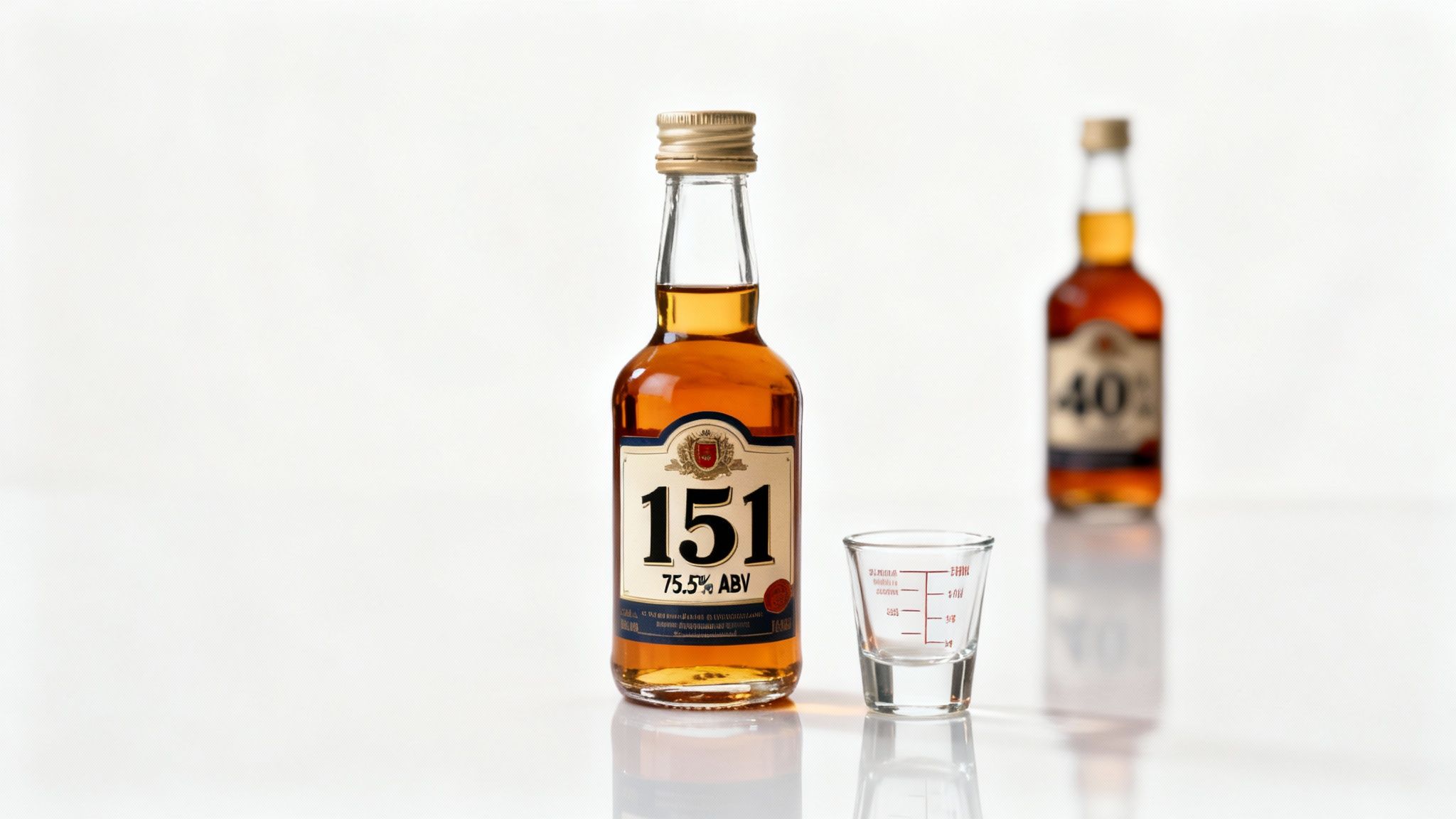
So, what does 151 proof signify? In the United States, the proof of a spirit is double its alcohol by volume (ABV). A simple calculation reveals that 151 rum contains a substantial 75.5% ABV.
To place that in context, a standard bottle of rum, gin, or vodka is typically bottled at 80 proof, or 40% ABV. This means 151 rum is nearly twice as potent, placing it in a distinct category of spirits. It is less a casual sipping spirit and more a high-performance component for cocktails.
From Naval Staple to Mixologist's Tool
High-proof spirits were not always a niche product. Historically, they were valued for their stability and efficiency, famously carried on naval vessels as "navy proof" rum. That potent legacy has since found a more refined purpose behind the modern bar.
Today, 151 rum is a specialist's ingredient. Its intensity makes it an unsuitable choice for drinking neat, but it excels in other applications, adding a unique potency to sophisticated drinks.
Here is where it truly performs:
- Amplifying Flavor: Its high alcohol content acts as a conduit for other ingredients. It extracts and carries bold flavors from fruits and spices, preventing a drink from tasting diluted.
- Adding an Aromatic Component: A small amount floated on top of a cocktail—known as a "float"—delivers an intense aromatic burst before the first sip, transforming the experience.
- Creating a Spectacle: It is, of course, famously flammable. In the hands of a professional, it is the key to the dramatic, flaming cocktails that define classic tiki culture.
This spirit is far more than a novelty; it is a specialized tool for the ambitious mixologist. Understanding how to manage its power is the first step toward creating truly memorable cocktails.
This guide will explore the history, safety considerations, and elegant uses of 151 rum, treating it not just as a spirit, but as an essential component for elevated entertaining and cocktail artistry.
The Storied History of High-Proof Rum
High-proof rum was not developed in a sophisticated cocktail bar; its story begins on the unpredictable waters of the high seas. For centuries, the British Royal Navy provided its sailors a daily rum ration, but they required a method to ensure it was not being diluted by unscrupulous pursers. The solution was a simple, fiery test.
A small amount of gunpowder was mixed with the rum. If the mixture ignited, the spirit was confirmed to be "navy proof"—a benchmark now understood to be approximately 57% ABV. This practical need for a potent, verifiable spirit laid the groundwork for all that followed.
By the mid-20th century, the stage for 151 rum's cultural debut was set. Post-war America was captivated by the allure of exotic locales, and Tiki culture became a popular form of escapism. This was not just about beverages; it was about creating an experience. Pioneers like Donn Beach and Trader Vic were its architects, crafting elaborate tropical concoctions that were equal parts cocktail and performance.
The Rise of Flaming Cocktails
What made Tiki so unforgettable was the theater. The high-octane nature of 151 rum made it the perfect fuel for the pyrotechnic flair that defined the movement. A small amount floated atop a drink and set alight created a mesmerizing blue flame—a spectacle that instantly captured the imagination of patrons.
This is where brands like Bacardi 151 truly established their niche. The iconic bottle, fitted with a steel flame arrester in the cap, became a permanent fixture on nearly every backbar in the country. For decades, it was the non-negotiable ingredient in formidable Tiki classics like the Zombie and the Jet Pilot, providing their signature potency and visual drama.
When Bacardi 151 was discontinued in 2016, it sent a ripple through the cocktail world. It was not merely a product leaving the shelves; it felt as though a piece of history was gone. Bartenders and home enthusiasts alike were left searching for a replacement, wondering if the era of the go-to, high-proof mixer had concluded.
The departure of iconic brands did not mark the end of high-proof rum; instead, it cleared the way for a new chapter focused on craftsmanship and complexity.
A Modern Craft Renaissance
In the space left by the established brands, a new generation of distillers saw an opportunity. They stepped in not just to fill a void, but to completely redefine what a 151 rum could be. The focus shifted from pure, unadulterated power to creating overproof rums with genuine character and layers of flavor.
Today's craft 151s are made for careful use and appreciation, not just for pyrotechnics. Distillers like Hamilton offer a superb blend of bold Guyanese rums, while Don Q brings the clean, classic profile of Puerto Rican rum to the category. These modern expressions honor the spirit's potent legacy while advancing it, proving that 151 rum is far more than a party trick—it is a serious, versatile tool for crafting exceptional drinks.
How to Handle 151 Rum Safely
The very quality that makes 151 rum so distinctive—its significant 75.5% ABV—is also what demands the utmost respect. This extends beyond simple potency to matters of basic chemistry and fire safety. Due to its high alcohol content, 151 rum is far more flammable than an average spirit, a crucial fact to understand before opening a bottle.
Consider this: alcohol vapor is the fuel. A standard 80-proof bottle of vodka or whiskey (40% ABV) has a flash point of approximately 79°F (26°C), the temperature at which it emits enough vapor to ignite. In sharp contrast, 151 rum’s flash point is much lower, around 68°F (20°C). This means that at normal room temperature, it is already producing a flammable vapor cloud awaiting an ignition source.
The journey of rum is a fascinating one, from a sailor's ration to a key element of Tiki culture.
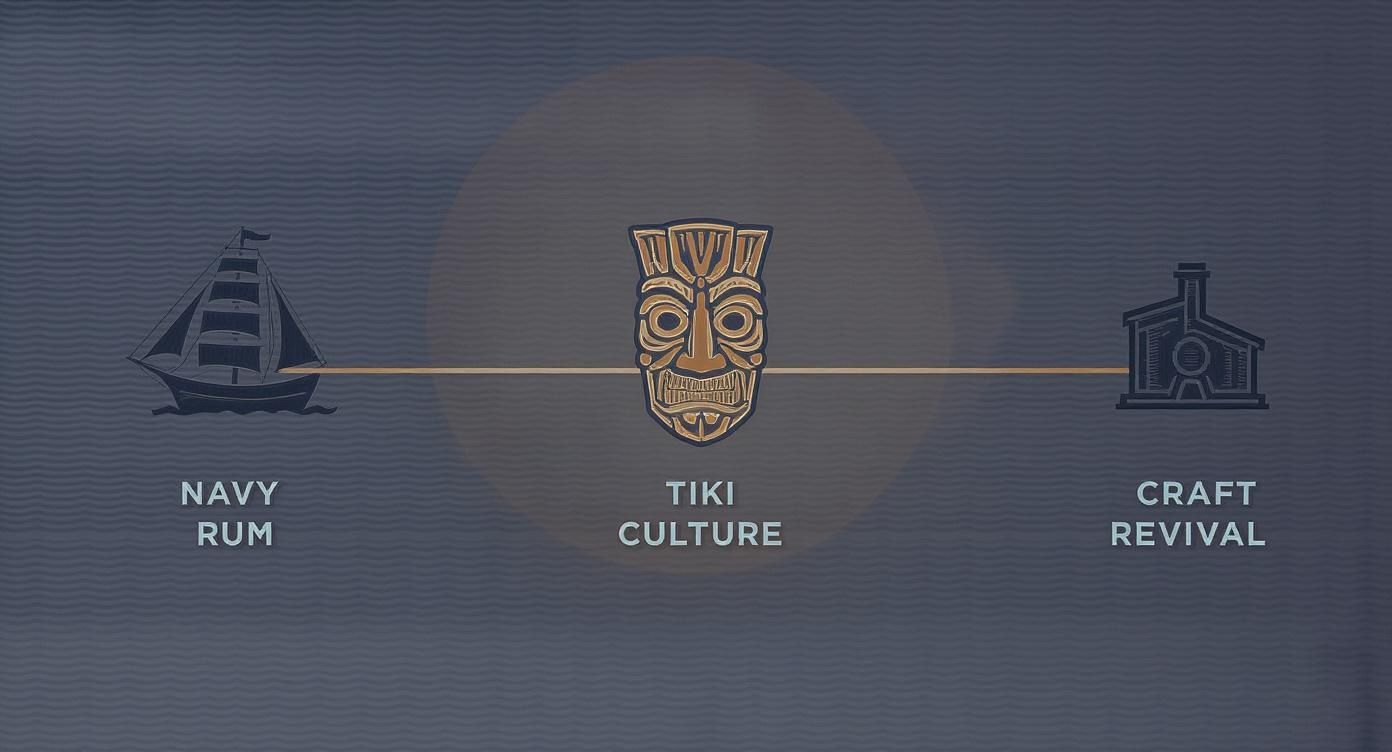
This graphic illustrates how rum transformed from a practical navy staple into a central player in the dramatic world of Tiki, which has paved the way for the craft spirits revival being witnessed today.
Essential Storage and Pouring Protocols
Handling 151 rum is not complicated, but it is a serious responsibility. Once its properties are understood, a few simple rules become second nature. These practices are non-negotiable, whether for a home cocktail enthusiast or a seasoned bartender.
The primary objective is simple: control the environment to minimize risk. Always store bottles of 151 rum well away from heat sources. This includes locations near a stove, oven, water heater, or even in direct, intense sunlight, which can heat the liquid and build vapor pressure inside the bottle.
When it comes time to pour, precision is paramount.
- Never Pour Near an Open Flame: This is the absolute golden rule. The pilot light on a gas stove, a nearby candle, or a lit grill can all ignite the vapors instantly. Measure the rum a safe distance from any potential ignition source.
- Use a Jigger: Free-pouring is ill-advised. A jigger provides complete control, preventing spills and ensuring the addition of the exact, potent dose the cocktail requires.
- Wipe Up Spills Immediately: If any drops are spilled, do not ignore them. Clean the area thoroughly with a damp cloth before introducing any flame, such as for a garnish or with a culinary torch.
To put the unique hazard of 151 rum into perspective, here is a brief comparison with other common spirits.
Alcohol Proof and Flammability Comparison
This table clearly illustrates why 151 rum occupies a category of its own. While most spirits are flammable to some degree, the risk with 151 is significantly higher due to its low flash point and high vapor production.
| Spirit Type | Standard Proof | ABV % | Flammability Risk |
|---|---|---|---|
| 151 Rum | 151 | 75.5% | Extreme |
| Absinthe | 110-148 | 55-74% | Very High |
| Whiskey/Vodka | 80-100 | 40-50% | Moderate |
| Liqueur | 30-60 | 15-30% | Low |
| Wine | 24-30 | 12-15% | Very Low |
The conclusion is clear: the leap from a standard 80-proof spirit to a 151-proof one represents a major shift in volatility.
The most immediate danger of 151 rum is not just its flammability—it is the severe harm from consuming it straight. Consuming this spirit undiluted can cause immediate, painful irritation to the mouth, throat, and esophagus. It is always intended as a component in a mixed drink, never to be consumed on its own.
Responsible Use in Cocktails
While the spectacle of a flaming cocktail is memorable, it is an advanced technique that belongs in the hands of trained professionals working in a controlled environment. For everyone else, the appeal of 151 rum lies in how it transforms a drink through careful dilution.
Its proper role is to add a powerful potency and an aromatic punch, either as a float that sits atop a finished cocktail or as a small, precisely measured ingredient. By respecting its power and handling it with the care it deserves, one can safely unlock the incredible character it brings to the art of mixology.
Crafting Sophisticated Cocktails with 151 Rum
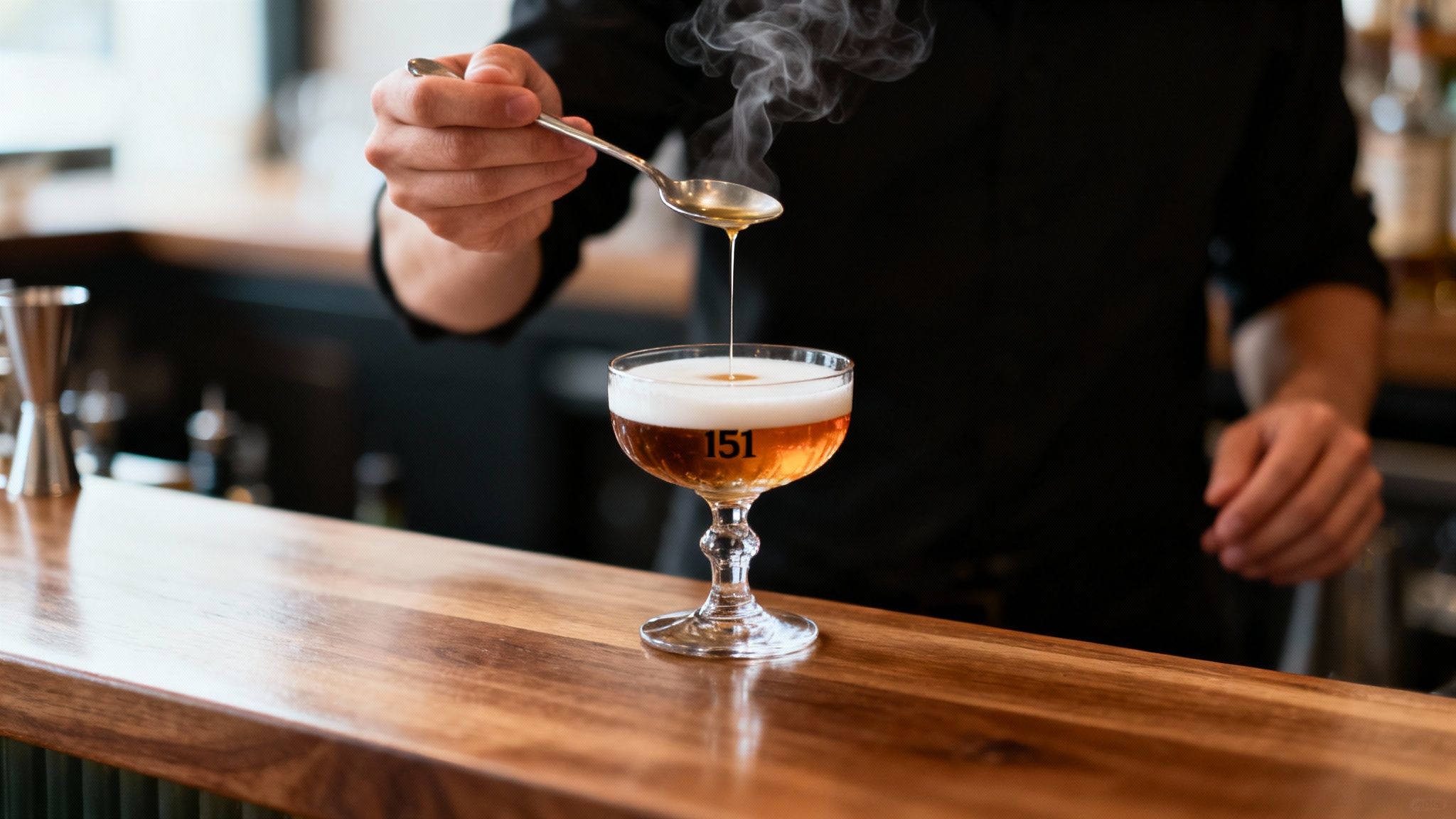
When people think of 151 rum, they often picture a flaming shot. However, for anyone serious about mixology, that is merely a party trick. The real appeal of this spirit is far more subtle and sophisticated.
In an expertly crafted cocktail, 151 rum is not about brute force; it is about its incredible ability to carry and amplify flavor. Its high alcohol content acts as a powerful solvent, one that can extract the deepest, most complex aromatics from spices, fruits, and liqueurs.
A small amount can prevent a drink from tasting diluted or muddled. It helps bold flavors like passion fruit, cinnamon, or allspice stand out, creating a crisp, vibrant profile. Here, the focus shifts from raw power to pure precision.
The Art of the Float
One of the most elegant ways to use 151 rum is the float. This simple technique involves gently pouring a small measure—usually just a quarter-ounce—over the back of a bar spoon onto a finished drink. Due to its lower density, the rum sits perfectly on top, creating a distinct layer.
This accomplishes two things. First, it provides a powerful aromatic note before the first sip, instantly engaging the sense of smell and preparing the palate. Second, it allows the cocktail to evolve as it is consumed, with the potent rum slowly mingling with the layers beneath.
Using 151 rum is like adding a finishing touch of high-quality perfume. A small, well-placed amount adds depth and an aromatic signature that elevates the entire experience, transforming a good drink into a great one.
This appreciation for high-proof spirits is part of a larger trend. The global rum market reached an impressive USD 15.8 billion in 2023 and is on track to reach USD 17.0 billion in 2024. At-home consumption alone is projected to hit USD 11.7 billion. This surge reflects a growing taste for premium spirits where unique expressions like 151 rum are prized for their character, a trend you can explore in recent rum industry statistics.
Signature Cocktail Recipes
To truly understand what 151 rum can do, let's move beyond theory. Here are three recipes that showcase its finesse, each built around balance, complexity, and a deep respect for the spirit’s intensity.
1. The Modernized Zombie
This is not the overly sweet Zombie some may recall. This interpretation of the Tiki classic reduces the sweetness to allow the fresh ingredients to shine, using the 151 rum float for its aromatic purpose, not just for potency.
- Ingredients:
- 1.5 oz Aged Jamaican Rum
- 1.5 oz Gold Puerto Rican Rum
- 1 oz Fresh Lime Juice
- 0.5 oz Falernum
- 0.5 oz Donn's Mix (2 parts grapefruit juice, 1 part cinnamon syrup)
- 1 tsp Grenadine
- 2 dashes Aromatic Bitters
- 0.25 oz Hamilton 151 Rum for float
- Instructions: Combine all ingredients except the 151 rum in a shaker filled with crushed ice. Shake vigorously, then pour into a tall glass. Gently float the Hamilton 151 on top and garnish with a fresh mint sprig.
2. The Volcanic Kiss
An original creation, this cocktail uses a 151 rum rinse—coating the inside of the glass—to add a subtle, smoky foundation to a bright, fruit-forward drink.
- Ingredients:
- 2 oz Reposado Tequila
- 1 oz Fresh Blood Orange Juice
- 0.75 oz Agave Nectar
- 0.5 oz Aperol
- Don Q 151 Rum for rinse
- Instructions: Pour a small amount of Don Q 151 into a chilled coupe glass. Swirl to coat the entire inside surface, then discard any excess. Shake the other ingredients with ice, double strain into the rinsed glass, and garnish with a dehydrated orange wheel.
3. The Black Seal Storm Float
This is a more refined take on the classic Dark 'n' Stormy. The float of rich, dark 151 rum adds a final layer of aromatic complexity that truly elevates the drink.
- Ingredients:
- 2 oz Gosling's Black Seal Rum
- 4 oz High-Quality Ginger Beer
- 0.5 oz Fresh Lime Juice
- 0.25 oz Gosling's Black Seal 151 Rum for float
- Instructions: Fill a highball glass with ice. Add the lime juice and ginger beer. To create a layered look, slowly pour the Black Seal Rum over the top. Finish by carefully floating the Gosling's 151 on top.
Exploring Today's Best 151 Rum Brands
When Bacardi 151 left the market, it created a void. However, the spirits world abhors a vacuum. A new wave of distillers has since emerged, focusing less on sheer flammability and more on character and complexity, creating a fascinating new landscape of high-proof rum.
Navigating this world means looking beyond the proof to see the personality in each bottle. The best 151 rums today offer something for everyone, from the adventurous home bartender to the serious spirits collector.
The New Mainstays
Two names one will see almost everywhere are Gosling's Black Seal 151 and Don Q 151, and for good reason. Gosling's is the dark, brooding heavyweight. It is rich and intense, with deep molasses and burnt caramel notes that finish with a touch of spice. To add a serious backbone to a cocktail, this is an excellent choice. It is ideally suited to be floated on a Dark 'n' Stormy.
On the other side of the spectrum is Don Q 151 from Puerto Rico. It is a much lighter and cleaner spirit. While it still possesses considerable potency, its aging period of up to three years softens the edges, revealing hints of vanilla and tropical fruit. It is surprisingly refined and makes for a more versatile mixer than one might expect.
For the Craft Cocktail Enthusiast and Collector
Beyond the major brands, one finds the truly interesting expressions. Hamilton 151 Overproof has become the go-to for Tiki aficionados, and rightfully so. It is a blend of bold, funky Guyanese rums that brings the exact robust character required for a proper Zombie. It effectively filled the void that the original Lemon Hart 151 left behind.
For collectors, the pursuit is for historical artifacts. A sealed bottle of the original Bacardi 151 is more than just rum now; it is a time capsule, a piece of cocktail history.
The current state of 151 rum mirrors a broader shift in the spirits world. Consumers are drinking better, not just more. They are seeking out unique, high-quality spirits, and the super-premium rum category is thriving as a result.
While the rum market as a whole experiences fluctuations, the top shelf is booming. Bacardi may still account for 20% of all rum poured in bars, but the real story is in the premium space. The high-end segment is projected to grow at a 6% CAGR through 2027, which indicates where consumer tastes are headed. One can get a deeper look at the numbers in these 2025 rum market forecasts.
This trend is excellent news for consumers. It means whether one is crafting an unforgettable cocktail or searching for the next prized bottle for a collection, there is a 151 rum out there that is perfect for the job. One simply has to know what to look for.
Beyond the Glass: Food Pairings and Clever Substitutions
The bold, unapologetic character of 151 rum is not just for cocktails; it has a fascinating life in the culinary world as well. It should be regarded as a powerhouse ingredient, one whose intense notes of molasses, burnt sugar, and spice can stand up to equally robust flavors. The key is to find a partner that will not be overpowered.
Rich, savory dishes are where 151 rum truly excels. Its deep sweetness is a brilliant counterpoint to the smokiness of slow-cooked barbecue, the salty notes of an aged Gouda, or the earthy character of venison. It is even used to create complex, layered flavors in products like a gourmet Honey Rum Chipotle Sauce, where it balances heat and sweetness. For dessert, it is a classic pairing for dark chocolate, cutting through the richness.
How to Make a Smart Swap
What should one do when a recipe calls for 151 rum and the bottle is empty? There is no need for alarm. The goal is to mimic its concentrated flavor and high proof, and several solid options exist.
- Other Overproof Rums: The easiest substitution is another high-ABV rum. Something like Wray & Nephew Overproof (63% ABV) or a quality Navy Strength rum (typically around 57% ABV) will approximate the effect. A slightly larger measure may be needed to match the intensity.
- A Standard Dark Rum Modification: If only a standard 80-proof dark rum is available, one can get creative. Gently warm the rum with spices—such as a cinnamon stick or a few cloves—to concentrate the flavors. It will not replicate the proof, but it can reasonably mimic the aromatic punch.
A word of caution when substituting with 151 rum: a little goes a very long way. If swapping it into a recipe that calls for a standard rum, begin with half the amount and taste. One can always add more, but it cannot be removed.
Conversely, if adding 151 rum to a standard drink, consider it an accent, not the main component. A small float on top or even a bar spoon's worth is often all that is needed to introduce its unique character without overpowering the cocktail. This careful application is precisely what connoisseurs seek in the ultra-premium rum market—a niche expected to grow by 6% CAGR as more consumers seek out these powerful, complex spirits. One can delve deeper into the growth of the global spirits market to see how popular these top-shelf bottles are becoming.
A Few Lingering Questions About 151 Rum
When dealing with a spirit this potent, it is natural to have some questions. Let's clarify some of the most common curiosities about 151 rum so you can approach it with both respect and confidence.
Is 151 Rum Legal to Purchase?
For the most part, yes. It is legal to purchase and own 151 rum for personal consumption throughout most of the United States and elsewhere. However, its availability can be inconsistent, as some states have specific laws that restrict the sale of such high-ABV spirits. The best chance of finding it is at a well-curated liquor store.
One place it absolutely cannot be taken is on an airplane. The FAA classifies any beverage over 140 proof (70% ABV) as a hazardous material due to its flammability. Therefore, leave the bottle at home; it is banned from both checked and carry-on luggage.
Can You Drink 151 Rum Straight?
Technically, one can, but it is strongly inadvisable. Drinking 151 rum neat is a poor decision. At 75.5% ABV, the alcohol concentration is so high that it can cause a painful burning sensation in the mouth, throat, and esophagus.
This is not a sipping rum. It should be regarded as a powerful ingredient, intended for use with precision and care, not for enjoyment on its own.
What Is the Proper Way to Use 151 Rum?
The best applications for 151 rum are those that harness its fiery intensity without allowing it to dominate a drink. It is all about strategic use.
- The Float: This is its most famous role. Carefully pouring a small amount (approximately a quarter-ounce) over the top of a finished cocktail creates a stunning aromatic layer and an intense first sip.
- The Rinse: Swirling a minuscule amount of 151 in a glass and then discarding it leaves behind a whisper of its character, adding a complex, funky note that lingers in the background.
- The Power-Up: In classic Tiki drinks like the Zombie, a small, measured amount of 151 is used to add its signature potency and deepen the flavor profile, balancing the sweet and fruity elements.
For more insights into the world of fine spirits and luxury living, discover Social Life Magazine, your guide to the most exclusive experiences. Explore our curated content at https://www.sociallifemagazine.com.
Author

Written by
Recent Posts
Taylor Sheridan Net Worth: $200M And The $1B NBCU Deal
Forrie J Smith Net Worth: $2M The Realest Cowboy On Yellowstone
Gil Birmingham Net Worth: $5M From Twilight To Marshals 2026
Kelsey Asbille Net Worth: $3M And The Wind River Pipeline 2026

Where Music Meets Diplomacy: Ronald C. Gunnell’s Mission to Unite the World Through Culture
Categories
- Art
- Articles
- Beauty & Skincare
- Celebrities
- Celebrities|Movies
- Celebrities|The Chronicles
- Chronicles
- Entertainment|Culture
- Event Photos
- Events
- Fashion
- Fashion & Style
- Featured
- Food & Beverage
- Food, Spirits, Wine
- Hamptons
- Hamptons Celebrities
- Hamptons Celebrities
- Health
- Health & Beauty
- Lifestyle
- Luxury Lifestyle
- Movies
- Movies|Culture
- Movies|Hamptons Lifestyle
- Press
- Profiles
- Real Estate
- Technology
- The Chronicles
- Travel
- TV
- TV & Film
- Uncategorized
- Weddings