

Family offices deployed over $3.2 trillion in alternative investments last year, yet most still overlook the sector delivering consistent 15-25% returns: wholesale real estate. Traditional investment committees dismiss it as mom-and-pop territory. However, sophisticated family offices now build dedicated wholesale teams that source off-market deals, negotiate directly with distressed sellers, and flip contracts to cash buyers within 30-60 days. This approach generates returns without capital deployment or property management headaches.
The fundamental mistake? Most family offices treat real estate as a passive asset class. They write checks to funds and wait. Meanwhile, wholesale operations create immediate cash flow through assignment fees ranging from $15,000 to $150,000 per transaction.
Why Family Offices Enter Wholesale Real Estate Markets
Institutional investors gravitate toward wholesale operations for three compelling reasons. First, the model requires minimal capital exposure compared to traditional acquisitions. Furthermore, family offices maintain complete control over deal flow without relying on external fund managers who charge 2-and-20 fee structures.

Capital Efficiency Drives Adoption
Traditional real estate investments lock up capital for years. Wholesale deals require earnest money deposits of $500-$5,000 per contract. According to McKinsey research, private market investors increasingly prioritize liquidity and quick capital rotation. Moreover, wholesale assignments generate returns in weeks rather than years.
Deal velocity matters more than individual transaction size. A well-structured team closes 3-8 wholesale contracts monthly. Consequently, annual returns compound faster than appreciation-based strategies.
Control Over Deal Selection
Family office principals grew wealthy by controlling outcomes. They reject passive investment models that surrender decision-making authority. Therefore, wholesale operations attract executives who built businesses through direct negotiation and relationship management.
The team evaluates every property personally. Members walk homes, assess renovation costs, and negotiate directly with sellers. Additionally, they build proprietary databases of cash buyers willing to close within days.
Market Cycle Resilience
Wholesale operations thrive during both bull and bear markets. Rising markets create motivated sellers who need quick exits. However, declining markets generate distressed inventory from foreclosures, divorces, and estate liquidations. Bain’s annual private equity report emphasizes that countercyclical strategies protect portfolios during volatility.
Furthermore, the business model doesn’t depend on appreciation or rental income. Assignment fees derive from the spread between contract price and buyer willingness-to-pay. Market direction becomes largely irrelevant.
Structuring High-Performance Wholesale Teams
Elite family offices don’t hire generalists for wholesale operations. They build specialized teams where each member owns specific responsibilities. Moreover, compensation structures align individual performance with overall profitability through transaction-based bonuses rather than fixed salaries.
Acquisitions Specialists Drive Deal Flow
Acquisitions managers source off-market inventory through direct mail campaigns, cold calling, and relationship networks. Top performers contact 100-200 property owners daily. However, conversion rates hover around 1-2%, requiring persistent effort and refined scripts.
The best acquisitions specialists come from sales backgrounds rather than real estate. They understand negotiation psychology and overcome seller objections. Additionally, they screen deals rapidly, eliminating properties with insufficient margins before wasting analytical resources.
Dispositions Managers Monetize Contracts
Closing wholesale deals requires robust buyer networks. Dispositions managers cultivate relationships with 50-200 active cash purchasers including fix-and-flip investors, landlords, and small institutions. Furthermore, they match property characteristics to buyer preferences, ensuring rapid assignments.
These professionals host buyer tours, manage due diligence requests, and coordinate closing logistics. Harvard Business Review research demonstrates that relationship-intensive businesses outperform transactional models. Dispositions managers embody this principle by treating buyers as long-term partners.
Analysts Underwrite and Validate Margins
Every contract requires rigorous financial analysis before execution. Analysts evaluate comparable sales, estimate renovation costs, and calculate maximum allowable offers. Moreover, they stress-test assumptions against worst-case scenarios to protect the family office from margin compression.
Technology amplifies analyst productivity. Proprietary software pulls MLS data, tax records, and demographic information instantly. Consequently, teams evaluate 20-30 properties daily without sacrificing accuracy.
Technology Infrastructure for Scalable Operations
Family offices investing in wholesale operations implement enterprise-grade systems from day one. Spreadsheets and email chains collapse under volume. Therefore, successful teams deploy integrated platforms that manage lead generation, contract tracking, and buyer communication within unified databases.
Customer Relationship Management Systems
CRM platforms track every seller interaction from initial contact through contract assignment. Sales pipelines visualize deal progression across acquisition stages. However, generic CRMs like Salesforce require extensive customization for real estate workflows.
Industry-specific solutions like REsimpli or PropStream offer pre-built features including automated follow-up sequences, SMS integration, and property detail scraping. Additionally, these systems generate performance metrics that identify top performers and bottlenecks. Deloitte’s investment management research confirms that data-driven organizations achieve 23% higher returns than competitors.
Marketing Automation Generates Consistent Leads
Direct mail campaigns remain the highest-converting lead source for wholesale operations. Teams send targeted postcards to absentee owners, expired listings, and pre-foreclosure properties. Moreover, automation platforms personalize messaging based on property characteristics and owner circumstances.
Digital marketing complements traditional channels. Pay-per-click campaigns target motivated seller keywords while retargeting captures website visitors. Furthermore, sophisticated attribution tracking reveals which channels generate profitable deals versus empty leads.
Due Diligence and Title Research Tools
Contract execution requires rapid title verification and lien identification. Third-party services provide instant title reports, mortgage balances, and ownership histories. However, experienced teams develop relationships with local title companies that expedite difficult situations.
Virtual assistants handle routine research tasks, freeing senior team members for high-value negotiations. Offshore teams in the Philippines or Latin America perform skip tracing, property research, and initial outreach at 70% cost savings compared to US-based staff.
Navigating Legal and Regulatory Frameworks
Family offices approach wholesale real estate through proper legal structures that protect principals from liability exposure. Single-member LLCs isolate transaction risk from other family assets. Moreover, experienced real estate attorneys draft assignment contracts that withstand seller objections and buyer scrutiny.

Licensing Requirements Vary by Jurisdiction
Some states require real estate licenses for wholesale activities. Others permit unlicensed principals to assign contracts they personally control. Therefore, family offices consult local counsel before launching operations in new markets.
Many sophisticated investors obtain broker licenses despite legal ambiguity. Licensing provides MLS access, credibility with sellers, and defense against regulatory challenges. BCG’s research on wealthy families emphasizes that proactive compliance prevents costly disruptions to profitable operations.
Contract Language Protects Assignment Rights
Standard purchase agreements often restrict assignment without seller consent. Wholesale contracts include explicit assignment clauses with broad “and/or assigns” language after the buyer’s name. Additionally, teams use phrases like “buyer or nominee” to preserve flexibility.
Some sellers balk at assignment clauses. Skilled negotiators present wholesaling as a business model rather than concealing intentions. Furthermore, transparency builds trust and reduces contract cancellations when sellers discover the buyer’s true identity.
Disclosure and Earnest Money Management
Ethical operators disclose their wholesale intentions upfront. This approach prevents legal challenges and maintains market reputation. Moreover, family offices deposit earnest money in attorney-managed escrow accounts rather than personal accounts.
Transaction coordinators track earnest money deadlines and inspection contingencies. Missed deadlines create liability exposure and financial losses. Consequently, sophisticated teams implement calendar systems with multiple redundancy checks before critical dates.
Performance Metrics and Continuous Optimization
Data-driven family offices measure every aspect of wholesale operations. Key performance indicators reveal team productivity, market conditions, and profit margins. However, vanity metrics like lead volume mislead investors unless tied directly to completed transactions and net profits.
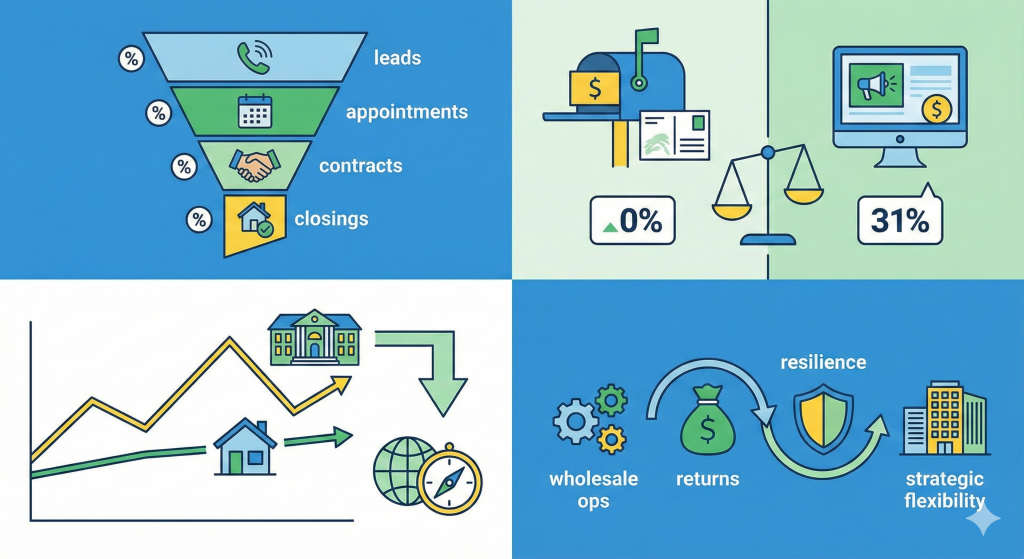
Conversion Ratios Identify Bottlenecks
Elite teams track conversion rates at each pipeline stage. Lead-to-appointment ratios measure acquisitions effectiveness. Appointment-to-contract rates reveal negotiation skill. Additionally, contract-to-closing percentages highlight dispositions challenges or due diligence gaps.
Industry benchmarks provide context. Top wholesalers convert 1-2% of marketing leads into contracts. Furthermore, 60-80% of executed contracts should reach closing. Lower conversion rates signal team training needs or market selection problems.
Cost Per Acquisition Determines Marketing ROI
Marketing budgets expand as operations scale. Family offices calculate cost per acquired contract by dividing total marketing spend by closed deals. Moreover, they segment costs by channel to identify highest-performing campaigns.
Direct mail typically costs $0.50-$2.00 per piece with 1-3% response rates. Digital campaigns generate cheaper leads but lower conversion quality. PwC’s asset management research demonstrates that sophisticated investors optimize channel mix rather than relying on single sources.
Average Assignment Fees Reflect Market Positioning
Assignment fees vary based on property price points and market competitiveness. Family office teams target $20,000-$40,000 average fees by focusing on mid-market properties between $150,000-$400,000. However, luxury wholesale deals generate $50,000-$150,000 fees with longer transaction timelines.
Tracking average fees over time reveals market saturation or competitive pressure. Declining fees indicate too many wholesalers chasing limited inventory. Consequently, successful teams expand geographically or adjust property criteria before margins compress completely.
Building wholesale real estate teams requires family offices to embrace operational intensity typically foreign to passive investment strategies. However, the returns justify the effort for principals seeking capital-efficient cash flow. Moreover, the skills developed through wholesale operations translate directly to other real estate strategies including fix-and-flip, rental portfolios, and commercial acquisitions. Therefore, forward-thinking family offices view wholesale teams as training grounds for comprehensive real estate platforms. The combination of immediate returns, market cycle resilience, and strategic flexibility makes wholesale real estate an essential component of sophisticated family office portfolios.
Author

Written by
Recent Posts
Sectional Sofa vs. Regular Sofa: Which One is Best for You?

Sober and Injured: How to Manage Pain Treatment After a Massachusetts Slip and Fall
Flexible Liquidity Options Are Reshaping How Modern Professionals Handle Unexpected Expenses
5 Best At-Home Teeth Whitening Kits for a Brighter Smile in 2026

From Spa Retreats to Aesthetic Care, the Luxury Travel Itinerary Is Changing
Categories
- Art
- Articles
- Business of Luxury
- Celebrities
- Culture
- Entertainment
- Events
- Faces of Summer 2026
- Fashion
- Fashion & Style
- Featured
- Finance
- Food, Spirits, Wine
- Hamptons
- Hamptons Celebrities
- Health
- Health & Beauty
- Lifestyle
- Luxury Lifestyle
- Press
- Profiles
- Real Estate
- Technology
- The Chronicles
- Travel
- Uncategorized
- Weddings