
Still Here, Still Ours
The carousel clicks forward.
That’s the Don Draper move, right? It’s the nostalgic hook that makes you feel something you can’t quite name—a memory you didn’t know you had, a place you’ve never been but somehow miss.
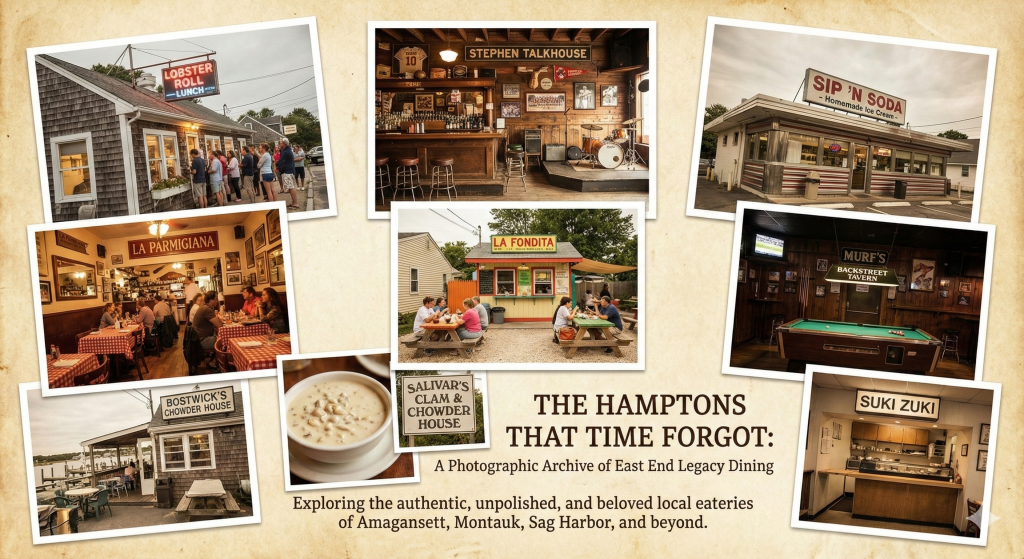
Yet the Hamptons doesn’t need manufactured nostalgia. After all, there are places that have been feeding the same families for sixty years. Moreover, a sumo champion’s sons still cut fish at the horseshoe bar their father built, while a building from 1792 continues to pour drinks for anyone who walks through the back door.
These eighteen restaurants represent the real thing. Unlike spots designed by consultants or optimized for Instagram appeal, they’re here because someone decided to stay. Essentially, families looked around and said: this corner, this counter, this community—this is ours.
Anthony Bourdain spent his career chasing places like these, calling them “pre-gentrification artifacts”—the spots that existed before the money came and somehow kept existing after. He understood that you could taste when someone gave a damn. Furthermore, he knew that the best meals weren’t about technique or trend, but rather about continuity—about showing up, day after day, year after year, until excellence became invisible.
Pierre Bourdieu would have recognized something else entirely: the quiet power reversal that happens inside these walls. In most Hamptons establishments, money talks. At these places, however, the dominant currency is tenure. Consequently, the billionaire who walks in for the first time ranks below the retired schoolteacher who’s been eating at that counter every Tuesday for thirty years.
What follows is our list—the legacy places, the family operations, the stubborn holdouts against forces that want to make everything new, exclusive, expensive, and forgettable.
The Seafood Institutions
At these establishments, you taste the Atlantic itself. Because the boats still go out in the morning and the catch still comes in fresh, “local seafood” isn’t a marketing angle here—it’s simply what happens when you build a restaurant next to a working harbor.
The Lobster Roll (LUNCH) — Amagansett, Since 1965
You see the sign before you understand what you’re looking at: LUNCH. White letters on a simple rectangle, perched atop a red, white, and blue awning on the Napeague stretch of Route 27. For sixty years, that sign has functioned as a cultural checkpoint—a declaration that you’ve crossed some invisible threshold into the East End that actually exists.
Fred Terry was just nineteen when he and his father bought this clam shack, though his family’s Long Island roots stretch back to 1640. According to local legend, the cold lobster salad roll—the mayonnaise-bound version that diverges from Connecticut’s hot butter style—was invented here. Fred, however, remains characteristically modest about the claim.
Andrea Anthony joined in 1978, stepping in to manage when a manager quit unexpectedly. She never left. Today, as President and COO, she’s built a lifestyle brand from a roadside shack—complete with cookbooks, a PBS cooking show, and a Southampton location. Nevertheless, the Amagansett original remains what it’s always been: the recipe hasn’t changed, the sign hasn’t changed, and the line still forms before noon on summer weekends.
Read the full story of The Lobster Roll →
Bostwick’s Chowder House — East Hampton, Since 1990
In June 1699, the privateer William Kidd buried treasure in a ravine near Bostwick’s Point on Gardiner’s Island. Centuries later, a young East Hampton cook named Chris Eggert discovered his favorite fishing spot off that same stretch of coast. When he and Kevin Boles finally opened their first restaurant together, they named it after the place where Eggert loved to cast his line.
Their story began with two teenage friends washing dishes in Springs. Now, thirty-plus years later, Eggert and Boles run what industry observers call a “restaurateur juggernaut”—multiple locations, a catering company, a seafood market. Despite this growth, Bostwick’s Chowder House on Pantigo Road remains the heart of it all. With no water views, paper plates, and curly fries, it’s earned TripAdvisor’s #1 restaurant ranking in East Hampton.
Throughout this expansion, the philosophy never changed: good food that isn’t fussy. Specifically, the baked stuffed clams earn comparison to the legendary Spring Close Restaurant. Meanwhile, the lobster roll comes in cold or hot buttered versions, both packed with meat. Simply put, the line forms because the promise is kept, day after day.
Read the full story of Bostwick’s →
Salivar’s Clam & Chowder House — Montauk, 60+ Years
First, you notice the shark watching you—a 4,500-pound great white, grinning with frozen menace from its mount high on the wall. Frank Mundus caught it in 1964, and he would later inspire one of cinema’s most iconic characters: Captain Quint from Jaws.
Mundus was a character himself. He painted his toenails red and green for port and starboard, wore a hoop earring, and called his work “Monster Fishing.” Then, in 2014, the Devlin family merged their beloved Clam & Chowder House into this space. Importantly, they kept what mattered: the grandfathered neon sign, the shark head, and the commitment to serving whatever the commercial boats brought in that morning.
Rob Devlin passed in 2020, but his daughters Hali and Shana continue the operation today. From the rooftop deck, you can see Montauk Harbor—still New York State’s largest commercial fishing port. As a result, the fish arriving at the restaurant each morning comes from boats that have worked these waters for generations.
Read the full story of Salivar’s →
Cowfish — Hampton Bays, Since 2012
On your first visit to Cowfish, you’ll almost certainly think you’re lost. After all, the driveway winds behind a marina and a seafood shop, past boats on trailers and stacks of lobster traps. Then, suddenly, the parking lot opens up, the Shinnecock Canal appears, and you understand what David and Rachel Hersh discovered: a restaurant that nobody could find unless they were already looking.
Hampton Bays represents the more affordable, more working-class Hamptons. Understanding this, David and Rachel built Cowfish for their actual community—not an imagined clientele of sophisticates. Even the name comes from Southern tradition, where “cowfish” restaurants serve both surf and turf. Accordingly, the bull skull mounted on fish vertebrae announces the philosophy: land and sea, the marriage of two worlds.
Not surprisingly, the clam chowder wins the Hampton Bays contest with suspicious regularity. Additionally, the rotisserie chicken has earned devoted fans. Perhaps most notably, the restaurant includes something you won’t find at most Hamptons establishments: a children’s playground. Why? Because year-round residents have kids, and a restaurant that excludes them excludes its own community.
Read the full story of Cowfish →
The Japanese Masters
When a sumo champion reinvents himself as a sushi master, when a family memorizes ice cream recipes they refuse to write down, when a sake sommelier—one of fewer than 100 on the East Coast—hosts a matsuri festival to thank his community—that’s when you know you’re witnessing something beyond a restaurant. Instead, these establishments represent craft as inheritance and hospitality as honor.
Sen — Sag Harbor, Since 1994
Kazutomo “Tora-san” Matsuoka was barely a teenager when recruiters pulled him into the secret world of Japanese sumo wrestling. Originally from Kumamoto, he arrived with nothing but determination and a desperate hope—both his mother and father had disappeared, and he believed that becoming famous might help his mother find him. Eventually, she did. By then, however, he’d risen to sumo’s top ranks, his forearms thick as most people’s calves.
In 1994, Tora-san and restaurateur Jeff Resnick opened Sen in a 120-year-old building on Main Street in Sag Harbor, creating the village’s first Japanese restaurant. Three decades later, it remains among the most beloved—and most difficult reservations to secure during peak season.
Sadly, Tora-san passed in December 2023. Now his sons Tora and Jesse helm Tip Top Hospitality, which includes Sen plus half a dozen other South Fork restaurants. Remarkably, Jesse is a certified sake sommelier—the only one on Long Island. For their 30th anniversary, he organized a matsuri festival featuring taiko drummers, koto performances, and a whole tuna cutting. As he explained, “This event is an ‘arigato’ to this community for being our home for the past three decades.”
Suki Zuki — Water Mill, Since 2000
You might drive past the exterior three times before realizing you’ve found the place. There’s no velvet rope, no valet stand, and no Instagram-ready neon sign—just a nondescript building on Montauk Highway, directly across from the hamlet’s iconic 1644 windmill, housing what might be the most beloved sushi restaurant in the Hamptons.
Toyo Kamatani and Feng Yunsheng built Suki Zuki on a premise most Hamptons restaurateurs overlook: locals need to eat too. Consequently, the spicy tuna sandwich—a triangular-cut roll shaped like a tea sandwich—and the chicken teriyaki salad have achieved something rare: genuine democratic appeal. Hedge fund managers at the sushi bar order them; so do contractors grabbing takeout and families celebrating birthdays.
Summer evenings follow predictable choreography: lines form by seven, waits stretch past thirty minutes by eight. Because there are no reservations for small parties, the wait effectively democratizes access. In other words, you can’t buy your way to the front or leverage connections—you simply stand with everyone else.
Read the full story of Suki Zuki →
The Family Italian
Picture this: A Sicilian farmer’s son walks into a German delicatessen in 1974. He has seven children to feed, almost no savings, and speaks heavily accented English. Against all odds, he buys the place for ten thousand dollars. Now, fifty-one years later, his children and grandchildren still run the restaurant, and the marinara sauce still tastes exactly the same. This is what inheritance looks like when it isn’t measured in dollars.
La Parmigiana — Southampton, Since 1974
Celestino Gambino named his restaurant for the principle he believed in most: everything is about the cheese. Fresh mozzarella made in-house, Parmigiano-Reggiano imported without apology—when the cheese was right, the food was right.
Originally, the Gambino family left Sicily in the early 1970s after the economy collapsed. At their peak, they operated six Italian restaurants across the East End: Baby Moon, Conca d’Oro, Luigi’s, Primavera, and La Parmigiana at the center of it all. Even today, almost everything on the menu costs under twenty-five dollars. Given that restaurants in this zip code routinely charge forty-five dollars for pasta, these prices represent practically an act of charity.
Celestino died in 2010, leaving the restaurant to eleven family members in equal shares. Then, in 2017, La Parmigiana went on the market for nearly seven million dollars. However, the community spoke up, and the family listened. As a result, they took it off the market. Clearly, some things aren’t for sale.
Read the full story of La Parmigiana →
The Bars That Built Communities
Back in 1792, when this nation was barely a decade old, someone built a structure on Division Street in Sag Harbor. Today, a ghost named Aggie allegedly haunts it, disapproving of the drinking but staying anyway. These are the places where the social fabric gets woven and re-woven every night—where the people who actually live here find each other, and where money doesn’t talk but tenure does.
Murf’s Backstreet Tavern — Sag Harbor, Since 1976
A small steel ring hangs from the ceiling on fishing line, positioned near a hook protruding from a nearby post. At first glance, the game seems simple: swing the ring and catch the hook. Yet simplicity deceives—this ring has hung here since before anyone can remember, predating the bar itself and tracing back to Sag Harbor’s whaling days.
Tom Murphy built Murf’s in 1976 after walking the beat in Harlem and riding motorcycle patrol in the Bronx. Specifically, he created a place where JFK Jr. could drink alongside plumbers and construction workers. Note: the dartboard sits by the front entrance, so use the back door or risk impalement. Meanwhile, the jukebox plays songs from before you were born, and bartenders still track tabs on colored Post-it notes.
Reviewers call it “the spiritual center of the un-Hamptons,” and with good reason. Dating to 1792, the building was possibly constructed from whaling ship timbers. According to local legend, a ghost named Aggie—a teetotaler in life—haunts the rafters. Apparently, she disapproved of the drinking but stayed anyway.
Read the full story of Murf’s →
Corner Bar — Sag Harbor, Since 1978
“Pre-Existing. Non-Conforming.” That’s what it says on the Corner Bar’s Instagram bio—three words from zoning law that tell you everything. Essentially, the place was there before the boutique hotels arrived, before the celebrity chefs discovered Sag Harbor, and before Goop opened on Main Street. Although the zoning changed and the village transformed, the Corner Bar didn’t budge.
The Bonackers—those working-class families who’ve fished and farmed the East End for almost four hundred years—consider this place home. They named themselves after Accabonac Harbor, derived from a Montaukett word meaning “root place.” Over time, the corner bar at 1 Main Street, directly across from Bay Street Theater, became their unofficial headquarters.
Here, the burger costs fifteen dollars, and the fish and chips rival anything across the Atlantic. In the Hamptons, authenticity has become the ultimate luxury—something you can’t buy your way into. You can only earn it by showing up. Therefore, the Corner Bar sells proximity to something money can’t manufacture.
Read the full story of Corner Bar →
Fellingham’s — Southampton, Since 1980
First came softball. In 1980, Joe Fellingham started a team that finished second in the country at nationals in 1981. Of course, every team needs somewhere to gather after the game—so Joe built a bar for his teammates.
Located at 17 Cameron Street, the building—an 1830s carriage house tucked behind Chase Bank—has housed many things over the years. For forty-four years, however, it’s housed something essential to Southampton’s working identity: a place where locals gather without pretense. In fact, Esquire named it one of America’s Top 25 Best Bars in 2010. As the editor observed, “Bars like this aren’t supposed to exist anymore—especially not here.”
Every burger on the menu honors a sports figure: the Bambino, the Phelps, the McEnroe. Only one breaks the pattern—the Jimmy Fallon, designed by the Tonight Show host himself. Over the years, Mark Messier and Whitey Ford have visited. Interestingly, before Google existed, people used to call Joe at home to settle bar bets.
Read the full story of Fellingham’s →
Stephen Talkhouse — Amagansett, Since 1970
Before there was a bar, there was a man who walked. Stephen Taukus “Talkhouse” Pharaoh, a Montaukett Native American, walked twenty-five to fifty miles round-trip from Montauk to East Hampton and Sag Harbor every single day. Eventually, P.T. Barnum hired him for his circus, billing him as “The World’s Greatest Walker” and staging races against horse-drawn wagons. Typically, he won.
Today, the main room measures roughly twenty by twenty feet. Remarkably, this is where Paul McCartney played “I Saw Her Standing There” in August 2024, where Metallica performed their smallest show in a decade, and where over fifty Rock and Roll Hall of Fame artists have played since Peter Honerkamp took over in 1987.
Jimmy Buffett played almost annually, often for charity. Meanwhile, twenty employees have worked here for over fifteen years—they call themselves “The Island of Misfit Toys.” As Honerkamp puts it, “There never was a bar like the Talkhouse, and there never will be one again.”
Read the full story of Stephen Talkhouse →
The Diners & Luncheonettes
At 7:15 in the morning, the parking lot is already full—not with Range Rovers and G-Wagons, but with pickup trucks sporting ladder racks and work vans with company names stenciled on the side. These are the vehicles of people who have somewhere to be by 8am. Consequently, these establishments serve the hidden economy of the Hamptons: the construction workers, the landscapers, the plumbers—the people who build the houses they could never buy, eating breakfast before dawn.
Sam’s Restaurant — East Hampton, Since 1966
In a village where a salad costs $38, there’s a place where the egg sandwich costs $6 and the real currency is information. Sam’s opened the same year the Beatles played Shea Stadium, back when East Hampton was still a place where working people could afford to live.
Essentially, the counter at Sam’s functions as a clearinghouse for local intelligence: who’s building what, who’s selling, who’s hiring, who’s trouble. If you want to know what’s actually happening in East Hampton—not the press release version, but the truth—you come here at 7am and listen. As regulars say, it’s been serving “egg sandwiches and local gossip since 1966.”
Here’s the uncomfortable reality: most of the people eating at Sam’s at 7am can no longer afford to live in East Hampton. Instead, they commute from Springs, Amagansett, or Riverhead. They drive in the dark, eat breakfast, work ten or twelve hours building houses they could never buy, then drive home in the dark. Although Sam’s can’t fix that systemic problem, it can provide a place where the workers feel like they belong somewhere.
Read the full story of Sam’s →
Eckart’s Luncheonette — Westhampton Beach, Since 1911
Upon entering, the tin ceiling is the first thing you notice. Then comes the floor—worn in patterns that map a century of footsteps. Finally, the smell hits you: coffee brewing since before dawn, bacon fat, something sweet from the griddle.
Jacob Eckart opened this place as a barroom when the Titanic hadn’t yet sunk. When Prohibition arrived, he adapted by transforming the barroom into a soda shop. That’s the first lesson of Eckart’s: survive. Keep the doors open, keep the griddle hot, and outlast everything.
Four generations, one location, 114 years. A sign warns customers: “Don’t let the regulars scare you away.” Notably, the dominant capital at Eckart’s isn’t economic—it’s temporal. What matters is how long you’ve been coming. Thus, the billionaire who walks in for the first time ranks below the retired schoolteacher who’s been eating eggs at that counter every Tuesday for thirty years.
Read the full story of Eckart’s →
Sip ‘n Soda — Southampton, Since 1958
Three generations. One counter. And an ice cream formula that exists only in the memory of the man who makes it.
For over a century, the Parash family has been in the luncheonette business. William Parash opened the original Candy Kitchen in Oyster Bay in 1918, and Sip ‘n Soda followed in 1958. Mark Parash took over in 1992 before becoming full owner in 2019. Incredibly, the ice cream recipe has never been written down—each generation memorizes it like a family prayer.
Naturally, the lime rickey is famous: tart, cold, and perfect. Although the luncheonette looks like a museum exhibit, everything actually works. Irwin Hasen posters—custom drawings from the “Dondi” creator—still hang on the walls. Best of all, you can eat a full breakfast for under $15. Through these prices, the restaurant sends a clear message: working people deserve to eat, and this place is for everyone.
Read the full story of Sip ‘n Soda →
Candy Kitchen — Bridgehampton, Since 1925
The screen door slaps shut behind you, and for a moment you’re suspended between two worlds. Outside, a $400,000 car idles at the curb while its driver checks a reservation at some place that didn’t exist three summers ago. Inside, a ceiling fan clicks overhead in a rhythm that hasn’t changed since Coolidge was president.
William Parash opened the original Candy Kitchen in Oyster Bay in 1918; seven years later, he and his wife Nicoletta opened this Bridgehampton location. They raised their sons Jim and Paul in an apartment above the restaurant. That lineage matters: five generations of one family have committed to one idea—that a neighborhood needs a place where neighbors can sit together, eat simple food, and feel like they belong.
The Candy Kitchen has now survived Prohibition, the Depression, a World War, Korea, Vietnam, disco, 9/11, the 2008 collapse, a pandemic, and the complete transformation of the Hamptons into America’s most expensive summer real estate market. The counter, the booths, the soda fountain—these aren’t reproductions. No designer decided “nostalgic luncheonette” would make a compelling brand identity. It earned its status by opening when luncheonettes were just called luncheonettes, then simply refusing to become anything else.
Read the full story of Candy Kitchen →
John’s Drive-In — Montauk, Since 1967
At the end of the world, there’s a burger stand with orange booths and homemade ice cream. It’s been waiting for you since the Summer of Love.
By now, you’ve driven as far east as you can go. Here, the highway ends; the land ends. Beyond the lighthouse, there’s nothing but ocean until Portugal. John Torr opened this place in 1967, designing the building to resemble a Carvel storefront. Remarkably, the orange plastic booths are still orange, and the walk-up window still works.
In 58 years, there have been only three owners. That’s not a business—that’s an institution. Consider the Big John Burger: hand-pressed with craggy charred edges. Or the shake: so thick the straw stands up straight. And the prices? They seem like typos until you remember this is Montauk, operating on its own logic. Ultimately, this is what a place looks like when it’s allowed to just be itself for half a century.
Read the full story of John’s Drive-In →
The Cultural Crossovers
Imagine a taco window where the hedge fund manager waits behind the landscaper. Or a German restaurant in a 1930s A&P building. Or an Irish bartender’s saloon now serving schnitzel. Together, these places prove that authenticity isn’t about purity—it’s about honest evolution. Layer upon layer, built into the place over decades, until excellence becomes invisible.
La Fondita — Amagansett, Since 1998
At La Fondita, the line is the point. Here at this walk-up taco window on Montauk Highway, the queue functions as a social experiment. A landscaper in work boots stands behind a woman whose wrist carries more carats than his truck payment. Similarly, a hedge fund manager who helicoptered in this morning waits with the same patience as the contractor’s crew breaking for lunch.
La Fondita opened in 1998 as the casual sibling to Nick & Toni’s. Translated from Spanish, the name means “little kitchen”—and twenty-seven years later, it’s still stubbornly little. There are no reservations, no host stand, and no concierge service. Instead, there’s just a counter where you order and technicolor picnic tables overlooking a pond.
Chef Juan Geronimo grew up in Acapulco watching his mother and grandmother cook, and the dishes he builds here are the ones he grew up eating. As Joan Reminick wrote in Newsday, “If you’re craving authentic Mexican food on a beautiful summer day, the search ends here.”
Read the full story of La Fondita →
Shippy’s — Southampton, Since 1954
Walk into Shippy’s on a cold January night, and the first thing that hits you isn’t the food—it’s time travel. Over seventy years, the wood paneling has absorbed cigarette smoke, whispered deals, and belly laughs. As a result, the booths carry the scent of something you simply can’t buy anymore.
William “Shippy” Casgrain once worked at Toots Shor’s in Manhattan—the legendary saloon where DiMaggio had his regular table and Sinatra dropped in after midnight. When his friends started buying summer places out east, Shippy followed, bringing Manhattan saloon culture to Southampton.
Then, in 1978, German-born Ed Nielsen added another layer: wiener schnitzel, sauerbraten, bratwurst, and Black Forest cake. More recently, in 2022, former McDonald’s executive John Betts—a North Sea native whose first job was prepping buns for $1.85 an hour—took over and restored rather than replaced. The result is seventy years of accumulated presence, a patina you can’t manufacture. Originally an A&P grocery in 1930, the building became a bar in 1954, a German restaurant in 1978, and whatever it is now—something irreplaceable.
Read the full story of Shippy’s →
The Point
There’s a reason these places endure when everything around them churns through concepts and closures.
It’s not primarily the food, though the food is excellent. Nor is it the prices, though the prices are fair. It’s not even the nostalgia, though these places carry decades of accumulated memory.
Rather, it’s the decision. At some point, someone decided that this corner, this counter, this community was worth fighting for. A Sicilian farmer’s son made that choice. So did a sumo champion, a softball team that needed somewhere to gather after games, and families who’ve been grinding since Taft was president.
They could have cashed out—after all, the real estate is worth millions. Indeed, the land under these buildings could support something considerably more profitable. Every year, someone probably makes an offer.
And every year, they say no.
That’s not sentiment; that’s defiance. It’s a quiet insistence that some things matter more than money—that a community deserves places where the workers feel welcome, that a family recipe doesn’t need to be written down, and that a bar built from whaling ship timbers should keep serving drinks until the timbers rot.
Certainly, the Hamptons has plenty of restaurants designed for people who don’t live here—designed to impress, to extract, to optimize.
These eighteen, however, are designed for people who do. They’re designed to endure.
Still here. Still ours.
The doors are open, the griddles are hot, and the families are still cooking.
Come eat.
Author

Written by
Recent Posts
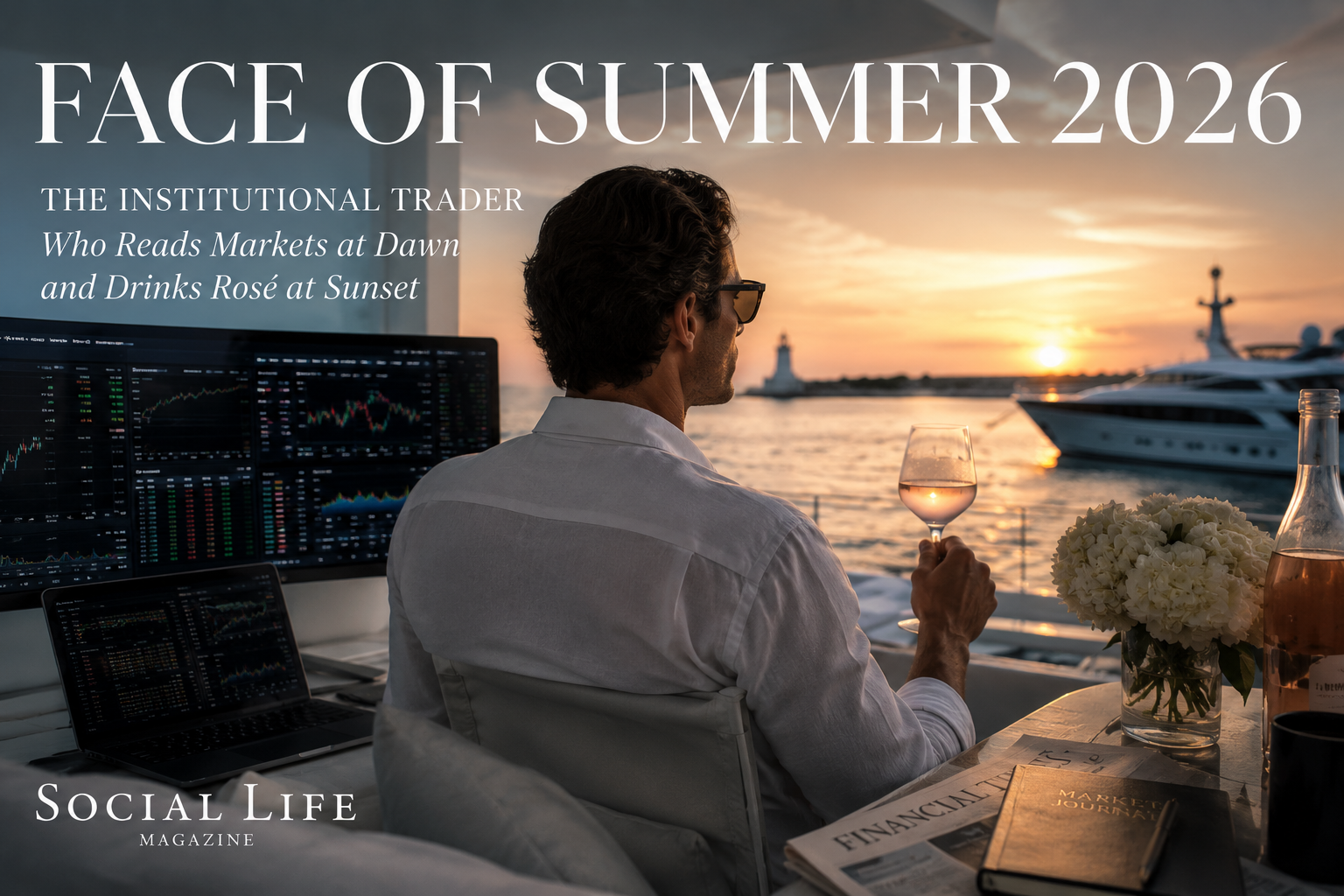
Face of Summer 2026: The Institutional Trader Who Reads Markets at Dawn and Drinks Rosé at Sunset

7 Common Mistakes New Dog Owners Make (and How to Avoid Them)
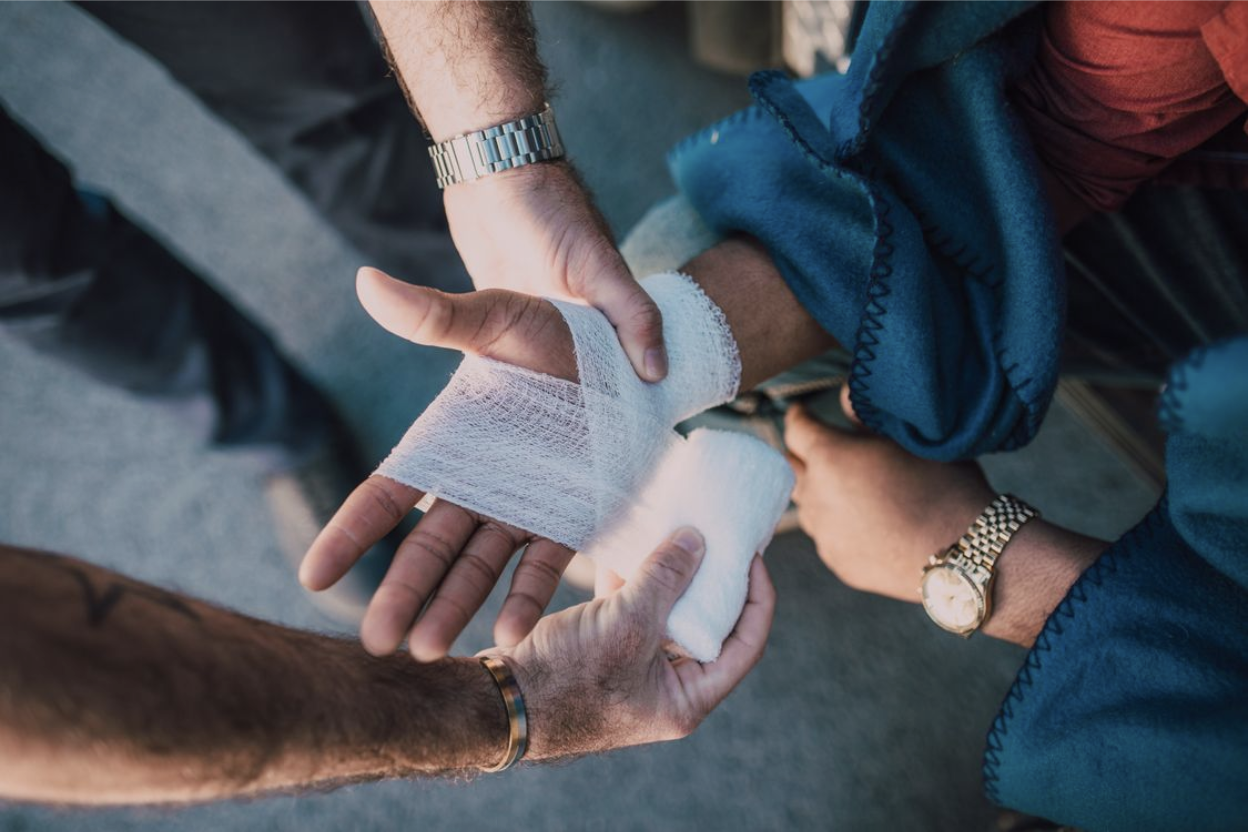
A Vacation Emergency Guide: How to Ask for Help After an Unexpected Accident
Post and Beam Homes Are Having a Moment in Oregon Wine Country
Eco-Friendly Builds Are Gaining Ground Faster in Texas Than Anywhere Else in the South
Categories
- Art
- Articles
- Business of Luxury
- Celebrities
- Entertainment
- Events
- Faces of Summer 2026
- Fashion
- Fashion & Style
- Featured
- Finance
- Food, Spirits, Wine
- Hamptons
- Hamptons Celebrities
- Health
- Health & Beauty
- Lifestyle
- Luxury Lifestyle
- Press
- Profiles
- Real Estate
- Technology
- The Chronicles
- Travel
- Uncategorized
- Weddings