
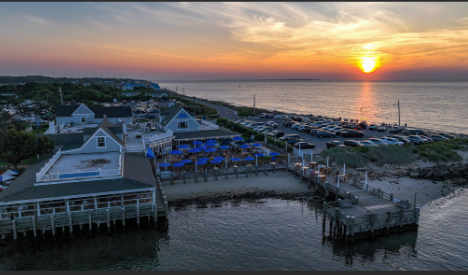
The 81-Year Empire That Defined Hamptons Waterfront Dining
The smell of salt and diesel hits you before you see the fishing boats. Walk down West Lake Drive past the charter captains hawking bluefish trips, and there it stands—eleven and a half acres of Montauk Harbor real estate that once belonged to a couple who sold chowder from fish boxes. Consequently, Gosman’s Dock became something no business plan could have predicted: the culinary heart of the East End’s wildest hamlet. Furthermore, it witnessed everything from the worst maritime disaster in Montauk history to Mick Jagger smashing his hand through a window.
The Origin Story: From Irish Immigrant to Fishing Empire
The Founders
Mary Harrington left County Roscommon, Ireland, in 1927 with little more than determination. She found work in East Hampton, where a summer romance introduced her to Robert Gosman, a local from Amagansett whose father worked for the Long Island Rail Road. However, love wouldn’t pay bills on the postwar East End. Therefore, the Gosmans became “fishdrummers”—agents who brokered deals between commercial fishermen and the Fulton Fish Market in Manhattan.
In 1943, they purchased Charlie Bonner’s gas dock on Montauk Harbor from the Bonner Fuel Company. At the time, the harbor barely existed as we know it. Indeed, before Carl Fisher dynamited the inlet connecting Lake Montauk to Block Island Sound in the 1920s, you could walk across the mud from where Gosman’s stands to Star Island. Meanwhile, the only structures were a few screaming seagulls, the bell buoy, and an old fish house with a caving roof.
The Original Vision
Mary Gosman recognized opportunity in the chaos of postwar Montauk. Subsequently, she added a food counter to the dock for fishermen needing sustenance between catches. Customers sat on old fish boxes to eat—there were no tables, no chairs, just chowder cooked by Mary herself and whatever the boats brought in that morning. Nevertheless, word spread among the commercial fleet that this Irish woman made the best soup on the harbor.
The family lived summers in Carl Fisher’s Round House, the distinctive circular harbormaster’s building Fisher had constructed in 1928 for a Danish captain who checked credentials of palatial yachts entering the harbor. Mary later recalled the primitive conditions: lightning raining down around the building, mice requiring a broom to ward off, and occasional drunken fishermen wandering into their home.
The First Years
By 1946, the Gosmans built their first proper restaurant—though “shack” described it more accurately. They purchased additional properties in 1950 and more land in 1958. Furthermore, the wholesale lobster and fish business thrived, supplying Manhattan restaurants with the freshest catches. The quality of their seafood encouraged the family—five sons and one daughter named Roberta—to expand what would become Gosman’s Restaurant and Clam Bar.
The Transformation: Tragedy, Jazz, and Rock Royalty
The Crisis That Changed Everything
September 1, 1951, dawned sunny and clear. The Fishermen’s Special train from New York City emptied its passengers at Montauk station, and 64 people climbed aboard the party boat Pelican for a day of fishing. Subsequently, an unexpected storm appeared, and the overloaded vessel capsized within sight of Montauk Point. Forty-five people died, including Captain Eddie Carroll.
Mary Gosman served coffee to survivors at the harbor. Meanwhile, Duryea’s ice house served as a temporary morgue for recovered bodies. The disaster transformed Montauk overnight—the village became “the place where the boat rolled over.” Consequently, new safety regulations were enacted that continue protecting passengers today. For the Gosmans, the tragedy underscored what they already understood: the sea gives and the sea takes.
The Figure Who Changed Everything
John Gosman Sr., born in 1934, grew up between Amagansett and the Round House on Montauk Harbor. After graduating from East Hampton High School in 1952 and earning his degree from St. Bonaventure University, he returned to drive Gosman’s evolution from modest chowder shack to sprawling entertainment complex. His son Michael later called him “a brilliant hurricane” whose ambition built something extraordinary.
In 1960, John expanded the restaurant with an outside deck. On May 21, 1968, the bar area opened—a bell commemorating that date still hung there decades later. However, John’s most lasting contribution came from his love of jazz. In 1972, he paid saxophonist Lee Konitz $300 to assemble a group for a performance at the dock. Thus began a free concert series that would bring legends including Toots Thielemans, Ruth Brown, Dick Hyman, and the Heath Brothers to Montauk Harbor.
The Innovation That Defined It
July 22, 1973, marked the moment Gosman’s transcended local fame. John had met Richie Havens at the restaurant bar and asked if he’d consider performing. Havens—who had opened Woodstock before 300,000 people four years earlier—agreed for $500. By 10 a.m. that morning, the grounds were packed with thousands of young people. The marijuana haze was so thick you could get contact high just breathing.
Havens was flown to Montauk but landed at the airport across the harbor. A borrowed rowboat solved the transportation problem—though Havens somehow dropped his dentures, which slid under the boat’s floorboards. Nevertheless, he performed, and those who witnessed it compared the crowd to Woodstock itself. The free Sunday concert tradition continues more than half a century later.
What Makes Gosman’s Dock Iconic
The Signature Element
The 1970s transformed Gosman’s into a celebrity magnet. Andy Warhol purchased his Montauk compound, Eothen, in 1971, and suddenly the East End’s most isolated hamlet attracted an A-list crowd. Jackie Kennedy Onassis, John Lennon, Liza Minnelli, Elizabeth Taylor, and Halston all stayed at Warhol’s estate. Consequently, they all ate at Gosman’s.
In spring 1975, the Rolling Stones rented Eothen while rehearsing their Black and Blue album. The band’s music echoed across Montauk at all hours. Mick Jagger hung out at Shagwong Tavern while Bianca rolled up the sleeves of her Yves Saint-Laurent dresses to open clams. Furthermore, the Jaggers dined regularly at Gosman’s—where Mick reportedly tripped and smashed his right hand through a window weeks before their tour began.
The Famous Moments
Warhol himself wrote in his book Exposures that “Mick Jagger really put Montauk on the map. All the motels were overflowing with groupies. When Mick went into town everything stopped. Surfers chased him from White’s Drug Store to White’s Liquor Store.” Meanwhile, at Gosman’s, you never knew who would appear next. The summers of Warhol, Halston, the Rolling Stones, and Dick Cavett made the dock synonymous with bohemian glamour.
Mary Gosman brought another tradition to the harbor: Irish students. According to family accounts, she pioneered bringing young workers from Ireland to staff the dock during summer seasons. This practice became a Hamptons institution, with Irish accents becoming as familiar as seagull calls at waterfront restaurants throughout the East End.
What Locals Know
By the 2000s, Gosman’s had expanded into an empire. The complex sprawled across nine properties on 11.6 acres, encompassing four restaurants (Gosman’s Restaurant, Topside, Inlet Cafe, and the Clam Bar), six retail stores including the legendary Summer Stock clothing shop in Fisher’s Round House, wholesale and retail fish markets, staff housing, a marina, fishing charters, and boat rentals. The total footprint reached 48,145 square feet with over 600 feet of unobstructed waterfront.
Regulars understood the rhythms. Topside offered the most breathtaking panoramic harbor views, while Inlet Cafe served as the spot for intimate dinners with attentive service. The Clam Bar remained the real Montauk—stand-up, take-out, no pretension. Furthermore, the fish market continued operating exactly as Robert and Mary had intended: the freshest catches, direct from boats to customers.
The Experience Today: A New Chapter
The Billionaire Buyer
The Gosman family first listed the property in 2006 for $55 million. After years of speculation, the end came in October 2024 when Stephen Deckoff, billionaire founder of private equity firm Black Diamond Capital Management, acquired the complex for $34.35 million. Deckoff and his son Stephen E. had spent childhood summers in the Hamptons and continued docking their 80-foot sport fishing boat in Montauk every August.
“I remember having my first lobster roll at Gosman’s as a kid,” the younger Deckoff told The New York Post. “Everyone is concerned that someone will come in and disrupt what we all love about Montauk, and that is not our intention. We are plugging into what makes Montauk great.”
The Transformation
The main restaurant now operates under the Bagatelle Group, which runs 15 venues including locations in St. Tropez, St. Barthelemy, Dubai, Miami’s South Beach, London, and Athens. At Bagatelle Gosman’s Montauk—”where the bohemian energy of the Hamptons meets the elegance of Mediterranean cuisine inspired by the sea”—the menu bears little resemblance to Mary Gosman’s chowder days. A DJ booth stands on the lower deck, and the company’s social media emphasizes music and dancing alongside dining.
However, the Topside, Inlet Cafe, and Clam Bar restaurants remain largely unchanged, with many of the same front-of-house and kitchen staff. The retail and wholesale fish markets continue operating with a staff largely intact—though Gosman family members now work as employees rather than owners. Most retail buildings stand empty, and the Round House that once housed Summer Stock sits vacant. Mary Gosman, who tended flowerbeds throughout the complex until her death in 1997, would notice the difference.
The Insider Move
The sale included an option to build a 46-room hotel on the property—a development that could fundamentally alter the waterfront character that made Gosman’s special. Furthermore, the transaction coincided with legal troubles for family members Bryan and Asa Gosman, who pleaded guilty to criminal conspiracy in a decade-long federal probe into illegal commercial fishing and faced $725,000 in restitution.
For now, visit the fish market for the authentic experience. The wholesale and retail operations continue with the same people, the same boats unloading catches, the same connection to Montauk’s working waterfront. As the East Hampton Star reported, “Asa and Bryan are still at the head of the ship with too much inertia to cease.”
The Legacy: Why Gosman’s Endures
Influence on Hamptons Culture
Gosman’s Dock pioneered the model that every Hamptons waterfront destination now copies: working fishing operation plus casual dining plus retail plus entertainment. The formula seems obvious in retrospect. Nevertheless, in 1943, when Mary Gosman ladled chowder to fishermen sitting on fish boxes, nobody imagined this future.
The free concert tradition elevated Montauk’s cultural profile beyond surfing and sport fishing. Simultaneously, the celebrity patronage during the Warhol era established Montauk as a legitimate alternative to the social hierarchies of Southampton and East Hampton. At Gosman’s, billionaires waited in the same clam bar line as charter boat captains.
Why It Matters
Once known as “the un-Hampton” for its rustic charm, Montauk has watched most iconic mom-and-pop businesses get usurped by big money. The Gosman’s sale follows massive transactions throughout the harbor: Gurney’s selling the Montauk Yacht Club for $149.4 million, the Marram Montauk trading for $77.5 million, and Blue Flag Partners acquiring Sunset Montauk and surrounding parcels.
The question now is whether new ownership can preserve what made Gosman’s matter. The Deckoffs promise no major disruptions, but the Bagatelle Group’s St. Tropez sensibility already signals a different direction. Mediterranean elegance and DJ sets weren’t part of Mary Gosman’s vision when she brought Irish students to work alongside her children.
Still, the harbor remains. The fishing boats still unload their catches. The salt air still carries that mixture of diesel and brine that signals you’ve reached the end of the road. For 81 years, the Gosman family understood that Montauk’s magic came from its authenticity—from being a real fishing village where real fishermen made real livings. Whether the next chapter preserves that truth remains the essential question for everyone who loves this windswept hamlet at the edge of everything.
The Insider’s Take: Skip the main restaurant’s Mediterranean makeover and head directly to the fish market. Purchase a pound of fresh-caught striped bass or locally harvested lobster. The wholesale operation continues exactly as Robert and Mary established it—same boats, same fishermen, same connection to the water that made Gosman’s legendary.
Continue Your Hamptons Journey
- Feature & Partnership Inquiries
- Polo Hamptons Tickets & Sponsorships
- Join Our Email List
- Subscribe to Print Edition
- Support Social Life Magazine
Related Articles
Author

Written by
Recent Posts
The Man Who Isn’t at Your Party: Howard Stern’s Hamptons
A Field Guide to the Hamptons Casualty

Aesthetic Medicine Distributor: The Foundation of Patient Confidence in Modern Aesthetic Medicine
What Makes a Custom Wool Rug Worth the Higher Price Tag
Simple DIY Air Conditioner Maintenance Tips That Extend Unit Life
Categories
- Art
- Articles
- Business of Luxury
- Celebrities
- Entertainment
- Events
- Faces of Summer 2026
- Fashion
- Fashion & Style
- Featured
- Finance
- Food, Spirits, Wine
- Hamptons
- Hamptons Celebrities
- Health
- Health & Beauty
- Lifestyle
- Luxury Lifestyle
- Press
- Profiles
- Real Estate
- Technology
- The Chronicles
- Travel
- Uncategorized
- Weddings