
The armed guards at the door should have been the first clue. When Kathleen King arrived at her own bakery that February morning in 2000, men in uniforms blocked her path. A stack of legal papers informed her she’d been terminated from the company she’d spent twenty years building from nothing. Her name—Kathleen’s Bake Shop—now belonged to strangers. Her recipes, her reputation, her life’s work: gone.
What happened next became one of the great American comeback stories. The same community that had lined up for Kathleen’s cookies since she was eleven years old wasn’t about to let her disappear. Within weeks, protesters marched outside her former bakery carrying a banner that read: “NO KATHLEEN’S COOKIES UNTIL KATHLEEN IS BACK.”
Eighteen years later, Kathleen King sold Tate’s Bake Shop—the phoenix she’d built from those ashes—for $500 million.
The Origin Story: From Farm Stand to Tate’s Bake Shop
Before the betrayal, before the empire, there was a girl obsessed with perfecting a chocolate chip cookie. Kathleen King grew up on North Sea Farms in Southampton, where work started the moment you could walk. Her father Tate—nicknamed for the potatoes he picked as a boy—taught his children that ambition required action. When Kathleen turned eleven, he struck a deal: bake cookies for the farm stand, and you can keep the money for school clothes.
Most kids would have made something passable. Kathleen became obsessive. She experimented endlessly with ratios of butter to flour, testing baking temperatures and timing until she achieved something no commercial cookie could match. She discovered that using more butter and baking longer created a thin, crispy texture that shattered when you bit into it. The cookies developed an almost caramel-like flavor from the browning sugars.
Customers noticed immediately. Six large cookies sold for fifty-nine cents, and they flew off the shelf so fast that Kathleen had to run between the kitchen and the farm stand between batches. Her sister and friend eventually abandoned baking to work at the local ice cream parlor where they could meet boys. Kathleen kept perfecting her recipe.
By high school, she was baking ten hours a day, seven days a week during summers. After two years of college, her mother delivered an ultimatum: find your own kitchen. A rental storefront on North Sea Road became available, and in 1980, at age twenty-one, Kathleen opened Kathleen’s Bake Shop.
Twenty Years of Building an Empire—Then Losing Everything
Success came quickly but demanded everything. When summer crowds vanished, Kathleen hustled her cookies to grocery stores and bodegas throughout New York City. She bought the building. Published a cookbook. Hired forty employees. Built a regional reputation that made her shop a Hamptons institution.
The work consumed her entire youth. By 1999, at forty years old, she was exhausted and overweight, working impossible hours while life passed her by. When her bookkeeper Bob Weber and his brother Kevin proposed a partnership—they’d handle expansion while she focused on baking—it seemed like the answer to a prayer.
The Webers paid nothing upfront, instead promising installment payments totaling $860,000 through IOUs. Each partner would own one-third. Kathleen would remain CEO while they built a factory in Virginia for national distribution. The arrangement soured almost immediately.
Behind the scenes, the brothers had executed a classic leveraged buyout, saddling the company with $600,000 in debt to finance their own acquisition. They began stiffing Kathleen on payments, using store receipts to cover obligations instead of paying her directly. When she objected, they accused her of stealing the cash that customers paid at the register.
Six months after signing the partnership agreement, the armed guards appeared at her door. One of the wives called police demanding a restraining order against Kathleen, initially claiming she “feared for her life.” That phrase was later amended to “feared for her livelihood.”
The lawsuit that followed stripped Kathleen of nearly everything. She lost the business name—Kathleen’s Bake Shop moved to Virginia under the Weber brothers’ control. She inherited $200,000 of the debt they’d accumulated. Legal fees consumed whatever remained. The only thing she retained was the building itself.
The Community Rallies: How Southampton Saved the Cookie Queen
But the Webers had underestimated something crucial: this wasn’t just a bakery. For twenty years, Kathleen’s cookies had marked every Southampton summer, every holiday gathering, every childhood memory of trips to the farm stand. The community had watched her grow from an eleven-year-old entrepreneur to a local legend.
Protesters picketed Kathleen’s former shop for two weeks. A truck drove through Southampton bearing a massive banner: “NO KATHLEEN’S COOKIES UNTIL KATHLEEN IS BACK.” The Webers sued to stop the demonstrations. The court denied their request—freedom of speech, public road.
Local stores refused to carry the Virginia-made cookies. Tourists who asked for Kathleen’s were redirected: the real Kathleen had a new place now, called Tate’s. The Webers’ operation collapsed within two years. Meanwhile, Kathleen had already begun rebuilding.
She named the new bakery after her father. Tate King had encouraged her first cookie sales at the farm stand, had watched her perfect her recipe in the family kitchen, had helped her price those initial fifty-nine-cent bags. Naming the company after him was both tribute and motivation.
This time, Kathleen approached everything differently. She hired the right people and let them do their jobs. She refused to work herself to exhaustion. She developed an exit strategy from day one: build something valuable enough to sell by age fifty-five, then retire. The Kathleen who lost Kathleen’s Bake Shop could never have delegated like this. The Kathleen who built Tate’s had learned from dying and coming back.
From $200,000 in Debt to America’s Best Cookie
Within three years, Tate’s had paid off the debt and matched the $3 million annual revenue of the old company. The community’s support had created unstoppable momentum. The thin, crispy cookies that Kathleen had perfected as a child now had a second chance at national distribution—this time on her terms.
Recognition followed. Consumer Reports tested eighteen store-bought and fast-food chocolate chip cookies in 2011 and crowned Tate’s the best in America. Their testers found the cookies “like a really good homemade cookie,” with “big butter and chocolate flavors.” Rachael Ray’s magazine reached the same conclusion, stunned that the best-tasting cookie came from a grocery store rather than an artisan bakery.
In 2014, private equity firm The Riverside Company paid $100 million for a majority stake, with Kathleen retaining shares and continuing to oversee quality control. Production scaled from thousands to millions of cookies weekly, all still baked on Long Island. By 2018, Tate’s was producing 1.5 million cookies per day at its East Moriches factory.
That year, Mondelez International—the corporate parent of Oreo and Chips Ahoy—acquired Tate’s for $500 million. Kathleen officially retired at fifty-eight, three years past her original target. The girl who sold cookies for five cents had built a half-billion-dollar empire.
What Makes Tate’s Cookies Worth Half a Billion Dollars
Walk into any Whole Foods, scan the cookie aisle at Target, or browse Amazon’s bestsellers—Tate’s signature bag with its blue-and-white packaging dominates the premium cookie category. But what makes these cookies worth the premium price?
The answer lies in what Kathleen figured out as a child: texture changes everything. Most commercial cookies aim for soft and chewy, but Tate’s are deliberately thin and crispy. The dough spreads flat during baking, caramelizing the sugars into something approaching butterscotch. Each bite shatters rather than bends.
The ingredient list reads like a home baker’s pantry: chocolate chips, flour, butter, cane sugar, brown cane sugar, eggs, baking soda, salt, vanilla extract, and water. No high-fructose corn syrup. No artificial preservatives. This simplicity made Tate’s an unlikely pioneer in the “clean label” trend years before that became a marketing buzzword.
Critics occasionally note the higher price point and limited distribution. The official response has always been that quality requires trade-offs. The Southampton retail store still bakes everything from scratch, and the packaged cookies maintain the same standards that won those blind taste tests.
The Southampton Bake Shop Today
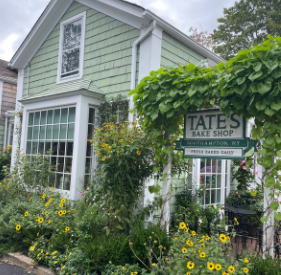
Visit 43 North Sea Road and you’ll find the original Tate’s Bake Shop still operating, seven days a week from 6 AM to 4 PM. The light-green storefront has become a Hamptons pilgrimage site, drawing over a thousand visitors on busy summer Saturdays. Lines wrap around the building for cookies, muffins, pies, and the sour cream coffee cake that locals consider essential.
Everything is baked from scratch on the premises using recipes Kathleen developed over four decades. The chocolate chip cookies that made her famous share counter space with brownies, blondies, oatmeal raisin, and seasonal specialties. Ice cream sandwiches made with Tate’s cookies have developed their own cult following.
Mondelez has maintained the bake shop as a shrine to the brand’s origins rather than converting it to corporate uniformity. The cookies sold in the store taste identical to those shipped nationally—a testament to production standards that scale without compromise.
Kathleen King’s Legacy: Cookie Queen and Beyond
In retirement, Kathleen hasn’t exactly slowed down. She published Cookie Queen in 2023, a children’s book chronicling her journey from farm stand entrepreneur to cookie empire builder. The book aims to inspire young readers—particularly girls—to pursue their business dreams.
Her philanthropy focuses on causes close to her Southampton roots. She supports i-tri, a program that builds self-esteem in East End girls through triathlon training. The Peconic Land Trust, which preserves Long Island farmland, has honored her as a champion of conservation. She still lives in North Sea, not far from the farm where she sold her first cookie.
Her brother Richie now runs North Sea Farms, the family business where it all began. The farm stand still sells Tate’s cookies alongside fresh eggs, organic chickens, and vegetables grown on the property. Three generations of Kings have now worked that land.
Asked about her greatest accomplishment, Kathleen points not to the $500 million exit but to the customers and staff who stayed with her across decades. Families who discovered her cookies in the 1980s now bring grandchildren to the Southampton shop. The community that rallied behind her during the Weber lawsuit still treats Tate’s as their bakery.
Experience Tate’s Bake Shop Today
The Southampton shop offers the full Tate’s experience: fresh-baked goods, coffee, and the chance to taste cookies straight from the oven rather than from a sealed package. Arrive early on weekends to beat the crowds. The chocolate chip cookie remains the essential order, but the seasonal pies and the legendary sour cream coffee cake reward repeat visits.
For those who can’t make the trip, Tate’s ships nationwide through its website and stocks grocery stores across the country. The thin, crispy cookies that Kathleen King perfected as an eleven-year-old remain the signature product—now produced at a rate of two million per day.
Kathleen’s two cookbooks, The Tate’s Bake Shop Cookbook and Baking for Friends, include home versions of many shop favorites. The chocolate chip cookie recipe appears in both, though bakers report the homemade version never quite matches the original. Some secrets, apparently, stay in Southampton.
The Real Lesson of Tate’s Bake Shop
Every Hamptons success story claims to be about hard work and perseverance. Tate’s Bake Shop is different because it’s equally about community. When Kathleen lost everything to partners who valued money over integrity, Southampton didn’t just sympathize—they acted. They picketed. They redirected tourists. They refused to buy the impostor cookies.
That support wasn’t charity. It was reciprocity. For twenty years, Kathleen had baked for every birthday party, every holiday gathering, every summer memory. She’d created jobs for local families. She’d become part of the community’s identity. When she needed them, they showed up.
The thin, crispy cookies are excellent. The comeback story is inspiring. But the real reason Tate’s Bake Shop matters is what it reveals about loyalty—the kind that can’t be leveraged, bought out, or moved to Virginia. In a place where wealth often arrives from elsewhere and leaves just as quickly, Kathleen King built something that belonged to Southampton. The community made sure it stayed that way.
Visit Tate’s Bake Shop at tatesbakeshop.com or stop by 43 North Sea Road in Southampton.
Related Reading:
- Golden Pear Cafe: 38 Years of Hamptons Morning Ritual
- The Ultimate Guide to East Hampton vs. Southampton
- Best of the Hamptons 2026
Support Social Life Magazine: Contact us | Polo Hamptons | Subscribe to Print
Author

Written by
Recent Posts

Why the Supplement Market Is Shifting From More Products to Smarter Choices
5 Ways Engraved Custom Trophies Boost Employee Engagement
Creating Beautiful Mix-and-Match Tablescapes for Any Occasion
Is It Cheaper to Drive or Ship Your Car? We Ran the Numbers
Dear Margo: Restaurateur Dean Pashilis’ Tribute to Family, Food and Hospitality
Categories
- Art
- Articles
- Business of Luxury
- Celebrities
- Culture
- Entertainment
- Events
- Faces of Summer 2026
- Fashion
- Fashion & Style
- Featured
- Finance
- Food, Spirits, Wine
- Hamptons
- Hamptons Celebrities
- Health
- Health & Beauty
- Lifestyle
- Luxury Lifestyle
- Press
- Profiles
- Real Estate
- Technology
- The Chronicles
- Travel
- Uncategorized
- Weddings