
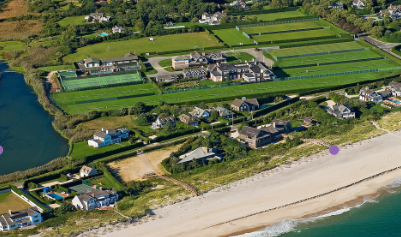
Where 137 Years of Grass Court Elegance Define Hamptons Society
The parasols appeared first. Before the white flannel trousers, before the Pimm’s cups sweating in the August heat, before Bobby Riggs stepped onto Court One to warm up for another U.S. Open—the parasols told you everything.
You notice them from First Neck Lane, bobbing above the privet hedges like pale moons. Consequently, you understand: This is not merely a tennis club. This is a social institution that predates electricity in Southampton Village, where the geometry of grass courts echoes the geometry of old money, and where an invitation still carries the weight of a debutante’s introduction.
The Meadow Club of Southampton opened its gates in 1887, when lawn tennis was considered a radical pastime and the Hamptons were still a working agricultural community. Furthermore, it remains one of only a handful of American clubs where you can hear the distinctive thwack of ball against gut strings on authentic grass courts—thirty-six of them, maintained with the obsessive precision of an English manor’s bowling green.
The Origin Story: Born on a Gilded Age Estate
The Vision of J. Bowers Lee
In 1887, J. Bowers Lee surveyed his Southampton estate and saw possibility. Tennis had arrived in America barely a decade earlier, imported from England along with the social rituals of afternoon tea and weekend house parties. Meanwhile, Lee recognized that the flat meadowlands of the South Fork—blessed with ocean breezes and sandy loam soil—could support the kind of grass courts that made Wimbledon legendary.
Lee was among Southampton’s first summer residents, part of a generation that saw the East End not as farmland but as an American Riviera. However, his vision extended beyond personal recreation. He understood that a tennis club could anchor a community—providing the social infrastructure that would transform Southampton from a quiet village into America’s most exclusive summer colony.
Establishing the Standard
The club wasted no time asserting its ambitions. By 1888, just one year after founding, the Meadow Club inaugurated a major international tennis tournament. The Southampton Invitation quickly became a fixture on the grass court circuit, joining the prestigious rotation that included the Merion Cricket Club in Philadelphia and the Newport Casino.
Subsequently, the tournament attracted the era’s greatest players. For Southampton’s hostesses, tournament week presented opportunities for grand parties. Additionally, large houses opened their doors, wine cellars were tapped, and debutante daughters appeared in the grandstands with strategic precision.
The Transformation: From Local Club to International Stage
The Champions Who Defined an Era
The roll call of Meadow Club champions reads like a tennis hall of fame. Bill Tilden, the imperious American who dominated the 1920s, claimed three Southampton titles. Bobby Riggs, whose later Battle of the Sexes would make him a household name, won four. Meanwhile, Vinnie Richards and Frank Parker each etched their names into the club’s trophy cases.
After World War II, the tournament’s international profile expanded dramatically. Pancho Segura, the Ecuadorian wizard with the two-handed forehand, won three titles in the 1940s. Then came the Australian invasion: Roy Emerson, Fred Stolle, Tony Roche, and the incomparable Rod Laver—all used the Meadow Club’s grass as their final tuning ground before Forest Hills.
The End of an Era
By 1973, the world of tennis had fundamentally shifted. The Open Era had arrived, professionalism had replaced the amateur gentleman ideal, and the U.S. Open had abandoned Forest Hills for the hard courts of Flushing Meadows. Consequently, the Southampton Invitation was discontinued after 85 editions.
For lesser institutions, this might have spelled decline. However, the Meadow Club had never defined itself solely by its tournament. The club’s identity rested on something more enduring: the preservation of grass court tennis as a living tradition, and the maintenance of social standards that made membership a marker of arrival.
What Makes It Iconic: The Meadow Club Southampton Difference
Thirty-Six Courts of Living Tradition
Walk onto a Meadow Club grass court and you feel history beneath your feet. The club maintains thirty-six grass courts across eighteen-plus acres—one of the largest collections of natural grass tennis surfaces in the Western Hemisphere. Each court requires obsessive care: daily mowing, rolling, watering, and the kind of patient cultivation that cannot be rushed.
In addition, the gardens established in 1902 link the clubhouse to the courts in deliberate procession. English-style privet hedges, clipped with neurotic precision, frame views of play. An ovoid arrangement of Pee Gee hydrangeas, their trunks knotted and gnarled by decades of salt wind and age, anchors the composition. The effect is both botanical and architectural—a designed landscape that makes tennis feel ceremonial.
The Insider’s Southampton
Club membership structures Southampton society with the subtlety of an algorithm. As Town & Country once noted, life in Southampton was—and to some extent still is—defined by club affiliations: Shinnecock Hills for golf, the Bathing Corporation for beach, and the Meadow Club for tennis, croquet, and the dinner dances that have launched countless summer romances.
Regulars know the unwritten protocols. White attire remains the standard on court. Furthermore, the club maintains guest rooms for summer visitors, a tradition dating to its earliest years when Wall Street figures like Muriel “Mickey” Siebert—the first woman to own a seat on the New York Stock Exchange—returned season after season.
The Experience Today: Stepping Inside the Hedges
Beyond Tennis: A Complete Social Institution
The Meadow Club has evolved beyond its tennis origins while maintaining its essential character. The club now offers croquet—hosting United States Croquet Association championship events—pickleball courts, and junior programs designed to cultivate the next generation. Additionally, the dining facilities remain central to the social experience, providing the backdrop for the kind of lingering lunches that build lasting networks.
The Insider Move
The Insider’s Take: Request play on the courts nearest the original clubhouse, where the privet archway frames your view of the ocean beyond. Arrive early on weekday mornings when the grass is still damp with dew and the courts play slightly slower—the closest approximation to Wimbledon’s Centre Court you’ll find in America. Moreover, understand that membership at the Meadow Club is by invitation only, requiring sponsorship from existing members. Even for guests, proper tennis attire—specifically, traditional whites—is expected without exception.
The Legacy: Why the Meadow Club Southampton Endures
Shaping the Social Landscape
The Meadow Club’s influence extends far beyond its privet boundaries. Alongside the Maidstone Club in East Hampton, it established the template for how private clubs function in the Hamptons: as social sorting mechanisms, business networking venues, and guardians of traditions that connect present members to a century of predecessors.
Importantly, the club’s insistence on grass court maintenance has preserved a form of tennis that has nearly vanished elsewhere. When Rod Laver and Roy Emerson practiced here in the 1960s, they were training for a professional circuit dominated by grass. Today, grass represents less than one percent of professional tournament surfaces. Nevertheless, at the Meadow Club, the tradition continues unchanged.
The Enduring Appeal
In an era of disruption and constant reinvention, the Meadow Club’s persistence feels almost radical. The same privet hedges that framed games in 1902 still define the garden’s edges. Similarly, the same commitment to grass court excellence that attracted Bill Tilden still drives daily maintenance routines. The club understands something fundamental about luxury: true exclusivity cannot be purchased or rushed.
One hundred thirty-seven years after J. Bowers Lee first imagined a tennis club on his Southampton estate, the Meadow Club continues to set the standard for what a private club can be. For those fortunate enough to pass through its gates, the experience offers something increasingly rare in American life: connection to a living tradition, maintained with care and passed down through generations.
The parasols still appear on tournament days. Consequently, they continue to signal what they always have: that at the Meadow Club of Southampton, some things never change—and that, perhaps, is precisely the point.
Continue Your Hamptons Journey
- Feature & Partnership Inquiries
- Polo Hamptons Tickets & Sponsorships
- Join Our Email List
- Subscribe to Print Edition
- Support Social Life Magazine
Related Articles
Author

Written by
Recent Posts

Victoria Justice Kicks Off Halloween Early with Love Zombie Bash in Hollywood

Planning an Arizona Road Trip? Practical Details to Handle Before You Leave

Short Homecoming Dresses That Feel Polished, Not Overdone
Men’s Health After 40: Important Changes to Pay Attention To
What You Need to Know About Spray Tanning
Categories
- Art
- Articles
- Business of Luxury
- Celebrities
- Culture
- Entertainment
- Events
- Faces of Summer 2026
- Fashion
- Fashion & Style
- Featured
- Finance
- Food, Spirits, Wine
- Hamptons
- Hamptons Celebrities
- Health
- Health & Beauty
- Lifestyle
- Luxury Lifestyle
- Press
- Profiles
- Real Estate
- Technology
- The Chronicles
- Travel
- Uncategorized
- Weddings