
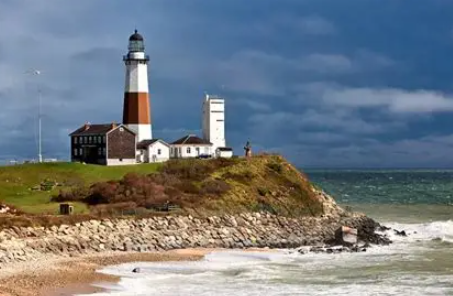
George Washington made a promise in 1796 that this lighthouse would stand for two hundred years. He was wrong. It’s been 228 years, and the Montauk Lighthouse still commands Turtle Hill like a sentinel refusing to surrender its post. Standing at the absolute edge of Long Island, where the Atlantic crashes against bluffs that have witnessed revolutions, pirates, and Cold War paranoia, this isn’t just a maritime landmark. It’s a 110-foot testament to American defiance.
The Montauk Lighthouse Story: Washington’s Vision Takes Shape
In 1792, a young nation faced a problem. Nearly one-third of all American imports were sailing into New York harbor, yet ships approaching from the east had no guidance around the treacherous shoals of Montauk Point. Ezra L’Hommedieu, a member of the Second Continental Congress and trusted advisor, presented the case to President Washington himself. The argument was compelling. Additionally, the commercial stakes were enormous.
Congress authorized the lighthouse that same year. However, construction wouldn’t begin until 1796. John McComb Jr., a New York contractor who had already proven himself building Cape Henry Lighthouse in Virginia, submitted the winning bid of $22,300. His competition included Abisha Woodward, Nathaniel Richards, and Abraham Miller & Company. McComb assembled a fifty-man crew of masons, carpenters, blacksmiths, and bricklayers.
The construction details reveal engineering ambition. Heavy sandstone blocks were hauled from Connecticut in horse-drawn wagons across rugged terrain. Moreover, McComb ordered a foundation dug thirteen feet deep into the crest of Turtle Hill. At its base, the octagonal tower measured twenty-eight feet in diameter with walls nine feet thick. Subsequently, at the eighty-foot summit, those walls tapered to three feet. The work progressed remarkably fast. Construction began in early June 1796 and finished by November of that same year.
In April 1797, the first keeper, Jacob Hand, carried eight whale-oil lanterns up the 137 iron steps and lit the wicks. The Montauk Lighthouse began its vigil. For the next 228 years, that beacon would never stop shining.
Where Pirates Once Buried Gold: The Captain Kidd Connection
Walk five minutes from the Montauk Lighthouse and you’ll reach two small ponds that locals have called “Money Ponds” for over three centuries. The name isn’t poetic whimsy. Legend holds that Captain William Kidd buried treasure here around 1699, creating one of Long Island’s most enduring mysteries.
The historical record confirms Kidd’s presence in these waters. In June 1699, the Scottish-born privateer-turned-pirate stopped at nearby Gardiner’s Island, where he buried approximately $30,000 worth of gold, silver, rubies, and diamonds with John Gardiner’s reluctant cooperation. Kidd gave Mrs. Gardiner a piece of gold cloth from a Moorish ship and a sack of sugar as tokens of appreciation. Then he made a chilling promise: if the treasure disappeared before his return, he would take their heads.
That Gardiner’s Island cache was eventually recovered and sent to England as evidence in Kidd’s trial. Nevertheless, whispers persisted that Kidd made additional deposits at Montauk Point and other Long Island locations. Treasure hunters have scoured Money Ponds for generations without success. Indeed, some locals have taken to throwing pennies into the water for luck. The treasure, if it exists, remains undiscovered.
Whether Kidd’s doubloons actually rest beneath Montauk’s soil matters less than what the legend reveals. This peninsula has always existed at civilization’s edge, attracting rogues, visionaries, and anyone seeking refuge from conventional society. Consequently, that spirit persists today in Montauk’s countercultural energy.
The Woman Who Saved the Montauk Lighthouse from the Sea
By 1967, the United States Coast Guard had made a decision: tear down the Montauk Lighthouse and replace it with a steel tower farther from the eroding cliff edge. When McComb built the structure in 1796, it stood approximately 300 feet from the bluff’s edge. Relentless Atlantic storms had reduced that buffer to less than 100 feet. The lighthouse was literally crumbling into the ocean.
Dan Rattiner, founder of Dan’s Papers, organized protests that drew thousands. Three thousand people stood vigil on one occasion, 1,500 on another. The Coast Guard rescinded its demolition order. However, the erosion hadn’t stopped. The lighthouse still needed saving.
Enter Giorgina Reid, a textile designer from Rocky Point who had developed an unconventional solution. Reid had saved her own cottage from cliff collapse by building simple terraces in the gullies using beach debris, notably reeds. She proposed the same approach at Montauk Point. Her technique, which she patented as “Reed-Trench Terracing,” seemed almost too simple to work.
Every Sunday for nearly twenty years, Reid and her volunteers traveled to the lighthouse with Coast Guard permission to build terracing on the cliff face. Greg Donohue, a Montauk landscaper, worked alongside Reid and continued the project after she retired in 1986. By 1998, with support from the Montauk Historical Society and New York State, the Erosion Control Project of Montauk Point was successfully completed.
A textile designer’s stubborn ingenuity accomplished what government agencies couldn’t. The erosion ceased. Nevertheless, periodic maintenance remains necessary, as the ocean never stops trying to reclaim the land.
Camp Hero: The Military Shadow Behind the Montauk Lighthouse
The fire control tower standing near the Montauk Lighthouse wasn’t built to watch for brush fires. During World War II, the United States Army established Camp Hero as a coastal defense station just west of the lighthouse, and that concrete observation tower directed artillery fire from nearby Fort Hero against potential German naval threats.
The installation was brilliantly deceptive. From the water, Camp Hero appeared to be a typical Long Island fishing village. Buildings were designed to blend with civilian architecture. Subsequently, four 16-inch naval rifles—guns originally intended for battleships—were installed in concrete bunkers capable of firing shells twenty-three miles into the Atlantic. These batteries rendered obsolete nearly every other heavy gun in the Harbor Defenses of Long Island Sound.
The lighthouse itself was occupied by the U.S. Army Signal Corps during the war. Soldiers watched for German U-boats from the same tower that had guided merchant ships for 150 years. The integration of America’s oldest lighthouse with its newest military technology created a layered defense system protecting New York Harbor.
After the war, Camp Hero’s mission shifted. The Air Force activated the 773rd Aircraft Control and Warning Squadron in 1950, operating radar equipment that could detect aircraft over 200 miles away. The enormous 126-foot SAGE radar dish, still visible today, represented Cold War-era state-of-the-art technology. The base operated until 1981, when the FAA opened a new facility in Riverhead.
Today, Camp Hero State Park encompasses 754 acres of hiking trails, World War II bunkers, and that iconic radar tower. For visitors exploring Montauk’s beaches and coastal scenery, the park offers a fascinating counterpoint to the lighthouse’s civilian maritime history.
The Montauk Lighthouse Today: A $44 Million Revival
In August 2023, Governor Kathy Hochul, the U.S. Army Corps of Engineers, and the Montauk Historical Society celebrated the completion of a major restoration project that had transformed the landmark. The numbers tell the story: $44 million total investment, approximately 1,000 linear feet of new stone revetment, armor stones weighing between 10 and 20 tons apiece.
The restoration addressed both the shoreline and the structure itself. The U.S. Army Corps of Engineers reconstructed the revetment using a combination of existing armor stones and new materials, stabilizing the site against future coastal storms. The work was cost-shared between USACE and New York State’s Department of Environmental Conservation, which allocated $15.4 million in NY Works funding.
Concurrently, the Montauk Historical Society invested $2 million in renovations to the lighthouse tower and the historic 1838 Keeper’s Dwelling. New York State contributed over $435,000 through preservation grants and Empire State Development funds. The exterior restoration addressed damage to the sandstone façade and secured the structure’s long-term integrity.
The lighthouse tower now stands 110 feet, 6 inches tall—30 feet higher than McComb’s original construction. That extension was added in 1860 to accommodate a massive 12-foot-tall Fresnel lens weighing over 10,000 pounds. The current beacon, a 290,000-candlepower airport-style light, flashes every five seconds and remains visible for 19 nautical miles in clear weather. The Coast Guard still maintains the aids to navigation, even though the Montauk Historical Society has owned the property since 1996.
Experiencing the Montauk Lighthouse: What Visitors Discover
The Montauk Point Lighthouse Museum offers something rare: an encounter with history that engages all senses. Climb the 137 iron steps—the same steps keepers ascended with whale oil for generations—and you’ll understand why the journey matters as much as the destination. The spiral staircase narrows as you rise, walls pressing closer, each step echoing against sandstone that has absorbed over two centuries of footfalls.
At the top, 360-degree views unfold across Block Island Sound and the Atlantic Ocean. On clear days, Block Island itself emerges from the horizon, approximately 14 miles distant. Morning light transforms the water into hammered silver. Furthermore, sunset paints the bluffs in colors that no photograph adequately captures. Early risers who arrive at dawn often describe the experience as revelatory.
The museum within the Keeper’s Dwelling traces the full arc of Montauk’s maritime heritage. The Congressional authorization signed by George Washington is on display, linking visitors directly to the nation’s founding generation. Additionally, a stuffed wood duck tells a peculiar story: the bird crashed into the lantern room in 1906 and was discovered the next morning by eight-year-old Willy, grandson of Keeper James G. Scott. The keeper had it preserved, and decades later, Willy’s grandson donated it to the museum.
Adjacent to the lighthouse, the Montauk Oceans Institute and Surf Museum explores the peninsula’s relationship with the sea from a different angle—oceanography, marine science, and the surfing culture that has made Ditch Plains legendary.
Practical Information for Montauk Lighthouse Visitors
The Montauk Point Lighthouse Museum operates year-round with seasonal hours. Currently, the museum is open daily from 10:30 AM to 4:30 PM on weekdays, with extended Sunday hours until 6:30 PM. Admission includes access to the museum, tower climb, and surrounding grounds.
Ticket prices are straightforward: $15 for adults, $10 for seniors 62 and older, and $5 for children under 12. Children under 41 inches tall cannot climb the tower for safety reasons but enter free. The tower climb requires reasonable physical fitness—137 steps through narrow passages—so visitors with mobility concerns should plan accordingly.
Parking is managed by Montauk Point State Park. The fee is $8 between 8 AM and 4 PM. Visitors 65 years or older with a New York state license plate park free, as do Empire Pass holders. The parking lot fills quickly on summer weekends, making early arrival advisable.
The lighthouse sits at 2000 Montauk Highway, approximately six miles east of Montauk village. Visitors without cars can take taxi services from Montauk Station; the fare runs approximately $21 each way. The Long Island Rail Road’s Montauk branch provides service from Penn Station and Jamaica, though the trip requires planning—trains take roughly three hours from Manhattan.
For those exploring broader Montauk accommodations, luxury hotel options range from the oceanfront sophistication of Gurney’s Montauk to boutique properties throughout the village.
The Montauk Lighthouse in Hamptons Culture
The Montauk Lighthouse functions as more than a tourist attraction. It anchors the East End’s identity, appearing on everything from local business logos to municipal seals. Moreover, the Montauk Historical Society vigorously protects its trademark, licensing the lighthouse’s likeness to fund ongoing preservation efforts.
The structure’s designation as a National Historic Landmark in 2012—the 14th site on Long Island and only the 11th lighthouse in the country to receive this recognition—formalized what locals always understood. This isn’t merely old. It’s foundational. The lighthouse predates the Louisiana Purchase, the War of 1812, and every other structure on the East End by decades.
Montauk itself operates on a different frequency than its Hamptons neighbors. Southampton and East Hampton perform careful ballets of old money and new celebrity. Meanwhile, Montauk strips pretense down to its essential truth: wind, salt, and waves that don’t care about net worth. The lighthouse embodies that spirit—functional, enduring, beautiful in its utility.
Understanding where the Hamptons are geographically is one thing. Understanding what Montauk represents culturally requires standing at the lighthouse as dawn breaks over the Atlantic, watching the beacon that has guided sailors home since before your great-great-great-grandparents were born.
The Montauk Lighthouse Stands: A Conclusion
Washington predicted 200 years. The Montauk Lighthouse has now surpassed that by nearly three decades, and after the 2023 restoration, it’s positioned to endure centuries more. The sandstone walls that John McComb’s crew hauled from Connecticut in horse-drawn wagons still stand against Atlantic storms. The beacon still flashes every five seconds. The 137 iron steps still lead to the same extraordinary view.
But the Montauk Lighthouse offers more than longevity. It offers perspective. Stand at its base and you’re standing where Montaukett Indians once lit signal fires to guide canoes home.
You’re standing near where Captain Kidd may have buried treasure, on the same ground where soldiers once watched for German U-boats and Cold War radar operators tracked Soviet bombers. This is where a textile designer proved that one person’s stubborn ingenuity could save a national landmark.
The Montauk Lighthouse is the fourth-oldest active lighthouse in the United States, the oldest in New York State, and arguably the most storied beacon on the Eastern Seaboard. It’s also simply beautiful—a white tower with its distinctive brown band, rising from wild bluffs at the absolute end of Long Island, where America begins its conversation with the Atlantic.
Some things are worth the drive. The Montauk Lighthouse is one of them.
Stay Connected with Social Life Magazine
- Contact Social Life Magazine
- Experience Polo Hamptons
- Subscribe to Our Newsletter
- Print Subscription
- Support Our Journalism ($5)
Related Articles
- Guide to Montauk Restaurants: Discover Hidden Gems – From fish shacks to Michelin-worthy dining, find where insiders eat at the End.
- Best of the Hamptons 2026 – Insider secrets to restaurants, beaches, and the power scenes worth your time.
Author

Written by
Recent Posts
How to Measure Whether a Hair Loss Treatment Is Working
Is Online Psychiatry Covered by Insurance? What to Know Before Booking
Four Habits of Quietly Successful Entrepreneurs

The Most Common Preventable Health Concerns Doctors See Today
What Affects a Rideshare Injury Settlement?
Categories
- Art
- Articles
- Business of Luxury
- Celebrities
- Culture
- Entertainment
- Events
- Faces of Summer 2026
- Fashion
- Fashion & Style
- Featured
- Finance
- Food, Spirits, Wine
- Hamptons
- Hamptons Celebrities
- Health
- Health & Beauty
- Lifestyle
- Luxury Lifestyle
- Press
- Profiles
- Real Estate
- Technology
- The Chronicles
- Travel
- Uncategorized
- Weddings