
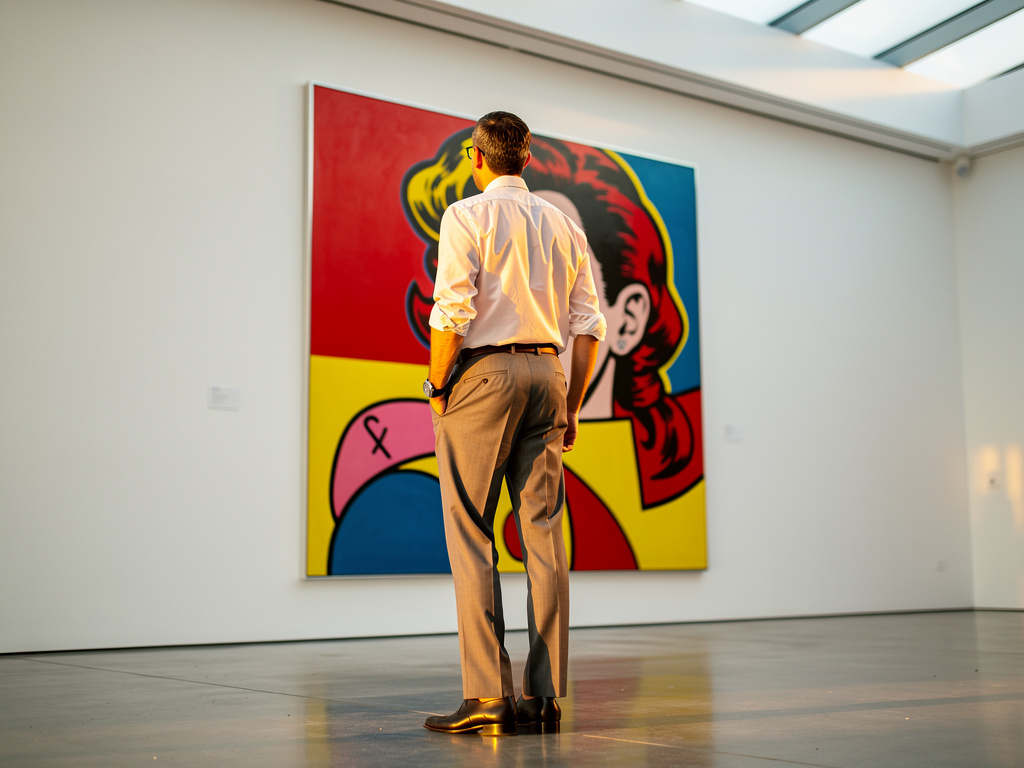
The auction paddle rises. A silk-screened portrait of Marilyn Monroe commands $195 million. Meanwhile, somewhere in Southampton, a first-time collector wonders how a Campbell’s soup can became more valuable than a Monet. This moment of confusion separates tourists from collectors. Understanding what is pop art—truly understanding it—transforms casual observers into serious players in one of the art market’s most enduring sectors.
What Is Pop Art: Defining the Movement
Pop art emerged in the mid-1950s as a deliberate rebellion against abstract expressionism’s brooding intensity. While Jackson Pollock splattered paint in emotional fury, a new generation of artists pointed their brushes at billboards, comic books, and grocery store shelves. The movement began in London with the Independent Group, a collective of young provocateurs who met at the Institute of Contemporary Art starting in 1952.
British critic Lawrence Alloway coined the term, but American artists transformed it into a cultural phenomenon. Andy Warhol, Roy Lichtenstein, James Rosenquist, and Claes Oldenburg didn’t merely depict popular culture. Instead, they elevated it to fine art status, challenging centuries of artistic hierarchy. Richard Hamilton famously described the characteristics as “popular, transient, expendable, low cost, mass produced, young, witty, sexy, gimmicky, glamorous, and big business.”
Nevertheless, this irreverence masked serious artistic innovation. The movement asked uncomfortable questions: Why should a Renaissance Madonna command more respect than a Hollywood starlet? What separates a museum masterpiece from a magazine advertisement? These inquiries still drive collector interest today.
The Pop Art Movement’s Hamptons Connection
Long Island’s East End has hosted American artists since the Abstract Expressionists colonized Springs in the 1940s. However, pop art claimed its own territory at the peninsula’s far tip. In 1971, Andy Warhol and filmmaker Paul Morrissey purchased Eothen, a five-cottage compound in Montauk, for $225,000. The property became a legendary gathering place where art world luminaries mixed with rock royalty.
Jackie Kennedy rented the main house during summers. The Rolling Stones rehearsed Black and Blue among the dunes. Halston, Liza Minnelli, and Truman Capote became regular visitors. As former Interview editor Bob Colacello noted, Eothen was “the Factory answer to Hyannisport.” This Hamptons connection legitimized pop art within social circles that initially dismissed it as commercial gimmickry.
Meanwhile, Roy Lichtenstein maintained a studio in Southampton, producing some of his most celebrated works while overlooking potato fields that would later become hedge fund estates. Today, the Montauk landscape still bears Warhol’s influence—15 acres of his former property now comprise the Andy Warhol Preserve, maintained by the Nature Conservancy.
Pop Art Characteristics: What Collectors Recognize
Several distinctive elements define authentic pop art. Recognizing these characteristics separates informed collectors from impulse buyers. First, appropriation of mass media imagery stands as the movement’s signature technique. Artists borrowed directly from advertisements, comic strips, and product packaging. Warhol’s Campbell’s Soup Cans didn’t interpret the label—they replicated it with mechanical precision.
Second, bold colors and hard edges replaced the gestural brushwork of preceding movements. Lichtenstein’s Ben-Day dots mimicked commercial printing processes. These techniques weren’t merely stylistic choices; they commented on mass production’s dominance in postwar American life. Additionally, repetition became a philosophical statement. Warhol’s serial portraits of Marilyn Monroe questioned whether uniqueness still held meaning in an age of mechanical reproduction.
Third, irony permeates the best pop art without overwhelming it. The movement simultaneously celebrated and critiqued consumer culture. This ambiguity gives the work lasting relevance. A Warhol dollar sign painting hangs in investment bank lobbies and activist galleries alike. Both audiences find validation. Consequently, this interpretive flexibility sustains market demand across economic cycles.
Pop Art History: From Scandal to Blue-Chip
Understanding pop art’s trajectory illuminates why it commands current prices. The movement faced fierce initial resistance. Critics dismissed it as shallow, commercial, and fundamentally unserious. Hilton Kramer of The New York Times called pop art “the product of a mentality that thinks the artist’s social task is to duplicate the visual effluvia of the commercial world.”
Nevertheless, museums and collectors gradually recognized the movement’s significance. The Museum of Modern Art began acquiring pop works in the 1960s. Leo Castelli’s gallery became the movement’s commercial epicenter, launching careers that would dominate auction records for decades. By 1973, when Robert Scull sold his collection at Sotheby’s, pop art had become big business.
Furthermore, subsequent generations embraced and extended pop’s legacy. Jeff Koons, Takashi Murakami, and KAWS built careers on pop art foundations. This continuity ensures the original movement remains historically significant rather than merely nostalgic. Collectors acquiring Warhol or Lichtenstein aren’t buying dated artifacts—they’re acquiring source material for contemporary practice.
The Market Intelligence: What Pop Art Costs Today
Current market conditions favor informed collectors. According to the Sotheby’s market analysis, pop art remains a stabilizing force in contemporary auctions. While the broader art market contracted 27 percent in 2024, established pop artists maintained relative value. Works by Warhol and Lichtenstein still function as portfolio anchors for sophisticated collectors.
Entry points vary dramatically by medium and period. Warhol prints from authorized editions start around $5,000 for smaller works. Unique paintings command millions. Lichtenstein lithographs offer similar accessibility, with signed prints available under $10,000. However, his oil paintings rarely surface below seven figures. Understanding these tiers helps collectors build strategically rather than impulsively.
Moreover, the accessible end of the market surged in 2024. Works under $5,000 saw increased transaction volume even as mega-lots softened. This democratization benefits new collectors who can build positions in authenticated prints and multiples before graduating to unique works. The key lies in provenance verification and condition assessment—skills that separate successful collectors from disappointed speculators.
The Collector’s Playbook: Starting Your Pop Art Journey
Building a credible pop art collection requires strategy beyond simply writing checks. First, develop your eye through direct exposure. Visit the Christie’s and Phillips preview exhibitions. Handle condition reports. Learn to distinguish a crisp impression from a faded one. This education costs nothing but time—yet most collectors skip it.
Second, establish relationships with reputable galleries and advisors. Hamptons galleries carrying pop art offer private viewing opportunities unavailable to walk-in traffic. Additionally, building these connections provides access to works before they reach public auction. The best pieces often trade privately, never appearing in catalogues.
Third, start with what genuinely excites you rather than what seems safest. The collectors who built legendary holdings followed passion, not just market reports. Furthermore, authentic enthusiasm sustains interest through market cycles. A collection assembled purely for investment purposes rarely survives the first downturn. Conversely, works acquired with genuine appreciation become companions rather than assets.
Why Pop Art Matters Beyond the Price Tag
Owning pop art signals more than financial capacity. It demonstrates cultural fluency—an understanding that art connects to broader conversations about commerce, celebrity, and American identity. When a Lichtenstein hangs in your dining room, you’re not merely decorating. You’re participating in an ongoing dialogue about what images mean and who controls them.
This cultural capital appreciates alongside financial value. The conversations sparked by serious artwork create connections that purely decorative pieces cannot. Consequently, collectors find that thoughtfully acquired pop art generates returns beyond auction estimates. Business relationships form. Social circles expand. The collection becomes a calling card.
Furthermore, pop art’s visual accessibility makes it ideal for collectors who entertain frequently. Unlike conceptual work requiring extensive explanation, a Warhol flower painting communicates instantly. Guests engage without art history degrees. This democratic quality—the same characteristic critics once dismissed—proves advantageous in social settings where pretension alienates rather than impresses.
Your Next Move in Understanding Pop Art
Answering what is pop art fully requires ongoing engagement rather than a single article. The movement’s depth reveals itself through sustained attention. Visit the Hamptons galleries during summer openings. Attend auction previews in Manhattan. Build your visual vocabulary one work at a time.
The collectors who dominate today’s market started exactly where you are now—curious, engaged, and ready to learn. Pop art rewards that curiosity with works that remain visually compelling and intellectually stimulating decades after their creation. Moreover, the movement’s Hamptons legacy means serious examples regularly surface in local galleries and estate sales.
Understanding what is pop art transforms you from passive observer to active participant in one of the twentieth century’s most significant artistic developments. The soup cans make sense now. The price tags do too. What remains is the pleasure of building a collection that reflects both taste and knowledge—the ultimate marker of a serious collector.
Continue Your Collecting Journey
Social Life Magazine connects discerning collectors with the Hamptons art world.
- Inquire About Gallery Partnerships
- Subscribe for Art Market Updates
- Experience Polo Hamptons
- Print Subscription
More from The Collector’s Guide to Pop Art
- Next: Andy Warhol Pop Art: What His Montauk Years Reveal About Collecting Today
- Coming Soon: Pop Art Artists: 12 Names Collectors Are Watching Now
Author

Written by
Recent Posts
What Goes Into Planning a Professional Furnace Installation?
Why Sports Card Collecting Is More Than Just a Hobby
From Signature Scents to Scent Wardrobes: The Evolution of Personal Fragrance

Beyond the Booth: How Exhibition Design Is Creating New Brand Experiences
Trading the Hamptons for Hvar: A Summer on Croatia’s Most Glamorous Island
Categories
- Art
- Articles
- Business of Luxury
- Celebrities
- Culture
- Entertainment
- Events
- Faces of Summer 2026
- Fashion
- Fashion & Style
- Featured
- Finance
- Food, Spirits, Wine
- Hamptons
- Hamptons Celebrities
- Health
- Health & Beauty
- Lifestyle
- Luxury Lifestyle
- Press
- Profiles
- Real Estate
- Technology
- The Chronicles
- Travel
- Uncategorized
- Weddings