
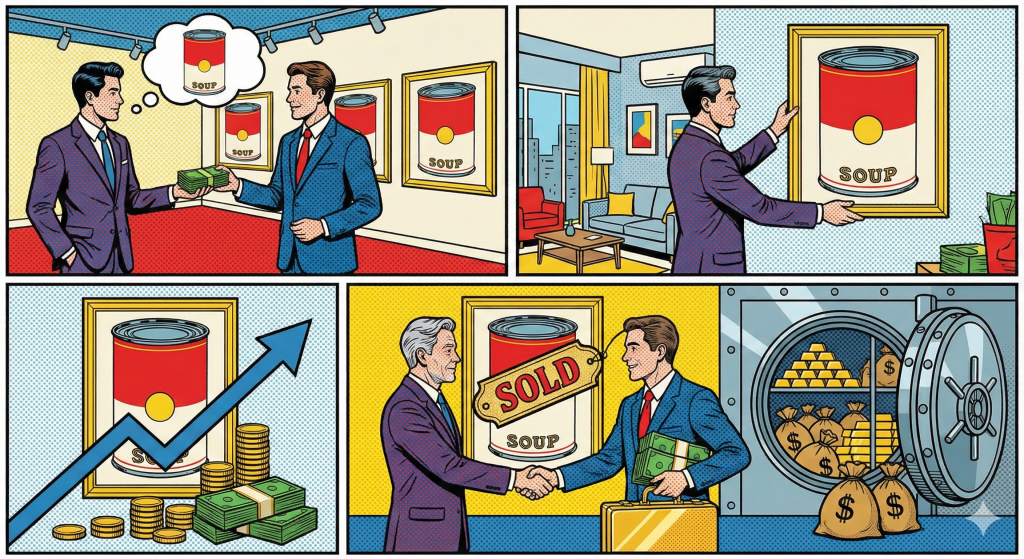
The collector who paid $1.7 million for Roy Lichtenstein’s Nurse in 1995 watched it sell for $95.4 million twenty years later. That’s not luck. That’s understanding how certain works transform from purchases into dynasty-building assets. Pop art has outperformed the S&P 500 over three decades, but the difference between spectacular returns and expensive wallpaper comes down to strategy most investors never learn.
Why Pop Art Commands Institutional Capital
Family offices managing $6 trillion in combined assets have tripled in number since 2019, and their approach to art has shifted dramatically. According to Bank of America’s 2024 Study of Wealthy Americans, 78% of collectors with holdings exceeding $100,000 describe transferring art to the next generation as a priority. This intergenerational focus changes the calculus entirely.
Pop art occupies a unique position in this landscape. The movement’s accessibility, cultural resonance, and institutional validation create multiple demand drivers beyond pure speculation. When a Warhol or Lichtenstein enters a museum collection, it removes supply while confirming the artist’s canonical status. This ratcheting effect explains why top-tier pop works rarely reappear at auction and why, when they do, records frequently fall.
The Deloitte Art & Finance Report documents a shift in family office allocations, with average holdings falling from 13.4% in 2023 to 8.8% in 2025. This reflects consolidation, not retreat. Sophisticated collectors are concentrating positions in institutional-quality works rather than spreading thin across speculative purchases. For pop art specifically, this concentration favors authenticated, properly provenanced pieces by artists with established catalogue raisonnés.
Authentication: The Non-Negotiable Foundation
The Andy Warhol Art Authentication Board dissolved in 2012 after spending $8 million defending authentication decisions in a single five-year period. The Keith Haring Foundation faced a $40 million lawsuit. The Calder Foundation endured similar legal pressure. These battles reveal a uncomfortable truth: authentication determines not just value but marketability itself.
For Warhol, the four-volume Catalogue Raisonné published by the Warhol Foundation remains the primary reference, with additional volumes covering later periods still in development. Works included in the catalogue trade at substantial premiums. Those excluded face permanent questions regardless of their actual authenticity. During Warhol’s Factory era, recordkeeping was notoriously haphazard. Works were traded, given away, and occasionally taken without permission, creating gaps that legitimate pieces sometimes fell through.
The Roy Lichtenstein Foundation maintains a digital Catalogue Raisonné at lichtensteincatalogue.org, documenting over 5,000 works including paintings, sculpture, drawings, collages, prints, and commissions. Critically, neither the Foundation nor the Estate authenticates artworks directly. The catalogue provides documentation but explicitly disclaims warranty of authenticity or provenance. Inclusion supports a work’s legitimacy; absence creates complications requiring additional evidence.
For collectors entering this market, authentication creates a binary filter. Works with clear provenance, catalogue inclusion, and consistent exhibition history command liquidity premiums that compound over time. Works requiring explanation, regardless of their aesthetic merit, face perpetual discounts and reduced buyer pools. The sophisticated approach treats authentication not as verification but as qualification for investment-grade status.
Provenance: The Paper Trail That Creates Value
Provenance means ownership history, but its investment implications extend far beyond simple tracking. A Warhol with continuous documentation from the Factory through reputable dealers and collectors to the present date trades differently than an identical work with gaps or unexplained periods. The paper trail itself becomes part of the asset.
Exhibition history compounds provenance value. Works included in major retrospectives, museum presentations, or scholarly publications develop institutional validation that strengthens with each appearance. When Lichtenstein’s Diana and Ajax paintings, commissioned by Gianni Versace, were displayed at Phillips Southampton in 2022, their exhibition history expanded to include a respected venue presentation. Each documented showing adds to the historical record.
Estate sales demonstrate provenance premium in action. The September 2025 Lichtenstein estate sale realized $27 million against a $15 million estimate. Every lot sold. Works from the artist’s personal collection carried implicit authentication and unbroken chain of custody that eliminated buyer hesitation. Comparable works without estate provenance would face deeper due diligence and negotiation leverage.
Building a Pop Art Portfolio: The Layered Approach
Smart collectors build positions across generations and price tiers rather than concentrating in single acquisitions. This layered strategy creates conversation among works while diversifying exposure to market cycles and taste shifts. A collection might include a Warhol print for foundational legitimacy, Murakami or KAWS for contemporary engagement, and an emerging voice for discovery potential.
Entry points vary dramatically by artist and medium. Authenticated Warhol prints begin around $5,000 for smaller editions and extend to $200,000 or beyond for iconic images in excellent condition. Lichtenstein exhibition posters start under $25,000, while signed limited-edition prints command $25,000 to $100,000 depending on series, condition, and provenance. The Nudes series from 1994 has shown particular strength, with individual works reaching $1.2 million at recent sales.
Condition separates winners from regrets at every price level. Fading, foxing, and handling marks substantially reduce values, and these defects often worsen over time. Climate control, proper framing, and professional conservation represent ongoing costs that serious collectors factor into acquisition decisions. A pristine example of a common print outperforms a compromised example of a rarer one.
Edition size directly impacts appreciation potential. Prints with fewer than 100 copies tend to appreciate faster than larger editions due to genuine scarcity. Warhol’s Marilyn Monroe silkscreen prints, produced in editions of 250, now sell for over $200,000 on strong provenance despite relatively high edition counts. Smaller editions by the same artist on comparable subjects command proportionally higher premiums.
The Tax Dimension: Strategy Beyond Appreciation
Art investment offers tax advantages unavailable in conventional asset classes, but realizing these benefits requires planning that begins at acquisition. The IRS classifies art as a collectible subject to 28% capital gains rather than the 20% maximum for securities. This higher rate makes tax-aware structuring essential for optimal after-tax returns.
Charitable donations of appreciated artwork provide perhaps the most favorable treatment. Collectors can typically deduct fair market value for works held more than one year and donated to qualified organizations. A work purchased for $50,000 that appreciates to $500,000 generates a $500,000 deduction when donated to a museum whose mission relates to art. This eliminates the unrealized gain entirely while creating current-year tax benefit.
The related use rule significantly impacts charitable deduction amounts. Donated art must serve the recipient charity’s exempt purpose to qualify for full fair market value deductions. Museums, educational institutions, and cultural organizations typically satisfy this requirement. Donations to private foundations or unrelated charities may limit deductions to cost basis, requiring careful recipient selection.
Installment sales spread capital gains recognition across multiple years, preventing a single large sale from pushing collectors into higher brackets. For works worth millions, this strategy can save hundreds of thousands in taxes while providing steady income streams. Professional structuring ensures compliance with complex installment sale regulations.
Estate planning with art enables significant wealth transfer optimization. The individual gift and estate tax exemption of $13.99 million in 2025 is scheduled to revert to approximately $7 million per person in 2026. Families concerned about this potential reduction might accelerate transfers of appreciated artwork, removing future appreciation from taxable estates while using current exemption levels.
Art-Secured Lending: Unlocking Liquidity Without Selling
Collections meeting institutional standards can serve as collateral for credit facilities, creating liquidity without triggering capital gains. Major private banks including Citi, Bank of America, and UBS maintain specialized art lending divisions that evaluate collections and structure loans against qualified holdings.
Loan-to-value ratios typically range from 50% to 70% depending on artist liquidity, work quality, and collection diversification. A collection valued at $10 million might support $5 million to $7 million in credit facility. Collectors continue displaying works in their homes or offices while accessing capital for acquisitions, investment opportunities, or business growth.
This financing structure allows collectors to benefit from appreciation while maintaining flexibility. Rather than selling a work that might continue appreciating, borrowing against it preserves upside exposure while providing current capital. Interest payments become the cost of maintaining optionality on future gains.
Due Diligence: The Acquisition Framework
Every acquisition should follow a systematic evaluation covering authentication, provenance, condition, market position, and comparable sales. This framework applies whether purchasing from auction houses, galleries, or private parties. Shortcuts invite problems that compound over time.
For works exceeding $5,000, independent appraisals from qualified appraisers become essential for insurance, lending, and eventual resale. The IRS requires qualified appraisals for charitable donations at this threshold, and the appraisal must be dated within 60 days of contribution. Establishing appraisal relationships before transactions occur enables faster execution when opportunities arise.
Auction houses provide extensive due diligence for consigned works, but their interests align with sellers rather than buyers. Christie’s, Sotheby’s, and Phillips employ specialists who research provenance and authenticate through expert networks, yet warranties remain limited. Condition reports require careful reading, and in-person inspection before bidding reveals issues photographs miss.
Gallery purchases shift due diligence responsibility more fully to buyers. Reputable dealers provide documentation and stand behind attributions, but verification remains prudent. Emerging galleries handling established artists merit particular scrutiny regarding their supply sources and authentication standards.
Market Intelligence: Reading the Signals
The Artprice100 Index tracks the 100 most successful artists by auction revenue over rolling five-year periods. This benchmark has demonstrated 8.9% annualized growth since 2000, providing context for evaluating individual artist performance against broader market trends. Post-war and contemporary artists dominate the index, reflecting where institutional capital concentrates.
Recent market data reveals nuanced patterns. Works under $5,000 saw growth in 2024 even as sales above $10 million plunged 45%. This bifurcation suggests accessible works by established artists offer entry points while ultra-high-end transactions face more selective buying. First-time collectors accounted for 46% of online art purchases in 2024, indicating expanding demand at accessible price points.
Artist-specific momentum provides actionable signals. The September 2025 Lichtenstein estate sale saw 10 of 11 works exceed high estimates, with Sotheby’s citing unmet demand justifying additional consignments. When estates release fresh supply and markets absorb it at rising prices, bullish sentiment dominates. Concentration risk exists if release velocity exceeds collector appetite, but current indicators suggest sustained demand.
Building Relationships: The Competitive Advantage
Art markets operate on relationships that take years to develop. Dealers reward genuine interest with early access, holding inventory for established clients before public offering. Auction house specialists remember bidders who participate consistently, providing intelligence on upcoming opportunities and condition insights unavailable publicly.
Museum memberships at institutions like the Parrish Art Museum and Guild Hall provide access to opening events where collectors, dealers, and curators gather. These settings enable relationship building in contexts that commercial interactions cannot replicate. Collectors who support institutions through acquisitions, donations, and board service gain access and influence that amplify collection-building opportunities.
Art fairs concentrate opportunities but require preparation. The Hamptons Fine Art Fair in July brings 150 galleries from 20 countries to Southampton. Arriving with researched lists, pre-scheduled booth visits, and established dealer relationships transforms the experience from overwhelming to productive. VIP previews provide first selection before general admission.
The Southampton Advantage
The Hamptons’ transformation into a year-round gallery destination creates access advantages for local collectors. Phillips, Christie’s, and Sotheby’s maintain seasonal outposts offering preview exhibitions of works from upcoming New York sales. These presentations enable evaluation and relationship building without Manhattan logistics.
The artistic legacy surrounding pop art in this region provides particular resonance. Warhol’s Montauk compound, Lichtenstein’s 27 years on Gin Lane, and the Pollock-Krasner Springs studio create historical connections that museums, galleries, and auction houses emphasize in their regional programming. Collecting pop art while living among its history generates insights unavailable elsewhere.
Year-round gallery operations have expanded as the market matures. Off-season visits offer unhurried engagement, extended dealer conversations, and reduced competition for attention. The collector who builds relationships during quieter months earns advantages when competitive situations arise.
The Long View: Investment Horizon and Legacy
Art requires patience that most investment categories do not demand. The optimal holding period extends beyond typical financial planning horizons, with institutional validation and scarcity effects compounding over decades rather than quarters. The collector who purchased Lichtenstein’s Nurse held it for twenty years before realizing fifty-fold returns.
This time horizon shifts evaluation criteria from short-term appreciation to legacy value. Works that museum curators seek for retrospectives, scholars reference in publications, and collectors recognize as canonical appreciate through mechanisms beyond market speculation. Institutional demand creates floors that speculative demand cannot.
Succession planning begins with current acquisitions. Documenting provenance, maintaining conservation records, and establishing relationships with potential institutional recipients creates transfer optionality. Whether heirs maintain collections, donate for tax benefit, or sell through prestigious channels, preparation during ownership determines outcome quality.
The most sophisticated approach treats collecting as simultaneously personal and strategic. Acquiring works that provide aesthetic satisfaction ensures living with the collection remains rewarding regardless of market fluctuations. Acquiring works that meet investment-grade standards ensures those rewards compound financially. Pop art’s unique combination of visual impact and institutional validation enables both objectives within a single collection.
Ready to build an art collection with investment-grade standards? Contact our art advisory network for introductions to qualified specialists, or explore our complete guide to Hamptons galleries. Join us at Polo Hamptons where collectors, advisors, and tastemakers gather, or subscribe to Social Life Magazine for continuing coverage of the artists, galleries, and trends shaping the market.
Author

Written by
Recent Posts
What an Auto Accident Lawyer Can Recover After a Serious Wreck
What Ginger and Turmeric Shots Do for Your Body When Taken Daily
What Should You Know About Getting a Cold Sore Prescription Online?
Porch Enclosures That Let Outdoor Living Last Longer
What Your E1 Visa Lawyer Verifies in Substantial Trade Records
Categories
- Art
- Articles
- Business of Luxury
- Celebrities
- Culture
- Entertainment
- Events
- Faces of Summer 2026
- Fashion
- Fashion & Style
- Featured
- Finance
- Food, Spirits, Wine
- Hamptons
- Hamptons Celebrities
- Health
- Health & Beauty
- Lifestyle
- Luxury Lifestyle
- Press
- Profiles
- Real Estate
- Technology
- The Chronicles
- Travel
- Uncategorized
- Weddings