
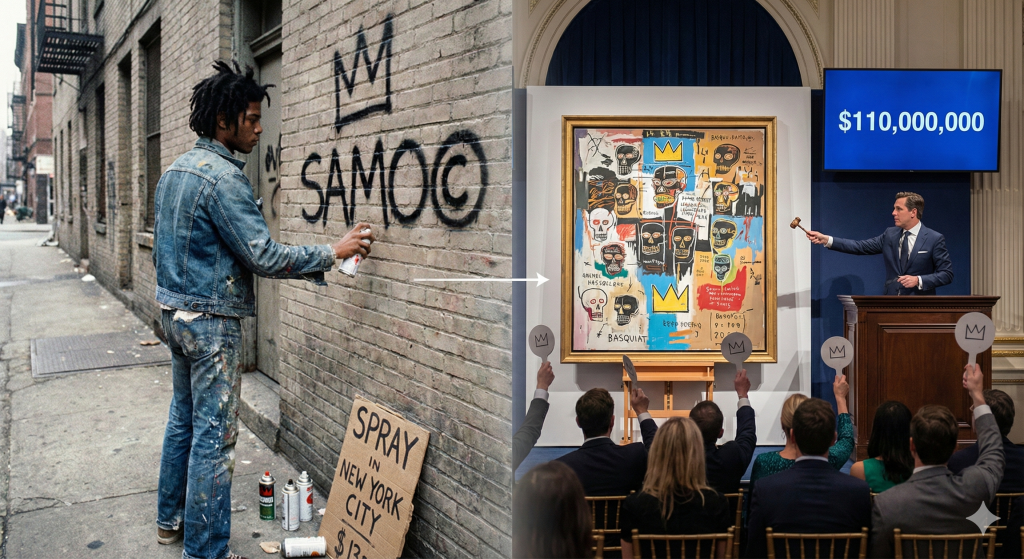
The Wealth Trajectory Every Collector Studies
The Basquiat Street Artist Origin: SAMO and the Brooklyn Beginnings
Jean-Michel Basquiat was born December 22, 1960, in Brooklyn to Gerard Basquiat, a Haitian-born accountant, and Matilde Andradas, a Brooklyn native of Puerto Rican descent. Consequently, he grew up trilingual, speaking English, French, and Spanish. His mother took him to the Brooklyn Museum and Manhattan’s major institutions from an early age. By six, he was enrolled as a Junior Member of the Brooklyn Museum.
At eight, a car struck him while playing in the street. Subsequently, his mother gave him a copy of Gray’s Anatomy during his recovery. The medical illustrations would haunt his canvases for the rest of his career. Meanwhile, his parents’ marriage was dissolving. His mother struggled with mental illness. By fifteen, Basquiat was skipping classes and dropping acid in Washington Square Park.
He eventually dropped out of Edward R. Murrow High School in September 1978. Nevertheless, education continued elsewhere. “I never went to art school,” Basquiat later explained. “I just looked at a lot of things. And that’s how I learnt about art, by looking at it.”
SAMO: The Graffiti Tag That Changed Everything
The Basquiat street artist story truly begins with four letters and a copyright symbol. In 1978, Basquiat and his friend Al Diaz started tagging Lower Manhattan with the moniker SAMO©. The name originated from “Same Old Shit,” a phrase born from a late-night marijuana session. However, the execution was anything but ordinary.
Unlike traditional graffiti writers who focused on stylized names and street numbers, SAMO© delivered philosophical epigrams. “SAMO© AS AN END TO MINDWASH RELIGION, NOWHERE POLITICS, AND BOGUS PHILOSOPHY” read one tag. “SAMO© AS AN ALTERNATIVE TO GOD” proclaimed another. Indeed, this wasn’t ego graffiti. It was guerrilla marketing disguised as street philosophy.
The Village Voice took notice first. On December 11, 1978, the paper published an article offering $100 to identify the mysterious taggers. Basquiat and Diaz came forward. Additionally, the coverage provided exactly the art-world attention Basquiat had calculated. The downtown scene was watching.
By 1979, Keith Haring had started following the SAMO© graffiti and befriended Basquiat. Furthermore, the Mudd Club in TriBeCa became his second home. Then, in 1980, Basquiat and Diaz had a falling out. Consequently, the phrase “SAMO IS DEAD” began appearing on SoHo buildings. One chapter ended. Another was about to explode.
From Postcards to Paintings: The Meteoric Rise
Before the galleries came calling, Basquiat hustled. He sold hand-painted postcards on the street with artist Jennifer Stein. He made “MAN MADE” clothing from painted upcycled garments. Designer Patricia Field carried his pieces in her Greenwich Village boutique. Subsequently, his sculptures appeared in her store windows.
The real break came in June 1980 at the Times Square Show, a multi-artist exhibition where Basquiat displayed fourteen SAMO drawings. Afterward, curator Diego Cortez included him in the landmark New York/New Wave exhibition at MoMA PS1 in 1981. Collectors started circling. Gallerists started calling.
Annina Nosei gave him basement studio space in her SoHo gallery. The arrangement was controversial. Nevertheless, it worked. Basquiat produced rapidly, painting on canvas with the same urgency he’d brought to walls. His first solo show at the gallery in 1982 sold out. Additionally, prices climbed from $5,000 to $25,000 within months.
That same year, at twenty-one, he became the youngest artist ever to participate in Documenta in Kassel, Germany. Furthermore, he would become one of the youngest to exhibit at the Whitney Biennial. The Basquiat street artist had officially crossed over. The art establishment couldn’t look away.
The Warhol Connection: Mentorship, Collaboration, and Mutual Reinvention
Their first encounter happened before fame found Basquiat. One afternoon, he approached Andy Warhol at a SoHo restaurant, trying to sell a handmade postcard. Warhol bought it for a dollar. Curator Henry Geldzahler, dining with Warhol, dismissed the young artist as “too young.” History would prove otherwise.
Swiss dealer Bruno Bischofberger formally introduced them in October 1982. Subsequently, Warhol documented the lunch in his diary, noting that Basquiat “went home and within two hours a painting was back, still wet, of him and me together.” The work, titled Dos Cabezas, ignited a friendship that would define both artists’ later careers.
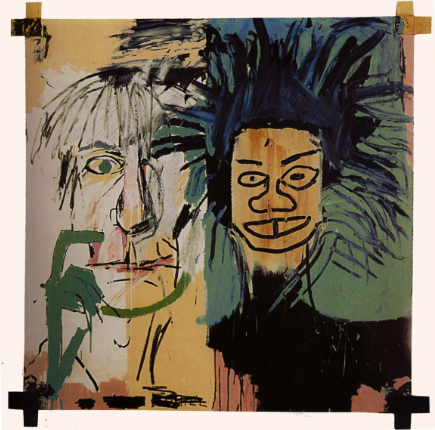
Warhol, in his mid-fifties, had been dismissed by critics as coasting. Consequently, he saw in Basquiat the raw energy the art world accused him of losing. “Jean-Michel got me into painting differently,” Warhol later admitted. Meanwhile, Basquiat found in Warhol the validation and access he craved.
They produced over 100 collaborative paintings. The process was physical, almost competitive. Keith Haring described watching them work: “Each one inspired the other to out-do the next. The collaborations were seemingly effortless. It was a physical conversation happening in paint instead of words.”
A 1985 exhibition at Tony Shafrazi Gallery paired them in boxing gloves for the promotional poster. Furthermore, the show itself became a cultural moment. However, critics panned the collaboration harshly. The New York Times called Basquiat “an art world mascot.” The assessment devastated him. Their friendship cooled, though it never fully fractured.
The Work: Crowns, Skulls, and the Language of Power
Basquiat’s visual vocabulary remained remarkably consistent from street to studio. Crowns topped his figures, conferring royalty on Black bodies the art world had historically ignored. Skulls referenced mortality, Gray’s Anatomy, and perhaps his own premonitions. Text fragments invaded his canvases, words crossed out and rewritten, meaning simultaneously revealed and obscured.
He drew from sources high and low: Leonardo da Vinci and comic books, jazz history and television commercials. Indeed, his work critiqued colonialism, celebrated Black excellence, and interrogated the very market that was enriching him. “I am not a Black artist,” he insisted. “I am an artist.”
The paintings moved fast. So did the prices. By 1984, individual works were selling for $25,000 to $35,000. Subsequently, six-figure sales became routine. Collectors who understood the cultural moment accumulated aggressively. Sophisticated advisors like Isabella del Frate Rayburn, who invested early in Basquiat alongside Warhol and Twombly, built collections that would appreciate exponentially over the following decades.
August 1988: The End at Twenty-Seven
Warhol died unexpectedly in February 1987 following gallbladder surgery. Basquiat spiraled. The heroin use that had punctuated his career intensified into full addiction. Friends worried publicly. Furthermore, the art world watched helplessly as one of its most vital voices dimmed.
On August 12, 1988, Basquiat was found dead in his studio at 57 Great Jones Street in Manhattan. He was twenty-seven years old. The cause was acute mixed drug intoxication, specifically heroin and cocaine. He left behind no will. He left behind approximately 1,000 paintings and 2,000 drawings.
The location mattered. Warhol had rented that Great Jones Street space to Basquiat in 1983. Consequently, the younger artist had lived and worked there until his death. In 2025, the city officially renamed the block “Jean-Michel Basquiat Way.” The Basquiat street artist had become permanent New York geography.
The Market After Death: From Thousands to Hundreds of Millions
Death often elevates artists. Nevertheless, Basquiat’s posthumous ascent remains extraordinary even by those standards. Works that sold for tens of thousands in the 1980s now command eight figures. The Sotheby’s and Christie’s results tell the story in cold numbers.
The $110.5 million 2017 sale wasn’t an anomaly. It was a confirmation. Yusaku Maezawa had already set a Basquiat record the previous year, paying $57.3 million at Christie’s for another 1982 skull painting. Furthermore, he’d announced plans to house both works in a museum in his hometown of Chiba, Japan.
In 2021, Christie’s Hong Kong sold Warrior (1982) for $41.7 million, setting a record for the most expensive Western artwork ever sold in Asia. Subsequently, major Basquiat works have consistently topped contemporary art evening sales worldwide. The Basquiat market operates at its own altitude.
Why the sustained demand? Scarcity plays a role. Basquiat’s eight-year career produced finite inventory. Additionally, provenance matters intensely. Works with exhibition history and prominent previous ownership command premiums. Moreover, the cultural relevance has only intensified. Young collectors with recent liquidity events see Basquiat as cultural capital that traditional luxury goods can’t provide.
The Collector’s Calculus: What the Hamptons Crowd Understands
Art advisor Olyvia Kwok recently noted that she’s transacted millions in pieces that seasoned collectors declined but Gen Z investors purchased eagerly. Indeed, the generational shift favors artists like Basquiat who bridge high culture and street credibility. Furthermore, his work photographs beautifully for the visual platforms that drive contemporary taste.
The serious collectors in the Hamptons gallery scene understand several truths about the Basquiat market. First, condition matters enormously. Works on paper require museum-quality conservation. Second, 1982 represents the peak vintage. Basquiat himself called it the year of his “best paintings ever.” Third, provenance from major galleries and collections adds substantial value.
Prints offer entry points. Original editions from collaborations with various publishers trade actively, though authentication remains critical. Meanwhile, drawings provide another tier of access. However, major paintings increasingly trade privately, outside auction houses, as collectors seek discretion and strategic placement.
The ultimate lesson? The collectors who bought Basquiat in the 1980s, when critics dismissed him as a flash-in-the-pan graffiti artist, built generational wealth. The painting that sold for $19,000 in 1984 returned over 5,800 times that investment in 2017. No index fund touches that performance.
Legacy: Why Basquiat Matters Now More Than Ever
Basquiat’s influence extends far beyond auction prices. Fashion houses license his imagery for collections. Musicians sample his visual language in album art and music videos. Furthermore, major retrospectives continue drawing record attendance at institutions worldwide.
The Barbican’s 2017 exhibition “Boom for Real” became one of the museum’s most successful shows. Subsequently, similar retrospectives have toured globally. The work speaks to contemporary audiences grappling with the same issues Basquiat confronted: systemic racism, wealth inequality, cultural appropriation, and the commodification of rebellion.
Perhaps most significantly, Basquiat opened doors. He demonstrated that a young Black artist from Brooklyn could dominate the global art market on his own terms. He refused the categories critics tried to impose. Consequently, a generation of artists who followed could imagine careers his predecessors couldn’t.
The Basquiat street artist who once slept in Washington Square Park now hangs in the world’s most prestigious collections. His crowns adorn museum walls from MoMA to the Broad to private galleries throughout the Hamptons. The kid who sold postcards for a dollar became the most expensive American artist ever sold at auction.
For collectors, the story contains a crucial insight. The art world’s most transformative talents often emerge from margins the establishment dismisses. Those who recognized Basquiat’s significance early didn’t just acquire paintings. They acquired pieces of cultural history that would define an era. The question for today’s collectors: who is the next artist the establishment is underestimating?
Stay Connected with Social Life Magazine
- Contact Social Life Magazine
- Experience Polo Hamptons
- Subscribe to Our Newsletter
- Print Subscription
- Support Our Journalism ($5)
Related Articles
- Isabella del Frate Rayburn: Collector & Art Advisor — Learn how one of the art world’s most respected advisors built a blue-chip collection including early Basquiat works.
- Status Symbols Young Millionaires Actually Buy Today — Why contemporary art is replacing traditional luxury as the ultimate wealth signal for a new generation.
Author

Written by
Recent Posts
Financial Resilience Is the Real Luxury: Why a Strong Credit Foundation Matters

Miami’s best morning workouts before 9AM
Understanding Window Styles: Awning, Sliding, and Casement Explained
Single vs. King Single vs. Double: Choosing the Right Bed Size
The Travel Consequences Many First-Time DWI Offenders Overlook
Categories
- Art
- Articles
- Business of Luxury
- Celebrities
- Culture
- Entertainment
- Events
- Faces of Summer 2026
- Fashion
- Fashion & Style
- Featured
- Finance
- Food, Spirits, Wine
- Hamptons
- Hamptons Celebrities
- Health
- Health & Beauty
- Lifestyle
- Luxury Lifestyle
- Press
- Profiles
- Real Estate
- Technology
- The Chronicles
- Travel
- Uncategorized
- Weddings