
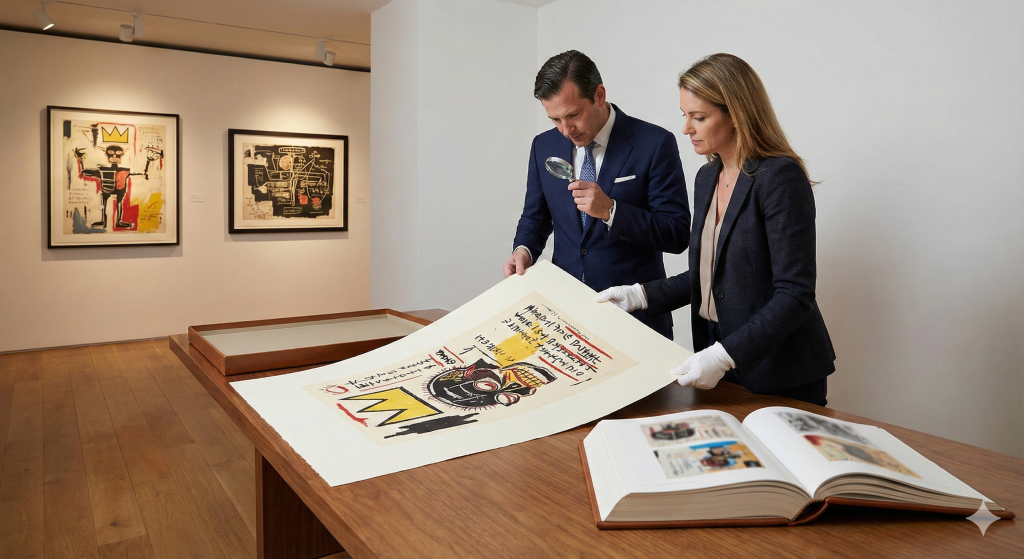
The collector who paid $19,000 for a Basquiat skull painting in 1984 watched it sell for $110.5 million three decades later. That ship has sailed. But Basquiat art prints offer something his major paintings no longer can: accessible entry points into the market of the most expensive American artist ever sold at auction. The question isn’t whether to collect Basquiat. It’s whether you know enough to collect him wisely.
The Basquiat Art Prints Market: Two Distinct Categories
Every collector must understand a fundamental distinction: lifetime prints versus estate editions. Basquiat produced remarkably few prints during his eight-year career, typically in very small editions. Nevertheless, the estate he left behind—now managed by his sisters Lisane Basquiat and Jeanine Heriveaux—has released additional portfolios since 2001. Both categories trade actively, but the value propositions differ significantly.
Lifetime prints carry the artist’s own signature in pencil. These editions typically numbered between 10 and 45 prints, making them genuinely scarce. Subsequently, works like “Back of the Neck” (1983), signed and numbered from an edition of 24, have sold for upwards of £600,000 to £1 million. Indeed, the most sought-after signed Basquiat print, “Untitled” (1983), sold for over £2.52 million at Sotheby’s in November 2022.
Estate editions, by contrast, come in larger runs of 60 to 85 prints. Posthumous works bear signatures from family members—Gerard Basquiat (the artist’s father) until his death in 2013, and now his sisters. These prints typically trade between £30,000 and £150,000, depending on the image and condition. Moreover, they come with certificates of authenticity from publishers like Flatiron Editions, providing documentation that lifetime prints often lack.
The Anatomy Series: Where Print Collecting Began
Basquiat’s first print portfolio remains his most historically significant. The Anatomy series comprises 18 photo silkscreen prints created in 1982, published by Annina Nosei Gallery shortly after his breakthrough solo exhibition. Furthermore, the series directly references the Gray’s Anatomy book his mother gave him after a childhood car accident—imagery that would define his visual vocabulary throughout his career.
Annina Nosei provided Basquiat with basement studio space at her SoHo gallery, where he conceived the Anatomy portfolio. The prints encapsulate his obsession with the human form and the written word. Subsequently, they established the template for all his later editions: skulls, bones, and anatomical fragments rendered with urgent, almost violent marks.
Individual signed prints from the Anatomy series now trade for upwards of £5,000 at the entry level, with exceptional examples commanding significantly more. Additionally, the prints were executed on Arches wove paper, a heavyweight, acid-free stock known for its archival durability. Serious collectors examine paper quality closely. The Anatomy editions have survived four decades, but condition issues—toning, foxing, light damage—directly impact value.
Major Portfolios Every Collector Should Know
Beyond Anatomy, several portfolios define the Basquiat print market. Understanding their provenance and current performance separates informed buyers from impulse purchasers.
The Superhero Portfolio represents one of the most recent estate releases, with prints based on paintings from 1982-87 and published in 2022. In April 2025, Phillips sold a complete Superhero Portfolio for £143,824. Indeed, these newer releases offer contemporary collectors the opportunity to acquire museum-quality imagery at prices well below lifetime editions.
The Daros Suite achieved a new auction record of £134,495 at Sotheby’s during the April 2025 sales. Meanwhile, the complete Rinso Suite sold for £304,567 in the same season. Furthermore, Portfolio I (1983-2001) includes iconic images like “Ernok” and “Per Capita,” which regularly appear at major auction houses.
The Hollywood Africans in Front of the Chinese Theatre edition exemplifies how estate releases can command substantial premiums. In 2015, Pace Prints released 60 prints based on the famous 1983 painting now in the Whitney Museum’s permanent collection. Subsequently, they sold for $50,000 each at release. The secondary market has validated that pricing.
Authentication: The Critical Challenge
In September 2012, the Authentication Committee of the Estate of Jean-Michel Basquiat disbanded after eighteen years of operation. The committee had reviewed over 2,000 works. Nevertheless, facing costly litigation and repeated provenance disputes, the estate concluded its authentication mission was complete. No central authority now exists to verify Basquiat works.
This vacuum has created both opportunity and danger. Consequently, provenance documentation becomes paramount. Serious buyers require gallery invoices, exhibition history, publication records, and past sales from recognized sources. For prints specifically, identifying the original publisher provides a crucial verification step.
The Anatomy series, for example, can be traced to Annina Nosei Gallery. Other lifetime editions emerged from New City Editions in Venice, California, where Basquiat worked during his West Coast period. Furthermore, estate-authorized prints come with publisher documentation and certificates of authenticity. Prints lacking this paper trail deserve intense skepticism.
Red Flags: How Forgeries Enter the Market
Basquiat’s improvisational style makes his work particularly vulnerable to forgery. Additionally, his use of modern materials—spray paint, oil stick, acrylic—means forgers don’t need to source period-specific supplies. The result: fakes circulate constantly.
The FBI’s 2022 investigation of 25 alleged Basquiats at the Orlando Museum of Art illustrated how sophisticated these schemes can become. Furthermore, investigators discovered that the cardboard on which the “paintings” were created bore FedEx labels that didn’t exist until six years after Basquiat’s death. The collection, estimated at $100 million if authentic, proved worthless.
Forgers have created fake authentication stamps mimicking the defunct Basquiat committee. Others fabricate elaborate provenance stories involving lost storage units or direct studio purchases. Indeed, Basquiat’s reputation for selling works directly from his studio to anyone with cash makes these narratives plausible—and therefore dangerous.
For print collectors, specific warning signs demand attention. Inconsistent paper stock, printing quality that doesn’t match known editions, signatures that deviate from documented examples, and missing publisher documentation all indicate potential problems. Moreover, prices significantly below market rates should trigger immediate suspicion rather than excitement.
What Smart Collectors Do Differently
The absence of an authentication committee hasn’t stopped serious collectors from building valuable holdings. Rather, it has shifted responsibility to individual due diligence and trusted intermediaries.
First, buy from established sources. Major auction houses like Sotheby’s, Christie’s, and Phillips maintain research departments that vet consignments. Similarly, established galleries with decades of Basquiat experience—names like Annina Nosei, Tony Shafrazi, and Gagosian—carry reputational stakes that discourage handling questionable work.
Second, demand comprehensive documentation. This includes original purchase receipts, exhibition records, publication appearances, and any correspondence with the estate or former authentication committee. Furthermore, prints from major portfolios should include publisher certificates and, for estate editions, family signatures that can be compared to documented examples.
Third, engage specialist advisors. Art advisors like Isabella del Frate Rayburn, who collected Basquiat alongside Warhol and Twombly decades ago, bring expertise that protects clients from costly mistakes. Their relationships with dealers, conservators, and scholars provide verification resources individual collectors cannot easily access.
Fourth, understand condition. Prints are fragile. Arches wove paper from the 1982 Anatomy series has survived remarkably well, but decades of improper storage leave marks. Light exposure causes fading. Humidity triggers foxing. Physical damage—tears, creases, staining—diminishes value substantially. Consequently, serious collectors request condition reports and, when possible, examine works personally before purchase.
Investment Performance: What the Numbers Show
Basquiat’s print market experienced significant correction in 2024 after years of exceptional growth. Total turnover dropped even as volume increased, suggesting a shift toward lower-priced editions. Nevertheless, 2025 has shown strong recovery, with multiple records set during the April auction season.
The trajectory of specific works illustrates potential returns. “Flexible” (1984), a painting on a picket fence that Basquiat found outside his studio, sold for $45.3 million in 2018 when it was expected to bring $20-30 million. Subsequently, estate prints based on this image have appreciated correspondingly. Indeed, the entire Basquiat market operates on a rising tide that lifts even modest editions.
For collectors weighing prints against other assets, the comparison proves instructive. Young millionaires increasingly view contemporary art as cultural capital that traditional luxury goods cannot provide. Art advisor Olyvia Kwok notes transacting millions in pieces that seasoned collectors declined but Gen Z investors purchased eagerly. Furthermore, a Basquiat print on the wall signals sophistication that no watch or car can match.
Where to Start: Entry Points for New Collectors
Most Basquiat prints trade at auction between £100 and £500 at the low end, with significant numbers reaching £50,000 and exceptional lifetime editions commanding seven figures. Subsequently, the market accommodates various budgets while rewarding those who understand its nuances.
Estate editions offer the most accessible entry. Superhero Portfolio prints, released in 2022, provide museum-quality Basquiat imagery at prices ranging from £15,000 to £30,000 for individual works. Furthermore, these prints come with contemporary documentation, eliminating the provenance concerns that complicate vintage editions.
For collectors seeking lifetime prints, the Anatomy series remains the benchmark. Individual sheets from this portfolio appear regularly at auction, typically starting around £5,000 and escalating based on specific images and condition. Moreover, the series’ art-historical significance—Basquiat’s first print project, published by his first major dealer—adds narrative value beyond the imagery itself.
Regardless of entry point, the same principles apply. Buy from reputable sources. Demand documentation. Examine condition. Understand what you’re acquiring and why it matters. The collectors who built generational wealth on Basquiat didn’t get lucky. They got informed.
The Hamptons Connection: Where Collectors Converge
The galleries dotting the Hamptons represent ground zero for serious contemporary art collecting. Southampton and East Hampton have cultivated gallery scenes where Basquiat prints trade alongside emerging talents. Furthermore, the summer social calendar brings collectors, advisors, and dealers into proximity, enabling the relationship-building that premium transactions require.
For aspiring collectors, these communities offer more than purchase opportunities. They provide education. Conversations at gallery openings, networking at polo matches, and informal consultations with established collectors demystify the market in ways that research alone cannot accomplish. Additionally, the density of expertise creates natural mentorship opportunities for those willing to ask informed questions.
The serious collector recognizes that Basquiat art prints represent more than decorative assets. They’re entry points into cultural conversations that define sophisticated taste. They’re investments backed by a market with over three decades of appreciation. And they’re opportunities—for those who do the work—to own pieces of art history that will only become more significant with time.
Stay Connected with Social Life Magazine
- Contact Social Life Magazine
- Experience Polo Hamptons
- Subscribe to Our Newsletter
- Print Subscription
- Support Our Journalism ($5)
Related Articles
- Basquiat Street Artist to $110 Million Auction King — The complete origin story of the artist whose prints now command six and seven figures.
- Isabella del Frate Rayburn: Collector & Art Advisor — How one of the art world’s most respected advisors built a collection including early Basquiat works.
Author

Written by
Recent Posts

The First Decision After a Collision Can Be the Most Important One
Two Weeks in Rome and Beyond: Turkish Airlines Itineraries from Boston, Chicago and Onward to India

Top 10 Hair Transplant Clinics in Turkey 2026
Artist Alley to Online Store: How Convention Artists Can Keep Selling After the Event
When an 18-Wheeler Crash Leaves Lasting Consequences
Categories
- Art
- Articles
- Business of Luxury
- Celebrities
- Culture
- Entertainment
- Events
- Faces of Summer 2026
- Fashion
- Fashion & Style
- Featured
- Finance
- Food, Spirits, Wine
- Hamptons
- Hamptons Celebrities
- Health
- Health & Beauty
- Lifestyle
- Luxury Lifestyle
- Press
- Profiles
- Real Estate
- Technology
- The Chronicles
- Travel
- Uncategorized
- Weddings