
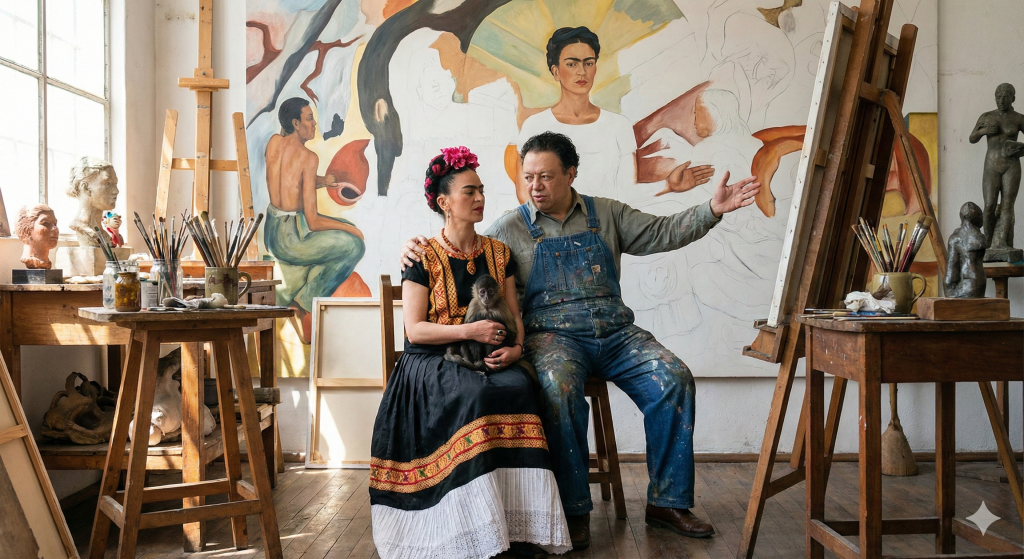
For collectors, cultural sophisticates, and anyone who wants to speak intelligently about twentieth-century art, the marriage of Frida Kahlo and Diego Rivera isn’t gossip. Consequently, it’s essential context for understanding two of the most consequential artists in the Western hemisphere, the development of Mexican modernism, and a market dynamic where the once-overshadowed wife now commands auction prices five times higher than her legendary husband.
The Numbers That Changed Everything
In November 2025, Frida Kahlo’s El sueño (La cama) sold at Sotheby’s for $54.7 million, setting the record for any female artist at auction. Diego Rivera’s auction record stands at $14.13 million for The Rivals, achieved at Christie’s in 2022. The gap is $40 million and widening.
During their lifetimes, this hierarchy was reversed. Rivera commanded international commissions, museum retrospectives, and magazine covers. Kahlo was introduced as his wife. Time magazine dismissed her 1938 New York exhibition by noting that “Little Frida’s pictures had the daintiness of miniatures.” Furthermore, Rivera earned the equivalent of millions in contemporary dollars painting murals for the Rockefellers, Ford, and the Mexican government while Kahlo sold paintings for hundreds.
Understanding how this reversal happened requires understanding their relationship from the beginning.
First Encounter: The Elephant and the Dove
They met in 1922 when Kahlo was 15 and Rivera was 36. She was a student at the prestigious National Preparatory School in Mexico City. He was painting his first significant mural, Creation, in the school’s Bolívar Auditorium. According to Rivera’s autobiography, Kahlo led a group of students who teased him while he worked. She once soaped the auditorium stairs hoping he would slip.
They reconnected in 1928 through photographer Tina Modotti at a Communist Party gathering. By then, Kahlo had survived the bus accident that shattered her pelvis, spine, and foot. She had begun painting during her long recovery. Rivera was famous, finishing his massive mural cycle at the Ministry of Public Education. He was also married to his second wife, Guadalupe Marín.
Kahlo showed Rivera her paintings and asked his honest opinion. He later recalled telling her: “You have talent. You must continue to paint.” She did. Within months, he had divorced Marín. On August 21, 1929, they married in a civil ceremony in Coyoacán.
Kahlo was 22, stood five feet three inches, and weighed 98 pounds. Rivera was 42, stood six feet one inch, and weighed 300 pounds. Her mother called it “a marriage between an elephant and a dove” and refused to attend the wedding.
The Architecture of Their Partnership
Rivera’s fame created opportunities for both of them. When he accepted commissions in San Francisco, Detroit, and New York, she traveled with him. These years abroad shaped her artistic identity. Surrounded by Americans who romanticized Mexico, she began wearing traditional Tehuana dress, pre-Columbian jewelry, and elaborate braided hairstyles. Additionally, the costume became her brand. It distinguished her from every other artist’s wife at every gathering.
Rivera genuinely championed her work. He introduced her to collectors, arranged exhibitions, and defended her artistic seriousness when critics condescended. Nevertheless, his support came with complications. Their open marriage included his affairs with models, assistants, and eventually her younger sister Cristina. Kahlo’s affair with his political hero, Leon Trotsky, was partly revenge.
They divorced in 1939. They remarried in 1940, this time in San Francisco. The second marriage came with new terms: separate bedrooms, separate finances, and no sexual obligations. They remained married until Kahlo’s death in 1954.
What Their Art Reveals About the Relationship
Kahlo painted Rivera constantly, directly and symbolically. Understanding these paintings illuminates the emotional architecture of their partnership.
Frieda and Diego Rivera (1931): Their wedding portrait, painted in San Francisco, shows them holding hands but facing different directions. He holds palette and brushes, the great maestro. She cocks her head toward him, one hand on her stomach, tiny feet barely touching the ground. A dove above them carries a ribbon inscribed with their names. The power dynamic is explicit: he towers, she tilts.
A Few Small Nips (1935): Painted after discovering Rivera’s affair with her sister, this work depicts a woman murdered by her lover. Blood spatters everywhere, including onto the frame. The title comes from a newspaper story about a man who killed his girlfriend and told police he only gave her “a few small nips.” Kahlo transformed domestic betrayal into forensic evidence.
Self-Portrait as a Tehuana (1943): Diego’s face appears on Kahlo’s forehead, embedded in her thoughts, inescapable. She began this painting in 1940 during their brief divorce but didn’t complete it until three years into their second marriage. Furthermore, the obsessive quality is undeniable: he occupies her mind literally, painted as a third eye between her famous brows.
Diego and I (1949): One of her last portraits referencing him. Diego appears again on her forehead, but now she weeps. Her loose hair wraps around her neck like a noose. This is not celebration. This is documentation of a love that felt like strangulation.
Rivera painted Kahlo into his murals, depicting her as a communist militant distributing arms in his Ministry of Education frescoes. He also painted her in Dream of a Sunday Afternoon in Alameda Central, placing her beside his own childhood self. These inclusions weren’t tributes to a wife. Subsequently, they positioned her as an equal participant in Mexican revolutionary history.
The Market Implications of Their Legacy
Rivera’s murals cannot be sold. They’re painted on walls belonging to governments, museums, and corporations. His auction record of $14.13 million represents a canvas painting, not his most significant work. Consequently, collecting Rivera means settling for secondary pieces while his masterworks remain publicly accessible but permanently unavailable.
Kahlo’s situation differs. She painted primarily on portable surfaces. Her entire output of roughly 200 paintings can theoretically circulate. In practice, Mexico’s 1984 declaration of her works as national cultural patrimony prohibits export of pieces held within the country. The major Mexican collections at Museo Frida Kahlo, Museo Dolores Olmedo, and Museo de Arte Moderno will never sell. Furthermore, this creates extraordinary scarcity. When a significant Kahlo reaches the market, it arrives from collections formed before the export ban, from foreign collectors who acquired work directly from the artist or her early gallerists.
The $54.7 million record for El sueño demonstrates what happens when genuine scarcity meets sustained demand. The painting had been in private hands since 1980, when it sold for $51,000. The 107,155 percent appreciation over 45 years reflects both Kahlo’s rising cultural status and the mathematical reality that supply cannot expand to meet demand.
For collectors, this suggests adjacent strategies. Rivera works on paper, lithographs, and smaller canvases remain accessible. Additionally, photography by Nickolas Muray, Lola Álvarez Bravo, and others who documented both artists offers collecting opportunities with direct provenance connections. Pre-Columbian objects similar to those Kahlo and Rivera collected, Mexican folk art they championed, and works by their contemporaries like Rufino Tamayo all represent ways to build context around artists whose masterworks are unobtainable.
Where to See Frida Kahlo and Diego Rivera Together
Three locations offer the most complete picture of their intertwined lives:
Museo Frida Kahlo (Casa Azul): The blue house where Kahlo was born, lived with Rivera, and died. His presence saturates the space even though the museum focuses on her. Their shared domestic life survives in the kitchen with its names spelled in clay vessels, the studio where she worked while he visited, and the garden where they kept their pet monkeys and hairless dogs.
Museo Dolores Olmedo: Businesswoman Dolores Olmedo knew both artists personally. Her museum in Xochimilco reunited their works in 2019, displaying 27 Rivera paintings alongside 20 Kahlos. This is the only place where their oeuvres coexist in substantial depth.
Diego Rivera Mural Museum: Houses Dream of a Sunday Afternoon in Alameda Central, the 50-foot mural Rivera painted in 1947 depicting himself as a child holding hands with the skeletal figure La Catrina while adult Kahlo stands behind them. The mural survived the 1985 earthquake and was relocated to this purpose-built museum. Consequently, it offers the most intimate glimpse of how Rivera situated their relationship within Mexican history.
In the United States, San Francisco Museum of Modern Art holds Frieda and Diego Rivera, their wedding portrait. The Detroit Institute of Arts displays Rivera’s Detroit Industry murals, painted while Kahlo suffered a miscarriage in Henry Ford Hospital and transformed her grief into one of her most devastating paintings.
What Sophisticated People Actually Say
Drop these insights at your next cultural gathering:
On their complementary practices: “Rivera worked monumentally, for public spaces and political messaging. Kahlo worked intimately, for private contemplation and personal mythology. Neither approach is superior. Furthermore, they represent two necessary modes of artistic engagement with Mexican identity.”
On the market reversal: “Rivera’s best works are immovable. They’re on walls. Kahlo’s scarcity advantage combined with her cultural moment to create a price asymmetry that says more about market mechanics than artistic merit.”
On their relationship dynamic: “Calling their marriage toxic misses the point. They operated as creative collaborators who used each other as raw material. She painted her obsession with him. He painted her into revolutionary history. Subsequently, both benefited artistically from a partnership that would have destroyed lesser talents.”
On legacy preservation: “Rivera established the trust that controls both their legacies. He ensured Casa Azul became a museum. He protected her posthumous reputation. Whatever happened during their marriage, his actions after her death demonstrate genuine devotion.”
The Relationship That Explains the Art
You cannot understand Frida Kahlo’s paintings without understanding Diego Rivera. The tears, the obsessive imagery, the transformation of suffering into art all emerge from their partnership. Similarly, you cannot understand Rivera’s commitment to accessible public art without recognizing that his wife created intimate private works that complemented his murals.
Mexico’s first art world power couple, they entertained Trotsky, Breton, and Rockefeller in their home. The pair shaped how the world perceived Mexican culture during a pivotal period of national reinvention. Furthermore, their marriage, with all its infidelities, reconciliations, and artistic cross-pollination, became itself a form of collaborative creation.
When someone at dinner brings up Frida Kahlo and Diego Rivera, you now have more than mythology. You have the market numbers, the artistic dynamics, the institutional context, and the conversational gambits to demonstrate actual understanding. Use them well.
Stay Connected with Social Life Magazine
- Contact Social Life Magazine for editorial inquiries
- Experience Polo Hamptons — where culture meets sport
- Subscribe to Our Newsletter for insider access
- Print Subscription — join the conversation
- Support Independent Journalism
Related Reading
Author

Written by
Recent Posts
Why Workplace Hygiene Is Becoming a Strategic Priority for Modern Businesses
Autism Treatment Across the Lifespan: From Toddlers to Adults

How Lawyers Evaluate the Impact of Catastrophic Injury
Can an IQ Test Change the Way We Look at Art?

What Recovery Can Really Look Like When You Decide to Get Help
Categories
- Art
- Articles
- Business of Luxury
- Celebrities
- Culture
- Entertainment
- Events
- Faces of Summer 2026
- Fashion
- Fashion & Style
- Featured
- Finance
- Food, Spirits, Wine
- Hamptons
- Hamptons Celebrities
- Health
- Health & Beauty
- Lifestyle
- Luxury Lifestyle
- Press
- Profiles
- Real Estate
- Technology
- The Chronicles
- Travel
- Uncategorized
- Weddings