
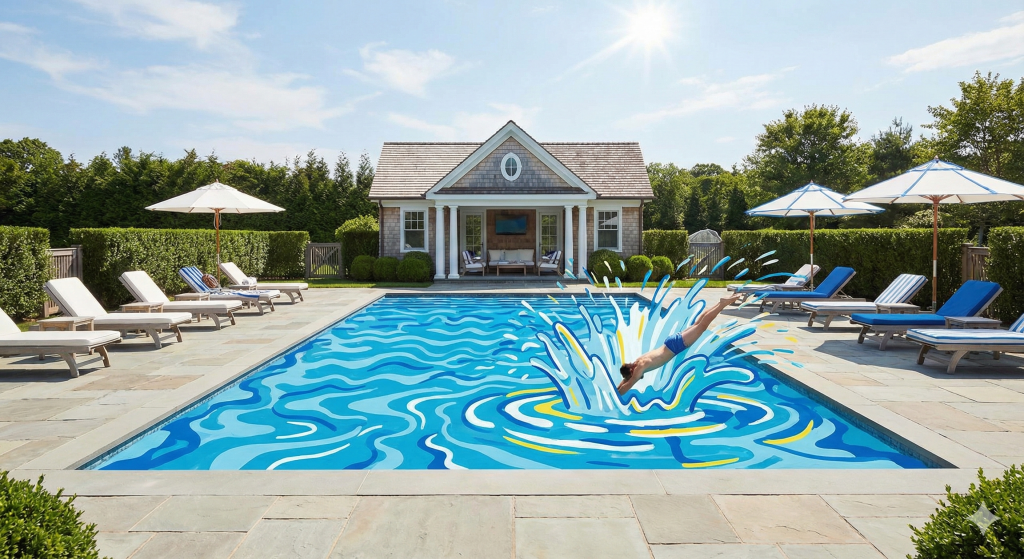
The water in your Hamptons pool looks wrong. You’ve spent $80,000 on infinity edges and imported Italian tile. The landscaper positioned the hedges exactly right. Yet something is missing. The blue doesn’t sing. The light doesn’t dance. The whole composition lacks the effortless glamour you imagined when you signed the closing documents.
What David Hockney Saw When He Landed in California
David Hockney arrived in Los Angeles in 1963 and immediately understood something the locals had missed. Flying into LAX, he looked down and saw blue swimming pools dotting the landscape like scattered sapphires. In England, a pool meant aristocracy. In California, pools were everywhere, democratized and mundane—yet paradoxically more beautiful for their abundance.
He called it his “promised land.” The artist sent a postcard to a friend: “Arrived in the promised land 2 days ago. The world’s most beautiful city is here—LA. You must come.” What followed over the next decade would reshape how the world visualizes wealth, leisure, and the particular quality of American aspiration that defines luxury real estate from Malibu to Montauk.
The modernist architecture captivated him equally. Hockney later admitted he traveled to Los Angeles partly because of a Julius Shulman photograph of Case Study House #21. Those clean lines, sliding glass doors, and geometric precision weren’t just buildings to him. They were theatrical sets waiting for human drama. The swimming pool became his stage.
The David Hockney Swimming Pool Trilogy That Changed Everything
Between 1966 and 1967, Hockney painted three works that would become collectively worth more than most Hamptons estates. The Little Splash came first, modest in scale. Then The Splash at six feet square. Finally, the masterpiece: A Bigger Splash, measuring nearly eight feet in each direction, now permanently housed at Tate Britain.
The premise seems simple. A modernist house. A diving board. A still blue pool. And exploding from the water’s surface, a white eruption where someone has just disappeared beneath. No figure visible. No context provided. Just the frozen evidence of human action lasting two seconds, which Hockney spent two weeks painting.
This temporal paradox delighted him. “I loved the idea of painting this thing that lasts for two seconds; it takes me two weeks to paint this event that lasts for two seconds,” he explained. “Everyone knows a splash can’t be frozen in time, so when you see it like that in a painting it’s even more striking than in a photograph.” The result transcends documentation. It becomes fantasy crystallized.
Hockney used acrylic paint, then a relatively new medium, applied with rollers for the flat surfaces and tiny brushes for the intricate splash. The technique suited California perfectly. Fast-drying acrylics matched the sun-drenched clarity he wanted to capture. Oil paints would have been too heavy, too European, too burdened with tradition.
David Hockney A Bigger Splash: Anatomy of an Icon
Examine A Bigger Splash closely and you’ll find the blueprint for Hamptons pool aesthetics hidden in plain sight. The pink modernist building suggests wealth without shouting it. Two palm trees provide just enough tropical signaling. An empty director’s chair implies leisure without depicting it. The whole composition balances on the knife’s edge between invitation and exclusion.
The painting’s structure divides almost mathematically: sky and building occupy the upper half, pool and diving board the lower. Strong horizontals and verticals create stability that the diagonal diving board disrupts. Then the splash itself explodes through the geometric order, a controlled chaos suggesting that something exciting just happened and you missed it.
Art critics have spilled considerable ink on the painting’s ambiguity. Is it celebratory or melancholic? The absent diver creates unease. The stillness feels almost ominous. Luca Guadagnino named his 2015 thriller A Bigger Splash precisely because the image contains both seduction and danger beneath its placid surface.
For Hamptons homeowners, the lesson is compositional. Your pool exists within a visual framework. The relationship between water, architecture, and landscape creates meaning. Hockney understood that negative space—the empty chair, the unpopulated scene—generates more desire than activity ever could.
The Hamptons-Hockney Connection You Didn’t Know About
David Geffen purchased The Splash in the 1980s when he was quietly building one of the world’s most significant private art collections. He sold it in 1985, but the painting haunted him. When it came to auction at Sotheby’s London in February 2020, Geffen was the buyer, paying nearly $30 million to reacquire a work he’d let go decades earlier.
Here’s the connection that matters: Geffen also owns a $70 million oceanfront compound on Lily Pond Lane in East Hampton, purchased in 2016. The DreamWorks co-founder’s collection includes major works by Pollock, de Kooning, Jasper Johns, and Rauschenberg. But he wanted that Hockney back badly enough to pay eight times what he’d originally sold it for. The painting now hangs somewhere within his constellation of properties, possibly within driving distance of your Hamptons rental.
This isn’t coincidence. The Hamptons have been a laboratory for modernist architecture since the mid-twentieth century. Norman Jaffe, Richard Meier, Charles Gwathmey—these architects created the same clean-lined environments Hockney immortalized in California. The aesthetic aspiration is identical. Blue water, geometric precision, wealth expressed through restraint rather than ostentation.
Why David Hockney Prints Make Smart Entry Points for Collectors
The original paintings are museum pieces or locked in billionaire collections. But David Hockney prints offer something remarkable: affordable access to one of the most commercially successful living artists. And “affordable” requires context when discussing the art market.
According to recent auction data, prints account for 85% of all Hockney lots sold. Posters start around £1,000-2,000. Photographs range from £2,000-5,000 depending on rarity. Signed lithographs and etchings occupy the £10,000-50,000 bracket, which has generated over £30 million in total sales since 2000. The market is deep, liquid, and mature.
The Paper Pools series commands the highest premiums among prints. Created in 1978 using colored paper pulp, these works approach the originals in visual impact while remaining technically editions. Piscine de Medianoche (Paper Pool 30) sold at Sotheby’s in May 2018 for over £7.5 million—exceptional for any print, unprecedented for Hockney.
For first-time buyers, specialists recommend starting with iPad drawings from The Arrival of Spring series or the Yosemite Suite. These digital works, printed in small editions, bridge Hockney’s traditional practice with contemporary technology. Prices typically range from £50,000 to over £100,000, but growth has been dramatic. One iPad work sold for £8,700 at its first auction appearance and fetched £30,000 within five years.
The Print Market Intelligence Serious Collectors Need
Condition determines everything. Hockney prints suffer from sun damage, improper storage, and amateur framing. Well-preserved works from small editions outperform proofs in poor condition regardless of rarity designations. Inspect for fading, warping, and staining before committing capital.
Provenance matters significantly. Works traced to major galleries like L.A. Louver, Annely Juda Fine Art, or Galerie Lelong carry additional credibility. Documentation—invoices, exhibition records, auction history—transforms a print from decorative object into investment asset.
Edition size affects value but isn’t determinative. Artist’s Proofs (AP), Printer’s Proofs (PP), and Trial Proofs (TP) command premiums when condition and timing align. However, a well-preserved main edition print with strong color quality can outperform a proof at auction if demand spikes.
The swimming pool subjects remain most sought-after, but market sophistication rewards contrarian thinking. Interior prints, floral etchings, and abstract works from less frequently traded collections offer value opportunities. As Phillips’ June 2025 auction demonstrated—87% of lots sold above estimate despite a leaner catalogue—competition for desirable Hockneys now often plays out in private channels rather than auction rooms.
How the Pool Paintings Reflect Hamptons Pool Culture
Walk through any high-end Hamptons neighborhood and you’ll see Hockney’s influence everywhere. The rectangular pools with clean geometric edges. The deliberate relationship between water and architecture. The way landscaping frames views. The insistence on visual clarity over Victorian ornamentation.
This isn’t imitation but rather shared DNA. Both California modernism and Hamptons architecture descend from the same International Style principles. Both prioritize indoor-outdoor flow. Both treat the swimming pool as architectural element rather than recreational afterthought. Hockney didn’t create this aesthetic; he codified it visually for generations to come.
Contemporary Hamptons architects explicitly cite this lineage. “It’s hard not to be affected by the water,” notes one prominent local practitioner. “I don’t think I’m alone in feeling a certain calmness that its presence quietly instills.” That calmness—the composed serenity of a Hockney pool scene—has become the default aspiration for luxury outdoor design.
The Abstract Expressionists who fled to the Hamptons in the mid-twentieth century transformed the region into an artistic laboratory. Pollock, de Kooning, Motherwell—they found inspiration in the same light and landscape that attracts today’s hedge fund managers and tech entrepreneurs. Art and real estate have always been intertwined here. Hockney simply made the connection explicit.
What Your Pool Is Missing (And How to Fix It)
Return to your $80,000 pool. The problem isn’t construction quality or material selection. The problem is context. Hockney’s pools exist within carefully composed visual narratives. Every element serves the whole. Your pool probably sits within a collection of expensive but unrelated design decisions.
First, consider the viewing angle. Hockney composed his paintings from specific vantage points that emphasized geometric relationships. Where do you actually look at your pool? From the house? From a lounger? Design the sightlines intentionally rather than accepting whatever the contractor suggested.
Second, eliminate visual noise. The empty chair in A Bigger Splash works because nothing competes with it. Your poolside probably contains accumulated furniture, toys, maintenance equipment, and decorative objects that fragment attention. Edit ruthlessly.
Third, understand color relationships. Hockney’s pools read as pure cobalt because he controlled everything around them. Pink buildings, beige diving boards, green grass—each color choice reinforces the blue. Your pool likely sits within a palette that happened accidentally.
Fourth, embrace emptiness. The absence of the diver creates A Bigger Splash‘s magic. Your pool becomes most beautiful when it’s not being used. Photograph it at dawn before the family arrives. That’s when it achieves its potential.
The Investment Case for David Hockney Pool Paintings
Nine of Hockney’s ten highest auction results have occurred in the last seven years. Portrait of an Artist (Pool with Two Figures) sold for $90.3 million in 2018, briefly making him the most expensive living artist. Market depth remains strong even during broader art market corrections.
Print sales tell an equally compelling story. Total turnover increased more than fivefold from £1.3 million in 2015 to over £7.2 million in 2024. Despite economic headwinds, unsold rates dropped from 27% to 23% even as volume expanded dramatically. Hockney’s print market demonstrates remarkable maturity and resilience.
For Hamptons residents specifically, the synergy between art collecting and real estate appreciation creates compound effects. The same demographic that drives Hamptons property values—tech entrepreneurs, private equity principals, media executives—also drives blue-chip contemporary art markets. Geffen didn’t buy The Splash twice by accident. He recognized that certain assets appreciate together.
Where to See David Hockney Pool Paintings Now
A Bigger Splash resides permanently at Tate Britain in London. The painting anchors their Pop Art collection and appears in virtually every survey of postwar British art. If you’re traveling to London, it’s essential viewing.
Portrait of an Artist (Pool with Two Figures) is privately held, its current location undisclosed. The painting appeared in Hockney’s 2017 retrospective at Tate Britain and was famously parodied in the Netflix series BoJack Horseman.
The Splash is now owned by Geffen after his 2020 reacquisition. Given his privacy preferences—he rarely lends from his collection—public viewing opportunities are essentially nonexistent.
The Metropolitan Museum of Art, the Museum of Modern Art, and major institutions worldwide hold significant Hockney works including pool-adjacent subjects. His 2017 retrospective traveled from Tate Britain to the Centre Pompidou to the Metropolitan Museum, drawing record crowds at each venue.
Building Your Own Hockney Collection: A Strategic Approach
Start with what you can afford and expand systematically. A signed poster from a major exhibition costs £1,000-2,000 and establishes presence without requiring significant capital. These works won’t appreciate dramatically but provide affordable entry into Hockney’s visual world.
Move to photographs if budget permits. Hockney’s photocollages and experimental photography occupy the £2,000-5,000 range. These works demonstrate his technical range and often precede major painting series in his development.
Lithographs and etchings offer the next tier. The Dog Etchings series provides accessible single works while complete sets command premiums—one set achieved £260,000 at Phillips in January 2023. Pool subjects within this bracket remain most sought-after but interiors and portraits offer value.
iPad drawings represent the growth sector. Initially dismissed as gimmicks, these digital works now command serious prices. Their small edition sizes, bold colors, and connection to Hockney’s experimental spirit appeal to younger collectors building contemporary portfolios.
At the top end, Paper Pools works approach painting prices. These acquire carefully—condition issues are common and authentication is essential. Work with established dealers who specialize in Hockney rather than generalist auction houses.
The Bigger Picture: Why David Hockney Pool Paintings Still Matter
Art movements come and go. Tastes shift. Markets correct. Yet Hockney’s pool paintings continue appreciating because they capture something permanent about American aspiration. The desire for beauty. The dream of leisure. The fantasy that wealth can purchase not just comfort but compositional perfection.
Every Hamptons pool attempts to realize this fantasy. Most fail because they confuse expense with excellence. The lesson from Hockney isn’t about paint or technique. It’s about intention. He spent two weeks on a splash because he understood that careful attention transforms ordinary subjects into transcendent ones.
Your pool doesn’t need to be a Hockney painting. But it could learn from one. The clean lines, the considered relationships, the embrace of emptiness, the understanding that luxury expresses itself through restraint—these principles cost nothing to implement and everything to ignore.
Meanwhile, David Hockney prints hang in collections from Southampton to Sagaponack, appreciating quietly while their owners swim beneath lesser compositions. The smart money has always understood: in the Hamptons, art and real estate are the same game played at different speeds.
Stay Connected with Social Life Magazine
- Feature Article Ideas, Advertising & Brand Partnership Inquiries
- Polo Hamptons Tickets, Cabanas & Brand Sponsorships
- Subscribe to Our Newsletter
- Print Subscription
- Support Our Journalism ($5)
Related Articles
- Art Basel Miami 2025: A Collector’s Perspective — Smart positioning strategies for December deal flow
- Luxury Real Estate Hamptons Trends: The $50M Shift Smart Money Can’t Ignore — How cash buyers and micro-markets create wealth
Author

Written by
Recent Posts
Rebecca Minkoff and RummiKlubLA Celebrate Their First-Ever Collaboration at The Maidstone Hote
5 Apps That Make Your Beauty Routine Smarter

Strategic Edge Why Precision and Speed in Modern Fabrication are Non Negotiable for Top Performance
9 Interior Design Details That Make a Home Feel More Thoughtful
Evil Eye Bracelet vs Evil Eye Anklet: Which One Is Right for You?
Categories
- Art
- Articles
- Business of Luxury
- Celebrities
- Entertainment
- Events
- Faces of Summer 2026
- Fashion
- Fashion & Style
- Featured
- Finance
- Food, Spirits, Wine
- Hamptons
- Hamptons Celebrities
- Health
- Health & Beauty
- Lifestyle
- Luxury Lifestyle
- Press
- Profiles
- Real Estate
- Technology
- The Chronicles
- Travel
- Uncategorized
- Weddings