
To define the location of the Hamptons, it is a collection of seaside communities situated at the eastern end of New York's Long Island. It is not a single town, but rather a prestigious coastal region known for its expansive beaches, impressive homes, and high-profile residents. For many, it serves as a premier summer destination, located just a few hours from Manhattan.
Pinpointing The Hamptons On The Map
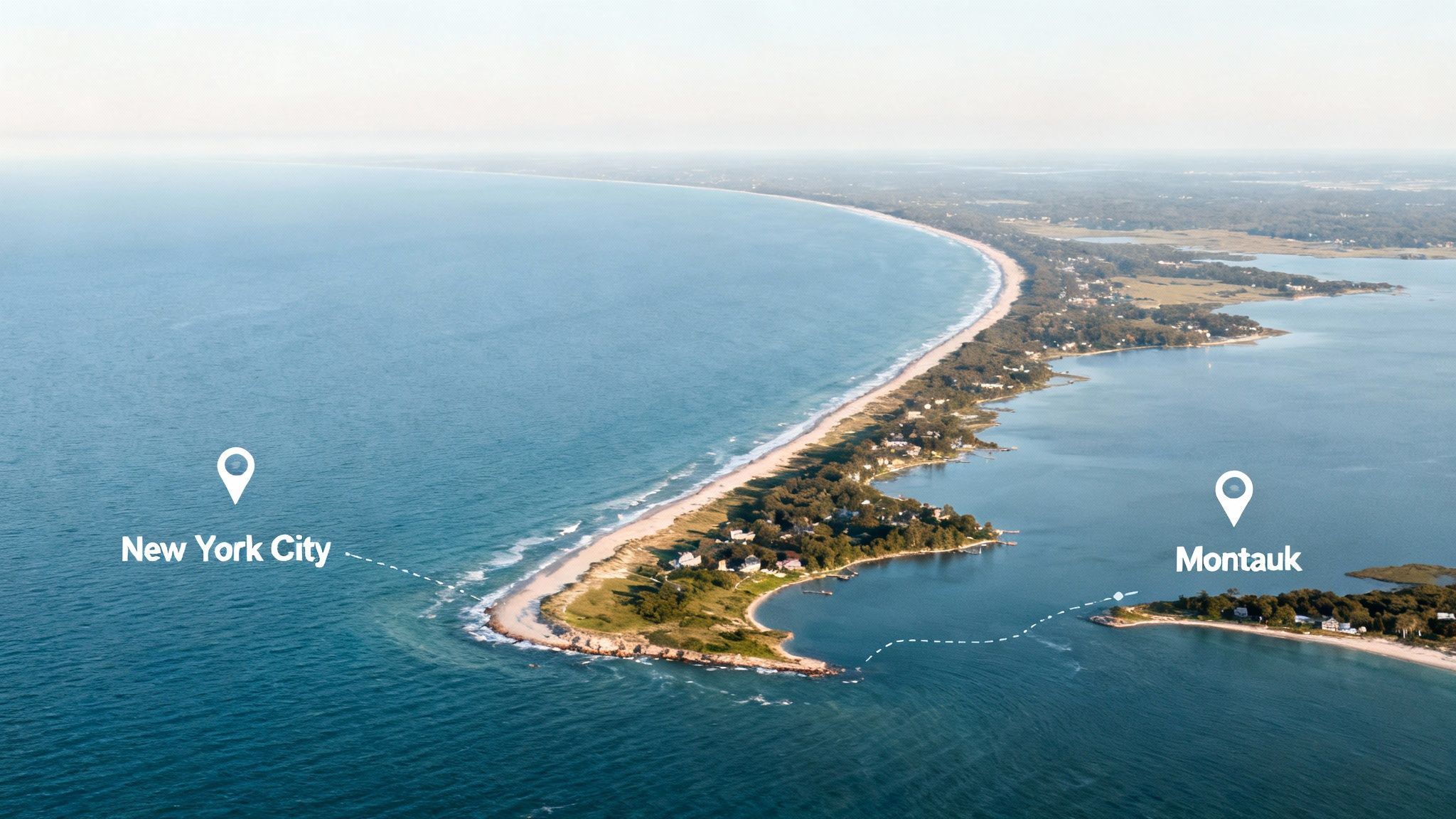
To accurately visualize the location of the Hamptons, consider the geography of Long Island. At its eastern end, the land splits into two peninsulas: the North Fork and the South Fork. The Hamptons are located across the majority of the South Fork, a desirable strip of land bordered by the Atlantic Ocean to the south and Peconic Bay to the north.
This geography is a key element of the area's appeal. It offers both dramatic, windswept oceanfronts and serene, protected bay waters within close proximity. The Hamptons are more than a location; they are a specific collection of villages and hamlets, each with a unique character.
Defining The Geographic Boundaries
Officially, the Hamptons are part of Suffolk County and are composed of two primary townships: the Town of Southampton and the Town of East Hampton. This entire region stretches for approximately 30 miles, beginning at Westhampton in the west and extending to Montauk Point, the easternmost tip of Long Island.
Depending on the specific destination, the drive from New York City is between 90 to 120 miles. It is close enough for a weekend trip, yet distant enough to feel like a distinct environment. Additional details on the Hamptons' layout can be found at Social Life Magazine.
The identity of the Hamptons is intrinsically linked to its geography. Its position on the South Fork peninsula creates a natural barrier, fostering a sense of separation from the mainland. This feeling of exclusivity has shaped its culture for generations.
This unique positioning has established the Hamptons as a celebrated sanctuary for artists, celebrities, and business leaders seeking a quiet refuge by the sea. Understanding this fundamental geography is the first step to appreciating the distinct communities within this famous enclave.
The Hamptons At A Glance
For a concise summary, the following table outlines the key geographical facts about the Hamptons.
| Attribute | Details |
|---|---|
| Location | The South Fork of Long Island, New York |
| Townships | Town of Southampton & Town of East Hampton |
| County | Suffolk County |
| Distance from NYC | Approximately 90-120 miles east |
| East-West Span | Roughly 30 miles (from Westhampton to Montauk) |
| Water Bodies | Atlantic Ocean (south) and Peconic Bay (north) |
This table provides a clear, at-a-glance picture of where the Hamptons are situated and how the region is structured. The combination of proximity to the city and coastal isolation defines the area.
Discovering The Two Townships That Define The Hamptons
To fully understand the Hamptons, it is essential to recognize a core concept: it is not a single town. It is a collection of smaller communities located within two larger municipalities: the Town of Southampton and the Town of East Hampton.
These townships serve as the administrative umbrellas for the famous villages and hamlets that give the region its legendary status. This structure shapes local laws, culture, and the distinct atmosphere one feels when traveling through the area.
The Town of Southampton forms the western anchor of the Hamptons, while the Town of East Hampton covers the area further east, extending to the tip of Montauk Point.
The Town of Southampton: A Historic Gateway
When traveling east from New York City, the Hamptons experience begins in the Town of Southampton. This area includes some of the most storied and classic destinations, such as the iconic Southampton Village, Westhampton Beach, Sag Harbor, and Bridgehampton.
The area is rich with history. English Puritans established a settlement here in 1640, making Southampton the first English settlement in what would become New York State. You can delve deeper into this history at Britannica. This centuries-old legacy contributes to the established, "old money" atmosphere, which is visible in the grand shingle-style estates and well-preserved main streets.
The Town of East Hampton: An Exclusive Enclave
Continuing east, one enters the Town of East Hampton. Settled in 1648, just eight years after its neighbor, it also possesses a significant history. Over the years, however, it has cultivated a reputation for being more chic and exclusive, with a distinctly artistic and bohemian spirit.
The town is a mosaic of sought-after communities, each with its own personality.
- East Hampton Village: The quintessential Hamptons experience, famous for its immaculate beaches, designer boutiques, and beautiful historic homes.
- Amagansett: A more rustic and laid-back community, with a low-key atmosphere that has long attracted artists, writers, and musicians.
- Montauk: Located at the easternmost point, this area is a world of its own—known for dramatic cliffs, a legendary surf scene, and the iconic Montauk Point Lighthouse.
Understanding this two-township structure is the key to making sense of the Hamptons. It explains why a short drive can transport you from the polished, social scene of Southampton Village to the wild, windswept coastline of Montauk. Each location is a unique piece of the same beautiful puzzle.
With this knowledge of the region's layout, one can begin planning a visit that aligns with their preferences. Whether drawn to the historic grandeur of Southampton or the trendy, windswept charm of East Hampton, understanding this basic geography is the first step.
Your Guide for Getting to The Hamptons
Knowing the location of the Hamptons is one part of the equation; traveling there from New York City is another. The journey itself can set the tone for the entire visit, and there are several viable options depending on whether one prioritizes speed, scenery, or convenience.
Driving is the most popular choice, offering the freedom to travel between villages and explore on a personal schedule. However, this freedom comes with a significant challenge: traffic.
The Classic Drive from NYC
Under optimal conditions with no traffic, the drive from Manhattan to the Hamptons takes approximately two to three hours. On a summer Friday, this travel time can easily extend to four, five, or even six hours.
The primary route is the Long Island Expressway (I-495), commonly known as the LIE. Motorists take this route east until it connects with Route 27, also known as Sunrise Highway, which runs directly through the Hamptons towns.
Effective timing is critical. To avoid the peak rush for a weekend trip, it is advisable to depart the city either very early on Friday (before 1 p.m.) or wait until later in the evening (after 9 p.m.). This is the single most effective strategy for avoiding significant delays.
A More Relaxed Journey
For those who wish to avoid traffic, there are two excellent, stress-free alternatives that have become institutions for New Yorkers traveling east.
-
The LIRR (Long Island Rail Road): This is the most straightforward public transit option. The train departs from Penn Station and is often faster than driving, particularly during peak weekend travel times. It serves all the key villages—Southampton, Bridgehampton, East Hampton, and Montauk—allowing for a relaxing journey.
-
The Hampton Jitney: This is more than a standard bus service; it is an experience. The Jitney is a local institution, offering a premium coach service with comfortable seating, Wi-Fi, and amenities. It has multiple pickup locations in Manhattan and provides drop-offs in the heart of the Hamptons, balancing affordability with comfort.
The choice between the LIRR and the Jitney is a matter of personal preference. The train is often the faster option when traffic is heavy, while many find the Jitney to be a more comfortable and civilized start to a vacation.
Arriving in Style: The Luxury Options
For those who prioritize speed and wish to bypass the journey on the ground, air travel is the ultimate option. A helicopter or seaplane charter is a premium mode of transport. Several companies offer flights from Manhattan, with travel times as short as 30 to 45 minutes.
This option completely avoids all ground traffic, and the trip itself provides an incredible experience with aerial views of the city skyline transitioning to the Long Island coastline. While it is a significant expense, it is an unparalleled method for a swift and grand arrival.
A Journey Through The Hamptons Villages
The Hamptons is not a monolithic destination; it is a collection of unique villages and hamlets, each with a distinct personality. The best way to experience the area is to travel from the historic, established towns in the west to the rugged, windswept cliffs at the island's eastern end.
This can be compared to exploring different neighborhoods in a major city. Each one has its own atmosphere—some are polished and historic, while others are artistic and surf-centric. Finding the right fit is the key to a perfect Hamptons trip.
Historic Grandeur: Southampton and Sag Harbor
Traveling east from the city, the journey begins in the western Hamptons, where history and high society are deeply intertwined. Southampton Village is what many people envision when they think of "The Hamptons." It features large estates, the renowned Coopers Beach, and a variety of upscale boutiques along Jobs Lane. The village exudes an air of established elegance and classic glamour.
Nearby, Sag Harbor offers a different atmosphere. Once a major whaling port, its maritime history is evident in the beautifully preserved 19th-century buildings and the numerous masts in the marina. Sag Harbor is more low-key and artistic, with a charming, walkable village center filled with independent shops and cozy restaurants.
Chic and Cultured: Bridgehampton and East Hampton
Continuing east, the landscape blends rustic farmland with a more refined, cultural feel. Bridgehampton is where bucolic charm meets modern sophistication. It is famous for its sprawling horse farms and the prestigious Hampton Classic Horse Show, but it is also a destination for oenophiles, thanks to world-class vineyards like Wölffer Estate.
Next is East Hampton, a hub of chic coastal living. Known for its immaculate Main Beach and a lineup of designer shops, it has long been a haven for artists and writers. The village feels polished yet relaxed, with beautiful tree-lined streets, top-tier art galleries, and a deep sense of cultural history that attracts those seeking both style and substance.
Regardless of the village chosen, the journey is part of the experience.
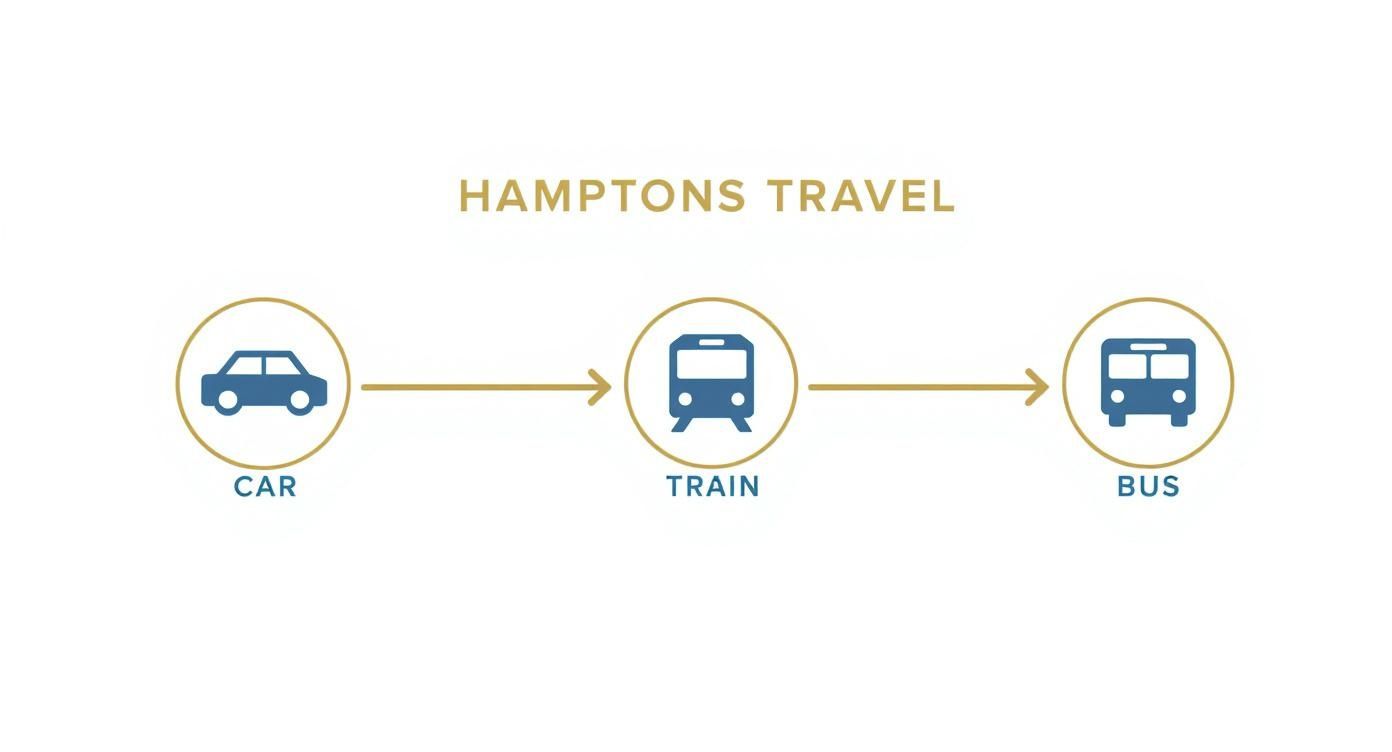
As illustrated, whether traveling by car, train, or bus, all major villages are well-connected, making it easy to explore the unique character of each one.
Laid-Back Shores: Amagansett and Montauk
The final stretch of the journey leads to the far eastern end of the island, where the atmosphere becomes progressively more casual and rugged. Amagansett is the definition of understated cool. It is a quiet village with a bohemian spirit, known for its authentic farm stands like Amber Waves Farm and a rustic, laid-back beach scene that feels far removed from the energy of Southampton.
Finally, the journey concludes in Montauk, nicknamed "The End." Here, the manicured Hamptons aesthetic gives way to a wilder, more dramatic coastal landscape.
Montauk’s identity is defined by its dramatic cliffs, the legendary surf at Ditch Plains, and the iconic Montauk Point Lighthouse. It represents the adventurous, free-spirited soul of the Hamptons, attracting surfers, fishermen, and anyone seeking a connection with the raw power of the Atlantic.
This west-to-east journey is the best way to understand the essence of the Hamptons. It is not a single point on a map, but a collection of diverse experiences, from the old-world elegance of Southampton to the untamed beauty of Montauk.
Comparing Hamptons Villages: A Quick Guide
To assist in deciding which village is the right home base for a trip, the following table breaks down the atmosphere and highlights of the most popular spots.
| Village | Vibe/Atmosphere | Known For | Best For |
|---|---|---|---|
| Southampton | Classic, high-society, polished | Grand estates, Coopers Beach, upscale shopping | Luxury seekers, beach connoisseurs, and people-watching |
| Sag Harbor | Historic, charming, artistic | Whaling history, a walkable village, marina life | History buffs, boaters, and those seeking a quaint, relaxed vibe |
| Bridgehampton | Rustic yet sophisticated, equestrian | Horse farms, wineries, the Hampton Classic | Equestrian lovers, wine enthusiasts, and families |
| East Hampton | Chic, cultural, refined | Designer boutiques, art galleries, Main Beach | Art and culture lovers, luxury shoppers, style-conscious travelers |
| Amagansett | Laid-back, bohemian, understated cool | Farm stands, quiet beaches, surf culture | Those seeking a relaxed, authentic beach town feel |
| Montauk | Rugged, adventurous, surf-centric | Surfing, fishing, Montauk Point Lighthouse | Surfers, adventurers, and anyone wanting to escape the "scene" |
Ultimately, the "best" Hamptons village is subjective. Whether one is looking for the glamour of Southampton or the raw nature of Montauk, there is a corner of the South Fork that will meet their preferences.
Understanding The Hamptons Lifestyle
To fully answer "where is the Hamptons," one must look beyond its geographical coordinates. The location is defined as much by its unique culture as by its physical setting. It is a place of contrasts, highlighted by the dramatic shift between its two main seasons.

From Memorial Day to Labor Day, the Hamptons transform into a high-energy summer destination. The population increases dramatically, roads become congested, and the social calendar is filled with exclusive parties, charity galas, and art openings. This is the vibrant, sun-soaked scene often depicted in media, where New York City’s elite gather.
The Social Fabric: Old Meets New
The social landscape is a fascinating mix of tradition and trend. On one side are the established, "old money" families who have summered in the area for generations, valuing privacy and tradition. On the other side, a continuous influx of celebrities, Wall Street executives, and artists brings a more contemporary and visible glamour to the scene.
This interplay creates a social rhythm unique to the region.
- Historic Families: They represent a quieter, more understated luxury, centered on private clubs, generational estates, and a low-key social circuit.
- Modern Glamour: This is the high-profile side, defined by media-covered events, celebrity sightings at popular establishments like Nick & Toni's, and a very visible social presence.
- Local Community: It is important to acknowledge the year-round residents—the farmers, shop owners, and tradespeople who form the backbone of daily life on the East End.
This blend of influences gives the Hamptons its soul. It is a place where one can spend a quiet morning at a local farm stand and later observe A-list celebrities on Main Beach in East Hampton on the same day.
From Summer Buzz To Off-Season Calm
After Labor Day weekend, the atmosphere shifts entirely. The crowds dissipate, the traffic vanishes, and a profound sense of calm settles over the villages. The Hamptons in the off-season reveals a completely different, more intimate personality.
During this time, the focus returns to the stunning natural beauty and the close-knit local community. The pace of life slows considerably. It becomes a time for long, quiet walks on the beach, cozy dinners, and enjoying the serene coastal landscape without the summer crowds.
For many locals and knowledgeable visitors, this quiet season is when the true character of the Hamptons is most apparent. It is a peaceful refuge that feels worlds away from the electric energy of July and August. Understanding this seasonal duality is key to a complete appreciation of the Hamptons.
Common Questions About The Hamptons
Even with a comprehensive understanding of the area, a few practical questions often arise when planning a trip. The following section addresses some of the most common inquiries from first-time visitors to Long Island's famous South Fork.
Clarifying these details is the final step toward ensuring a smooth and enjoyable visit.
What Is The Best Time Of Year To Visit The Hamptons?
The classic Hamptons season, known for its social scene, runs from June through August. During this period, visitors will find ideal beach weather, bustling restaurants, and a social calendar full of events. July and August represent the absolute peak, offering the most energy but also the largest crowds and highest prices.
However, many locals and repeat visitors consider the "shoulder seasons" to be the optimal time to visit. Late spring in May and early fall through September are particularly pleasant. These months offer beautiful weather, far fewer people, and more competitive pricing, all while the area's natural beauty is at its best.
Do I Need A Car To Get Around?
While it is easy to get to the Hamptons by train or bus, a car is highly recommended for getting around. The villages are spread out, and many of the best beaches, farm stands, and attractions are not easily accessible on foot. A car provides the freedom to explore everything at one's own pace.
If the plan is to remain primarily in a single, walkable village like East Hampton or Sag Harbor, it may be possible to rely on ride-sharing apps and local taxis for short trips. For any significant exploration, however, a car is nearly essential.
The key distinction to remember is this: traveling to the Hamptons without a car is straightforward. Navigating around the Hamptons without one presents a considerable challenge. Plan accordingly based on your intended itinerary.
Why Are The Hamptons So Famous?
The reputation of the Hamptons has been built over more than a century through a unique combination of factors.
- Proximity to NYC: First and foremost, it is a stunning coastal escape just a few hours from one of the world's most dynamic cities. This made it a natural retreat for New York's wealthy and influential residents.
- Natural Beauty: The region is exceptionally beautiful, with some of the most pristine beaches in the country set against a backdrop of charming historic villages and tranquil farmland.
- An Artistic Soul: For generations, it was a haven for artists like Jackson Pollock and Willem de Kooning. They were drawn by the unique light and serene landscape, which endowed the area with a deep cultural credibility that transcends wealth alone.
- An Aura of Exclusivity: Over time, the Hamptons became synonymous with luxury, sprawling estates, and a high-profile social scene. It attracted celebrities, financiers, and trendsetters, cementing its iconic status in popular culture.
It is this blend of raw nature and sophisticated culture that has created a powerful mystique, continuing to draw people from all over the world.
So, Are The Hamptons Just One Town?
To clarify a common misconception: no, the Hamptons are not a single town. This is perhaps the most significant point of confusion for those unfamiliar with the area.
The Hamptons are a collection of distinct villages and hamlets, all located within two larger townships (the Town of Southampton and the Town of East Hampton). Each one possesses its own personality, history, and atmosphere—from the classic, old-money elegance of Southampton village to the laid-back, surf-centric feel of Montauk.
Considering it a single town is akin to describing Manhattan as one neighborhood; it would completely overlook the incredible diversity that makes the region so special.
For an insider's look into the culture, events, and luxury lifestyle that define this iconic region, explore Social Life Magazine. Discover exclusive features and guides that bring the Hamptons to life at https://www.sociallifemagazine.com.
Author

Written by
Recent Posts
Sectional Sofa vs. Regular Sofa: Which One is Best for You?

Sober and Injured: How to Manage Pain Treatment After a Massachusetts Slip and Fall
Flexible Liquidity Options Are Reshaping How Modern Professionals Handle Unexpected Expenses
5 Best At-Home Teeth Whitening Kits for a Brighter Smile in 2026

From Spa Retreats to Aesthetic Care, the Luxury Travel Itinerary Is Changing
Categories
- Art
- Articles
- Business of Luxury
- Celebrities
- Culture
- Entertainment
- Events
- Faces of Summer 2026
- Fashion
- Fashion & Style
- Featured
- Finance
- Food, Spirits, Wine
- Hamptons
- Hamptons Celebrities
- Health
- Health & Beauty
- Lifestyle
- Luxury Lifestyle
- Press
- Profiles
- Real Estate
- Technology
- The Chronicles
- Travel
- Uncategorized
- Weddings