
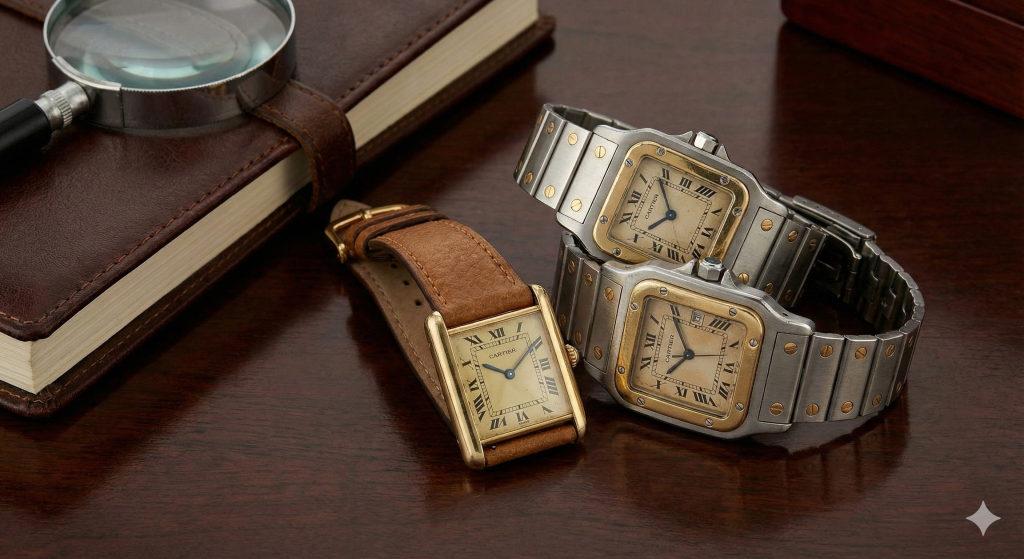
The Southampton estate sale started at 10 a.m. on a Tuesday in September. By 10:47, a vintage Cartier watch in its original burgundy box had sold for four times the estimate. The buyer wasn’t a celebrity or a hedge fund manager with more money than sense. He was a second-generation dealer from the city who noticed what everyone else missed: the engraving on the caseback matched a documented 1962 production run, and the crown still held its original sapphire cabochon.
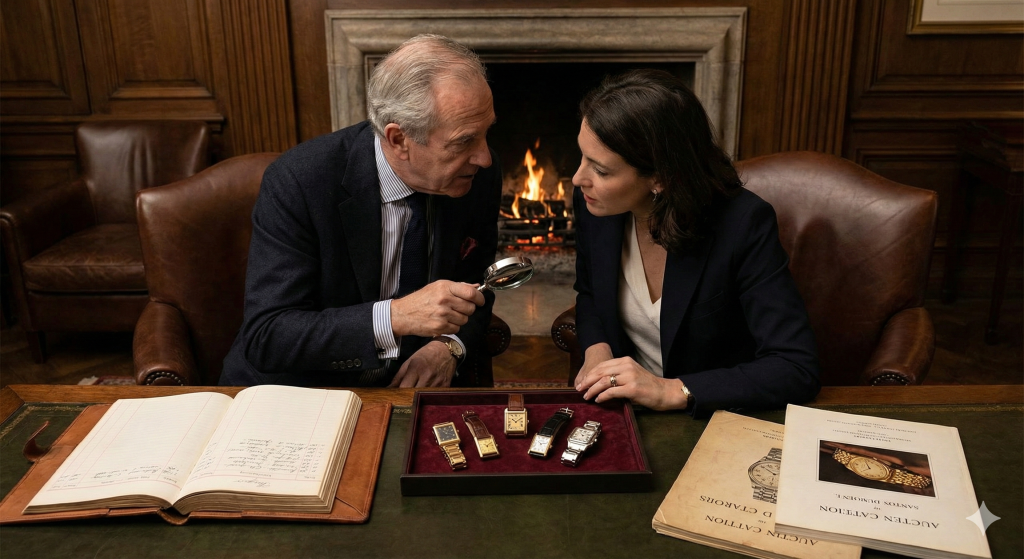
Most people think they understand the vintage watch market. They don’t. Consequently, they overpay for pieces that will never appreciate and ignore the references that quietly triple in value. The vintage Cartier watch market operates on information asymmetry, and dealers prefer it that way.
Here’s the first thing they won’t tell you: not all Cartier watches are investments. According to Bain & Company’s latest luxury report, the secondhand luxury goods market grew to €48 billion in 2024, with hard luxury comprising 80-85% of total sales. However, growth was particularly strong in jewelry while watches saw a slowdown. This means selectivity matters more than ever.
The pieces that appreciate share three characteristics. They possess historical significance, production scarcity, and what collectors call “wearable provenance”—a story that enhances rather than complicates ownership. Additionally, vintage Cartier watches have appreciated at an average rate of 6-10% per year over the past decade, depending on model, material, and provenance.
Price Stratification: What Separates $2,000 from $200,000
A vintage Tank Must from the 1970s might cost you $2,000. Meanwhile, Jackie Kennedy’s personal Tank sold at Christie’s for $379,500. The difference isn’t just celebrity provenance. It’s understanding where value actually lives in the market.
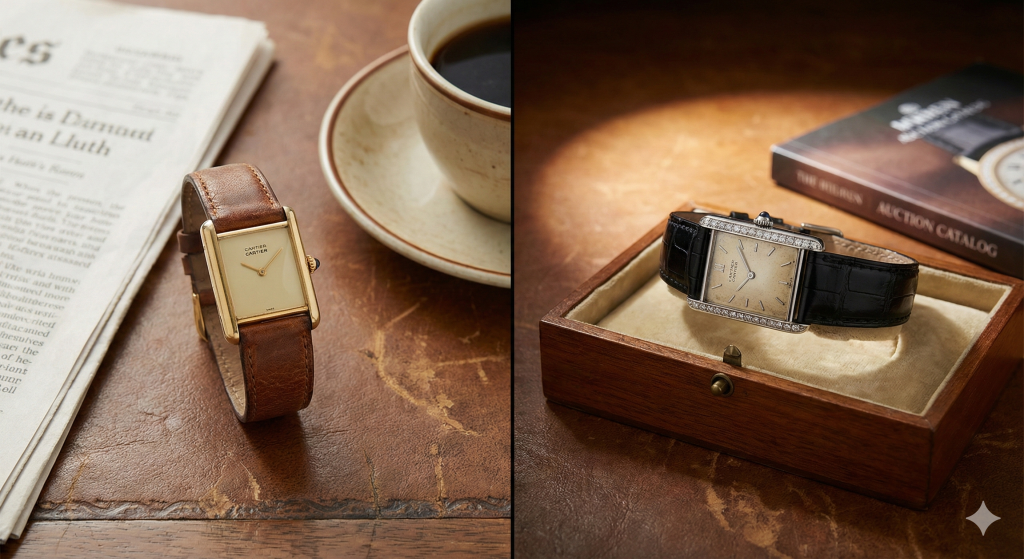
Entry-level vintage Cartier watches—quartz models from the 1980s, steel pieces without documentation—retain value but rarely appreciate significantly. Nevertheless, they serve as gateway pieces for new collectors learning the market. The Tank Must ref. WSTA0072 retails for $3,450 new and trades secondhand for approximately $3,090, representing only a 10% loss.
Investment-grade pieces occupy a different universe entirely. A 1970s Tank Louis in 18k gold, originally sold for under $2,000, now commands $10,000-$20,000 depending on condition and originality. Moreover, certain Tank Cintrée models from the 1920s have fetched over $100,000 at auction, with one 1931 platinum example selling at Phillips for $448,346.
What Hamptons Collectors Know About Cartier
Walk into Glenn Bradford Fine Jewelry on Jobs Lane in Southampton, and you’ll notice something immediately. The vintage Cartier watches in the case aren’t the models you see on Instagram. Glenn Bradford, who has spent decades curating rare timepieces, understands what Hamptons collectors actually want: pieces with stories that can be verified and value that can be documented.
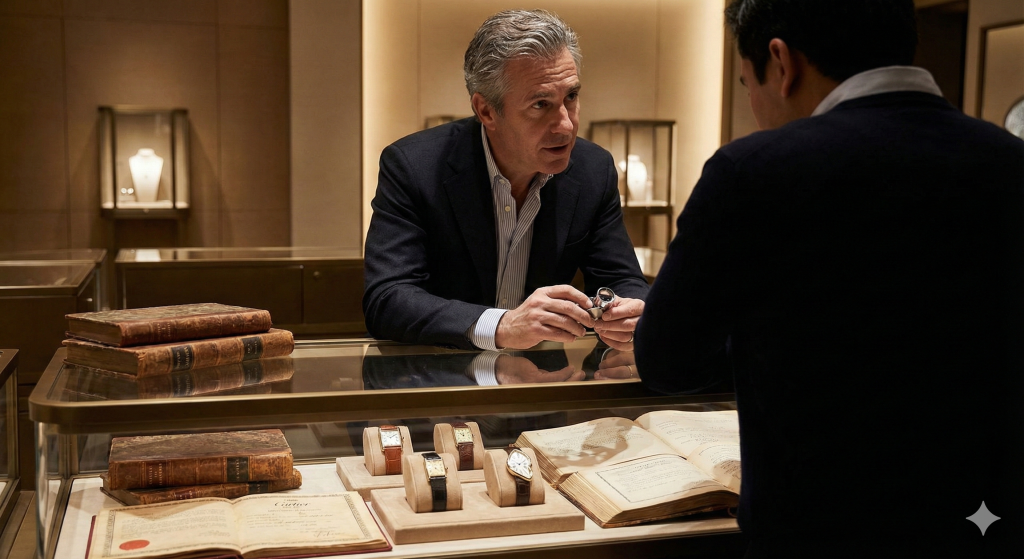
“The Hamptons client isn’t buying a watch,” one East End dealer explained. “They’re buying membership in a club where everyone recognizes the reference number.” Subsequently, local preferences skew toward the Tank over the Santos, mechanical movements over quartz, and 18k gold over steel. These aren’t arbitrary preferences—they reflect an understanding of how wealth signals itself without speaking.
The Tank vs. Santos Debate
The Tank remains the blue-chip investment in Cartier collecting. Its 1917 design, inspired by Renault FT-17 tanks on the Western Front, has never gone out of production and never lost its cultural relevance. Princess Diana wore one. Andy Warhol famously claimed he never wound his—he wore it “because it is the watch to wear.”
The Santos, introduced in 1904 as the world’s first purpose-built men’s wristwatch, offers different appeal. Created for aviator Alberto Santos-Dumont, it features exposed screws and a square case that introduced a new language of watch design. Santos models have been auctioned approximately 3,056 times historically, with the highest example fetching $218,407 in 2011.
For Hamptons collectors, the choice often depends on context. The Tank suits board meetings and benefit galas. The Santos works at Polo Hamptons and casual dinners at Nick & Toni’s. Smart collectors own both.
Authentication Red Flags Every Buyer Must Know
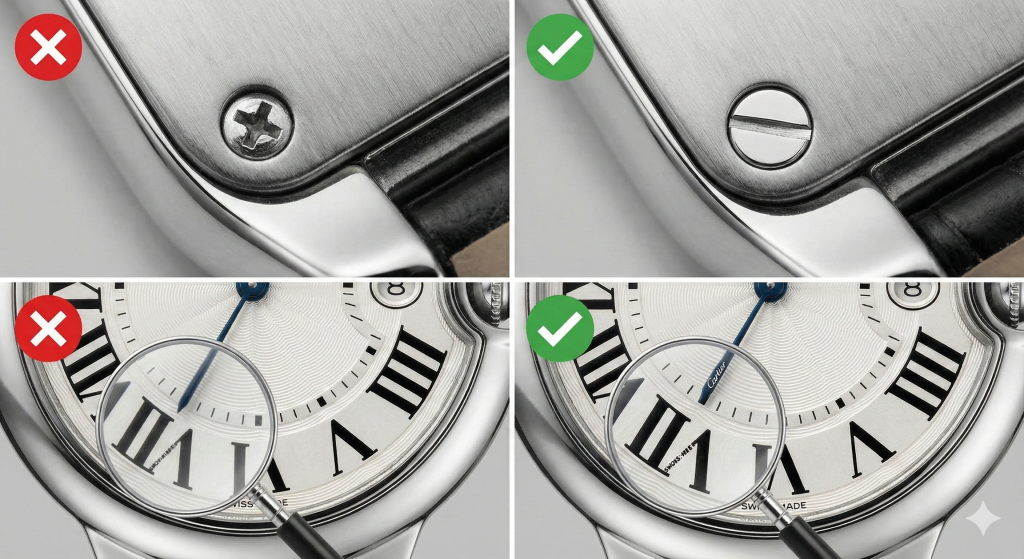
The counterfeit market for Cartier watches has grown more sophisticated, but fakes still reveal themselves to educated eyes. Before you spend a dollar on any vintage Cartier watch, commit these tells to memory.
The Screw Test
Cartier never uses Phillips-head or X-shaped screws. Ever. Genuine Cartier watches feature flathead screws that are perfectly aligned and uniformly tightened. Furthermore, the screws hold the case together—front and back—rather than snapping in place. If you see cross-shaped screws, walk away immediately.
The Secret Signature
Most genuine Cartier dials contain a hidden signature—the brand’s name spelled out in microscopic text at the 7 or 10 o’clock position. This signature appears as a thin line to the naked eye but reveals itself under magnification. Counterfeiters frequently miss this detail. Additionally, authentic dials display “Swiss Made,” “Swiss,” or “Paris” below the 6 o’clock marker.
The Cabochon Check
The blue sapphire cabochon on the crown is a hallmark of Cartier design. Authentic pieces feature a genuine sapphire that’s been expertly set, not glued. Consequently, examine the cabochon for proper color, quality, and setting. Counterfeit versions often use inferior materials or display sloppy finishing.
Serial Number Verification
Every genuine Cartier watch has a unique serial number engraved—not etched—on the caseback. The number consists of 8 characters: 6 numbers and 2 letters. Modern pieces also include a 4-digit case reference number. Since there’s no public database for verification, you’ll need to take the piece to a Cartier service department or reputable dealer for authentication.
The Weight Test
Cartier constructs watches from high-quality materials: premium steel, 18k gold, platinum, and sapphire crystal. Authentic pieces feel substantial on the wrist. If a supposed gold Cartier feels lightweight, trust your instincts. Real luxury carries weight—literally.
Where to Source Vintage Cartier Watches in the Hamptons
The East End offers several trusted sources for vintage Cartier watches. Each serves different collector profiles and price points.
London Jewelers — East Hampton
London Jewelers at 2 Main Street represents the establishment option. Their collection includes Cartier alongside other prestige brands, with authentication guaranteed and service records documented. Mark Udell’s family has served the Hamptons watch market since the 1970s, building a reputation that eliminates risk for buyers who prioritize certainty over bargain-hunting. Their new standalone Rolex boutique on Newton Lane has already attracted collectors including Mark Wahlberg and John Mayer.
Glenn Bradford Fine Jewelry — Southampton
For collectors who appreciate dealer expertise as much as the timepieces themselves, Glenn Bradford’s Jobs Lane shop offers a more curated experience. Glenn is world-renowned as a vintage Rolex and Patek Philippe expert, and his passion extends to vintage Cartier. The shop provides personalized service, expert advice on overhauls, and access to pieces that never reach the broader market.
Southampton Jewelry Exchange
Southampton Jewelry Exchange serves collectors seeking repair and authentication services alongside purchases. Their watchmakers work on every make, from Rolex to Timex, with a one-year limited warranty on all watches sold.
Estate Sales and Local Auctions
The deepest value often emerges from estate sales, where pieces with Hamptons provenance surface without the premium of established dealers. Nevertheless, these opportunities require expertise to navigate. Attend previews, examine pieces personally, and never bid on authentication faith alone.
The Investment Case for Vintage Cartier
The numbers support what seasoned collectors already know. Tank Louis models in 18k gold have appreciated 25-40% over the past five years. Stainless steel Santos models have seen value gains of 10-20% depending on reference and condition. Furthermore, select vintage pieces have doubled in value over the past decade.
The most dramatic returns come from the rarest references. A London-made 1990s Cartier Crash sold in 2022 for over $225,000. Original 1967 Crash models have fetched more than $1 million at auction. Meanwhile, even the relatively accessible Tank Américaine—originally priced around $5,000 in 1989—now trades for $10,000-$50,000 depending on configuration.
What’s Climbing Now
Current market momentum favors several categories. Vintage pieces from the 1970s-1990s, particularly in precious metals, are gaining collector attention. Limited editions and discontinued references create scarcity premiums. Additionally, pieces with original documentation—box, papers, and service records—command 20-30% premiums over watches sold alone.
The Panthère, originally popular in the 1990s, has experienced a remarkable renaissance. Vintage examples now command significant premiums, with gold versions exceeding $20,000 and rare limited editions reaching $30,000 or more on the secondary market.
Storage, Insurance, and Care
Investment-grade vintage Cartier watches require proper stewardship. Store pieces in climate-controlled environments away from magnetic fields. Service mechanical movements every 5-7 years through Cartier or authorized specialists—but preserve original components whenever possible. Dial refinishing and case polishing destroy value; patina proves authenticity.
Insurance through specialists like Hodinkee Insurance or Jewelers Mutual provides coverage tailored to collectible timepieces. Document everything: purchase receipts, authentication papers, service records, and dated photographs. This paper trail becomes part of the watch’s value proposition when it’s time to sell.
The Cultural Capital of Cartier
Beyond financial returns, vintage Cartier watches signal something that new luxury cannot replicate: informed taste developed over time. When Jackie Kennedy wore her Tank, she communicated an understanding of design history and personal restraint that aligned with her broader aesthetic philosophy. Andy Warhol’s admission that he never wound his Tank wasn’t carelessness—it was a statement that the object’s meaning transcended its function.

In the Hamptons, where status symbols have shifted toward experiences and expertise over conspicuous consumption, a vintage Cartier watch says something specific. It says you’ve studied the market rather than simply entered it. It says you understand that true luxury appreciates rather than depreciates. Subsequently, it signals membership in a community of collectors who recognize what they’re looking at.
That Southampton estate sale buyer didn’t get lucky. He got educated. The eleven seconds it took him to make the decision represented years of study, thousands of pieces examined, and a refined understanding of where value actually lives in the vintage watch market.
Now you have the same information. What you do with it determines whether you’re a collector or simply a customer.
Related Reading
- Vintage Rolex Watches – A Quiet Investment for Hamptons Collectors
- Polo Hamptons in Bridgehampton: The Luxury Networking Guide
Stay Connected with Social Life Magazine
Author

Written by
Recent Posts

Unlocking the Berkshires

Dalia Forman Design
Alberto Luzzi
How to Pick a Homecoming Dress for Your Body Type and Feel Amazing in It
How to Prepare a Home for Sale When Major Repairs Are Not Affordable
Categories
- Art
- Articles
- Business of Luxury
- Celebrities
- Culture
- Entertainment
- Events
- Faces of Summer 2026
- Fashion
- Fashion & Style
- Featured
- Finance
- Food, Spirits, Wine
- Hamptons
- Hamptons Celebrities
- Health
- Health & Beauty
- Lifestyle
- Luxury Lifestyle
- Press
- Profiles
- Real Estate
- Technology
- The Chronicles
- Travel
- Uncategorized
- Weddings