
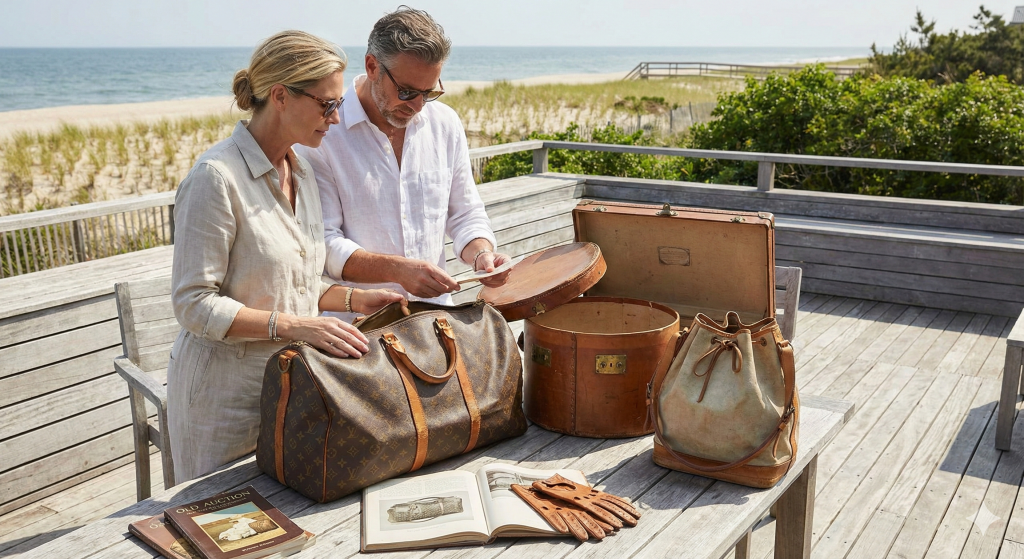
The monogrammed Neverfull dangling from every arm at the Southampton farmers market tells you nothing. However, the woman with the stenciled steamer trunk repurposed as a foyer console? She inherited money before Instagram existed.
Understanding this hierarchy separates collectors from customers. Moreover, in the secondary market for vintage luxury handbags, that knowledge gap represents serious money left on the table—or paid unnecessarily to dealers who recognize tourists from locals.
The Hidden Market for Vintage Louis Vuitton Bags
Louis Vuitton holds a unique position among quiet luxury brands. Notably, academic investment research confirms the brand’s bags retain approximately 85 to 92 percent of retail value on average—far exceeding most luxury competitors. Furthermore, the Neverfull alone shows consistent appreciation averaging seven percent annually, with some periods delivering exceptional growth.
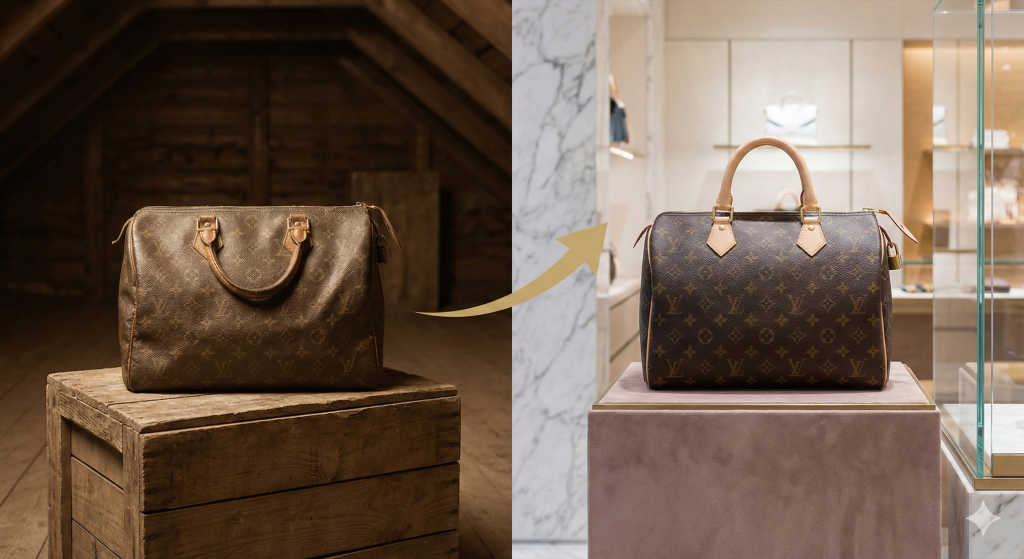
Yet those statistics obscure a crucial reality. Simply put, not all vintage Louis Vuitton bags appreciate equally. The pieces flooding consignment shops differ fundamentally from what serious collectors pursue. As a result, entry-level bags like the Speedy and Pochette Accessoires dominate the secondary market precisely because everyone bought them. In contrast, investment-grade vintage requires different criteria entirely.
Consider the spread. A pre-owned Neverfull MM in monogram canvas trades between $1,395 and $1,800 on authenticated platforms. Meanwhile, a 1920s steamer trunk with original stenciled canvas and brass hardware commands $15,000 to $100,000 depending on size and provenance. Essentially, the trunk appreciates while the tote circulates.
This bifurcation explains why Hamptons estates yield such different discoveries than Manhattan consignment shops. Specifically, the families who summer here didn’t buy bags—they commissioned luggage for transatlantic crossings before commercial aviation existed.
What Hamptons Collectors Know About Louis Vuitton
Walk into Collette Consignment in Southampton and observe what moves versus what sits. Typically, the monogram canvas bags turn over weekly—functional, recognizable, easily priced. However, the vintage designer bags with unusual provenance require patience and the right buyer.
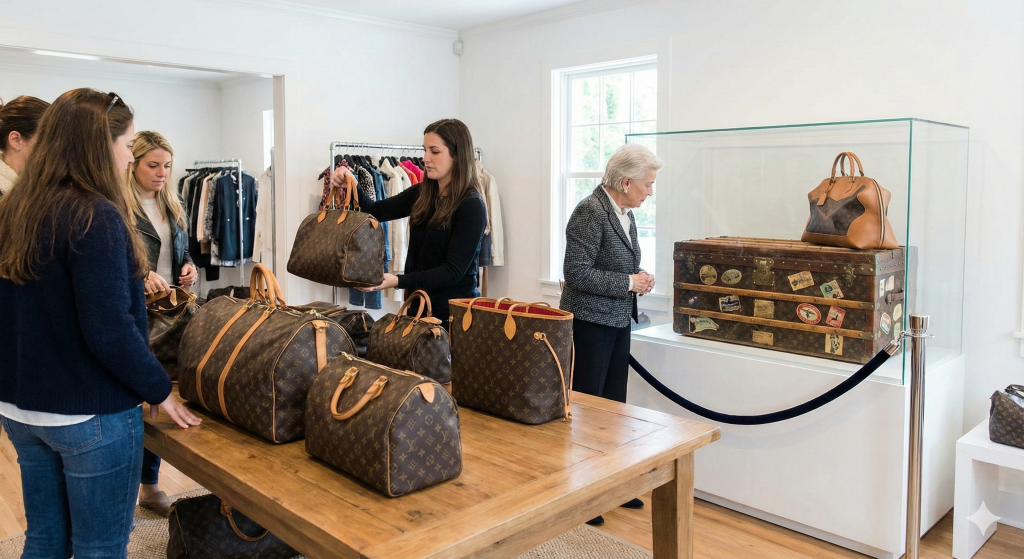
Local collectors favor three categories that casual shoppers overlook entirely. First, pre-1959 travel pieces—the era before Louis Vuitton introduced the modern canvas we recognize today. Notably, early trunks featured hand-stenciled monograms rather than printed patterns. This subtle distinction therefore separates decorative purchases from actual antiques.
Second, discontinued leather lines carry premiums that monogram canvas never achieves. For example, Epi leather debuted in 1985 as Louis Vuitton’s first permanent leather collection. Consequently, vintage Epi pieces in discontinued colors—the deep green, the vibrant yellow—fetch far more than their retail prices suggested possible.
Third, artist collaborations from before collaborations became marketing stunts. Specifically, the Takashi Murakami partnership launched in 2003 and defined an entire fashion decade. When the collaboration ended in 2015, resale values subsequently exploded. In particular, a Monogramouflage Speedy 35 that retailed around $1,500 in 2008 now commands over $9,000. That’s the kind of appreciation stock portfolios envy.
The Hamptons preference generally skews older and rarer. Wardrobe trunks designed for ocean liner travel—complete with hanging space, drawers, and hat compartments—serve as conversation pieces in estate foyers and pool houses. Importantly, they weren’t purchased as investments. Instead, they survived as heirlooms.
Authentication Red Flags Every Buyer Must Know
Louis Vuitton remains the most counterfeited luxury brand on earth. In fact, some estimates suggest ninety percent of bags sold through unvetted channels are fake. As a result, the sophistication of modern counterfeits means even experienced collectors get fooled without systematic verification.
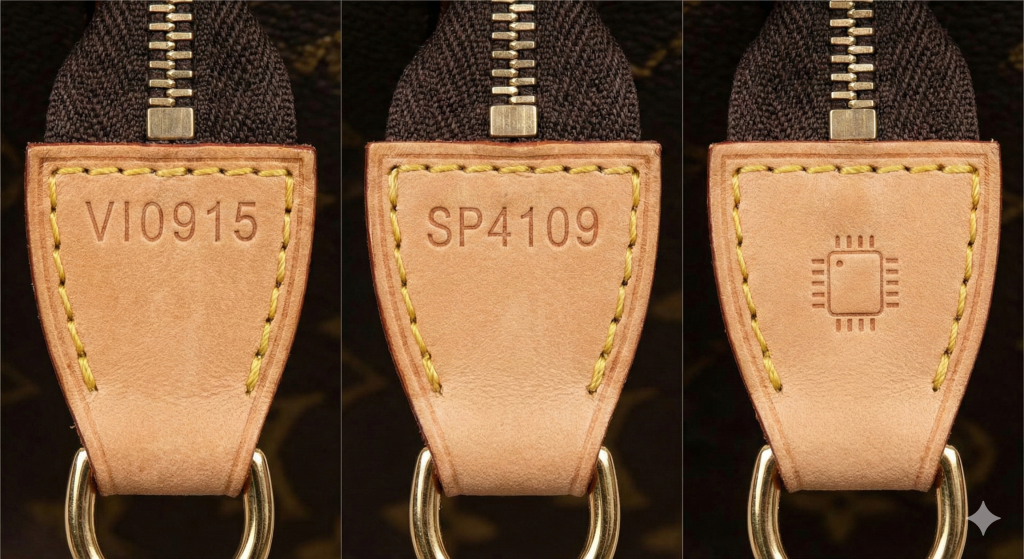
First, start with the date code. Since the early 1980s, Louis Vuitton has embedded codes indicating production location and date. Before 2007, the format showed factory letters followed by numbers representing month and year. However, after 2007, the system shifted to week-based production dating. Then in 2021, Louis Vuitton began replacing physical date codes with microchips readable only by store associates.
The critical rule: date code letters must match the “Made in” stamp. For example, if your bag claims French production but the code indicates Spain, you’re holding a counterfeit. Specifically, France uses codes like VI, FL, and SP. Meanwhile, Spain uses CA, LO, and LB. Similarly, Italy uses CE, FO, and MA. Therefore, mismatches are immediate disqualifiers.
Physical Tells That Expose Counterfeits
Next, examine the stitching with fresh eyes. Authentic Louis Vuitton uses mustard-yellow thread coated in resin for durability. In contrast, counterfeits favor bright synthetic yellow or orange. Additionally, count the stitches at handle attachments—genuine bags maintain consistent counts, typically five stitches across specific connection points.
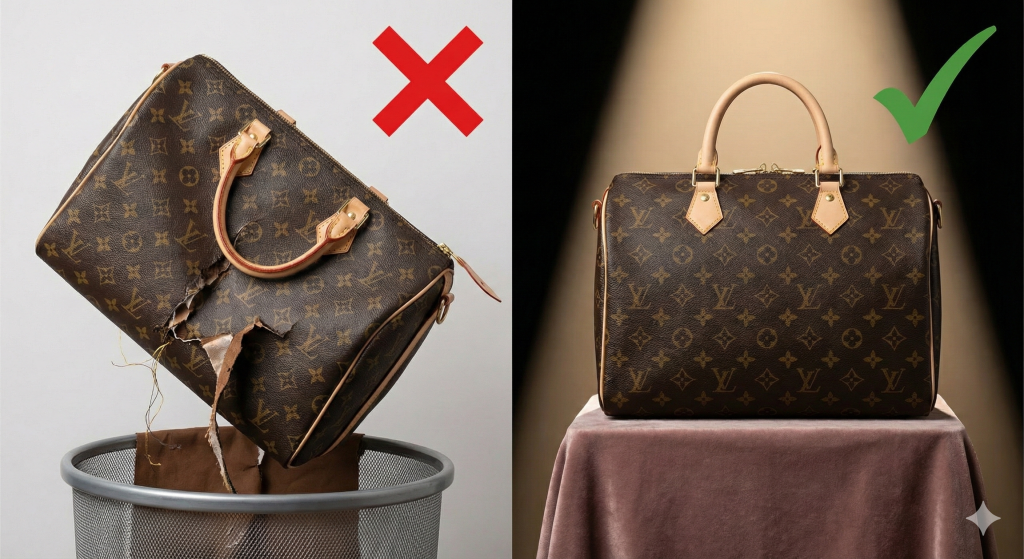
Furthermore, the vachetta leather trim tells a story counterfeits cannot fake. Untreated cowhide naturally oxidizes from pale cream to rich honey-brown patina over years of handling and sun exposure. Consequently, if a supposedly vintage bag shows brand-new pale handles, either the leather was replaced or the entire bag is suspect. Conversely, uneven darkening or splotchy staining indicates water damage that permanently devalues authentic pieces.
Finally, hardware reveals manufacturing quality instantly. Genuine Louis Vuitton uses solid brass with deep, crisp engravings. Moreover, feel the weight—authentic hardware is substantial. On the other hand, counterfeit bags substitute lightweight metals with shallow stamping that wears quickly. Zippers should glide without catching. Indeed, every metallic component should display the Louis Vuitton name in precisely rendered typography.
One final note: Louis Vuitton never includes authenticity cards with purchases. Therefore, if a seller presents a card as proof, they’re either ignorant or deceptive. Neither inspires confidence.
Where to Source Vintage Louis Vuitton Bags in the Hamptons
The local consignment scene has matured considerably over two decades. Collette Consignment operates multiple locations—most notably, the flagship at 1 Hampton Road in Southampton occupies the historic former town hall building with luxury fashion upstairs and furnishings below. Additionally, their Bridgehampton location on Montauk Highway specializes in home goods, including the occasional vintage trunk from estate cleanouts.
Meanwhile, The Retreat Boutique Thrift Store in Bridgehampton occasionally surfaces exceptional finds. Every so often, vintage Chanel, Dior, or Louis Vuitton emerges from estate donations. Although the best-sellers remain cashmere sweaters, patient hunters score pieces far below market value. Moreover, proceeds benefit domestic violence services—virtue and value combined.
For serious vintage luxury handbags, Lynn Stoller Collection in Westhampton Beach maintains curated inventory of authenticated designer pieces. Specifically, the shop focuses on bags, shoes, and accessories from established houses, with Louis Vuitton representing consistent demand.
Estate Sales and Authenticated Platforms
Estate sales yield the deepest value but consequently require expertise. Families liquidating Hamptons properties often underestimate what their grandmother’s travel trunk commands at auction. As a result, arriving early, cash ready, with authentication knowledge transforms weekend browsing into strategic acquisition.
Alternatively, authenticated resale platforms offer broader selection with buyer protections. TheRealReal employs expert authenticators and therefore offers returns for authenticity concerns. Similarly, Rebag provides an online tool estimating bag values before purchase, thus creating market transparency. Likewise, Fashionphile maintains rigorous verification with detailed condition grading.
The trade-off is clear: local sources offer discovery and negotiation opportunities while platforms provide authentication infrastructure and return policies. Ultimately, sophisticated collectors use both depending on the specific piece and their comfort with risk.
The Investment Case for Vintage Louis Vuitton
Louis Vuitton raises prices with remarkable consistency. For instance, in 2025 alone, the Speedy lineup increased $80 to $90 per bag, roughly five percent. Similarly, the Neverfull climbed $100 across all sizes. Most dramatically, some Epi leather styles jumped over twenty percent in a single year. These retail increases directly support resale appreciation—essentially, buying pre-owned at today’s prices means acquiring tomorrow’s relative bargains.
The Bain & Company luxury report valued the secondhand luxury market at approximately €48 billion, with hard luxury goods representing 80 to 85 percent of sales. Furthermore, demand continues accelerating as younger consumers embrace authenticated resale as both financially smart and environmentally conscious.
Specific pieces demonstrate exceptional performance. For example, vintage Murakami collaboration bags, particularly the multicolor Speedy variations Kim Kardashian bulk-purchased in Japan for $1,100 each in 2018, now trade between $1,495 and $4,370 depending on condition. Moreover, the 2025 Murakami re-edition—with new Speedy 30 retailing at $4,300—only elevated vintage originals further.
Trunks, however, occupy a different investment category entirely. Currently, a special-order wardrobe steamer trunk on 1stDibs lists at $120,000. Even more modest examples—1970s Alzer suitcases, for instance—command $4,750 to $5,200. These aren’t bags that depreciate with fashion cycles. Rather, they’re furniture pieces that anchor rooms and appreciate across generations.
Storage and care matter significantly for protecting value. First, keep vintage Louis Vuitton bags stuffed with acid-free tissue to maintain shape. Additionally, store away from direct sunlight to prevent uneven patina development. Furthermore, humidity damages canvas and encourages mold in leather. Finally, insurance through specialists like Jewelers Mutual or dedicated collectibles coverage protects against theft and damage that homeowner’s policies often exclude.
The Cultural Capital of Louis Vuitton
Audrey Hepburn defined the Speedy’s status when she personally requested Louis Vuitton create a smaller version of the Keepall travel bag in 1965. The house obliged, and the Speedy 25 became her signature accessory—photographed at Heathrow Airport with fur-edged coats, lunching in Paris wearing Givenchy, strolling through Rome with suede accessories. Remarkably, she carried two simultaneously in the 1980s, proving the bag only improved with age. Her Toron handles developed deep amber patina that authenticated decades of elegant use.
Jackie Kennedy carried the Speedy alongside her. Lauren Bacall did too. Essentially, the bag’s appeal crossed from Hollywood to politics to society because it solved a practical problem—providing daily utility without compromising refinement. As a result, the heritage persists. When collectors pay premiums for vintage Speedys with properly aged patina, they’re purchasing connection to that lineage.
The distinction between collector and customer crystallizes here. On one hand, customers buy Louis Vuitton for recognition—the monogram announcing brand awareness to observers. On the other hand, collectors buy for appreciation—both financial and aesthetic. The 1930s steamer trunk converted to a coffee table communicates something the new-season Neverfull cannot: that your relationship with luxury predates marketing departments.
This matters in the Hamptons more than most places. The social fabric here distinguishes between earned wealth and inherited position. Therefore, vintage Louis Vuitton bags that survived estate transfers signal the latter without requiring explanation. The monogram bag purchased last season joins a crowded field. In contrast, the trunk that sailed from Le Havre to New York in 1925 stands alone.
For those building collections rather than filling closets, the path is clear. First, seek discontinued pieces over current inventory. Second, prioritize provenance over popularity. Third, authenticate ruthlessly. And ultimately, remember that in status symbols young millionaires actually buy, restraint signals more than display ever could. The vintage Louis Vuitton bags that matter most are the ones that require explanation—pieces whose stories don’t fit Instagram captions but fill dinner conversations for decades.
Interested in Hamptons lifestyle coverage? Contact Social Life Magazine for advertising and editorial opportunities. Join us at Polo Hamptons this summer for exclusive networking with collectors, dealers, and tastemakers. Subscribe to our print edition or support our journalism with a $5 contribution.
Related Reading:
Author

Written by
Recent Posts
Simple Ways to Maintain Your Energy During a Busy Week

How South Florida Commercial Properties Are Adapting to Modern Energy Demands
How to Measure Whether a Hair Loss Treatment Is Working
Is Online Psychiatry Covered by Insurance? What to Know Before Booking
Four Habits of Quietly Successful Entrepreneurs
Categories
- Art
- Articles
- Business of Luxury
- Celebrities
- Culture
- Entertainment
- Events
- Faces of Summer 2026
- Fashion
- Fashion & Style
- Featured
- Finance
- Food, Spirits, Wine
- Hamptons
- Hamptons Celebrities
- Health
- Health & Beauty
- Lifestyle
- Luxury Lifestyle
- Press
- Profiles
- Real Estate
- Technology
- The Chronicles
- Travel
- Uncategorized
- Weddings