
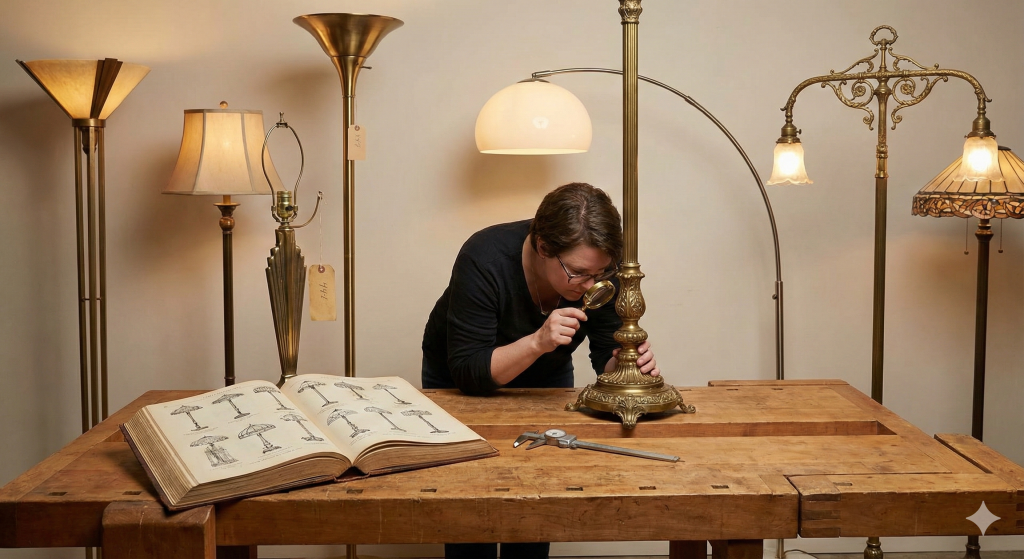
You’ve found a brass floor lamp at an estate sale, inherited one from a relative, or spotted a potential treasure at a thrift store. Before you pay $50 or $5,000, you need answers: Is it genuinely vintage? Who made it? What’s it actually worth?
This guide covers everything collectors and buyers need to know about vintage floor lamp identification—from reading maker marks to spotting reproductions. Furthermore, we’ve included current market values based on recent auction results and dealer pricing through 2025.
How to Identify a Vintage Floor Lamp: Step-by-Step Process
Proper vintage floor lamp identification requires systematic examination. Follow these steps before making any purchase or valuation decision.
Step 1: Check the Socket and Switch
The socket reveals more than any other component. Turn the lamp upside down and examine the socket interior and exterior for:
- Maker stamps: Many manufacturers stamped initials or logos directly on socket housings
- Patent dates: “Pat. Pend.” or specific patent numbers help date the piece
- UL listings: Underwriters Laboratories marks indicate US manufacture; their absence often signals European origin
- Switch type: Push-pull, rotary, or toggle switches each correspond to different eras and makers
Consequently, Stiffel lamps feature a distinctive push-pull switch mechanism patented in the 1950s. This switch alone can authenticate a genuine Stiffel versus reproductions that use standard rotary switches.
Step 2: Examine the Base
Flip the lamp to inspect the underside of the base. Look for:
- Paper labels: Original manufacturer labels (often damaged but partially legible)
- Impressed marks: Stamped letters, numbers, or logos in the metal or material
- Model numbers: Alphanumeric codes that can be cross-referenced with catalogs
- Country of origin: “Made in USA,” “Italy,” or “Made in Japan” indicates manufacturing location
- Felt padding: Original felt is typically aged and compressed; new felt suggests recent work
Additionally, weight matters significantly. Genuine vintage brass lamps have substantial heft from solid construction. Modern reproductions often use hollow or plated materials that feel noticeably lighter.
Step 3: Analyze Construction Quality
Vintage floor lamp identification depends heavily on construction assessment:
- Joints and seams: Hand-finished pieces show subtle variations; machine-perfect uniformity suggests modern manufacture
- Patina consistency: Authentic age creates uneven patina in recessed areas versus exposed surfaces
- Material quality: Vintage brass, bronze, and ceramic have density and finish quality rarely matched by reproductions
- Hardware: Original screws, nuts, and connectors often show period-appropriate slot-head or square-drive patterns
Vintage Floor Lamp Maker Marks: Complete Reference Guide
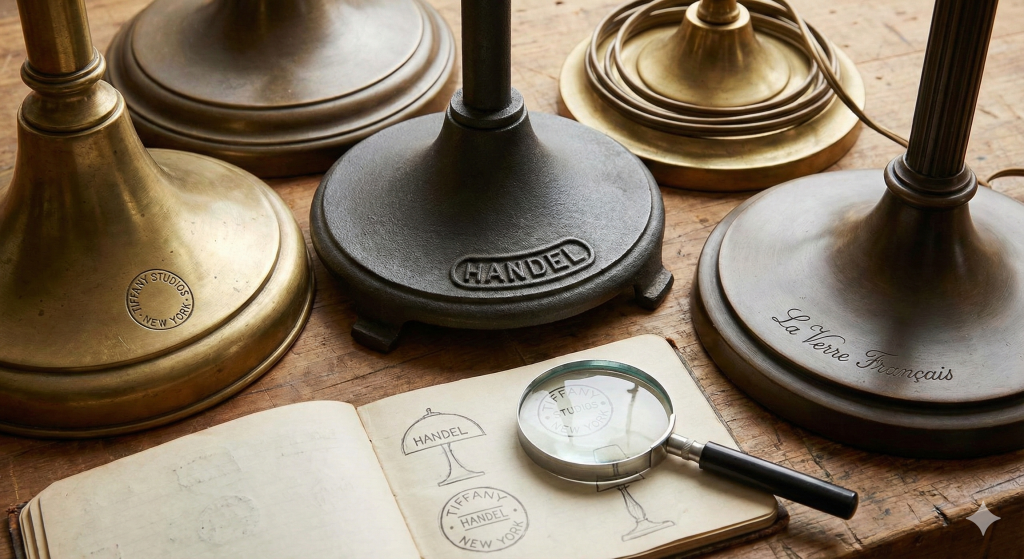
Knowing the major manufacturers and their identifying marks is essential for accurate vintage floor lamp identification. Here are the most valuable makers and how to recognize their work.
American Makers
Stiffel Lamp Company (1932-2000s)
Marks to look for:
- “Stiffel” in script on paper label or impressed in base
- “SLC” (Stiffel Lamp Company) stamp
- Push-pull switch mechanism (patented design)
- Model numbers beginning with single letters followed by numbers
Current values: Common Stiffel floor lamps sell for $100-$500. Rare models by designer Edwin Cole or Raymond Loewy reach $1,000-$2,000. The 1957 Raymond Loewy brass and glass design recently sold for $1,200.
Authentication tip: Genuine Stiffel pieces have solid brass construction with significant weight. The push-pull switch should have a distinct mechanical feel—smooth reproductions lack this tactile quality.
Frederick Cooper Lamp Company (1923-2011)
Marks to look for:
- “FC” or “F” marking on base, socket, or turn switch
- “Frederick Cooper” on paper label (often with Chicago address)
- Model numbers on base or socket housing
Current values: Standard Frederick Cooper floor lamps trade at $500-$1,500. Chinoiserie designs, Hollywood Regency styles, and pieces with original shades command $1,500-$3,000. A pair of 1970s brass lamps recently sold for $1,400.
Authentication tip: Frederick Cooper used high-quality materials including glazed ceramics, painted porcelain, marble, and jade. The company produced pieces in various furniture styles—Neoclassical, Hollywood Regency, Empire, and Asian-inspired designs.
Laurel Lamp Company (1950s-1970s)
Marks to look for:
- “Laurel Lamp” label or stamp
- Model numbers beginning with “L”
- Often unmarked but identifiable by distinctive mid-century designs
Current values: Standard pieces sell for $200-$600. Designer collaborations and rare models reach $800-$1,500.
Rembrandt Lamp Company
Marks to look for:
- “Rembrandt” in script or block letters
- Often features distinctive tole (decorated metalware) designs
Current values: $150-$800 depending on style and condition.
Italian Makers (Premium Category)
Stilnovo (1946-present)
Marks to look for:
- “Stilnovo” label, typically yellow with black text
- Impressed marks on metal components
- Distinctive toggle switches with specific tactile feel
- Carrara marble bases on many floor lamp models
Current values: Authenticated Stilnovo floor lamps start at $3,000 and reach $15,000 for rare models. The Alberello multi-arm design sells for $4,000-$8,000. Pieces attributed to named designers (Joe Colombo, Gae Aulenti, Ettore Sottsass) command significant premiums.
Authentication tip: Stilnovo used enameled metal in distinctive colors, opaline glass diffusers, and brass accents. Casting quality on genuine pieces shows hand-finishing characteristics. Subsequently, reproductions typically lack the weight and material density of originals.
Arredoluce (1943-1987)
Marks to look for:
- “Arredoluce” label or impressed mark
- Often features travertine or marble bases
- Distinctive adjustable arm mechanisms
Current values: The iconic Triennale three-arm floor lamp trades at $8,000-$25,000. Standard designs range from $2,000-$6,000. Pieces by Angelo Lelli command the highest premiums.
Fontana Arte
Marks to look for:
- “Fontana Arte” etched or labeled
- Known for glass and crystal components
Current values: $1,500-$10,000 depending on designer attribution and model.
French Makers
Maison Baguès
Marks to look for:
- “Baguès” mark on base
- Distinctive crystal and gilt bronze construction
- Floral and naturalistic motifs
Current values: Authentic Baguès floor lamps start at $2,000 and reach $15,000+ for elaborate designs.
How to Date a Vintage Floor Lamp by Era
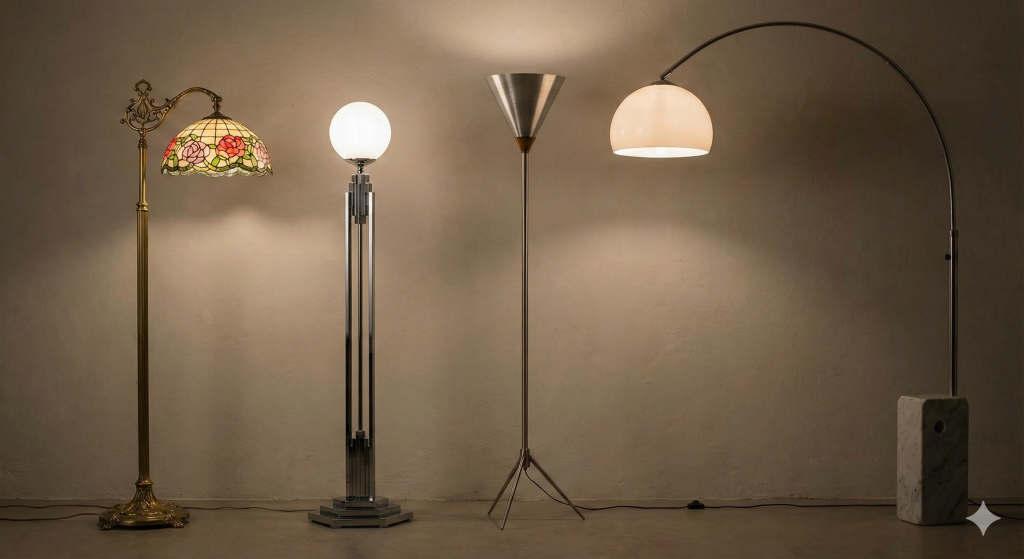
Beyond maker identification, dating your lamp by construction era helps establish authenticity and value. Each period has distinctive characteristics.
1920s-1930s (Art Deco)
Identifying features:
- Geometric forms and angular designs
- Chrome, nickel, and black lacquer finishes
- Frosted or etched glass shades
- Bakelite components on some models
Wiring clues: Cloth-wrapped wiring (requires replacement for safety). Two-prong plugs without grounding.
1940s-1950s (Mid-Century Beginning)
Identifying features:
- Transition from traditional to modern forms
- Brass and walnut combinations popular
- Emergence of Italian design influence
- Introduction of adjustable pharmacy-style lamps
Wiring clues: Early plastic-coated wiring appears. Some pieces have three-prong plugs by late 1950s.
1960s-1970s (Mid-Century Peak)
Identifying features:
- Bold sculptural forms
- Chrome and polished metals dominate
- Smoked glass and lucite components
- Space Age and organic influences
- Ceramic bases in bright colors
Wiring clues: Modern plastic-coated wiring. Three-prong grounded plugs standard by late 1960s.
1980s-1990s (Postmodern/Memphis)
Identifying features:
- Halogen bulb technology appears
- Bold colors and geometric patterns
- Mixed materials (metal, glass, painted surfaces)
- Some retro revival of earlier styles
Note: Pieces from this era are approaching vintage status (20+ years old) and may appreciate as collector interest grows.
Current Market Values: What Vintage Floor Lamps Are Worth in 2025
Market values fluctuate based on condition, provenance, and demand. These ranges reflect recent auction results, dealer pricing, and platform sales data from 1stDibs, Chairish, and major auction houses.
Value Tiers at a Glance
| Category | Price Range | Examples |
|---|---|---|
| Entry Level | $100-$500 | Common Stiffel, unsigned mid-century brass, 1970s ceramic |
| Mid-Range | $500-$2,000 | Frederick Cooper, signed Laurel, quality American brass |
| Premium | $2,000-$8,000 | Stilnovo, early Arredoluce, Maison Baguès |
| Investment Grade | $8,000-$25,000+ | Documented designer pieces, museum-quality Italian |
Factors That Increase Value
- Original components: Shades, finials, harps, and hardware intact add 30-50% to value
- Provenance: Documentation of ownership history, especially notable collections
- Designer attribution: Named designers (Raymond Loewy, Tommi Parzinger, Angelo Lelli) command significant premiums
- Condition: Working electrical, minimal damage, original patina preferred over refinished
- Rarity: Limited production runs, discontinued models, unique variations
Factors That Decrease Value
- Replaced shades: Non-original shades reduce value by 25-40%
- Over-polishing: Aggressive cleaning that removes patina
- Repairs: Visible repairs, replaced bases, non-period components
- Missing marks: Removed labels or obscured maker identification
- Damage: Dents, cracks, chips in glass or ceramic components
Authentication Red Flags:
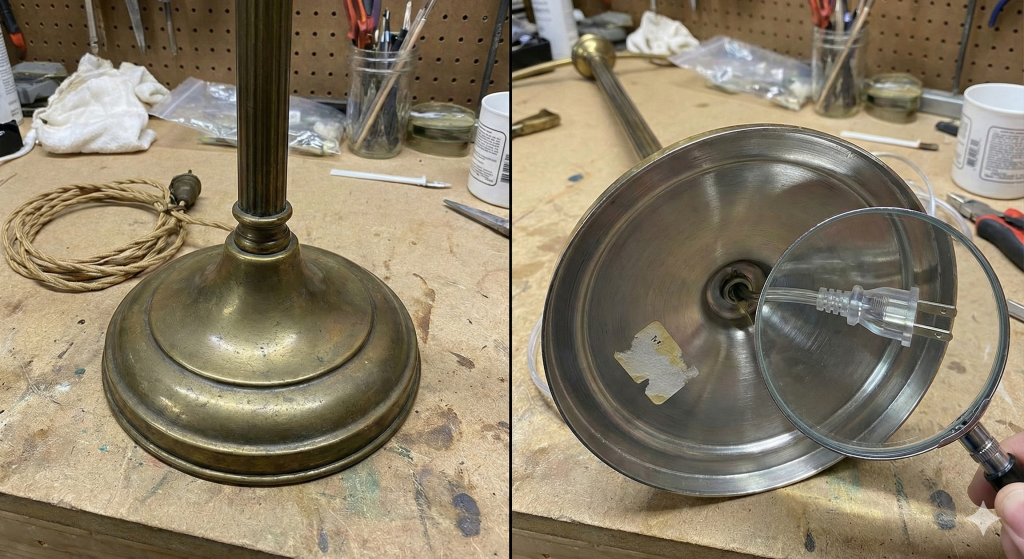
The vintage floor lamp market includes reproductions and misattributed pieces. Knowing the warning signs protects your investment.
Common Reproduction Indicators
- Too-perfect condition: Genuine vintage shows appropriate wear; pristine finishes suggest recent manufacture
- Uniform patina: Real age creates uneven coloring; chemically-applied patina looks artificially even
- Light weight: Reproductions often use hollow or plated components instead of solid brass or bronze
- Modern wiring: Brand-new wiring on a supposedly 60-year-old lamp raises questions
- Vague provenance: Sellers unable to explain acquisition history
- Price too good: Authenticated Stilnovo for $500 is almost certainly not authentic
Specific Reproduction Issues by Maker
Italian reproductions: Chinese manufacturers produce convincing Stilnovo and Arredoluce copies. Check casting quality, material weight, and switch mechanisms. Subsequently, authentic Italian pieces have hand-finishing variations that machine-made copies lack.
Stiffel copies: The distinctive push-pull switch is rarely replicated correctly. Test the mechanism—genuine Stiffel switches have specific resistance and click patterns.
Frederick Cooper: Less commonly reproduced due to diverse designs. Nevertheless, verify the “FC” mark placement and compare to documented examples.
Frequently Asked Questions About Vintage Floor Lamp Identification
How do I find out what my vintage floor lamp is worth?
Start with maker identification using this guide. Then search recent sold listings on 1stDibs, Chairish, and eBay (filter for “sold” items only). For valuable pieces ($2,000+), consider a professional appraisal from a certified antiques appraiser specializing in lighting or mid-century design.
Are vintage floor lamps safe to use?
Original wiring on lamps over 30 years old should be professionally replaced before regular use. Rewiring typically costs $75-$200 and doesn’t significantly impact value when done properly. Additionally, ensure bulb wattage matches socket ratings to prevent overheating.
What’s the difference between vintage and antique floor lamps?
Industry standards define “antique” as 100+ years old and “vintage” as 20-99 years old. Most collectible floor lamps fall into the vintage category. Subsequently, Art Deco pieces from the 1920s are approaching antique status, potentially increasing their value.
How can I tell if my brass lamp is solid or plated?
Check for wear spots where the base coat shows through—this indicates plating. Solid brass has consistent coloring throughout. Alternatively, a magnet test works: brass is non-magnetic while steel (often used as plating base) is magnetic.
Where should I sell a valuable vintage floor lamp?
Pieces valued under $1,000 sell well on eBay, Facebook Marketplace, or through local antique dealers. Lamps in the $1,000-$5,000 range belong on Chairish, 1stDibs, or with established vintage lighting consignment dealers. For $5,000+, consider major auction houses (Christie’s, Sotheby’s, Wright) or specialized design auctions.
Do vintage floor lamps work with LED bulbs?
Most vintage lamps accept modern LED bulbs with standard E26/E27 bases. Furthermore, LED bulbs generate less heat than incandescent, reducing stress on vintage components. Use appropriate wattage equivalents and consider “warm white” color temperatures (2700K-3000K) to maintain period ambiance.
Where to Source Quality Vintage Floor Lamps
For readers ready to purchase authenticated vintage floor lamps, these sources offer vetted inventory:
Online Platforms:
- 1stDibs – Premium dealer network, extensive selection, buyer protection
- Chairish – Curated vintage selection, moderate pricing
- Pamono – European dealers, strong Italian design inventory
Hamptons-Area Dealers:
- English Country Home, Bridgehampton – Large lighting inventory, diverse periods
- Laurin Copen Antiques, Montauk Highway – Mid-century specialist
- WYETH, Sagaponack – Museum-quality pieces, authentication guaranteed
- MONC XIII, Sag Harbor – Curated selection bridging vintage and contemporary
Related Articles
- Hamptons Luxury Real Estate: Billionaire Lane
- Where Are The Hamptons: A Location Guide
- Polo Hamptons in Bridgehampton: The Luxury Scene
Stay Connected with Social Life Magazine
Author

Written by
Recent Posts
What Goes Into Planning a Professional Furnace Installation?
Why Sports Card Collecting Is More Than Just a Hobby
From Signature Scents to Scent Wardrobes: The Evolution of Personal Fragrance

Beyond the Booth: How Exhibition Design Is Creating New Brand Experiences

Trading the Hamptons for Hvar: A Summer on Croatia’s Most Glamorous Island
Categories
- Art
- Articles
- Business of Luxury
- Celebrities
- Culture
- Entertainment
- Events
- Faces of Summer 2026
- Fashion
- Fashion & Style
- Featured
- Finance
- Food, Spirits, Wine
- Hamptons
- Hamptons Celebrities
- Health
- Health & Beauty
- Lifestyle
- Luxury Lifestyle
- Press
- Profiles
- Real Estate
- Technology
- The Chronicles
- Travel
- Uncategorized
- Weddings