
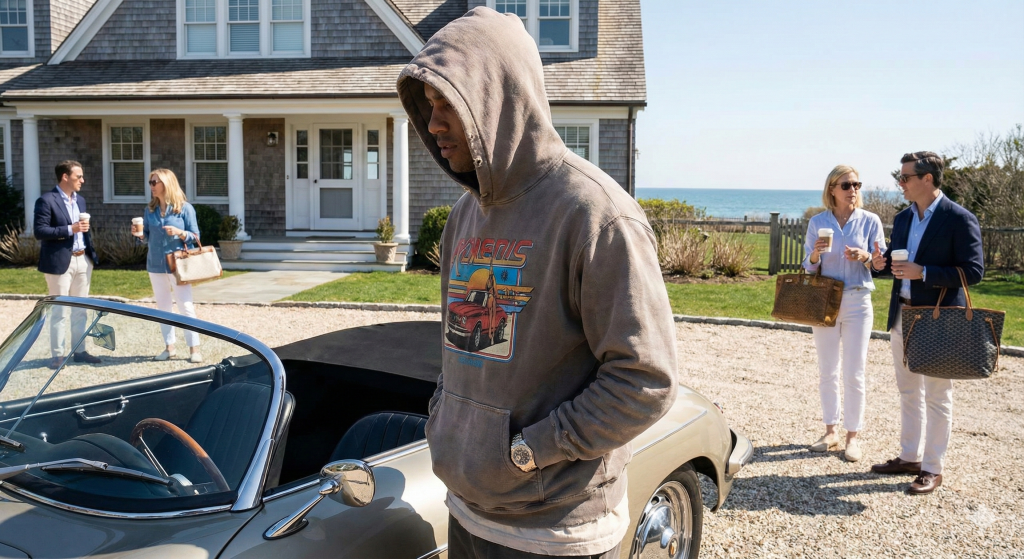
The scene at the Southampton Farmers Market last Saturday told you everything you need to know about the current state of wealth signaling. A managing partner at one of the Hamptons’ most prominent hedge funds stood examining heirloom tomatoes in a faded burgundy Champion Reverse Weave crewneck. The kind with action gussets and a slight pill across the chest. Retail value when new in 1987: approximately $40. Current market value on Grailed: $175. The message it transmitted to those who understood: priceless.
Vintage hoodies have become the ultimate power move in Southampton’s social landscape. While tourists queue for monogrammed totes, the people who actually write checks wear cotton that looks like it survived a decade of Sunday football. This isn’t accidental poverty cosplay. It’s calculated status communication that separates insiders from everyone else.
The Hidden Market for Vintage Hoodies
The secondhand apparel market reached $56 billion in 2025, according to ThredUp’s annual resale report. However, the vintage hoodie segment operates by different rules entirely. According to McKinsey research, the luxury resale market grew to an estimated $48 billion in 2024, with secondhand becoming a gateway to luxury for consumers priced out of new purchases. Furthermore, vintage clothing has been growing 21 times faster than traditional apparel retail.
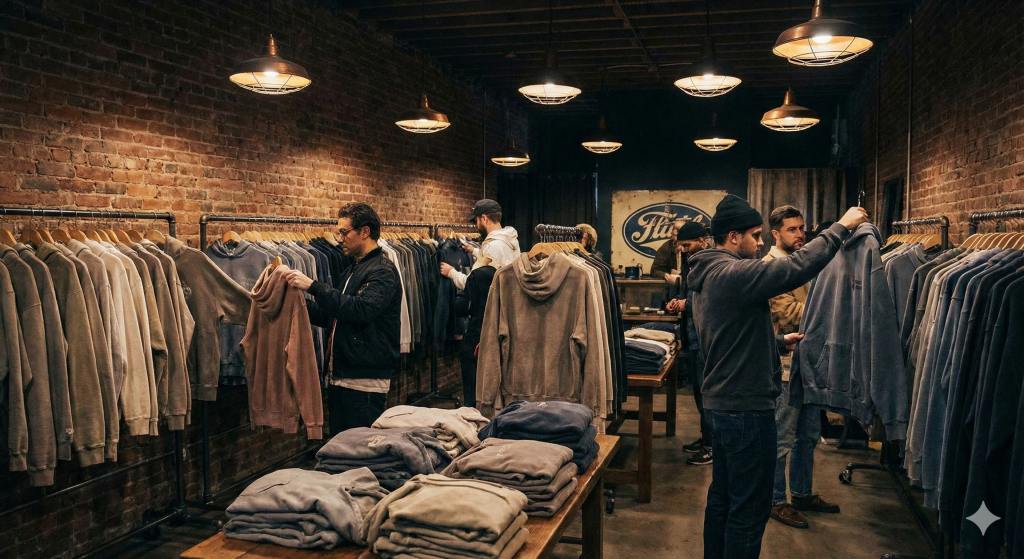
What separates a $40 vintage hoodie from a $400 specimen? Consequently, the answer involves provenance, condition, and cultural resonance. Champion Reverse Weave pieces from the 1980s command premiums because of their distinctive horizontal weave construction. This technique minimizes shrinkage while maximizing durability. Moreover, the oversized armholes and boxy fit signal authentic vintage rather than reproduction.
Price stratification in vintage hoodies follows specific markers. Basic vintage Champion crewnecks fetch $40 to $65 on resale platforms. Nevertheless, pieces with university affiliations, particularly Ivy League schools, command $100 to $200. Additionally, rare colorways or collaboration pieces push toward $300 or higher. The Southampton crowd knows exactly which markers matter.
What Hamptons Collectors Know About Vintage Hoodies
Local dealers report a distinct preference among Hamptons buyers. Subsequently, they favor pieces that communicate understated success rather than obvious wealth signaling. The stealth wealth movement, popularized by television shows like Succession, has fundamentally changed how affluent consumers approach casual wear.
According to Fortune magazine’s analysis of the quiet luxury trend, wealthy consumers want to resemble people in lower tax brackets through their wardrobe. However, they achieve this using invisibly higher-quality garments crafted with labor-intensive techniques and rare materials. Vintage hoodies perfectly satisfy this contradiction.
Southampton’s old-money families have particular tells when shopping vintage. They gravitate toward single-color logos rather than multi-colored graphics. Therefore, they prefer worn cotton that has softened through decades of washing. Furthermore, they avoid anything that screams “vintage” too loudly. The goal is appearing casually thrown together while wearing something that took considerable effort to source.
The cultural codes here matter tremendously. A faded Yale crew from 1985 communicates something entirely different than a pristine reproduction. One suggests generational wealth and actual attendance. The other suggests trying too hard. Additionally, local dealers note that certain labels have become almost too popular among the fashion set. Champion and Russell Athletic remain acceptable. Meanwhile, Nike vintage has become slightly too mainstream for the truly discerning.
Authentication and Red Flags for Vintage Hoodies
Spotting authentic vintage requires understanding tag evolution. Champion hoodies from the 1980s typically feature “Made in USA” labels with blue bar tags. Furthermore, the reverse weave patent number appears on genuine pieces from this era. Subsequently, pieces labeled “Made in Korea” or “Made in Honduras” indicate later production runs.
Tag authentication extends beyond country of origin. Genuine vintage Champion hoodies have specific stitching patterns on their tags. The “C” logo evolved through distinct phases that knowledgeable collectors can date precisely. Additionally, the font and spacing on care instructions changed across decades.
Fabric weight serves as another authentication tell. Pre-1990s reverse weave hoodies use significantly heavier cotton than contemporary reproductions. Moreover, the horizontal ribbing along the sides should show consistent construction. Reproduction pieces often substitute cheaper materials that lack the characteristic drape of authentic vintage.
Common fakes circulate through online marketplaces. Artificially distressed reproductions attempt to replicate age through acid washes and intentional damage. Nevertheless, genuine patina develops differently than manufactured wear. Real vintage shows fading concentrated at pressure points and seams. Fake aging appears uniform and artificial.
Documentation matters for premium pieces. Provenance records, original receipts, or photographic evidence of previous ownership add significant value. Therefore, pieces from notable collections or with celebrity associations command substantial premiums beyond standard vintage pricing.
Where to Source Vintage Hoodies in the Hamptons
Collette Designer Consignment operates three Hamptons locations with rotating vintage athletic wear selections. Their Southampton flagship at 1 Hampton Road occupies the historic former Saks Fifth Avenue building. The team there understands the nuanced preferences of local clientele. Consequently, they curate pieces that communicate authentic vintage rather than costume.

Ava’s & Around Again in Sag Harbor offers an eclectic blend of luxury consignment and genuine vintage finds. Located at 1 Long Wharf Street, this boutique attracts both longtime residents and discerning visitors. Furthermore, the owner hand-picks every piece, ensuring quality control that larger operations cannot match.
The Retreat Boutique Thrift Store in Bridgehampton at 2102 Montauk Highway represents the charitable shopping option. Every purchase supports the local nonprofit helping domestic violence victims. Additionally, the store occasionally receives donations from significant estates. Those with patience and timing can discover remarkable pieces.
LVIS Bargain Box at 95 Main Street in East Hampton has operated under the Ladies’ Village Improvement Society for over a century. Subsequently, this thrift shop receives donations from East Hampton’s most established families. The inventory turns quickly during peak season. Therefore, serious hunters visit multiple times weekly.
Online sourcing requires different strategies. Grailed specializes in verified streetwear and vintage athletic wear. Authentication services help buyers avoid reproductions on this platform. Similarly, The RealReal offers authenticated vintage with expert verification. Poshmark and Depop provide broader selections at varying quality levels.
The Investment Case for Vintage Hoodies
McKinsey’s State of Fashion report projects secondhand sales will grow two to three times faster than firsthand fashion through 2027. Furthermore, 58% of consumers purchased secondhand apparel in 2024, according to ThredUp data. The stigma that once attached to used clothing has completely evaporated among wealthy consumers.
Specific vintage hoodie categories show consistent appreciation. Champion Reverse Weave pieces from university athletic programs have increased 40% in average resale value over three years. Additionally, rare colorways and limited collaboration pieces appreciate faster than mass-produced alternatives. Therefore, selective acquisition can generate meaningful returns.
Storage and care requirements remain minimal. Vintage cotton hoodies require only cool water washing and flat drying. Moreover, cedar storage prevents moth damage without chemical treatments. Unlike watches or handbags, these pieces need no professional maintenance or insurance riders.
Exit strategies for vintage athletic wear mirror other collectibles. Consignment shops offer convenience at lower returns. Meanwhile, direct sales through platforms like Grailed or eBay maximize proceeds at the cost of additional effort. Estate sales and auction houses increasingly accept curated vintage athletic wear collections.
The sustainability angle strengthens the investment thesis. According to McKinsey research, extending clothing life cycles by nine months reduces carbon emissions by 30%. Furthermore, buying secondhand handbags instead of new reduces fashion’s carbon footprint by up to 90%. Vintage hoodies offer similar environmental benefits while delivering the aesthetic that Southampton’s conscious consumers prefer.
The Stealth Wealth Play

The calculation behind vintage hoodies as status symbols becomes clear upon examination. Loro Piana cashmere baseball caps retail for $525. Brunello Cucinelli t-shirts cost $300 at retail. These quiet luxury brands signal wealth through construction and materials rather than logos. However, they still require significant expenditure.
Vintage hoodies achieve similar status communication at a fraction of the cost. Moreover, they add a dimension of cultural knowledge that expensive basics cannot replicate. Knowing which Champion tags indicate true 1980s production requires research and attention. Consequently, wearing authentic vintage signals both financial capacity and cultural sophistication.
The Southampton farmers market has become an unofficial runway for this aesthetic. Technology entrepreneurs, hedge fund partners, and legacy wealth families all participate in this unspoken competition. The rules are simple but precise. Too pristine suggests reproduction. Too destroyed suggests affectation. The sweet spot communicates authentic history without trying too hard.
This trend represents a broader shift in how wealth signals itself. Bain & Company’s 2024 Luxury Report documents approximately 50 million consumers exiting the traditional luxury market over two years. Furthermore, younger generations prefer brands demonstrating cultural credibility over mere price point. Vintage hoodies satisfy both criteria.
The circle closes at Southampton’s power breakfast spots. The same people wearing faded Champion to the farmers market close deals worth millions over scrambled eggs at Sant Ambroeus. The hoodie communicates membership in a club that money alone cannot join. Understanding this represents the real status symbol. Everything else is just cotton.
Stay Connected with Social Life Magazine
- Contact Social Life Magazine
- Experience Polo Hamptons
- Subscribe to Our Newsletter
- Print Subscription
- Support Our Journalism ($5)
Related Articles
Author

Written by
Recent Posts

The First Decision After a Collision Can Be the Most Important One
Two Weeks in Rome and Beyond: Turkish Airlines Itineraries from Boston, Chicago and Onward to India

Top 10 Hair Transplant Clinics in Turkey 2026

Artist Alley to Online Store: How Convention Artists Can Keep Selling After the Event
When an 18-Wheeler Crash Leaves Lasting Consequences
Categories
- Art
- Articles
- Business of Luxury
- Celebrities
- Culture
- Entertainment
- Events
- Faces of Summer 2026
- Fashion
- Fashion & Style
- Featured
- Finance
- Food, Spirits, Wine
- Hamptons
- Hamptons Celebrities
- Health
- Health & Beauty
- Lifestyle
- Luxury Lifestyle
- Press
- Profiles
- Real Estate
- Technology
- The Chronicles
- Travel
- Uncategorized
- Weddings