
The late afternoon sun hits the dunes on Dune Road, casting long, golden shadows across the asphalt. You are behind the wheel of a vintage machine, the smell of oil and old leather mixing with the salt air. It is not the fastest car you own, nor the most expensive. But as you downshift for the corner, hearing that distinctive mechanical rasp of the flat-six engine, you realize it is the only one that truly matters.
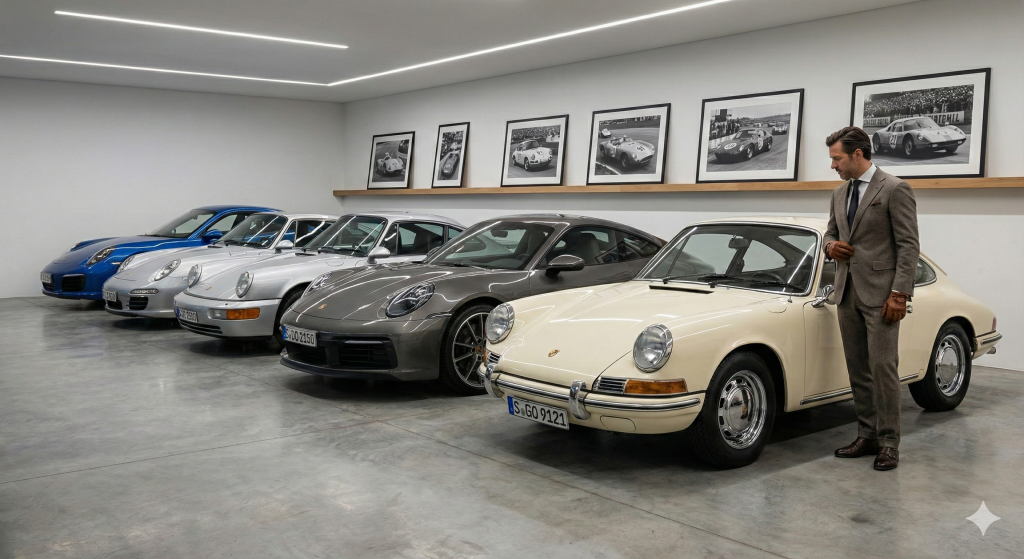
This is the allure of the Porsche 911 generations. It is perhaps the only vehicle in existence that looks equally at home parked on the crushed gravel of a Southampton estate as it does tearing down the Mulsanne Straight. It is “classless” in the most sophisticated sense—driven by rock stars, CEOs, and purists alike. For the Hamptons collector, the 911 is not just a car; it is an essential accessory to the lifestyle, a bridge between the analog romance of the past and the digital precision of the future. But with over six decades of history, which model belongs in your garage?
The Air-Cooled Era (1963–1998): Investment & Romance

Historically, the dividing line in the 911 lineage is clear: before 1998, engines were cooled by air and oil; after 1998, by water. For the serious collector, the “air-cooled” era represents the blue-chip stocks of the automotive world. These cars are visceral, smaller, and demand more from their driver. Consequently, they have become the darlings of the investment market.
The Classics and the G-Series (1963–1989)

The earliest Porsche 911 generations—the “Longhoods” of the 60s and early 70s—are pure art. Fragile and beautiful, a 1973 Carrera RS 2.7 is the “White Whale” for many, commanding prices that rival beachfront real estate. However, for a usable classic, look to the “G-Series” of the 1980s. These are the cars with the impact bumpers and the silhouette that defined a decade. A guarded secret among locals is that a vintage Targa from this era is the ultimate summer cruiser—perfect for the slow roll to Pierre’s in Bridgehampton for a sunrise espresso.
The 964 (1989–1994)
For years, the 964 was the overlooked middle child. Today, it is the donor chassis of choice for million-dollar restomods like Singer. It blends the classic upright headlights with modern coil-spring suspension, making it surprisingly usable on the potholed backroads of Sagaponack.
The 993 (1995–1998): The Holy Grail
If you buy only one, make it a 993. As the final air-cooled model, it marks the end of an era. The design is timeless—wide hips, smooth lines, and a build quality that feels like it was hewn from a single block of granite. From an investment standpoint, the 993 is gold. Values have remained rock-solid, even as other asset classes fluctuate. It is the automotive equivalent of a Rothko: complex, emotional, and perpetually appreciating.
The Water-Cooled Era (1999–Present): Usability & Performance
In 1999, Porsche changed the game. The switch to water-cooling was controversial, but it saved the company and birthed the modern GT cars we know today. These Porsche 911 generations trade some of the analog charm for blistering performance and the ability to drive from Tribeca to Montauk in distinct comfort.
The 996 (1999–2004)
Once maligned for its “fried egg” headlights, the 996 is currently enjoying a renaissance. It is the value play. A clean 996 Turbo offers supercar performance for the price of a luxury SUV. It is the perfect entry point for a younger collector looking to join the club without seven-figure buy-ins.
The 997 (2005–2012)
Ideally proportioned and returning to the classic round headlights, the 997 is often called the “modern classic.” It hits the sweet spot—modern enough to have working A/C and navigation, but analog enough to feel the road through the steering wheel. A 997 GT3 is, arguably, the best driver’s car of the 21st century.
The 991 & 992 (2012–Present)
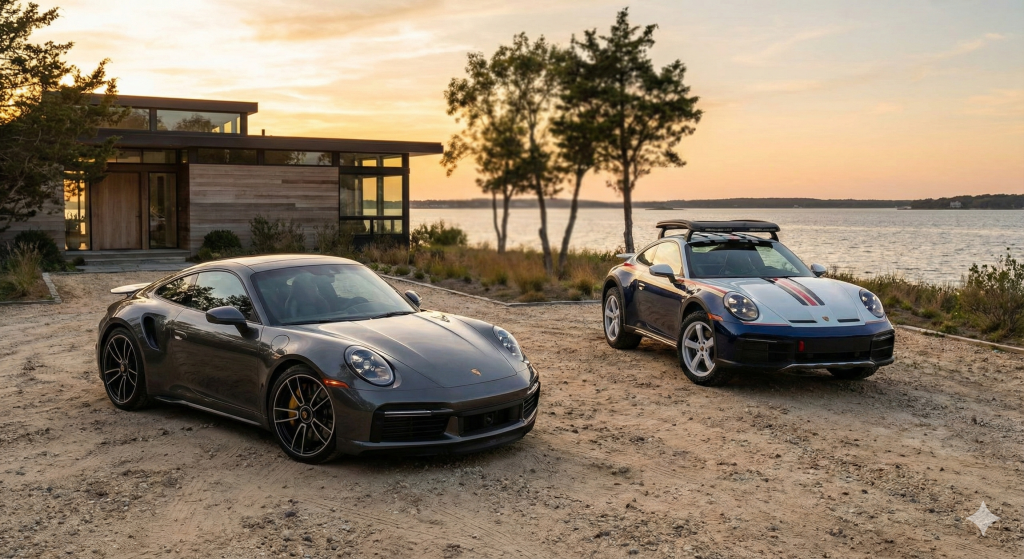
The current generations have evolved into sophisticated Grand Tourers. Larger and more luxurious, a 992 Turbo S is a stealth weapon. It flies under the radar in a way a Ferrari never could, yet it will outrun almost anything on the road. It is the choice for the executive who values dominance without drama. For the adventurous, the new 911 Dakar—with its lifted suspension—is becoming a cult favorite for navigating the sandy driveways of Shelter Island.
Ranking Porsche 911 Generations for the Hamptons
Choosing the right 911 is akin to choosing the right watch; it signals who you are and how you spend your time. Here is our curated ranking for the East End lifestyle.
- The Socialite: 1980s 911 Targa
Vibe: Top down, hair in the wind, oversized sunglasses.
Best For: Arriving at Polo Hamptons. The Targa roof allows you to be seen, while the vintage aesthetic guarantees you won’t look like you’re trying too hard. It is photogenic, nostalgic, and effortlessly cool. - The Purist: 1973 Carrera RS 2.7
Vibe: Uncompromising, knowledgeable, elite.
Best For: “The Bridge” event. When you park this on the lawn at the exclusive golf club, you don’t just attend the show; you are the show. It signals that you value provenance over flash. - The Executive: 2024 911 Turbo S (992)
Vibe: Powerful, understated, efficient.
Best For: The Friday night dash. When you need to escape the city and reach your Manhattan luxury investment or Hamptons estate in record time, nothing eats up highway miles like a Turbo S.
Market Watch & Investment Value
Treating Porsche 911 generations as an asset class is no longer a niche theory; it is a proven strategy. According to valuation experts at Hagerty, air-cooled models have outperformed many traditional market indices over the last decade. Unlike a “depreciating toy,” a well-maintained 993 or early 911 is a store of value.
However, provenance is key. In a market flooded with mediocre examples, the cars with documented history, original paint, and low owners are the ones setting records. It is a “winner takes all” market. Therefore, consulting with a specialist before acquisition is not just recommended; it is essential.
Conclusion: The Art of the Drive
Ultimately, the best Porsche 911 generation is the one that calls to you. Whether it is the raw, mechanical clatter of an air-cooled engine or the digital precision of a modern PDK gearbox, the DNA remains the same. These cars are meant to be driven, not hidden away in climate-controlled vaults.
So, as the season approaches, consider which silhouette belongs in your driveway. Because on a quiet Tuesday evening in September, when the summer crowds have thinned and the light hits the bays just right, there is no better place to be than behind the wheel of a 911.
Stay Connected with Social Life Magazine
Author

Written by
Recent Posts
How to Pick a Homecoming Dress for Your Body Type and Feel Amazing in It
How to Prepare a Home for Sale When Major Repairs Are Not Affordable
From Everyday Comfort to Personal Style: My SHEIN Slipper Habit
5 Best Mitsubishi Heat Pump Companies in Seattle
Tech Gadgets as Modern Corporate Gifts: Useful Ideas for Employees and Clients
Categories
- Art
- Articles
- Business of Luxury
- Celebrities
- Culture
- Entertainment
- Events
- Faces of Summer 2026
- Fashion
- Fashion & Style
- Featured
- Finance
- Food, Spirits, Wine
- Hamptons
- Hamptons Celebrities
- Health
- Health & Beauty
- Lifestyle
- Luxury Lifestyle
- Press
- Profiles
- Real Estate
- Technology
- The Chronicles
- Travel
- Uncategorized
- Weddings