
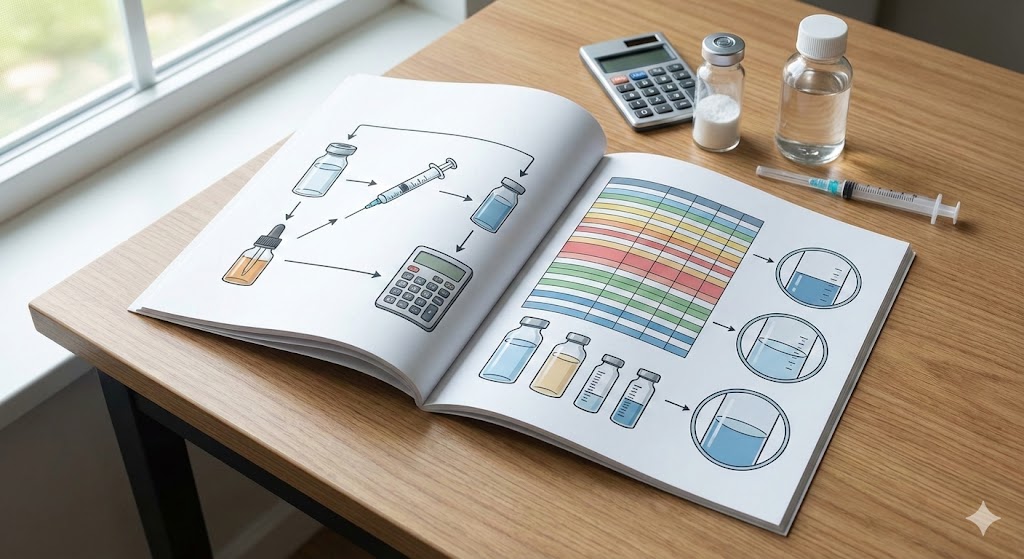
Peptide reconstitution intimidates newcomers more than it should. Although the math seems complex and the stakes feel high, the actual process follows straightforward formulas that anyone can master in minutes. Certainly, one calculation error means either underdosing ineffectively or overdosing dangerously—yet avoiding mistakes requires only basic arithmetic.
Most peptides arrive as lyophilized powder, which is freeze-dried for stability during shipping and storage. Before use, you must therefore reconstitute them with bacteriostatic water or sterile water to create an injectable solution. Consequently, the reconstitution ratio you choose determines how much liquid delivers your target dose.
This guide provides the calculator formulas, step-by-step instructions, and practical examples that eliminate guesswork from peptide preparation. Bookmark it now, because you’ll reference it repeatedly until the math becomes automatic.
The Peptide Reconstitution Calculator Formula
The core formula for peptide reconstitution calculates how many micrograms (mcg) each unit on your syringe delivers. Once you know this number, hitting your target dose becomes simple division. Importantly, this formula works universally for any peptide at any concentration.
The Master Formula:
Peptide Amount (mg) ÷ Water Added (mL) = Concentration (mg/mL)
Then convert to mcg: Concentration (mg/mL) × 1000 = mcg per mL
For insulin syringe users: mcg per mL ÷ 10 = mcg per 10 units (0.1mL)
Example Calculation:
Suppose you have a 5mg vial of BPC-157 and add 2mL of bacteriostatic water.
5mg ÷ 2mL = 2.5mg/mL
2.5mg × 1000 = 2,500mcg per mL
2,500mcg ÷ 10 = 250mcg per 10 units on an insulin syringe
Therefore, if your target dose is 250mcg, you would inject 10 units. Similarly, for a 500mcg target, simply inject 20 units. Indeed, the relationship stays proportional regardless of your specific dose.
Quick Reference Reconstitution Charts
These pre-calculated charts cover the most common peptide amounts and water volumes. Simply find your vial size and preferred water amount to see your resulting concentration instantly.
5mg Vial Reconstitution
With 1mL water, you get 5,000mcg/mL (meaning 500mcg per 10 units).
Using 2mL water yields 2,500mcg/mL (therefore 250mcg per 10 units).
At 2.5mL water, concentration becomes 2,000mcg/mL (thus 200mcg per 10 units).
Finally, 5mL water produces 1,000mcg/mL (consequently 100mcg per 10 units).
10mg Vial Reconstitution
With 1mL water, you achieve 10,000mcg/mL (meaning 1,000mcg per 10 units).
Using 2mL water results in 5,000mcg/mL (therefore 500mcg per 10 units).
At 2.5mL water, concentration reaches 4,000mcg/mL (thus 400mcg per 10 units).
Meanwhile, 5mL water creates 2,000mcg/mL (consequently 200mcg per 10 units).
2mg Vial Reconstitution
With 1mL water, you get 2,000mcg/mL (meaning 200mcg per 10 units).
Using 2mL water yields 1,000mcg/mL (therefore 100mcg per 10 units).
Alternatively, 0.5mL water produces 4,000mcg/mL (thus 400mcg per 10 units).
15mg Vial Reconstitution
With 3mL water, you achieve 5,000mcg/mL (meaning 500mcg per 10 units).
Using 5mL water results in 3,000mcg/mL (therefore 300mcg per 10 units).
Alternatively, 1.5mL water creates 10,000mcg/mL (thus 1,000mcg per 10 units).
How to Calculate Your Specific Dose
Once you know your concentration, calculating the exact injection volume for any dose requires just one simple division. Moreover, this method works regardless of your target amount or reconstitution ratio.
Dose Calculation Formula:
Target Dose (mcg) ÷ Concentration (mcg/mL) × 100 = Units to Inject
First Example:
Assume your concentration is 2,500mcg/mL (from a 5mg vial with 2mL water), and your target dose is 300mcg.
300 ÷ 2,500 × 100 = 12 units
Therefore, simply draw 12 units on your insulin syringe for exactly 300mcg.
Second Example:
In this case, your concentration is 5,000mcg/mL (from a 10mg vial with 2mL water), while your target dose is 750mcg.
750 ÷ 5,000 × 100 = 15 units
Consequently, draw 15 units for exactly 750mcg.
Choosing Your Water Volume
The amount of water you add directly affects convenience versus precision. Specifically, lower volumes create higher concentrations, which means smaller injection volumes. Conversely, higher volumes create lower concentrations, thereby enabling finer dose adjustments. Neither approach is inherently correct—instead, choose based on your priorities.
Less Water (Higher Concentration)
When you add minimal water, you create concentrated solutions requiring tiny injection volumes. For instance, a 5mg vial with 1mL water means just 5 units delivers 250mcg. As a result, this approach minimizes injection discomfort and liquid volume under the skin.
However, the tradeoff involves precision. Because small volumes magnify measurement errors significantly, being off by 1 unit at this concentration means you’re consequently off by 50mcg. For peptides with narrow therapeutic windows, this imprecision therefore matters considerably.
Additionally, higher concentrations exhaust vials faster since you’re measuring smaller volumes with inherent waste. Because the last few units in a syringe never inject completely, concentrated solutions ultimately lose more peptide to this dead space.
More Water (Lower Concentration)
When you add more water, you create dilute solutions requiring larger injection volumes. For example, a 5mg vial with 5mL water means 50 units delivers 250mcg. Naturally, the injection itself takes longer and deposits more liquid subcutaneously.
On the other hand, precision improves significantly with this approach. Since being off by 1 unit at this concentration means just 10mcg variance, this accuracy helps when dialing in optimal doses through experimentation. Therefore, users who need precise adjustments often prefer this method.
Furthermore, dilute solutions maximize usable peptide per vial. Because more total volume means dead space represents a smaller percentage loss, cost-conscious users frequently prefer higher dilutions for this practical reason.
The Sweet Spot
Generally, 2mL water for 5mg vials or 2-3mL for 10mg vials effectively balances precision with convenience. These middle-ground concentrations keep injection volumes reasonable while simultaneously maintaining acceptable accuracy.
Ultimately, match your dilution to your dosing precision needs. If you’re taking 500mcg doses, concentration matters less since you have room for minor errors. However, if you’re taking 100mcg doses, dilution enables the precision your protocol requires.
Step-by-Step Reconstitution Process
Proper technique ensures your peptide remains sterile and fully dissolved. Because rushing this process risks contamination or incomplete mixing, take the few extra minutes to do it correctly.
Materials Needed
Before starting, gather everything you’ll need: peptide vial, bacteriostatic water, alcohol swabs, insulin syringe (for drawing water), and a clean workspace. Having materials ready prevents scrambling mid-process with an open vial.
Step 1: Clean Everything
Begin by wiping the rubber stopper on your peptide vial with an alcohol swab. Next, wipe the bacteriostatic water vial stopper as well. Then allow both to air dry for 10-15 seconds, since this step prevents introducing contaminants during the process.
Step 2: Draw Your Water
Using an insulin syringe, carefully draw your calculated water amount from the bacteriostatic water vial. First, pull back the plunger slightly past your target, then push forward to eliminate air bubbles. Finally, confirm your volume reading is accurate before proceeding.
Step 3: Add Water to Peptide
Insert the needle through the peptide vial stopper at an angle, aiming toward the glass wall rather than directly at the powder. Then inject the water slowly, letting it run down the side of the vial. This technique matters because direct streams can damage delicate peptide structures.
Step 4: Allow Dissolution
Importantly, never shake the vial under any circumstances. Because shaking can denature peptides, it thereby destroys their structure and effectiveness. Instead, gently swirl the vial or simply let it sit undisturbed. Typically, peptides dissolve completely within 5-10 minutes, although some may take longer.
When properly dissolved, the solution should become completely clear. If particles remain after 15 minutes of gentle swirling, the peptide may have degraded before reconstitution. Similarly, cloudiness or floaters indicate potential problems with the product.
Step 5: Store Properly
Reconstituted peptides require refrigeration at 36-46°F (2-8°C). Additionally, keep the vial upright to minimize stopper contact with solution. Also protect from light by storing in the original box or wrapping in foil. Under these proper storage conditions, most reconstituted peptides remain stable for 4-6 weeks.
Understanding Insulin Syringes
Insulin syringes measure in “units” rather than milliliters, which understandably confuses many new users. However, once you understand the relationship between units and volume, this confusion disappears permanently.
Standard U-100 insulin syringes (the most common type) contain 100 units per 1mL. Therefore, the conversions work as follows:
10 units equals 0.1mL, while 25 units equals 0.25mL.
Similarly, 50 units equals 0.5mL, and 100 units equals 1.0mL.
This conversion explains why the reconstitution formula divides by 10 to get mcg per 10 units. Essentially, each 10-unit increment represents 0.1mL of solution. Once you know your concentration per mL, you can therefore calculate any dose easily.
Syringes come in different sizes: 0.3mL (30 units), 0.5mL (50 units), and 1.0mL (100 units). Notably, smaller syringes offer finer graduation marks for precise small-dose measurement. Consequently, always match syringe size to your typical dose volume for best results.
Bacteriostatic Water vs. Sterile Water
Reconstitution requires either bacteriostatic water or sterile water, and this difference matters significantly for how long your reconstituted peptide remains usable.
Bacteriostatic Water (BAC Water)
Bacteriostatic water contains 0.9% benzyl alcohol, which effectively inhibits bacterial growth. Because of this preservative, you can make multiple entries into the vial over weeks without contamination. Consequently, for multi-dose vials that you’ll draw from repeatedly, BAC water is the appropriate choice.
Typically, peptide protocols involve daily injections from a single vial over 2-4 weeks. Bacteriostatic water enables this usage pattern safely, and importantly, the slight alcohol content doesn’t affect peptide stability or effectiveness.
Sterile Water
In contrast, sterile water contains no preservatives whatsoever. Although it’s completely pure, it offers no protection against bacterial growth once opened. Therefore, use sterile water only for single-use reconstitution where you’ll inject the entire contents immediately.
Occasionally, certain individuals report sensitivity to benzyl alcohol, thereby experiencing injection site irritation. These users may prefer sterile water despite the contamination risk. In such cases, using new syringes for every draw while maintaining strict sterile technique partially compensates for the lack of preservative.
Sodium Chloride (Saline)
Interestingly, certain peptides specifically require reconstitution with sodium chloride solution rather than plain water. Because the salt content affects solubility and stability for these particular compounds, always check the manufacturer or provider instructions for specific reconstitution requirements before proceeding.
Common Reconstitution Mistakes to Avoid
These errors compromise peptide effectiveness or create safety issues. Fortunately, simple awareness prevents most problems before they occur.
Shaking the Vial
Vigorous shaking denatures peptides by creating mechanical stress and foam. Although the bubbles themselves aren’t problematic, the forces creating them significantly damage molecular structures. Therefore, always dissolve through gentle swirling or passive sitting instead.
Spraying Water Directly on Powder
Shooting water directly at lyophilized powder can damage peptide structure through localized high concentration and mechanical force. To prevent this issue, angle your needle so water runs down the vial wall, thereby gradually reaching the powder from the side.
Using the Wrong Syringe for Calculations
Every calculation in this guide assumes U-100 insulin syringes, since other syringe types have different unit-to-volume relationships. Because using a U-40 syringe with U-100 calculations produces dramatically incorrect doses, always confirm your syringe type before calculating.
Forgetting Displacement Volume
Lyophilized powder occupies volume, so when you add 2mL of water, your final solution volume is actually slightly more than 2mL due to the dissolved peptide. For most practical purposes, this difference is negligible. However, for extremely precise applications, adding slightly less water compensates appropriately.
Improper Storage After Reconstitution
Room temperature storage dramatically shortens peptide stability. Meanwhile, freezing reconstituted peptides can cause precipitation or degradation depending on the compound. Therefore, only refrigeration at appropriate temperatures preserves effectiveness for the expected duration.
Reusing Needles Between Vials
Each puncture of a rubber stopper creates contamination risk. Because using the same needle to draw bacteriostatic water and then inject into the peptide vial transfers potential contaminants, always use a fresh needle for each step. Although this adds minimal cost, it significantly reduces risk.
Storing Reconstituted Peptides
Proper storage protects your investment while ensuring consistent dosing throughout the vial’s usable life. Although different peptides have different stability profiles, general principles apply broadly across most compounds.
First, refrigerate immediately after reconstitution, because peptides left at room temperature degrade rapidly. Even brief periods outside refrigeration accumulate damage over a vial’s multi-week use period.
Second, keep vials upright at all times. Because the rubber stopper contains compounds that can leach into solutions with prolonged contact, storing vials on their sides increases stopper exposure. Upright storage, by contrast, minimizes this contact area effectively.
Third, protect from light since many peptides are photosensitive. Because UV and visible light exposure accelerates degradation considerably, store in original boxes, wrap in foil, or keep in a dedicated opaque container.
Finally, track reconstitution dates carefully by labeling each vial with the date you added water. Under proper storage, most reconstituted peptides remain stable for 4-6 weeks, although some degrade faster. Using a vial past its stability window therefore means inconsistent, declining doses.
The Bottom Line on Peptide Reconstitution
Peptide reconstitution follows predictable math that becomes second nature with practice. Essentially, the master formula—peptide amount divided by water volume—gives you concentration. From there, simple division determines injection volume for any target dose.
When choosing your dilution, consider your precision needs and convenience preferences. While more water enables finer adjustments, it requires larger injection volumes. Conversely, less water concentrates your solution but consequently magnifies measurement errors.
Above all, proper technique protects both the peptide and you. Gentle handling preserves molecular structure, while sterile practice prevents contamination. Similarly, correct storage maintains stability throughout the vial’s usable life.
Bookmark this guide and reference it until the calculations become automatic. Ultimately, the few minutes spent ensuring accurate reconstitution protect the time, money, and health investment that peptide therapy represents.
Peptide therapy providers: Interested in being featured in our optimization coverage? Contact our editorial team.
Join us at Polo Hamptons for conversations at the intersection of wellness and performance.
Subscribe to our newsletter for optimization intel delivered weekly.
Prefer print? Get Social Life Magazine delivered to your door.
Support independent wellness journalism. Donate $5 to keep our guides free and accurate.
Related Articles
Peptide Therapy in the Hamptons: Your Provider Guide
BPC-157 Peptide: The Recovery Compound Athletes Use Quietly
Sources
FDA: Pharmaceutical Quality Resources
United States Pharmacopeia: Compounding Standards
Author

Written by
Recent Posts

Unlocking the Berkshires
Dalia Forman Design

Alberto Luzzi
How to Pick a Homecoming Dress for Your Body Type and Feel Amazing in It
How to Prepare a Home for Sale When Major Repairs Are Not Affordable
Categories
- Art
- Articles
- Business of Luxury
- Celebrities
- Culture
- Entertainment
- Events
- Faces of Summer 2026
- Fashion
- Fashion & Style
- Featured
- Finance
- Food, Spirits, Wine
- Hamptons
- Hamptons Celebrities
- Health
- Health & Beauty
- Lifestyle
- Luxury Lifestyle
- Press
- Profiles
- Real Estate
- Technology
- The Chronicles
- Travel
- Uncategorized
- Weddings