
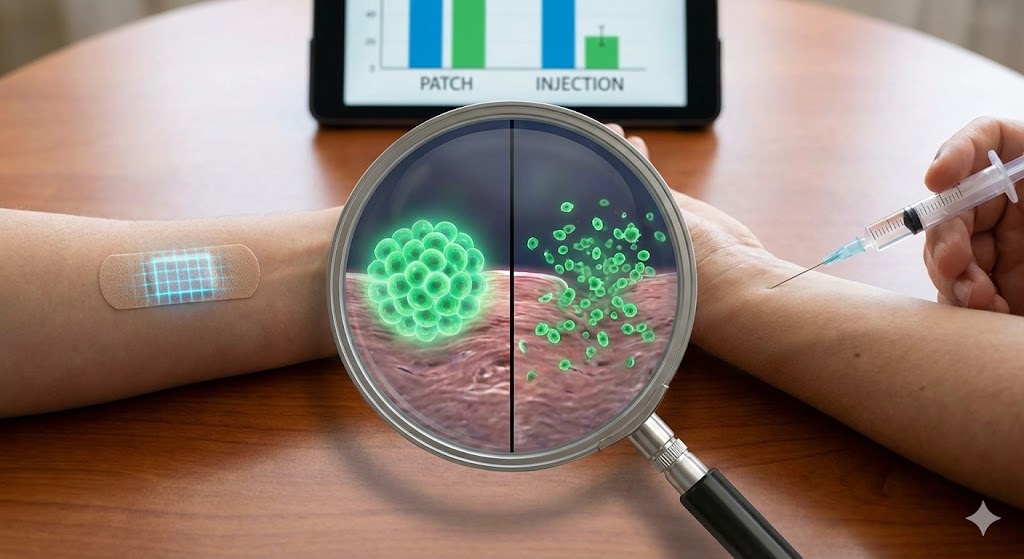
The advertisement promises everything. Wear a small patch on your skin for 12 hours. Your body’s stem cells “activate.” Inflammation decreases. Energy increases. You look younger within weeks. No needles, doctors, or $15,000 price tag.
The Two Technologies Called “Stem Cell Patches”
Search for stem cell patches online and you’ll encounter a confusing landscape. Consumer products like LifeWave X39 claim to “activate” your body’s stem cells through light or heat. Meanwhile, researchers at Stanford, Nature, and major medical centers develop bio-engineered patches containing actual stem cells for cardiac repair and wound healing.
These are not the same thing. Furthermore, the distinction matters enormously for anyone considering regenerative treatment.
Consumer activation patches typically cost $50 to $150 monthly. They’re classified as wellness products, not medical devices. Consequently, they haven’t undergone FDA approval or rigorous clinical testing. The companies selling them rely primarily on testimonials and general claims about “supporting” the body’s natural processes.
Medical stem cell patches, by contrast, are surgical implants used in research settings. A January 2025 study published in Nature documented how patches of muscle grown from stem cells helped repair a failing heart in clinical trials. Similarly, researchers have developed electromagnetic patches that deliver electrical pulses to stem cells for spinal cord injury repair.
The difference? One approach delivers actual living cells to damaged tissue. The other claims to stimulate existing cells through external means—without peer-reviewed evidence demonstrating effectiveness.
What Consumer “Activation” Patches Actually Claim
The marketing language around consumer stem cell patches deserves careful examination. These products don’t contain stem cells. Instead, they claim to use phototherapy or light frequencies to “activate” or “reset” stem cells already in your body.
Proponents cite studies showing the patches affect gene expression. Nevertheless, affecting gene expression and providing therapeutic benefit are different claims requiring different evidence. According to analysis from multiple independent sources, no peer-reviewed clinical trials demonstrate these patches deliver the anti-aging, pain relief, or regenerative benefits they advertise.
The FDA has not approved these products for any medical condition. Additionally, the International Society for Stem Cell Research warns consumers to verify claims about stem cell treatments through published research rather than testimonials.
This doesn’t mean everyone reporting benefits is lying. Placebo effects are real and measurable. Moreover, the human desire to believe in simple solutions to complex health problems is entirely understandable. However, spending $100 monthly on unproven patches while avoiding evidence-based treatments serves neither health nor wallet.
Medical Stem Cell Patches: What Research Shows
Legitimate stem cell patch research focuses on surgical applications. These bio-engineered devices contain living cells embedded in scaffolding materials like extracellular matrix or biodegradable polymers.
A Stanford study published in PubMed Central demonstrated that patches delivering adipose stem cells to wounds reduced scarring and improved healing compared to traditional treatment. The patch material extended stem cell survival long enough to create measurable positive effects.
Similarly, cardiac stem cell patches have shown promise in heart failure patients. Research in the Journal of the American Heart Association documented improved cardiac function in selected patients receiving autologous skeletal stem cell patch implantation. The 5-year survival rate for responders reached 90.9%—significantly better than predicted by standard heart failure models.
These results are encouraging. Nevertheless, medical stem cell patches require surgical implantation and remain largely experimental. They’re not available at wellness clinics or through consumer products. The gap between cutting-edge research and commercially available treatments remains substantial.
Stem Cell Injections: The Evidence Base
While patch technology develops in research settings, stem cell injections represent the current standard for regenerative treatment. Over 3,000 clinical trials involving adult stem cells are registered with the WHO International Clinical Trials Registry. The evidence base, while still evolving, offers substantially more support than consumer patch products.
For orthopedic conditions, meta-analyses of randomized controlled trials show mesenchymal stem cell injections improve pain scores and knee function in osteoarthritis patients. A 2025 systematic review in Stem Cell Research & Therapy analyzing multiple RCTs found significant improvements in WOMAC scores (the standard measure of arthritis symptoms) compared to control groups.
Dr. Brian Mehling, founder of Blue Horizon International and board-certified by both the American Board of Orthopaedic Surgeons and the American Board of Anti-Aging Medicine, has performed over 4,000 stem cell treatments. His practice uses IRB-approved protocols and has published research in peer-reviewed journals including PubMed Central and CellR4.
“The field is evolving rapidly,” explains the Harvard-educated physician who operates practices in West Islip, NY and Hackensack, NJ. “What distinguishes legitimate treatment from marketing is published outcomes data and regulatory compliance.”
Blue Horizon represents one of the few providers with FDA IND (Investigational New Drug) approval for acute ischemic stroke treatment—a distinction that required demonstrating safety and scientific merit to federal regulators.
Comparing Delivery Methods: Patches vs Injections
Understanding how each approach works clarifies their relative merits.
Consumer activation patches sit on skin surface. They claim to emit light frequencies that penetrate tissue and somehow “signal” stem cells to activate. No living cells are delivered. No direct intervention occurs at the cellular level. The mechanism relies on indirect effects that haven’t been validated in clinical trials.
Medical research patches are surgically implanted directly onto damaged tissue—the heart surface, wound bed, or spinal cord. They contain millions of living stem cells embedded in scaffolding that promotes cell survival and integration. The mechanism is direct: deliver regenerative cells to the site requiring repair.
Stem cell injections deliver living cells via needle to specific anatomical locations. For orthopedic conditions, ultrasound guidance ensures precise placement within joints or damaged tissue. For systemic conditions, intravenous administration distributes cells throughout the body. The mechanism is established: introduce regenerative cells where the body needs them.
The comparison reveals a fundamental distinction. Consumer patches attempt indirect stimulation. Medical treatments deliver direct cellular intervention. One approach hopes existing cells respond to external signals. The other provides new cellular resources for repair.
Cost Comparison: What You’re Actually Paying For
Price often drives treatment decisions. Therefore, understanding what different price points actually purchase matters.
Consumer activation patches cost $50 to $150 monthly, or $600 to $1,800 annually. For this investment, you receive a product with no FDA approval, no peer-reviewed efficacy data, and no guarantee of therapeutic benefit beyond placebo effect.
Stem cell injections typically range from $5,000 to $50,000 depending on the condition treated, cell source, and provider expertise. For orthopedic conditions, costs generally fall between $5,000 and $10,000 per treatment. This investment purchases living cells, medical oversight, treatment protocols developed from clinical research, and—at quality providers—published outcomes data.
The apparent cost advantage of consumer patches disappears under scrutiny. Two years of patch use ($3,600) approaches the cost of a single legitimate stem cell treatment that might actually address underlying tissue damage. Furthermore, the patch approach delays evidence-based intervention while conditions potentially worsen.
As healthcare economists often note, the cheapest treatment that doesn’t work is more expensive than the pricier treatment that does.
Who Should Consider Stem Cell Treatment
Not everyone benefits equally from regenerative medicine. Candidacy depends on specific conditions, overall health, and realistic expectations.
Strong candidates for stem cell injection therapy typically include individuals with osteoarthritis who want to avoid or delay joint replacement, athletes or active adults with tendon or ligament injuries, and patients with chronic inflammatory conditions unresponsive to conventional treatment.
Less suitable candidates include those expecting immediate or guaranteed results, patients with active infections or certain cancers, and individuals unwilling to participate in post-treatment rehabilitation protocols.
Quality providers conduct thorough evaluations before recommending treatment. At Blue Horizon International, patients undergo comprehensive assessment including laboratory and radiological examinations conducted according to established clinical protocols. The attending physician reviews each patient’s individual medical evaluation to determine the most appropriate approach.
This stands in stark contrast to consumer patch marketing, which typically promises benefits for virtually everyone regardless of condition or health status.
Questions to Ask Before Any Stem Cell Treatment
Whether considering patches, injections, or other regenerative approaches, informed consumers ask specific questions:
What peer-reviewed evidence supports this treatment? Legitimate providers can cite published research. Consumer patch companies typically cannot.
Is the provider following IRB-approved protocols? Institutional Review Board oversight indicates commitment to ethical research standards and patient safety.
What are the provider’s credentials? Board certification in relevant specialties (orthopedics, anti-aging medicine) demonstrates expertise. A physician who completed residencies at major hospitals and holds degrees from institutions like Harvard brings different qualifications than a wellness influencer.
How many procedures has the provider performed? Experience matters. A practice with 4,000+ treatments has encountered and learned from diverse patient presentations.
What outcomes data can they share? Quality providers track and publish results. Those with nothing to hide share their data.
The Counterintuitive Truth About Shortcuts
Here’s what the stem cell patch phenomenon reveals about healthcare decision-making: we desperately want simple solutions to complex problems. A patch you wear at home feels accessible and non-threatening. A medical procedure involving needles and physician visits feels intimidating and expensive.
Yet the counterintuitive truth is this—the path that feels easier often leads nowhere. Meanwhile, the path requiring more investment frequently delivers actual results.
Young millionaires spending $25,000 on comprehensive annual health screenings understand something the wellness patch customer doesn’t. As documented in Social Life’s coverage of status symbols young millionaires actually buy, the sophisticated wealthy invest in preventative medicine and evidence-based treatments—not consumer products promising effortless transformation.
This isn’t about gatekeeping regenerative medicine. It’s about distinguishing between hope and evidence, between marketing and medicine, between products that sound good and treatments that do good.
The Future of Stem Cell Patches
Legitimate stem cell patch technology continues advancing. Researchers are developing patches for wound healing, cardiac regeneration, and neurological conditions. The electromagnetic cellularized patch for spinal cord injury repair shows particular promise, with mouse studies demonstrating significant mobility recovery.
Eventually, some of this research will translate into clinical treatments. When it does, those treatments will come through medical channels with FDA oversight, published trial data, and physician administration—not through wellness websites promising activation through light frequencies.
Until then, consumers searching for legitimate regenerative treatment have established options. Stem cell injections from qualified providers offer the strongest current evidence base. Practices like Dr. Gaurav Goswami’s clinic and Blue Horizon International represent the standard for evidence-based regenerative medicine.
The choice between stem cell patches and injections ultimately comes down to this: Do you want the appearance of cutting-edge treatment, or do you want the substance? The answer determines not just your wallet’s health, but potentially your body’s as well.
Connect with Blue Horizon International
Dr. Brian Mehling and the Blue Horizon team offer consultations for patients exploring stem cell therapy options. With over 4,000 treatments performed and FDA IND approval for stroke treatment protocols, Blue Horizon represents the evidence-based standard in regenerative medicine.
- Schedule a Consultation with Blue Horizon
- Call Blue Horizon: (212) 206-7073
Stay Connected with Social Life Magazine
- Contact Social Life Magazine for features, advertising, and partnerships
- Experience Polo Hamptons – tickets and sponsorship opportunities
- Subscribe to Our Newsletter
- Print Subscription
- Support Our Journalism ($5)
Related Articles
Author

Written by
Recent Posts
How to Pick a Homecoming Dress for Your Body Type and Feel Amazing in It
How to Prepare a Home for Sale When Major Repairs Are Not Affordable
From Everyday Comfort to Personal Style: My SHEIN Slipper Habit
5 Best Mitsubishi Heat Pump Companies in Seattle
Tech Gadgets as Modern Corporate Gifts: Useful Ideas for Employees and Clients
Categories
- Art
- Articles
- Business of Luxury
- Celebrities
- Culture
- Entertainment
- Events
- Faces of Summer 2026
- Fashion
- Fashion & Style
- Featured
- Finance
- Food, Spirits, Wine
- Hamptons
- Hamptons Celebrities
- Health
- Health & Beauty
- Lifestyle
- Luxury Lifestyle
- Press
- Profiles
- Real Estate
- Technology
- The Chronicles
- Travel
- Uncategorized
- Weddings