
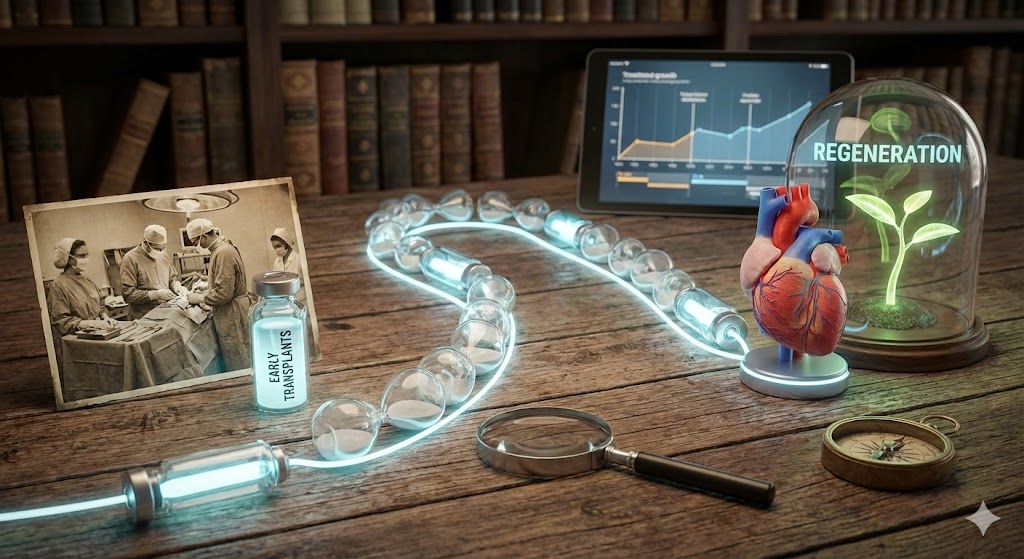
In 1958, six men exposed in a nuclear accident walked out of a Yugoslav hospital alive — saved by a therapy almost no one understood. That procedure was one of the first real uses of stem cell treatment in humans. It marked a quiet revolution behind the scenes of medicine. Over the decades, stem cells have graduated from emergency marrow rescues to experimental therapies with the potential to reshape aging, healing, and longevity. The story of stem cell therapy is also a story of bold science, ambition, controversy, and sometimes unfulfilled promise.
Tracing that arc — from the first marrow grafts to lab-grown tissues to today’s regenerative-medicine frontier — reveals how far we’ve come, why stem cells still fascinate, and where the boundary between real medicine and hype still holds firm.
Early Origins: How the Idea of “Stem Cells” Was Born
The term “stem cell” has roots in 19th-century biology. Back in 1868, the German biologist Ernst Haeckel used the German word “Stammzellen” to describe fundamental cells from which all multicellular life might arise. At the time, the concept was philosophical, not medical.
Over time, as scientists studied development and tissues under microscopes, hints emerged: some cells seemed to regenerate tissues — a signal that certain cells might act as cellular ancestors, capable of self-renewal and differentiation. That theoretical seed eventually sprouted true science.
Mid-20th Century Breakthroughs: First Transplants and Hematopoietic Stem Cells
The dramatic pivot from theory to therapy came in the 1950s and 1960s. In 1958, a French oncologist Georges Mathé performed bone-marrow transplantations on nuclear workers exposed to radiation — one of the first instances where stem cell treatment saved lives.
Then in the early 1960s, a pair of Canadian scientists — Ernest McCulloch and James Till — provided the first experimental proof that blood-forming stem cells existed. By transplanting bone-marrow cells into irradiated mice, they observed colony formation in the spleens — evidence that a single cell could self-renew and spawn different blood cells. That discovery sparked the modern stem cell field.
By the late 1960s, marrow transplants became a real therapy. In 1968, doctors at the University of Minnesota performed one of the first successful bone-marrow grafts to treat a child with a severe immune deficiency — paving the way for use in cancers, immunodeficiencies, and blood disorders.
Through the 1970s and 1980s, bone marrow transplantation matured. Researchers and clinicians began refining donor matching, transplant protocols, and supportive care. Those advances turned dangerous, experimental grafts into life-saving standard therapies.
The Rise of Pluripotent and Embryonic Stem Cells: From Mice to Humans
The next major wave came when scientists realized stem cells might do more than rebuild blood — they might regenerate tissues. In 1981, British scientist Martin Evans (among others) isolated embryonic stem cells from mouse embryos, creating the first lab-cultured lines. That breakthrough meant researchers could study development, disease, and genetics in unprecedented detail.
For nearly two decades, embryonic stem cell work stayed largely in mice — until 1998, when James Thomson and his team at the University of Wisconsin successfully derived human embryonic stem cells from donated embryos. That moment exploded possibilities: in-dish human tissues, disease modeling, and potential regenerative therapies.
These developments ignited both excitement and ethical debate. Embryonic stem cells held immense potential — but came with controversy around embryo use, consent, and regulation. That tension framed decades of research, funding battles, and social scrutiny.
Turning Back the Clock: Induced Pluripotency and the Promise of Patient-Matched Cells
The mid-2000s delivered a game changer. In 2006, scientist Shinya Yamanaka (and colleagues) discovered a method to reprogram adult skin or other cells back into a pluripotent state, creating what are now known as induced pluripotent stem cells (iPSCs). That innovation skirted ethical issues tied to embryonic cells — and opened the door to patient-specific therapies, where cells from an individual could potentially be used to regenerate their own tissues.
With iPSCs, researchers began imagining custom-built tissues: perhaps cardiac muscle after a heart attack, or even personalized organ patches without rejection risk. The lab-to-clinic pathway remains long, but the vision shifted: stem cell therapy was no longer just about blood — it was about rebuilding parts of the body.
From Theory to Trials: The Spread of Regenerative Medicine
Since the late 1990s and early 2000s, scientists have steadily pushed toward clinical applications. Treated conditions have ranged from blood cancers to genetic disorders, and increasingly into areas like musculoskeletal disease, neurology, and tissue engineering.
For example, in the 1990s researchers began testing adult stem cells (such as mesenchymal stromal cells, MSCs) in human patients. One early trial in 1995 treated fifteen patients with their own cultured MSCs, establishing early safety data.
By the 2010s and beyond, researchers were reporting pre-clinical successes: lab-grown cardiac cells, cartilage repair models, nerve regeneration experiments, and more. The field expanded into “regenerative medicine” — not just transplants, but potential restoration of damaged tissues.
The Complex Present: Many Promises, Some Reality, Ongoing Debate
Today, stem cell therapy sits at a crossroads. On one hand, bone marrow and cord-blood transplants remain among the most effective medical procedures for blood and immune diseases — saving thousands of lives each year. On the other, regenerative medicine is still experimental in many domains. Some early-promise therapies remain in trials; others are offered by private clinics with varying levels of evidence.
Organizations like International Society for Stem Cell Research (ISSCR) have spent decades pushing for ethical standards, transparent data, and responsible translation from lab to clinic. Their guidance helps separate valid science from marketing hype.
Why This History Matters for the Future of Medicine — and for You
Understanding where we came from helps gauge where we’re heading. What began as marrow grafts for radiation victims evolved into a field with the ambition to regenerate cartilage, heart muscle, even aging tissues. The lineage of stem cell science shows both humility and ambition — meticulous animal experiments, decades of safety data, and long-term institutional commitment. That foundation matters.
For high-net-worth individuals focused on longevity, performance, or elite wellness, that history offers context: there are real, proven breakthroughs — and there are frontier therapies that remain speculative. Knowing which is which helps you make informed decisions, avoid pitfalls, and spot true innovation when it matters.
Stem cell therapy’s past is messy, brilliant, hopeful — and far from over. The coming decades could rewrite medicine again as meaning not just treatment, but repair. And in that future, being informed isn’t optional. It’s essential.
Medical Disclaimer
This article is for informational purposes only and does not constitute medical advice. Stem cell therapies discussed here may not be approved for all indications in all countries. Always consult a qualified healthcare professional before making medical decisions or pursuing any treatment.
Related Articles
- The Hamptons Wellness Guide: Spas, Clinics and Retreats — for a broader view of luxury health in the Hamptons.
- Longevity Lifestyle: How Hamptons Insiders Think About Healthspan — how high-status individuals approach long-term health and performance.
Stay Connected with Social Life Magazine
Author

Written by
Recent Posts

hiTechMODA Season 16
How to Keep Your Personal Number Private When Booking Events, Rentals and Services
Understanding Compensatory Damages in a Personal Injury Case

When Online Family Therapy Makes Sense for Modern Families

Carrier Oils, Essential Oils, and Oil Blends: What Beauty Brands Need to Know
Categories
- Art
- Articles
- Business of Luxury
- Celebrities
- Culture
- Entertainment
- Events
- Faces of Summer 2026
- Fashion
- Fashion & Style
- Featured
- Finance
- Food, Spirits, Wine
- Hamptons
- Hamptons Celebrities
- Health
- Health & Beauty
- Lifestyle
- Luxury Lifestyle
- Press
- Profiles
- Real Estate
- Technology
- The Chronicles
- Travel
- Uncategorized
- Weddings