
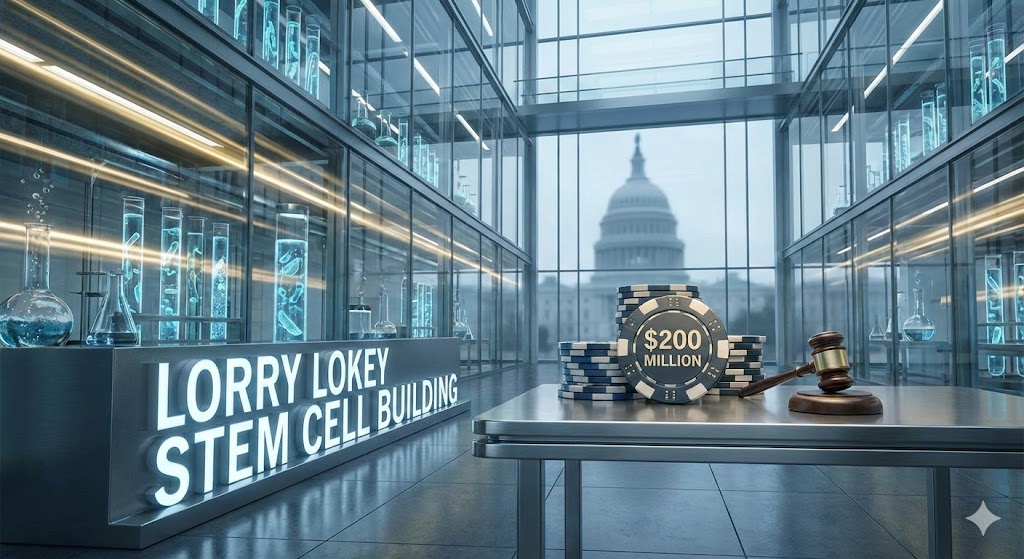
The first thing you notice when you walk into the Lorry Lokey Stem Cell Research Building is the chandelier. Or rather, the thing that looks like a chandelier but weighs as much as a Hummer H3. Two thousand and seventy-one pieces of hand-blown blue glass cascade through the three-story atrium, catching light in ways that make visitors stop and stare upward with their mouths slightly open. The artist Dale Chihuly named it Tre Stelle di Lapislazzuli. Three Stars of Lapis Lazuli. It glows gold at night.
The Man Who Saw What Others Missed
Lorry Lokey was born in Portland, Oregon, in 1927, during the Depression. His family nearly lost their house when a bank failed. He graduated from Stanford in 1949 with a journalism degree and spent his early career as a wire editor, watching financial news crawl across teletype machines. In 1961, at a conference in Los Angeles, he watched information move and had a thought that seems obvious now but wasn’t then. Corporate press releases could travel the same way.
He started Business Wire with $2,000 and seven clients. It turned profitable in four months. By 2006, when Warren Buffett’s Berkshire Hathaway bought the company for approximately $600 million, Lokey had already begun giving his fortune away. He would eventually donate more than $800 million, over 90 percent of his wealth. The pattern that made him rich was the same one that made him generous. He saw things before others did.
In 2001, the Bush administration restricted federal funding for human embryonic stem cell research to cell lines created before August of that year. Scientists could only use a handful of existing lines. Most researchers considered this a death sentence for the field. Lokey considered it an opportunity.
California’s Quiet Rebellion
What happened next is one of the more remarkable episodes in American science policy. In November 2004, California voters approved Proposition 71, creating a constitutional right to conduct stem cell research and allocating $3 billion in state bonds over ten years. The California Institute for Regenerative Medicine, known as CIRM, was born.
The vote passed 59 to 41 percent. More than 70 patient advocacy groups backed the measure, from the Juvenile Diabetes Research Foundation to the Alzheimer’s Association. Opponents filed lawsuits arguing CIRM violated the state constitution. Governor Arnold Schwarzenegger arranged loans from the general fund while the legal challenges dragged on. California issued its first stem cell research bonds in October 2007, nearly three years after voters approved them.
Stanford’s Irving Weissman, who had isolated stem cells in both mice and humans, watched these developments with particular interest. The man known as the father of hematopoiesis had a building to fill. He also had a benefactor willing to help fill it.
The $75 Million Question
In October 2008, Stanford announced that Lorry Lokey would donate $75 million toward a new stem cell research facility. CIRM added $43.6 million through its Major Facilities grants. The Lorry I. Lokey Stem Cell Research Building opened in 2010 with 200,000 square feet of laboratory space. At the time, it was the largest dedicated stem cell research building in the country.
Lokey was 81 when he made the gift. He expected to live past 90 and hoped to see some benefits from the research himself. When asked why stem cells, his answer was characteristically direct. He compared them to the silicon chip that created Silicon Valley. A new field of medicine for extending lives and improving their quality. He died in October 2022 at 95.
The building he funded now houses approximately 550 researchers. Four floors of laboratories support the Stanford Institute for Stem Cell Biology and Regenerative Medicine, the Stanford Cancer Center, the Ludwig Center for Cancer Stem Cell Research and Medicine, and the Stanford Neuroscience Institute. But the most important feature isn’t the equipment or the square footage. It’s the architecture.
The Hidden Architecture of Discovery
Theo Palmer was one of the first researchers to move in. An associate professor of neurosurgery, he had boxes everywhere. But he wasn’t complaining. The thing about the old arrangement, he explained, was that collaborators were 20 minutes away. You had to plan meetings. Schedule conversations. Make appointments to exchange ideas.
The Lokey Building changed that. Weissman and the architects designed open laboratories with communal gathering spaces. A wide central staircase leads to landings on each floor with comfortable seating overlooking the Chihuly sculpture. Break rooms and conference areas dot the research wings. The intention was deliberate. Make collision inevitable. Make serendipity structural.
Matthew Porteus moved to Stanford from Dallas shortly after the building opened. In his previous job, he said, many techniques had to be self-taught. Then he ran into Cindy Klein, who operates a training center in the Lokey Building for working with human embryonic stem cells and induced pluripotent stem cells. Any researcher who wanted training could get it. That’s what the center was for. His jaw dropped, he recalled. It was like being a kid in a candy store.
What Happens When You Bet on Science
Fifteen years after the building opened, the results are coming in. And they’re not subtle.
In July 2025, Stanford researchers published results from a Phase 1 clinical trial showing that an antibody treatment could prepare patients for stem cell transplants without toxic chemotherapy or radiation. The trial focused on children with Fanconi anemia, a genetic disorder that makes standard transplants extremely dangerous. All three patients in the study completed two years of follow-up and are doing well.
The research traces directly back to Weissman’s laboratory and the collaborative environment the building created. Agnieszka Czechowicz began studying blood-forming stem cells as an undergraduate in Weissman’s lab in 2004. Their work identified CD117, a protein that regulates stem cell growth. An antibody targeting CD117 could eliminate the cells without chemotherapy’s devastation. Working with other Stanford scientists in the Lokey Building, they identified the clinical antibody now being tested in humans.
In November 2025, another Stanford team reported they had cured Type 1 diabetes in mice using a combined blood stem cell and islet cell transplant. The procedure creates a hybrid immune system that stops autoimmune attacks. Human trials may follow.
Earlier that same year, Weissman and collaborators published research in Nature showing that depleting myeloid-biased stem cells could rejuvenate aged immunity. The discovery suggests potential strategies for improving immune function in older adults. The research was conducted in the building Lokey funded, by scientists who studied under Weissman, using infrastructure California voters authorized two decades ago.
The Economics of Defiance
Critics of Proposition 71 warned that public investment in stem cell research was a gamble. According to an economic impact report from USC, CIRM funding generated $10.7 billion in economic activity in California between 2005 and 2018. Nationally, the figure exceeded $15 billion. The program created an annual average of nearly 3,000 jobs in California alone, mostly in high-paying life sciences positions.
In 2020, California voters approved Proposition 14, authorizing an additional $5.5 billion in bonds for stem cell research. Robert Klein, who wrote the original Proposition 71, led the campaign again. The definition of possible, he said at a stem cell center opening years earlier, had changed.
Stanford has received more CIRM funding than any other institution, approximately $95 million in the program’s early years alone. The Lokey Building sits at the center of that investment. It houses the labs where the antibody for chemo-free transplants was developed. The training center where researchers learn to culture stem cells. The conference rooms where scientists from different disciplines accidentally encounter each other and start conversations that become collaborations that become clinical trials.
What the Chandelier Represents
Sue McCollum, the breast cancer survivor who asked about Chihuly, had received radiation therapy at Stanford. The treatments left permanent blue tattoos on her body as guide marks. She named her cancer research nonprofit My Blue Dots. When she flew to Seattle with Weissman to pitch Chihuly on creating something for the building, she brought slides of immunofluorescence images. One showed a sphere of human fetal brain stem cells with dividing cells extending axon-like processes outward. Chihuly saw his own work in it. He agreed to the commission.
Art can inspire people in life’s activities, Weissman said at the time. It provides symbols that remind us why we’re doing what we’re doing. The blue glass cascading through the atrium represents something more than aesthetic ambition. It represents a decision made when the federal government said no. A bet placed by a Depression-era kid who built a fortune seeing what others missed. A building designed so that people would bump into each other and start talking.
The Lorry Lokey Stem Cell Research Building is located at 265 Campus Drive in Palo Alto, a short walk from the Stanford School of Medicine. It looks like what it is: a world-class research facility with an impressive chandelier. What it represents is harder to see until you understand the history. California decided to fund the future when Washington wouldn’t. Lorry Lokey wrote a $75 million check because he believed stem cells would matter as much as silicon chips. Researchers who trained under Weissman are now running clinical trials that might eliminate chemotherapy from transplant protocols.
You can tour the building during Stanford’s regular campus visits. The Chihuly chandelier is worth seeing. So is everything happening in the laboratories above it. The scientists working there are translating what California voters authorized 20 years ago into treatments that might reach patients tomorrow. They’re proving what Lokey believed. Some bets pay off.
Learn More About Regenerative Medicine
The science emerging from Stanford’s stem cell research center represents the cutting edge of regenerative medicine. For those interested in how these breakthroughs translate to clinical treatments, including evidence-based stem cell therapy for back pain and the differences between stem cell patches and injections, understanding the research infrastructure is essential.
Stanford’s Institute for Stem Cell Biology and Regenerative Medicine conducts research, not patient treatments. However, the clinical trials and therapeutic approaches developed there eventually reach qualified providers. For readers exploring regenerative treatments for orthopedic conditions, our nine questions to ask before any stem cell treatment provides a framework for evaluating providers and understanding the evidence behind different approaches.
Connect with Social Life Magazine
- Contact Us for features, advertising, and partnerships
- Polo Hamptons — Tickets and sponsorship information
- Print Subscription
- Support Our Journalism ($5)
Related Articles
Author

Written by
Recent Posts
Unlocking the Berkshires
Dalia Forman Design
Alberto Luzzi
How to Pick a Homecoming Dress for Your Body Type and Feel Amazing in It
How to Prepare a Home for Sale When Major Repairs Are Not Affordable
Categories
- Art
- Articles
- Business of Luxury
- Celebrities
- Culture
- Entertainment
- Events
- Faces of Summer 2026
- Fashion
- Fashion & Style
- Featured
- Finance
- Food, Spirits, Wine
- Hamptons
- Hamptons Celebrities
- Health
- Health & Beauty
- Lifestyle
- Luxury Lifestyle
- Press
- Profiles
- Real Estate
- Technology
- The Chronicles
- Travel
- Uncategorized
- Weddings