
The Return to Roots: Where Horses Meet Haute Couture
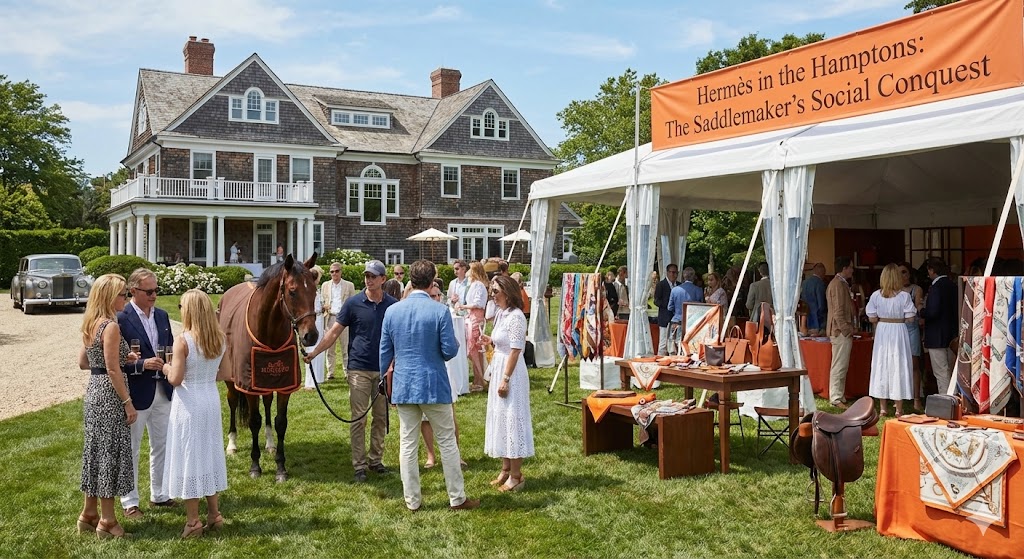
The Deslauriers Farm in Water Mill sits quiet most of the year. However, on the first Friday of September 2023, it transformed into something else entirely. Hermès had arrived—not to sell, but to consecrate. Indeed, the occasion was the unveiling of the Selle Faubourg saddle, and the guest list read like a social registry filtered through a fashion editor’s Rolodex: Brooke Shields, Aerin Lauder, Jessica Springsteen, Katie Couric. Notably, they gathered not in a boutique but on a working horse farm, surrounded by the animals that made Hermès Hamptons presence feel less like marketing and more like homecoming.
This is precisely what Hermès understands that its competitors struggle to replicate. While other luxury houses rent real estate and hang shingles, Hermès returns to its founding mythology. After all, the company began in 1837 making harnesses for horses. Nearly two centuries later, at the Hampton Classic horse show, they still sponsor the Hermès Equitation Championship. Consequently, the message requires no translation: we were here before you needed us, and we’ll be here long after.
Pierre Bourdieu, the French sociologist who spent his career dissecting how taste operates as a weapon of class warfare, would recognize the strategy immediately. Hermès isn’t selling bags in the Hamptons. They’re selling legitimacy.
The Hermès Genesis: From Krefeld to Cultural Empire
Thierry Hermès was born in 1801 in Krefeld, Germany, the sixth child of an innkeeper. By his early twenties, disease and the Napoleonic Wars had orphaned him. Subsequently, he moved to Paris and apprenticed as a saddler, eventually opening his own workshop at 26 rue Basse-du-Rempart in 1837. His insight was practical: the harnesses of the day were poorly designed, hampering horse movement. Therefore, he built better ones.
The quality attracted attention. Napoleon III became a customer, and so did his Empress Eugénie. Moreover, Hermès won first-class medals at the Universal Exhibitions of 1855 and 1867. When Thierry died in 1878, he left his son Charles-Émile a business already synonymous with excellence among European nobility.
Charles-Émile subsequently relocated the workshop to 24 rue du Faubourg Saint-Honoré—still the company’s headquarters today—and expanded into saddlery. His sons, Adolphe and Émile-Maurice, saw further. As the automobile threatened to make horses obsolete, Émile-Maurice pivoted decisively. First, he introduced leather goods, securing an exclusive French license for the zipper in 1923. Then came the silk scarves. Above all, he understood that a company built on serving horses could survive by serving the people who once rode them.
The Mythology Machine
The official Hermès narrative emphasizes continuity and craft: six generations of family ownership, single artisans handmaking bags from start to finish, no marketing department, no celebrity endorsements, no discounts—ever. Yet what the story elides is equally instructive: the strategic acquisitions of crystal maker Saint-Louis and silversmith Puiforcat, the quiet expansion into 300 stores worldwide, the 2010 battle against Bernard Arnault’s attempted takeover.
On one hand, Hermès tells a story of artisanal purity. On the other, the numbers tell a story of a $261 billion empire. In April 2025, Hermès surpassed LVMH to become the world’s most valuable luxury company. Ultimately, the mythology and the market capitalization are not contradictions—they’re accomplices.
Hermès’s Four Capitals: Decoding Luxury’s Hidden Currency
Bourdieu identified four forms of capital that determine social position. Remarkably, Hermès has mastered all of them.
Economic Capital
The entry point for Hermès leather goods begins around $3,200 for an Evelyne bag. Meanwhile, the Birkin 25 in Togo leather now retails at $12,700 in the United States—up 29% since 2016. Similarly, the Birkin 30 commands $13,900. Exotic skins push prices to $25,000 and beyond, while at auction, rare pieces fetch six figures. For instance, a Himalaya Birkin—crafted from Niloticus crocodile dyed to mimic snow-capped peaks—has sold for over $400,000.
These prices establish an economic floor, but they don’t capture the full cost. Indeed, studies suggest Birkin bags have appreciated at an average annual rate of 14.2% since their introduction in 1984, outperforming both the S&P 500 and gold. According to Sotheby’s, secondary market prices for pristine Birkins hover between $28,000 and $30,000—more than double retail. In other words, you’re not buying a bag. You’re acquiring a position in an asset class.
Cultural Capital
Hermès demands knowledge. The uninitiated might recognize a Birkin, yet insiders distinguish between Togo, Epsom, and Clemence leathers. Moreover, true connoisseurs know the difference between Retourne (softer, turned inside out during construction) and Sellier (structured, with visible exterior stitching). Beyond that, they understand that the bag’s date stamp indicates both year and individual artisan—and can spot a horseshoe stamp denoting a Special Order from thirty feet.
This knowledge isn’t accidental. Rather, Hermès designs products that reward connoisseurship. For example, the Kelly bag exists in at least a dozen sizes. Likewise, scarves come in Carré (90cm), Gavroche (45cm), Twilly, and Maxi formats, with designs that reference equestrian history, artistic movements, and house archives. Consequently, to properly consume Hermès is to have studied Hermès—a barrier as effective as any price tag.
Social Capital
Money alone cannot buy a Birkin. Hermès maintains what customers call the “quota system”—typically two Birkins or Kellys per customer per year. However, even this understates the gatekeeping. Prospective buyers must first establish “purchase history” with ancillary products: scarves, belts, shoes, home goods. Additionally, they must cultivate relationships with sales associates, sometimes over years. Furthermore, they must accept uncertain wait times with no official waiting lists.
The CBS News profile of artistic director Pierre-Alexis Dumas captured this dynamic. “Whatever we have, we put on the shelf, and it goes,” he explained. Hermès insists scarcity isn’t manufactured—they simply can’t train artisans fast enough. Critics call it artificial constraint. Either way, it transforms purchasing into privilege.
As a result, carrying a Birkin signals not just wealth but social access—the connections required to navigate the buying process, the patience to wait, the knowledge to select the right combination. Essentially, you join a community of people who have proven themselves worthy.
Symbolic Capital
Hermès occupies a peculiar position in the luxury hierarchy: simultaneously understated and unmistakable. Unlike competitors plastered with logos, Hermès products often bear only the most discreet branding. Specifically, the Kelly bag’s distinctive turn-lock closure and trapezoid silhouette communicate identity to those who recognize it while appearing merely elegant to those who don’t.
This is the purest form of symbolic capital. In essence, Hermès signals to those capable of receiving the signal. It allows old money to maintain distinction without vulgarity and permits new money to demonstrate taste rather than merely spending power. As Bourdieu observed, the dominant classes prefer cultural goods that require cultivation to appreciate. Thus, Hermès products are cultural goods disguised as consumer goods.
Why Hermès Chose the Hamptons—And What It Reveals
Hermès first entered the Hamptons market in 2009 with a temporary store at 63 Main Street in East Hampton. Notably, the 2,000-square-foot space, open May through September, was the brand’s first seasonal boutique anywhere. Furthermore, the design broke from typical Hermès retail: primarily white, with sisal flooring, emphasizing casual relaxation over Parisian formality.
“We know that the potential is great,” then-CEO Robert Chavez told Women’s Wear Daily. “We want to make this very casual and relaxed. People go to the Hamptons to get away from all the formality.”
Although the location has since closed, Hermès’s Hamptons presence has only deepened. Currently, the company maintains a presence at the Hampton Classic horse show, selling accessories from a stall in the Boutique Garden and sponsoring the Hermès Equitation Championship. In 2023, for instance, they hosted the Selle Faubourg saddle unveiling at a private farm event featuring entertainment and equestrian demonstrations. The invitation list included A-list attendees and equestrian nobility alike.
The strategy reveals sophisticated positioning. By aligning with equestrian culture rather than merely opening a store, Hermès returns to its origin story in a location where that story carries maximum resonance. After all, the Hamptons remain one of the few American locales where equestrian culture persists among the elite. Moreover, the Hampton Classic draws 50,000 spectators annually, including established families whose ancestors might have actually used Hermès harnesses. Here, accordingly, the brand’s founding mythology becomes lived experience.
Playing the Field: Hermès vs. the Competition
The Hamptons luxury landscape includes Louis Vuitton, Gucci, Brunello Cucinelli, and The Row, among others. Each occupies distinct territory. For example, Louis Vuitton offers accessible entry points and recognizable logos. Meanwhile, Brunello Cucinelli promises humanistic Italian craftsmanship. By contrast, The Row traffics in minimalist anonymity.
Hermès, however, competes on different terms. Where LVMH—Louis Vuitton’s parent company—owns 75 brands and generated €86.2 billion in 2023 revenue, Hermès remains singular. Specifically, the company maintains 80% of production in-house, primarily in France. It refuses to discount. It doesn’t chase trends or collaborate with streetwear labels. When LVMH’s Bernard Arnault attempted a hostile takeover in 2010, secretly amassing a 17% stake, the Hermès family rallied to create a holding company controlling 54% of shares. Ultimately, they successfully repelled the advance, and today the family owns 67% of the company.
This independence shapes customer perception. Fundamentally, Hermès buyers aren’t purchasing a conglomerate product—they’re buying into a family business that resisted the twentieth century’s most aggressive luxury acquirer. In Bourdieu’s terms, Hermès offers not just a bag but a position in a symbolic struggle: the customer aligns with independence against consolidation, craft against commerce, heritage against disruption.
For old money Hamptons residents, this positioning resolves a specific anxiety—they can consume luxury without appearing to chase fashion. Conversely, for new money arrivals, Hermès offers legitimate taste: the right choice, validated by history, that won’t embarrass them at dinner parties.
The Hermès Investment: Cultural Arbitrage or Earned Distinction?
Hermès products are available at the brand’s Manhattan flagship (706 Madison Avenue) and through its website, though the most coveted items remain subject to availability and relationship requirements. Additionally, the Hampton Classic runs annually over Labor Day weekend in Bridgehampton, where Hermès maintains a boutique presence.
For Hamptons visitors seeking meaningful engagement with the brand, timing matters. Specifically, the equestrian events offer opportunities to experience Hermès in context—watching riders in Hermès saddles, examining the craftsmanship that defines everything the company makes. This is more valuable than any purchase. Indeed, it’s education in the codes that govern legitimate taste.
Bourdieu argued that taste appears natural but is always learned. The wealthiest consumers understand this intuitively. Therefore, they don’t buy Hermès to display wealth—they buy Hermès to demonstrate mastery of the game itself. The bag is incidental. The cultural capital is the point.
At the Deslauriers Farm that September evening, surrounded by horses and heiresses, Hermès wasn’t selling saddles. Instead, they were selling what they’ve always sold: the feeling that you belong somewhere exclusive, that you understand something others don’t, that your choices reflect not just money but meaning. The saddle, like the bag, is just the artifact. Ultimately, the real product is distinction itself.
Continue Your Luxury Education
- Cultural Capital in Luxury Branding: A New Paradigm – Explore how authentic cultural integration drives measurable results for luxury brands in the Hamptons market.
- 10 Luxury Fashion Trends Defining The Hamptons Style in 2025 – Discover how houses like Hermès, Louis Vuitton, and Brunello Cucinelli are shaping East End aesthetics.
Stay Connected with Social Life Magazine
Author

Written by
Recent Posts

Unlocking the Berkshires
Dalia Forman Design
Alberto Luzzi
How to Pick a Homecoming Dress for Your Body Type and Feel Amazing in It
How to Prepare a Home for Sale When Major Repairs Are Not Affordable
Categories
- Art
- Articles
- Business of Luxury
- Celebrities
- Culture
- Entertainment
- Events
- Faces of Summer 2026
- Fashion
- Fashion & Style
- Featured
- Finance
- Food, Spirits, Wine
- Hamptons
- Hamptons Celebrities
- Health
- Health & Beauty
- Lifestyle
- Luxury Lifestyle
- Press
- Profiles
- Real Estate
- Technology
- The Chronicles
- Travel
- Uncategorized
- Weddings