
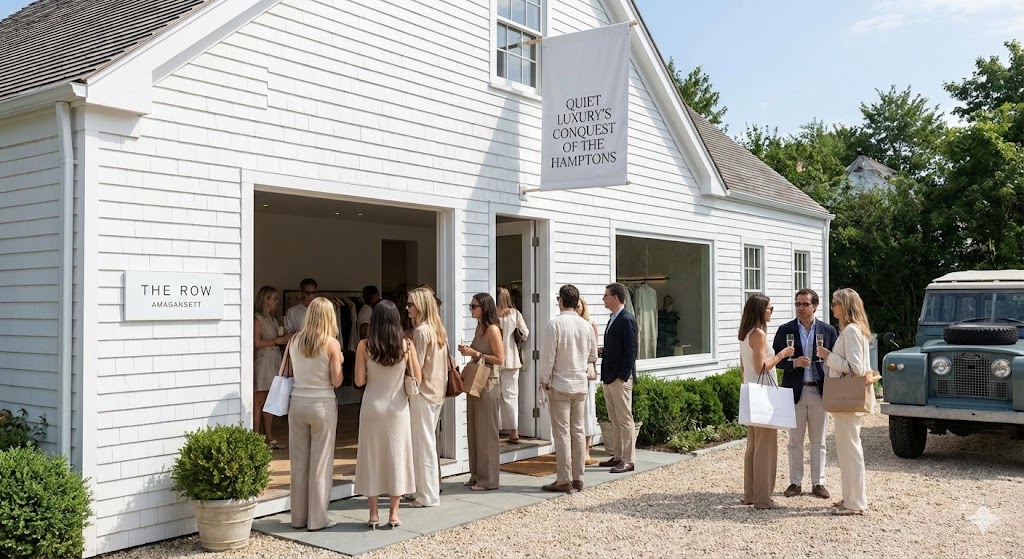
216 Main Street: Where Quiet Becomes Currency
She doesn’t browse. Instead, the woman enters The Row Amagansett the way one enters a private gallery—with purpose, without performance. Notably, the saleswoman doesn’t approach immediately. There’s a protocol here, a rhythm the staff has calibrated to match the clientele’s expectations.
This is 216 Main Street, where the Hamptons’ most understated boutique occupies a building that previously housed Tiina the Store. That space was itself a destination for fashion editors seeking refuge from logo-drenched retail. The Row opened here Memorial Day weekend 2024, arriving with what the Daily Front Row called “quiet fanfare befitting the quiet luxury brand.”
Inside, the space speaks in whispers. Vintage Pierre Jeanneret chairs—the same collectible furniture commanding five figures at auction—serve as seating, not merchandise. Meanwhile, a Charlotte Perriand daybed anchors one corner. Furthermore, the clothing hangs sparse against white walls, each piece given room to breathe, to declare its own significance through negative space.
Pierre Bourdieu, the French sociologist who spent his career dissecting how taste functions as social weaponry, would recognize this instantly. Essentially, what The Row Amagansett sells isn’t clothing. Rather, it’s a particular resolution to a very specific anxiety: the fear that your wealth is visible but your cultivation is not.
The Genesis: From Perfect T-Shirt to Billion-Dollar Valuation
In 2005, Ashley Olsen was eighteen years old and already worth more than most people would earn in several lifetimes. Yet she had one problem: she couldn’t find a decent white T-shirt.
This origin story has since become fashion mythology. Ashley tested prototypes on women aged twenty to sixty, searching for what she called a “commonality in fit and attitude.” By 2006, she and twin sister Mary-Kate had produced a seven-piece collection. Remarkably, Barneys New York bought every piece. Moreover, the brand was named after London’s Savile Row—a gesture toward bespoke tailoring’s highest temple—yet the sisters kept their names off the label entirely.
For three years, they gave no interviews. Instead, the clothes bore only a thin gold chain rather than a traditional label. Customers who knew, knew. Everyone else didn’t need to.
The Mythology Machine
Notably, the Olsen twins’ background is both advantage and obstacle. Cast as Michelle Tanner on Full House at nine months old, they became millionaires many times over by age eighteen. By twelve, they had launched a clothing line at Walmart. Celebrity designers typically fail because the market suspects—correctly—that fame substitutes for talent.
However, Mary-Kate and Ashley chose the opposite approach. Specifically, they made their celebrity invisible. They stopped acting entirely in 2012 and declined to leverage their famous faces for promotion. Consequently, The Row had to succeed on product alone.
And succeed it did. In 2012 and 2015, the CFDA named them Womenswear Designer of the Year, beating Marc Jacobs and Proenza Schouler. Additionally, they won Accessory Designer of the Year in 2014, 2018, 2019, and again in 2025. Then in September 2024, the families behind Chanel and L’Oréal—the Wertheimers and Françoise Bettencourt Meyers—acquired minority stakes at a valuation near one billion dollars.
These aren’t passive investors. According to Business of Fashion, the Wertheimers’ Mousse Partners and Bettencourt Meyers’ Tethys Invest represent two of Europe’s most sophisticated luxury dynasties. Therefore, their endorsement functions as consecration—the transformation of commercial product into cultural artifact.
The Four Capitals: Decoding The Row’s Hidden Currency
Economic Capital
The Row’s price architecture is unforgiving. For instance, a basic cashmere sweater starts around $1,500. Meanwhile, the signature Margaux handbag—a trapezoidal top-handle design that Harper’s Bazaar dubbed “the new Birkin”—begins at $3,200 for canvas and reaches $6,400 or more for calfskin. Furthermore, exotic leathers push the Margaux into five figures, pricing it alongside Hermès.
Investment performance tells the real story. According to resale market analysis, the Margaux regularly sells for forty percent above retail on secondary markets. Additionally, the brand has reportedly removed certain colorways from production entirely—thereby engineering scarcity that drives secondary prices higher. You don’t browse The Row’s website hitting “notify me” buttons. Either you catch a drop, or you enter the aftermarket.
Annual revenue likely falls between $250 and $300 million, with online sales contributing roughly thirty percent. This is unusually high for ultra-luxury, where tactile experience typically dominates purchasing. In fact, the billion-dollar valuation implies multiples comparable to what Kering paid for Valentino. Clearly, the market has spoken.
Cultural Capital
What must you know to properly consume The Row? First, start with the absence of visible branding. No logos appear anywhere, and the label is deliberately subtle. Consequently, recognizing a Row coat on another person requires preexisting knowledge—you must have studied the silhouettes, understood the drape, registered the precise shade of camel or midnight that the house favors.
Moreover, appreciation demands familiarity with what The Row references. The furniture in their stores signals taste hierarchies—Pierre Jeanneret, Jean Prouvé, Charlotte Perriand. Similarly, their Instagram posts feature Marc Chagall paintings and Man Ray sculptures alongside product shots. Essentially, the message is clear: purchasing here requires cultural literacy that money alone cannot provide.
This is embodied cultural capital in Bourdieu’s framework—the internalized knowledge that marks legitimate taste. New money can buy the bag. However, old money buys the bag and knows why the Traineau chair it’s displayed on matters.
Social Capital
The celebrity ecosystem around The Row reads like a roster of quiet sophistication. Jennifer Lawrence, Kendall Jenner, Gwyneth Paltrow—these are women whose wealth is unquestionable but whose public image benefits from appearing cultivated rather than flashy. As a result, carrying a Margaux signals membership in a network that values discretion.
Meanwhile, the Amagansett store’s sales associates operate differently from typical luxury retail, according to visitors. Rather than pressuring, they offer water. They prepare fitting rooms in advance for returning clients and remember what you purchased last season. Ultimately, this creates the intimate relationships that transform transactions into ongoing affiliations.
Symbolic Capital
Where does The Row sit in the luxury hierarchy? The answer depends on who’s evaluating. To mainstream consumers, Gucci and Louis Vuitton command more recognition. However, to fashion insiders, The Row occupies the same tier as Hermès and Phoebe Philo-era Céline—houses whose prestige derives from product excellence rather than marketing saturation.
This positioning solves a particular problem for wealthy consumers. After all, logos broadcast wealth to everyone—including people whose approval you neither need nor want. By contrast, The Row broadcasts taste exclusively to people already equipped to recognize it. You’re not signaling to the masses. Instead, you’re signaling to your peers.
Why Amagansett: The Strategic Geography of Quiet Luxury
The Row didn’t choose East Hampton proper, where Chanel and Gucci compete for Main Street frontage. Nor did they choose Southampton, with its see-and-be-seen energy. Instead, they chose Amagansett—the hamlet whose very name, derived from Montaukett for “place of good water,” suggests something essential rather than ornamental.
Historically, Amagansett is where Marilyn Monroe and Arthur Miller summered in a converted windmill. It’s where Lou Reed died in 2013, having made it his “spiritual home.” Furthermore, this is where the Devon Colony, founded by Procter & Gamble executives in the nineteenth century, established a template for discreet wealth that persists today. Although the village population hovers around 650 year-round, its beaches draw incognito celebrities precisely because nobody acknowledges them.
Location is strategy. Brunello Cucinelli and Loro Piana—The Row’s most direct competitors in the quiet luxury space—have established Hamptons presence elsewhere. By choosing Amagansett, The Row therefore claims territory aesthetically aligned with its brand identity: understated, knowledgeable, allergic to spectacle.
Notably, the store itself occupies a building dating to the 1800s, renovated in 2018 with double-height ceilings, ceramic tile floors, and exposed beams. This is The Row’s fourth boutique outside a major city—joining locations in Los Angeles, Manhattan’s Upper East Side, and London’s Mayfair. Indeed, each store is designed less as retail space than residential gallery, where merchandise exists alongside museum-quality furniture.
Playing the Field: The Quiet Luxury Competition
The Hamptons luxury retail field includes established European houses—Hermès in Southampton, Cartier’s summer presence, Gucci on East Hampton’s Newtown Lane. Additionally, newer arrivals like Khaite, which opened its East Hampton flagship the same summer as The Row’s Amagansett debut, have entered the scene.
So what distinguishes The Row from competitors? Consider the quiet luxury spectrum. Loro Piana and Brunello Cucinelli offer comparable fabrics and price points, but both are European houses with deeper heritage narratives. In contrast, The Row is American—founded by actresses, based in Tribeca, manufacturing in Italy. This combination is unprecedented.
Specifically, the brand occupies a particular position in what Bourdieu called the field of cultural production. It’s American enough to feel domestic, yet Italian-made enough to claim craft legitimacy. Moreover, it’s celebrity-adjacent enough to generate fascination, yet publicity-averse enough to maintain mystique. Paradoxically, the Olsen twins’ refusal to leverage their fame has made their fame more valuable—proof that the product can stand alone.
Prada’s 2024 release of a tote suspiciously similar to the Margaux demonstrates The Row’s market position. When competitors copy, you’ve established the template. Tellingly, The Row didn’t publicly acknowledge the resemblance—which, in the field of luxury, communicates more than any statement could.
The Verdict: Investment, Aspiration, or Cultural Arbitrage
The Row Amagansett opens daily from 10:00 AM to 6:00 PM at 216 Main Street. Appointments can be booked through the brand’s website. The salespeople will not pressure you. The prices, however, will.
Who belongs here? Essentially, it’s the customer who understands that conspicuous consumption has become its own form of vulgarity. It’s the customer who has moved beyond acquiring symbols and now acquires meaning. Ultimately, it’s the customer for whom a $6,400 handbag represents not expenditure but ideology—a belief that quality, discretion, and cultural capital outrank volume, visibility, and economic capital alone.
Bourdieu would note what’s actually for sale at The Row Amagansett. It’s not clothing. It’s not accessories. Rather, it’s resolution of a paradox that troubles anyone who has achieved material success: how do you display wealth without appearing to display wealth? How do you signal status without seeming to seek status? How do you demonstrate cultivation while appearing indifferent to cultivation?
The Row’s answer is elegant. You don’t display. You simply are. The clothes know. The furniture knows. And the people who matter will know too.
Finally, the woman finishes trying on a cashmere coat. She doesn’t check the price tag—she already knows what The Row costs. She leaves the coat on the Pierre Jeanneret chair for the saleswoman to return. Perhaps she’ll buy. Perhaps she won’t. But she’ll be back. They always come back.
Continue Your Luxury Education
- Best Hamptons Fashion Boutiques You Must Visit – Where fashion editors actually shop when the cameras aren’t watching.
- 10 Luxury Fashion Trends Defining Hamptons Style – From quiet luxury to conscious consumption, the codes that matter.
Stay Connected with Social Life Magazine
Author

Written by
Recent Posts
Simple Ways to Maintain Your Energy During a Busy Week

How South Florida Commercial Properties Are Adapting to Modern Energy Demands
How to Measure Whether a Hair Loss Treatment Is Working
Is Online Psychiatry Covered by Insurance? What to Know Before Booking
Four Habits of Quietly Successful Entrepreneurs
Categories
- Art
- Articles
- Business of Luxury
- Celebrities
- Culture
- Entertainment
- Events
- Faces of Summer 2026
- Fashion
- Fashion & Style
- Featured
- Finance
- Food, Spirits, Wine
- Hamptons
- Hamptons Celebrities
- Health
- Health & Beauty
- Lifestyle
- Luxury Lifestyle
- Press
- Profiles
- Real Estate
- Technology
- The Chronicles
- Travel
- Uncategorized
- Weddings