
How Two Sisters from Paddington Markets Built a Billion-Dollar Empire—And What Their East End Presence Reveals About Contemporary Luxury
The Bikini That Changed Everything
The woman hasn’t touched it yet. She circles the display at Zimmermann Hamptons on Newtown Lane, her fingertips hovering above the broderie anglaise cotton like a sommelier approaching a first-growth Bordeaux. The dress costs $1,200. The knowledge of how to want it properly—that took considerably longer to acquire.
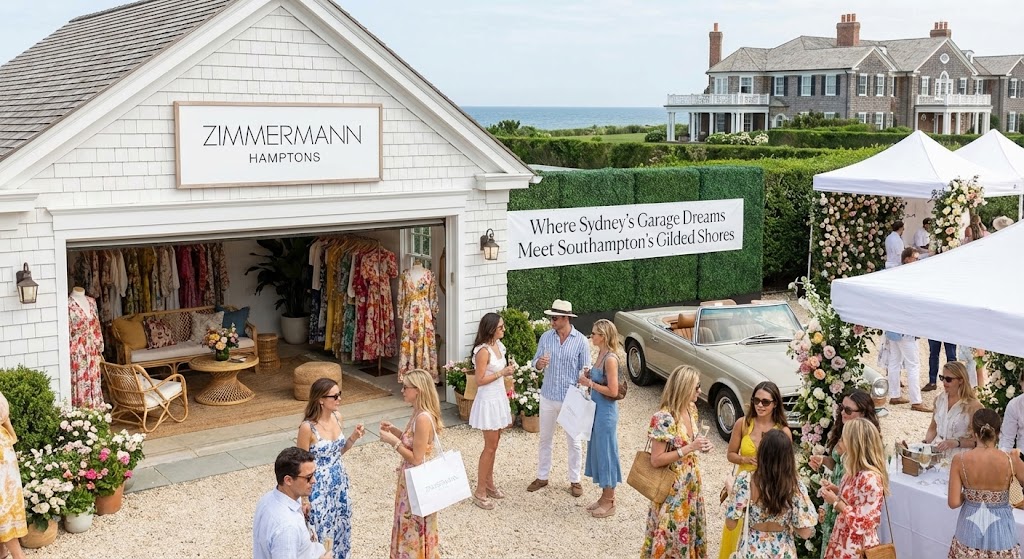
This is the quiet machinery of distinction at work. Furthermore, the Zimmermann boutique in East Hampton occupies a restored beach cottage that feels deliberately modest from the sidewalk. No marble, no gilded flourishes, no screaming logos. Just weather-beaten shingles and the faint promise of something worth knowing. Meanwhile, across the village, Louis Vuitton’s Bernard Arnault paid $22 million for prime real estate. Zimmermann’s strategy whispers where others shout.
Inside, ruffled gowns cascade from hangers like frozen waterfalls. Floral prints tell stories of Australian mornings and European summers. The sales associates speak with Brisbane accents, and the effect is disorienting in precisely the right way. Consequently, you’ve stepped outside the American luxury paradigm and into something both foreign and familiar. This is resort wear that understands resort life isn’t about where you go. It’s about who you are when you arrive.
The Zimmermann Genesis: From Garage to Global Empire
In 1991, Nicky Zimmermann worked from her parents’ garage in Sydney, cutting fabric by hand and dreaming about what women might want to wear. Her sister Simone handled the business side. Their first retail venue was a weekend stall at Paddington Markets, where Nicky could watch customers’ faces and adjust her designs accordingly. This wasn’t market research in the corporate sense. It was something more intimate: a conversation conducted in cotton and silk.
The inflection point came when Australian Vogue published two pages of Nicky’s designs. Orders flooded in from boutiques across the country. Nevertheless, the sisters maintained their operational discipline. They understood something that escapes many fashion entrepreneurs: growth without infrastructure creates chaos, not empire. They built showrooms in Sydney, then London, then New York and Los Angeles. Each expansion followed demand rather than preceding it.
The Mythology Machine
What Zimmermann tells about itself matters as much as what it makes. The garage origin story functions as cultural capital, positioning the brand against the corporate genealogies of LVMH or Kering conglomerates. This is fashion with fingerprints still on it. Consequently, ownership has evolved strategically: General Atlantic took a minority stake in 2016, followed by Style Capital’s 70% acquisition in 2020 at a €500 million valuation. Then in August 2023, Advent International acquired a majority stake at A$1.75 billion—making Zimmermann Australia’s first billion-dollar fashion brand.
The Zimmermann family retained 30% and continued creative control. This matters. In an industry where founders regularly get pushed aside by private equity, Nicky still designs every collection. As she told interviewers: “I could never have achieved what we have without Simone. While the business has evolved and fashion has changed, Simone has been a voice of reason and a constant.” Subsequently, the brand presents itself as proof that family businesses can scale without selling their souls.
Zimmermann’s Four Capitals: Decoding Luxury’s Hidden Currency
Pierre Bourdieu would have appreciated Zimmermann. The French sociologist understood that taste functions as a weapon of class distinction, and Zimmermann has mastered this grammar without ever appearing to study it. Therefore, let’s examine how the brand deploys capital in its various forms.
Economic Capital
Zimmermann operates in the “accessible luxury” tier, a strategic position that maximizes market penetration while maintaining aspirational distance. Entry points hover around $200 for swim separates. Bikini sets typically run $250-$400. Dresses range from $600 to $1,500, with showpiece gowns reaching $2,500 and beyond. Furthermore, the resale market validates these price points: 1stDibs reports average secondhand Zimmermann dresses selling for $529, with premium pieces commanding up to $2,900. This durability signals investment-grade quality.
The economic architecture reveals a deliberate inclusivity paradox. You can enter the Zimmermann world for $200. Subsequently, you discover there’s always another level. The bikini leads to the coverup. The coverup leads to the dress. The dress leads to the gown. Each purchase opens a door while creating the desire to open another. This is sophisticated customer acquisition disguised as product line extension.
Cultural Capital
What must you know to properly consume Zimmermann? The answer reveals the brand’s cultural positioning. You must understand that Australian design carries its own provenance—distinct from European fashion houses, unburdened by centuries of tradition, fresher for its relative youth. Moreover, you must recognize the signature elements: the ruffled hems, the romantic florals, the broderie anglaise, the sculptural one-piece swimsuits. These aren’t trends. They’re recurring motifs that signal fluency in the brand’s visual language.
The 2014 royal tour provided a masterclass in cultural capital transmission. When Kate Middleton wore the Zimmermann “Roamer Day Dress”—a $520 white broderie anglaise piece—during her Australia visit, the brand’s website crashed from traffic. The Duchess didn’t just endorse a dress. She validated an entire aesthetic vocabulary. Meanwhile, Beyoncé reportedly shops the West Hollywood store “all the time, never with a stylist,” according to Nicky Zimmermann. Taylor Swift, Margot Robbie, Katie Holmes, and Kendall Jenner have all been photographed in the brand. Consequently, wearing Zimmermann places you in a specific cultural conversation—one that bridges royal restraint and celebrity confidence.
Social Capital
Zimmermann grants access to a particular social tribe: women who understand that resort life is a lifestyle, not a vacation. The brand’s stockists read like a map of global taste-making institutions—Net-a-Porter, Saks Fifth Avenue, Harrods, Barneys (when it existed). Furthermore, the company’s 58+ stores occupy premium real estate in locations where being seen matters: Beverly Hills, Madison Avenue, Mayfair, Saint-Tropez, Capri, and now the Hamptons.
The social capital extends beyond retail. Zimmermann hosts events that create community—like their June 2023 summer dinner at Sunset Harbor in East Hampton, where guests including Karen Gillan, Aurora James, Athena Calderone, and Isabella Massenet wore the brand while drinking limited-edition Wölffer Estate x Zimmermann rosé. This collaboration with the beloved Hamptons vineyard wasn’t merely co-branding. It was social engineering, creating moments where Zimmermann became shorthand for a certain kind of summer.
Symbolic Capital
What does carrying Zimmermann say about you? The answer is more complex than “she has money.” It suggests refinement without rigidity, awareness without anxiety. The brand occupies a sweet spot between studied elegance and apparent effortlessness. As Nicky Zimmermann told ELLE: “When placing her designs in the hierarchy of Hollywood style, it’s useful to think of them as being the fashion equivalent of no-makeup makeup.”
This symbolic positioning resolves a specific anxiety that afflicts the newly wealthy: the fear that success is visible but taste is not. Zimmermann’s aesthetic reads as sophisticated without screaming effort. Therefore, it functions as legitimacy signaling—proof that you belong in the room, not just the tax bracket.
Why Zimmermann Chose the Hamptons—And What It Reveals
Zimmermann now operates two Hamptons boutiques, a presence that signals serious commitment to this particular field of luxury competition. The original East Hampton store opened in 2014 at 27 Newtown Lane, occupying a restored beach cottage that melded the brand’s signature aesthetic with local architectural vernacular. The Southampton location followed in July 2022, taking over a historic 1898 building at 25 Main Street that once housed the Southampton Bank.
Studio McQualter, Zimmermann’s longtime design collaborator, approached the Southampton space with characteristic restraint. The building’s façade remained largely untouched—minimal intervention that honors provenance. Inside, the original bank vault and wood paneling were incorporated into the design rather than replaced. Nevertheless, the space pulses with color: 1940s vintage furniture, Australian artworks by Beverly Rogers, Bridie Gillman, and Jedda Daisy Culley. The result spans approximately 4,374 square feet across two floors, with lounge areas designed for conversation rather than mere transaction.
“The Hamptons is always a go-to destination for me when I’m in New York,” Nicky Zimmermann has said, “and I think the lifestyle there fits so nicely with our brand.” Subsequently, this isn’t accidental alignment. Both Zimmermann and the Hamptons traffic in the same currency: beach life elevated to art form, leisure as performance, summer as philosophy.
Playing the Field: Zimmermann vs. the Competition
The Hamptons luxury retail landscape has intensified dramatically. Crain’s New York Business reported that commercial real estate rates out east now surpass those in Paris and Hong Kong. Within this field, Zimmermann competes for a specific customer against a specific set of alternatives. Moreover, understanding these dynamics illuminates the brand’s strategic positioning.
Direct competitors in the resort-wear space include Johanna Ortiz (Colombian romanticism), Cult Gaia (sculptural statement pieces), Sir. and Alemais (fellow Australian labels), and Pucci (Italian heritage prints). On the swimwear front, brands like Eres and Onia chase the same customer. Furthermore, at the higher end, customers might consider Valentino or Oscar de la Renta for special occasion dresses.
Zimmermann differentiates through consistency of vision. Where Pucci leans maximalist and Johanna Ortiz trends tropical, Zimmermann maintains its signature balance: feminine but not fussy, romantic but not saccharine, distinctive but not costume-like. Consequently, the aesthetic translates across contexts—from Bondi Beach to Bridgehampton benefit—without requiring explanation or apology. As Harper’s Bazaar noted in its resort-wear roundup: Zimmermann’s appeal lies in “mini hemlines, ruffle details, and colorful prints” that feel both playful and polished.
The brand also navigates the quiet luxury/logo luxury divide with unusual skill. Zimmermann pieces are recognizable to those who know without broadcasting to those who don’t. There’s no monogram, no obvious branding, no telegraphed price point. This positions the brand to serve both old money seeking discretion and new money seeking education in taste. Therefore, wearing Zimmermann signals insider status without the vulgarity of obvious flex.
The Zimmermann Hamptons Investment: Cultural Arbitrage in Cotton and Silk
Both Zimmermann Hamptons locations operate daily during summer season (10 AM–7 PM at East Hampton; check current hours at Southampton). The East Hampton boutique at 27 Newtown Lane sits steps from the village’s primary shopping corridor. The Southampton store at 25 Main Street anchors a stretch that includes other luxury flagships. Expect attentive service without pressure; the Australian staff understands that relationship-building matters more than immediate conversion.
What type of customer does Zimmermann Hamptons serve best? Someone who values design over display. Someone who understands that the best vacation wardrobes don’t announce themselves. Moreover, someone comfortable enough with luxury to choose restraint over recognition. The cultural literacy required is substantial but not prohibitive: familiarity with contemporary fashion discourse, appreciation for quality fabrication, and awareness that Australian design now commands global respect.
In the end, what Zimmermann Hamptons sells isn’t dresses or bikinis or the dream of endless summer. It’s proof that you understand a certain code—that you’ve done the work to develop taste that operates at this frequency. Furthermore, the brand’s trajectory from Paddington Markets to billion-dollar valuation offers its own instruction: excellence compounded over time creates distinction that capital alone cannot purchase. The woman circling that $1,200 dress on Newtown Lane knows this, even if she couldn’t articulate it. That’s precisely the point.
Continue Your Luxury Education
- Best Hamptons Fashion Boutiques You Must Visit — Discover where fashion insiders shop, from East Hampton to Montauk.
- 10 Luxury Fashion Trends Defining Hamptons Style in 2025 — From quiet luxury to sport-fusion, the movements shaping sophisticated wardrobes.
Stay Connected with Social Life Magazine
- Feature Your Brand in Social Life — Connect with our advertising team for features, partnerships, and brand integrations.
- Experience Polo Hamptons — Tickets, cabanas, and sponsorship opportunities for the Hamptons’ premier summer event.
- Subscribe to Our Newsletter — Weekly insider alerts delivered to your inbox.
- Print Subscription — Get Social Life Magazine delivered—the Hamptons’ luxury lifestyle authority since 2000.
- Support Our Journalism ($5) — Help sustain independent luxury coverage.
Author

Written by
Recent Posts

Unlocking the Berkshires
Dalia Forman Design
Alberto Luzzi
How to Pick a Homecoming Dress for Your Body Type and Feel Amazing in It
How to Prepare a Home for Sale When Major Repairs Are Not Affordable
Categories
- Art
- Articles
- Business of Luxury
- Celebrities
- Culture
- Entertainment
- Events
- Faces of Summer 2026
- Fashion
- Fashion & Style
- Featured
- Finance
- Food, Spirits, Wine
- Hamptons
- Hamptons Celebrities
- Health
- Health & Beauty
- Lifestyle
- Luxury Lifestyle
- Press
- Profiles
- Real Estate
- Technology
- The Chronicles
- Travel
- Uncategorized
- Weddings