
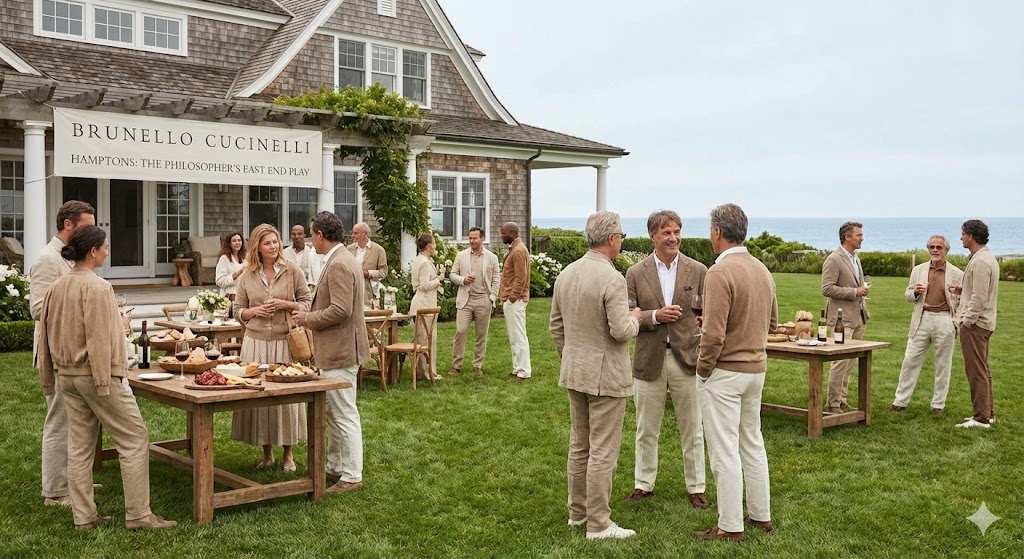
The Cashmere Confessional on Newtown Lane
The store occupies roughly 1,300 square feet of prime East Hampton real estate, yet it feels less like retail and more like entering someone’s exceptionally well-appointed study. Indeed, warm wood and soft lighting create an atmosphere where garments hang like manuscripts in a private library. Consequently, the absence of logos becomes the loudest statement in the room.
This is not shopping. Rather, this is something Pierre Bourdieu would recognize instantly: the acquisition of legitimate taste disguised as the purchase of clothing. Furthermore, what Brunello Cucinelli sells in the Hamptons isn’t cashmere—it’s the resolution of a very specific anxiety. Specifically, it’s the fear that your wealth is visible but your cultivation is not.
Since 2006, this boutique has served as a kind of finishing school for the newly affluent. The curriculum? Learning how to signal success without appearing to try. Meanwhile, the tuition runs steep: a $2,500 travel blazer that looks like something your grandfather might have worn, if your grandfather had summered in Umbria and read Marcus Aurelius for pleasure.
The Cucinelli Genesis: From Cement Dust to Cashmere Empire
Every luxury brand peddles mythology. However, Brunello Cucinelli’s happens to be true, which makes it infinitely more valuable.
Born in 1953 in Castel Rigone, a hamlet near Perugia, Cucinelli grew up without electricity or running water. His family were farmers, working land that belonged to others. Then his father took a job at a cement factory. Subsequently, the humiliation the elder Cucinelli endured there—returning home with tears in his eyes, asking what he had done wrong to deserve such treatment—became the founding trauma of a billion-dollar enterprise.
“I promised myself that no one would be humiliated at work,” Cucinelli has said. As a result, he dropped out of engineering school, read philosophy obsessively, and in 1978, with the equivalent of $550, began dyeing cashmere in colors no one had attempted before.
The innovation seems modest now. At the time, however, cashmere came in dark colors and was worn exclusively by men. Cucinelli’s pastel sweaters for women were considered borderline insane by industry veterans. Nevertheless, he found a dyer named Alessio willing to experiment. Those first 53 sweaters, ordered by a German boutique owner named Albert Franz, ultimately launched what would become a publicly traded company with a market capitalization exceeding $7 billion.
The Mythology Machine
In 1985, Cucinelli purchased a 14th-century castle in Solomeo, the hamlet where his wife Federica grew up. He restored it stone by stone. Subsequently, he moved his headquarters there, then rebuilt the entire village—a theater, a library, a School of Arts and Crafts, a monument called “Tribute to Human Dignity.”
This is cultural capital rendered in travertine. In essence, the castle isn’t merely headquarters; it’s legitimization made architectural. When Jeff Bezos, Reid Hoffman, and other tech titans visited Solomeo in 2019 for what Cucinelli called a “Symposium on Soul and Economics,” they weren’t touring a factory. Instead, they were making a pilgrimage. The difference, of course, matters enormously.
Brunello Cucinelli’s Four Capitals: Decoding Luxury’s Hidden Currency
Economic Capital: The Price of Entry
The architecture of Brunello Cucinelli pricing reveals a carefully constructed hierarchy. Entry begins around $400 for accessories—a silk pocket square, a beaded bracelet. From there, cashmere sweaters start near $1,200 and climb past $3,000 for more complex constructions. Meanwhile, a cashmere blazer runs $2,500 to $5,000, while full looks approach $10,000.
Yet these prices occupy a curious middle ground. They exceed what most can afford casually but remain accessible to the comfortably wealthy. For instance, a Cucinelli sweater costs more than Loro Piana’s entry point but less than Hermès ready-to-wear. This positioning is strategic. Essentially, the brand targets those wealthy enough to afford the best but discerning enough to question whether obvious luxury is truly best.
Resale value holds remarkably well. Furthermore, The RealReal and similar platforms show Cucinelli pieces retaining 30-50% of retail—better than most designer brands, though below Hermès. As a result, the cashmere, designed to last decades rather than seasons, often outlives the wardrobe it was meant to join.
Cultural Capital: What You Must Know
To properly consume Brunello Cucinelli requires knowledge that money cannot directly purchase. First, you must understand why the absence of logos signals higher status than their presence. Beyond that, recognizing that the slightly imperfect drape of a deconstructed blazer indicates superior construction—not inferior tailoring—separates initiates from outsiders. Similarly, appreciating why hand-stitched monili beading on a $2,100 cotton sweater justifies the price requires education that wealth alone cannot provide.
Additionally, the informed customer knows that cashmere comes from the neck and belly of Hircus goats in Mongolia, hand-collected during spring molting season. Furthermore, distinguishing between two-ply and eight-ply matters enormously. Equally important, understanding that plant-dyed yarns fade differently than chemically treated ones reveals the depth of connoisseurship required.
This knowledge functions as gatekeeping. The newly rich, arriving with money but without context, often gravitate toward more obviously luxurious brands. Those with cultivated taste—whether inherited or laboriously acquired—recognize Cucinelli as the sophisticated choice. The distinction separates legitimate cultural membership from mere economic power.
Social Capital: The Network You Join
Wearing Brunello Cucinelli places you within a specific constellation of people. Jeff Bezos wears it. Similarly, Mark Zuckerberg’s custom grey t-shirts come from Solomeo. Marc Benioff owns a vicuña suit. Meanwhile, Steve Jobs’s black turtlenecks were Cucinelli custom orders. Leonardo DiCaprio, Jennifer Lopez, Angelina Jolie—the celebrity roster reads like a list of people who could afford anything and chose this.
In Silicon Valley, consequently, Cucinelli has become something approaching a uniform. The tech set appreciates clothing that signals success without signaling that you care about signaling success. As such, a $2,500 cashmere travel blazer communicates wealth through fabric quality rather than brand visibility. This satisfies both the desire for status and the equally powerful desire to appear above status concerns.
At Salesforce’s Dreamforce conference, Cucinelli has appeared as a featured speaker—twice. There, he and Benioff discuss philosophy, not fashion. The clothing becomes incidental to a larger conversation about values, capitalism, and human dignity. Therefore, purchasing Cucinelli becomes purchasing membership in that conversation.
Symbolic Capital: What Ownership Declares
A Brunello Cucinelli garment declares several things simultaneously. First, that you possess wealth sufficient to spend $2,000 on a sweater. Second, that you possess taste sophisticated enough to choose understated luxury over obvious display. Third, that you care about how things are made, not merely how they appear. Finally, that you align yourself with humanistic values rather than pure capitalism.
This last point deserves emphasis. Cucinelli’s “humanistic capitalism”—paying workers 20% above market rate, limiting workdays to 5:30 PM, providing 90-minute lunch breaks, prohibiting after-hours email—has become central to the brand’s symbolic value. Indeed, Harvard Business School teaches a case study on it. In other words, buying the sweater means buying into the philosophy.
For the Hamptons customer specifically, Cucinelli resolves a delicate tension. The East End attracts enormous wealth yet maintains pretensions to old-money restraint. Accordingly, Cucinelli threads this needle perfectly: expensive enough to exclude, understated enough to belong.
Why Brunello Cucinelli Chose the Hamptons—And What It Reveals
The East Hampton boutique opened in late 2006 as only the brand’s second U.S. store, following a Bleecker Street location in Manhattan. Notably, the choice was deliberate. “The Hamptons reminds me of the village life I’ve always loved,” Cucinelli told The Purist. “The communal spirit, charm and serene beauty are all reminiscent of the close-knit community in Solomeo.”
Translation: the Hamptons offers the American equivalent of his Umbrian hamlet—a place where wealth retreats from urban intensity to cultivate the appearance of simpler pleasures. In practice, the aesthetic Cucinelli calls “casual luxury” fits East Hampton’s self-image precisely. Here, billionaires dress like they might wander into a farm stand. Ultimately, the goal is looking put together without looking like you tried.
The Newtown Lane location places Cucinelli adjacent to, but distinct from, the louder luxury brands. Louis Vuitton, Hermès, Cartier—these occupy their own territories on the Hamptons retail map. By contrast, Cucinelli chose a street that retains village character, away from the main luxury corridor. Thus, the positioning mirrors the brand’s market philosophy: present but not obvious, accessible but not common.
The Store as Extension of Solomeo
Inside, the boutique replicates Cucinelli’s Italian aesthetic. Natural materials predominate throughout. The lighting suggests afternoon sun through Umbrian windows, while garments hang with space between them—breathing room that signals abundance without clutter. Moreover, staff are trained to advise rather than sell, to build relationships rather than close transactions.
U.S. President Massimo Caronna, an 18-year company veteran who maintains a weekend home in East Hampton, oversees operations. His presence indicates the importance Cucinelli places on this market. “The atmosphere of casual luxury, which is so characteristic of East Hampton, is a perfect fit for our brand,” Caronna has explained. Significantly, first-year sales projections at opening targeted $1.5 to $2 million—substantial for 750 square feet of selling space.
Since then, the brand has expanded the footprint and deepened local connections. For example, a 2024 summer soirée at Wölffer Estate drew Emma Roberts, Rachel Zoe, Nicky Hilton Rothschild, and other figures who embody the casual-luxury demographic. These events transform customers into community, thereby converting brand exposure into social ritual.
Playing the Field: Cucinelli vs. the Competition
In the Hamptons luxury landscape, Brunello Cucinelli occupies a specific position. Notably, it competes less with heritage houses like Hermès or Chanel than with fellow quiet-luxury specialists—Loro Piana, The Row, Kiton.
Against Loro Piana, Cucinelli offers comparable material quality with stronger philosophical narrative. Loro Piana (now owned by LVMH) commands premium prices for vicuña and baby cashmere; however, Cucinelli matches quality in standard cashmere while adding the humanistic-capitalism story. Additionally, Loro Piana has suffered from fast-fashion imitation—Zara and Massimo Dutti now produce recognizable knockoffs of their signature pieces. By comparison, Cucinelli’s designs, less defined by specific silhouettes, prove harder to replicate.
The Row, founded by Mary-Kate and Ashley Olsen, attracts a younger, fashion-industry audience with more minimalist aesthetic. Their 2024 Amagansett boutique (replacing the beloved Tiina the Store) signals intensifying competition for the same customer. Nevertheless, The Row skews more severe, more New York. In contrast, Cucinelli offers warmth, earthiness, Mediterranean ease. The choice often comes down to whether you want to look like an art dealer or a philosopher.
For customers seeking quiet luxury, therefore, the hierarchy becomes: Hermès for those with inherited wealth and time to cultivate relationships with sales associates; Loro Piana for those prioritizing material rarity; Cucinelli for those wanting luxury with moral dimension; The Row for those wanting fashion-forward minimalism.
The Distinction Game: Old Money, New Money, and the Clothes Between
The quiet-luxury trend—what fashion calls “stealth wealth” or “old money aesthetic”—transformed Brunello Cucinelli from niche Italian brand to cultural phenomenon. Remarkably, sales grew 31.9% in first-half 2023 alone. When HBO’s Succession dressed its billionaire characters in understated knitwear and logo-free blazers, it codified what Cucinelli had been selling for decades.
“This year, we’re actually harvesting the fruit of taste,” Cucinelli told investors. “People’s taste is towards no logo. It’s about quiet luxury. For us, this is a big advantage.”
The trend reflects deeper anxieties. For one, economic uncertainty makes conspicuous consumption feel tone-deaf. Furthermore, social media has made every purchase visible; the sophisticated response is making purchases that only initiates recognize. Additionally, in China—Cucinelli’s fastest-growing market—the distinction between xinqianfeng (new-money aesthetic) and laoqianfeng (old-money look) drives wealthy consumers toward subtlety.
Yet the quiet-luxury customer faces a paradox. The desire to not appear wealthy still requires signifying wealth to those who matter. Cucinelli resolves this through fabric quality that rewards touch, construction that reveals itself over years, and a network of recognition among fellow initiates. Consider this: the $600 Loro Piana baseball cap became a meme precisely because it looks like nothing while costing everything. Similarly, Cucinelli’s equivalent might be a cashmere hoodie at $1,800—utterly ordinary in silhouette, utterly extraordinary in hand.
The Cucinelli Investment: Cultural Arbitrage or Conscious Consumption?
The East Hampton boutique at 39 Newtown Lane welcomes visitors Monday through Saturday, 10 AM to 6 PM, with Sunday hours from 11 AM to 5 PM. Notably, the staff understand that many browsers have no intention of purchasing. This is acceptable, because the brand plays a long game.
For the serious customer, however, the store offers something beyond product: validation of a certain approach to wealth. Purchasing Cucinelli means endorsing humanistic capitalism, artisanal production, and the belief that how things are made matters as much as what things are. In an economy of exploitation, therefore, this represents a kind of moral positioning—whether sincere or performed matters less than the positioning itself.
Bourdieu would note that such moral positioning is itself a form of distinction. After all, the wealthy have always sought to differentiate their wealth from the merely wealthy. Once, this meant collecting art or supporting opera. Now it might mean buying cashmere from a company that limits employee work hours. The mechanism changes; nevertheless, the function persists.
Yet perhaps this cynicism misses something genuine in the Cucinelli project. In truth, the workers in Solomeo do receive 20% above market wages. The lunch breaks do last 90 minutes. The School of Arts and Crafts does train young artisans who may work elsewhere. Consequently, if distinction-seeking capital flows toward genuinely better labor practices, perhaps distinction-seeking serves a purpose beyond itself.
The woman at 39 Newtown Lane finishes examining the oatmeal sweater. She decides to purchase it, and the transaction takes under a minute. Then she walks back onto Newtown Lane, into the late afternoon sun, wearing exactly what she came for: the visible evidence of invisible values, the uniform of thoughtful wealth, the cashmere confirmation of arrival.
Continue Your Luxury Education
- Best Hamptons Fashion Boutiques You Must Visit – Discover the boutiques where insiders actually shop, from Amagansett’s minimalist havens to Sag Harbor’s waterside gems.
- 10 Luxury Fashion Trends Defining Hamptons Style in 2025 – From quiet luxury to conscious consumption, understand the movements shaping how the East End dresses.
Stay Connected with Social Life Magazine
Author

Written by
Recent Posts

Unlocking the Berkshires
Dalia Forman Design
Alberto Luzzi
How to Pick a Homecoming Dress for Your Body Type and Feel Amazing in It
How to Prepare a Home for Sale When Major Repairs Are Not Affordable
Categories
- Art
- Articles
- Business of Luxury
- Celebrities
- Culture
- Entertainment
- Events
- Faces of Summer 2026
- Fashion
- Fashion & Style
- Featured
- Finance
- Food, Spirits, Wine
- Hamptons
- Hamptons Celebrities
- Health
- Health & Beauty
- Lifestyle
- Luxury Lifestyle
- Press
- Profiles
- Real Estate
- Technology
- The Chronicles
- Travel
- Uncategorized
- Weddings