
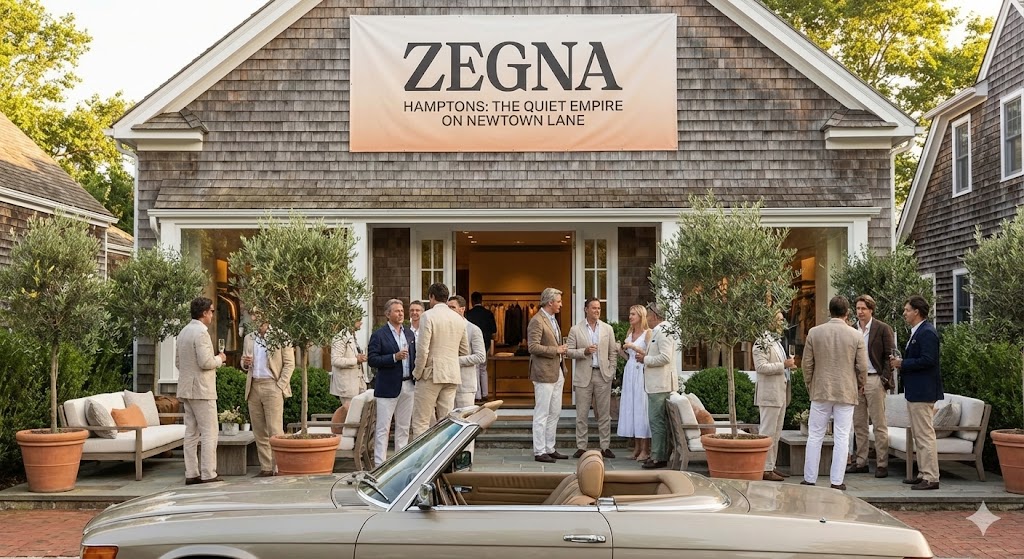
This is how Zegna operates in the Zegna Hamptons market: not through volume, but through verification. Furthermore, the store itself functions as a sorting mechanism, separating those who understand from those who merely spend. The 900-square-foot boutique, with its sand-colored resin floors and handcrafted Sardinian carpets, exists to confirm membership in a club that issues no cards.
Pierre Bourdieu, the French sociologist who spent his career dissecting how taste functions as a weapon of class warfare, would recognize this instantly. Indeed, Zegna’s East Hampton presence represents something more interesting than retail expansion. It is cultural positioning disguised as commerce, a masterclass in converting economic capital into something far more durable: legitimate distinction.
The Wool Mill Origins: From Trivero to the World
In 1910, an eighteen-year-old named Ermenegildo Zegna inherited four looms from his watchmaker father in Trivero, a mountain town in the Piedmont region of northern Italy. His ambition was specific and audacious: to create “the most beautiful fabrics in the world.” Moreover, this wasn’t marketing language retrofitted to heritage—it was the operating principle that would transform a family mill into a €1.94 billion luxury empire spanning three brands and 80 countries.
The founder’s genius lay in vertical integration before the term existed. By 1938, Zegna fabrics had reached New York tailors. Consequently, this established the pattern that would define the company: control the supply chain from sheep to sleeve, and you control quality at every point where competitors cut corners.
What makes the origin mythology compelling isn’t the rags-to-riches arc—it’s the conscience embedded within it. Ermenegildo Zegna didn’t just build a factory; he built a community. Starting in the 1930s, he planted over 500,000 trees on the barren mountainside surrounding his mill, created schools and housing for workers, and constructed the 232 Panoramica Zegna road that today serves as the brand’s logo element. This wasn’t philanthropy performed for applause. It was the belief that excellence required ecosystem—that fine fabric couldn’t emerge from depleted land or depleted people.
The Mythology Machine
Every luxury house tells its story selectively. ZEGNA emphasizes the environmental stewardship, the four-generation family continuity, the artisan hands touching every garment. What the mythology machine omits is equally instructive: the 2021 SPAC merger with Investindustrial that valued the company at $3.1 billion and made Zegna the first Italian fashion house traded on the New York Stock Exchange. Additionally, the acquisitions that transformed a menswear brand into a group—Thom Browne in 2018 for $500 million, Tom Ford Fashion in 2023 through a long-term license with Estée Lauder.
The tension between heritage narrative and corporate reality isn’t hypocrisy. It’s strategy. Gildo Zegna, the founder’s grandson and current CEO, understood that publicly traded companies require growth narratives, while luxury consumers require authenticity stories. Therefore, the solution was to separate the group (ambitious, acquisitive, NYSE-listed) from the brand (rooted, artisanal, Alpine).
Zegna’s Four Capitals: Decoding Luxury’s Hidden Currency
Bourdieu argued that social power operates through multiple forms of capital, each convertible into the others under specific conditions. Understanding Zegna through this framework reveals what the brand actually sells—and to whom.
Economic Capital
Zegna’s price architecture is precisely calibrated. Entry begins around $890 for the Triple Stitch sneaker—the brand’s bestselling product and, notably, Apple CEO Tim Cook’s footwear of choice. Ready-to-wear suits start near $3,500, with made-to-measure (Su Misura) options climbing from there. Couture-level pieces featuring exclusive fabrics like Vellus Aureum, woven from 11.9-micron wool finer than cashmere, can reach five figures.
The economic barrier isn’t designed to maximize transactions. Rather, it’s designed to filter clientele. At these price points, only those with substantial discretionary income can participate. Nevertheless, compared to competitors like Kiton ($7,000-$13,000 per suit) or Brioni ($6,000+), Zegna positions itself as accessible ultra-luxury—a doorway rather than a ceiling.
Cultural Capital
To properly consume Zegna requires knowledge that can’t be purchased at the counter. The initiated understand why 15 Milmil 15 fabric matters (15-micron fibers, among the finest wool commercially available). They recognize the significance of Oasi Zegna, the 100-square-kilometer nature reserve surrounding the original mill. Furthermore, they know that Alessandro Sartori, the artistic director since 2016, trained at the company’s Z Zegna line before departing for Berluti and returning to transform the mainline.
This embodied knowledge creates the distinction Bourdieu identified. Two men wearing identical ZEGNA jackets occupy different social positions if only one can explain the provenance, the construction, the invisible craftsmanship. In turn, the cultural capital required to decode Zegna excludes those who know only price tags.
Social Capital
Zegna’s customer list reads like a power index. Real Madrid’s football and basketball teams wear Zegna travelwear as part of a multi-year partnership announced in 2022. Celebrities from Adam Driver to Chris Pine have appeared in the brand’s campaigns. Tech executives, hedge fund managers, and media moguls populate the fitting rooms at 50 Newtown Lane during peak summer season.
The social capital here operates bidirectionally. Wearing Zegna signals membership in a network of successful men who prioritize substance over flash. Simultaneously, being seen at Zegna—not Louis Vuitton, not Gucci—communicates specific values: discretion, craftsmanship appreciation, European sophistication without Continental ostentation.
Symbolic Capital
In the hierarchy of men’s luxury, Zegna occupies a particular position: serious without being stuffy, prestigious without being performative. The brand resolves a tension that haunts successful men—how to signal achievement without appearing desperate for recognition.
This is the essence of “quiet luxury,” the trend that dominated fashion discourse following HBO’s “Succession,” where characters dressed in Loro Piana, Zegna, and The Row to communicate wealth that needed no introduction. Zegna’s symbolic capital derives from what it refuses: obvious logos, trend-chasing designs, seasonal reinvention that screams for attention. Instead, the message is: “I don’t need you to know what I’m wearing. I know what I’m wearing.”
Why Zegna Chose the Hamptons—And What It Reveals
The Zegna Hamptons boutique at 50 Newtown Lane opened as a seasonal pop-up in 2023, joining the luxury armada that transforms East Hampton village each summer. The timing was deliberate. Post-pandemic, men’s fashion had shifted decisively toward what Sartori calls “luxury leisurewear”—tailoring’s vocabulary applied to casual contexts. The Hamptons, where hedge fund principals pair $4,000 cashmere joggers with $15 million beach houses, represented the ideal proving ground.
At 900 square feet, the store is deliberately intimate. Sand-colored resin floors blend into white walls, creating what the brand describes as a “marine resort” aesthetic. Handcrafted carpets from Mariantonia Urru in Sardinia anchor the space—a detail that functions as a literacy test. Those who notice and appreciate the sourcing demonstrate the cultural capital ZEGNA seeks in its clientele.
The store’s product mix skews casual: Triple Stitch sneakers, overshirts, swimwear, sunglasses. This isn’t the formal tailoring that built the brand’s reputation but rather the lifestyle extension that drives contemporary growth. Indeed, suits now represent only 27% of Zegna sales, down from 44% in 2016. The Hamptons customer, arriving by seaplane or helicopter for a weekend that might include charity polo and private dinners, doesn’t need a boardroom suit. He needs pieces that transition from beach club to Dopo La Spiaggia without a wardrobe change.
Playing the Field: ZEGNA vs. the Competition
The Hamptons luxury retail landscape constitutes what Bourdieu called a “field”—a competitive arena where brands jostle for position and distinction. On Newtown Lane and Main Street, Zegna shares blocks with Louis Vuitton, Gucci, Chanel, and Prada. However, each occupies distinct territory.
Louis Vuitton and Gucci dominate the logo-driven segment, selling recognizable status to a broad audience including wealthy tourists and aspirational consumers. Chanel and Hermès own the heritage luxury position, with prices and waitlists that enforce scarcity. Loro Piana and Brunello Cucinelli compete most directly with Zegna in the quiet luxury category, all three emphasizing fabric quality, Italian craftsmanship, and minimal branding.
Zegna differentiates through its menswear focus and its textile heritage. Unlike Cucinelli (cashmere specialist) or Loro Piana (acquired by LVMH in 2013), Zegna remains family-controlled while operating publicly—a hybrid status that enables both heritage storytelling and growth capital. Moreover, the Fear of God collaboration in 2020 demonstrated willingness to engage younger, streetwear-adjacent consumers without abandoning core identity. Jerry Lorenzo’s relaxed silhouettes, rendered in Zegna fabrics, bridged worlds that rarely communicate.
The Distinction Game
For the Hamptons consumer, brand choice communicates precise social information. Wearing obvious logos (Gucci, Louis Vuitton) signals new money or aspiration. Wearing heritage European houses (Hermès, Loro Piana) signals old money or its emulation. Zegna occupies the space between—successful enough to afford the best, sophisticated enough to choose subtlety, connected enough to know that the right people will recognize quality without labels.
This is the brand’s particular genius: helping new money dress like old money without the awkward pretense of denial. Consequently, the forty-year-old tech founder who sold his startup can wear Zegna to the Polo Hamptons event and communicate arrival without announcing it.
The Zegna Investment: Cultural Arbitrage or Quiet Conviction?
The Zegna Hamptons boutique at 50 Newtown Lane operates Monday through Saturday, 10 AM to 6 PM, with Sunday hours from 11 AM to 5 PM during peak season. Appointments for Su Misura (made-to-measure) services are available and recommended for those seeking the full tailoring experience.
Who should shop here? Men who understand that clothes communicate before words do. Those who appreciate the subtle differences between good fabric and exceptional fabric. Professionals whose environments—finance, law, media, technology—reward understated signals of success over performative display.
What Zegna sells, ultimately, isn’t product but permission—to succeed without apology, to appreciate craft without pretension, to dress like the man you’ve become rather than the man you’re trying to convince others you are.
Bourdieu would note the irony: this “authenticity” is itself a construction, a careful brand positioning as calculated as any advertising campaign. But perhaps that’s the point. In a world where every choice is readable as status communication, Zegna offers the fiction of opting out—the quietly expensive uniform of those who claim to have transcended the game while still very much playing it.
The man with the Triple Stitch sneaker will purchase them. He’ll wear them to dinner at Sant Ambroeus, where the hostess won’t notice and the hedge fund manager at the next table will. That transaction—the knowing glance, the silent acknowledgment of shared taste—is what $890 actually buys. The shoe is merely the receipt.
Continue Your Luxury Education
- Best Hamptons Fashion Boutiques You Must Visit – A comprehensive guide to the East End’s most discerning retail destinations, from The Row’s minimalist sanctuary to Kirna Zabête’s curated collections.
- 10 Luxury Fashion Trends Defining Hamptons Style in 2025 – Explore the movements shaping contemporary wardrobes, from quiet luxury to sustainable fashion and the rise of sport-luxury fusion.
Stay Connected with Social Life Magazine
- Feature Your Brand in Social Life – Connect with us about editorial features, advertising partnerships, and luxury brand positioning.
- Experience Polo Hamptons – The Hamptons’ premier summer event. Tickets, cabanas, and sponsorship opportunities available.
- Subscribe to Our Newsletter – Weekly insights on Hamptons culture, luxury living, and exclusive events.
- Print Subscription – Get Social Life Magazine delivered to your door.
- Support Our Journalism ($5) – Help us continue covering Hamptons culture with depth and distinction.
Author

Written by
Recent Posts

Unlocking the Berkshires
Dalia Forman Design
Alberto Luzzi
How to Pick a Homecoming Dress for Your Body Type and Feel Amazing in It
How to Prepare a Home for Sale When Major Repairs Are Not Affordable
Categories
- Art
- Articles
- Business of Luxury
- Celebrities
- Culture
- Entertainment
- Events
- Faces of Summer 2026
- Fashion
- Fashion & Style
- Featured
- Finance
- Food, Spirits, Wine
- Hamptons
- Hamptons Celebrities
- Health
- Health & Beauty
- Lifestyle
- Luxury Lifestyle
- Press
- Profiles
- Real Estate
- Technology
- The Chronicles
- Travel
- Uncategorized
- Weddings