
The woman examining the wedge sneaker at 66 Newtown Lane does not touch it immediately. She knows this dance. Her fingers hover above the suede and leather Bekett, its three velcro straps positioned like a statement she’s already rehearsed. Furthermore, she understands what the $790 price tag actually purchases: permission to look like she doesn’t try too hard.
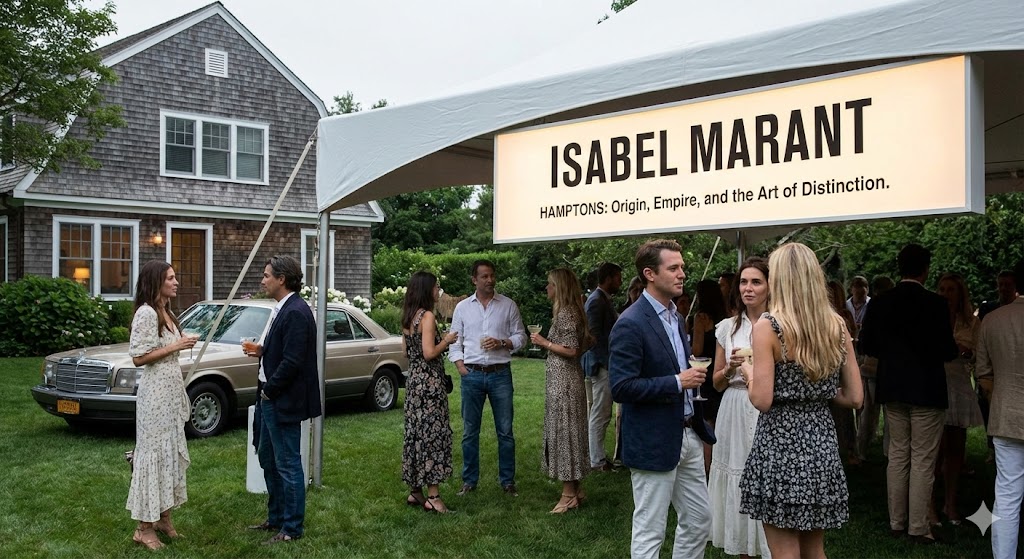
This is the paradox Isabel Marant has monetized for three decades. The East Hampton boutique—904 square feet of carefully curated insouciance—opened in summer 2023 as the brand’s first Hamptons outpost. Yet what it sells transcends garments. Inside these walls, visitors acquire a specific form of cultural fluency, one that Business of Fashion describes as “nonchalant Parisienne style” distilled into wearable form.
The sociologist Pierre Bourdieu spent his career dissecting how taste functions as social weaponry. Moreover, he understood what most luxury consumers would prefer not to acknowledge: their aesthetic preferences are strategies, their wardrobe investments are bids for legitimacy, and their shopping choices plant flags in contested status territory. Isabel Marant’s Hamptons presence offers a masterclass in these dynamics.
The Marant Genesis: From Parisian Suburb to Global Empire
Isabel Marant was born in 1967 to a French father and German mother in Boulogne-Billancourt. Her parents divorced when she was six. Subsequently, she lived with her father and stepmother in Neuilly-sur-Seine, the fashionable Parisian suburb where she developed her first acts of sartorial rebellion. She refused school uniforms, carried alternative outfits in plastic bags, and at fourteen styled herself after Patti Smith.
At fifteen, she asked her father for a sewing machine. That request birthed an empire. She began making clothes from discarded fabric, and friends demanded she make pieces for them. Consequently, at sixteen she met Christophe Lemaire—who would later helm Hermès and Lacoste—and together they launched Aller Simplex, selling clothes at a consignment shop that paid when items sold. The enterprise succeeded enough to make her reconsider economics school.
From 1985 to 1987, Marant studied at Studio Berçot, Paris’s influential fashion college. Director Marie Rucki delivered the philosophy that became her design credo: “You shouldn’t want others to wear things that you wouldn’t wear yourself.” This sentiment has guided every collection since.
After apprenticing with designer Michel Klein and assisting on projects for Chloé, Martine Sitbon, and Yohji Yamamoto, frustration with working for others crystallized her independence. In 1989, she launched a collection of belts and rings. In 1990, she started a knitwear label called Twen with her mother, Christa Fielder, a former model who also ran the Elite modeling agency. Finally, in 1994, Isabel Marant the brand was born.
The Mythology Machine
The brand’s origin story performs specific cultural work. It establishes Marant as authentically rebellious rather than commercially calculating. Moreover, the narrative positions her designs as extensions of personal conviction rather than market research. When Harper’s Bazaar profiled her thirtieth anniversary, she declared her goal was making women feel “comfortable and not too shitty.” That quote circulates because it sounds accidental. It isn’t.
What the founding mythology obscures matters as much as what it reveals. The trajectory from teenage seamstress to €300 million business required significant institutional support. Montefiore Investment acquired 51% of the company in 2016, providing capital infrastructure while the designer retained creative control. The brand has grown from nine stores to over 80 globally. Nevertheless, marketing materials emphasize handmade artistry and Parisian atelier intimacy.
Isabel Marant’s Four Capitals: Decoding Luxury’s Hidden Currency
Understanding Isabel Marant’s Hamptons positioning requires examining what Bourdieu termed the four forms of capital—economic, cultural, social, and symbolic—and how the brand deploys each.
Economic Capital
Isabel Marant’s price architecture maps territory between accessible luxury and stratospheric couture. Entry points begin around $200 for logo-bearing accessories and t-shirts. The signature Bekett wedge sneaker commands $790. Leather jackets reach $1,500, while statement dresses climb toward $2,000.
This positioning is strategic. The brand sits deliberately below heritage houses like Chanel and Hermès while distancing itself from contemporary competitors like Sandro and Maje. According to WWD, the brand generated nearly €300 million in revenue last year, with profitability accelerating since 2021.
The economic entry requirement signals something specific. You must possess enough to afford designer prices without accessing unlimited budgets. This creates community among buyers who share similar financial constraints, different from the rarified air of haute couture and the mass accessibility of fast fashion.
Cultural Capital
Consuming Isabel Marant correctly requires specific knowledge. You must understand why effortlessness requires effort, why bohemian chic differs from hippie aesthetic, and why “not trying too hard” constitutes its own discipline.
The brand’s codes reference specific cultural touchstones. Kate Moss at Glastonbury in 2003. Sienna Miller’s handkerchief hems and fringe. The Olsen twins before The Row. When Harper’s Bazaar convened experts to discuss boho-chic’s resurgence, Rachel Zoe named Isabel Marant as foundational: “Isabel Marant was huge.” Marant herself claimed leadership: “I do feel like, at the time, I was a leader in this kind of movement.”
Recognizing these references separates informed consumers from tourists. The culturally literate shopper identifies an Isabel Marant silhouette without seeing labels. Furthermore, she understands why pairing the pieces with certain accessories elevates the look while other combinations diminish it. This knowledge cannot be purchased directly. It must be accumulated through exposure, attention, and practice.
Social Capital
Wearing Isabel Marant signals membership in a specific network. The brand’s celebrity devotees include Kate Moss, Victoria Beckham, Alexa Chung, Kate Bosworth, and Rachel Weisz. Consequently, carrying an Oskan Moon bag or wearing Dicker boots positions you adjacent to this constellation of cool.
The H&M collaboration of 2013 demonstrated this social power dramatically. The collection sold out in 45 minutes online and crashed the retailer’s website. Shoppers queued overnight. Items appeared on eBay for triple their retail price within hours. What motivated this frenzy wasn’t fabric quality—it was temporary access to a social position typically requiring far greater investment.
In the Hamptons specifically, Isabel Marant announces particular affiliations. The wearer identifies with creative industries over finance, with artistic sensibilities over corporate polish. She signals that her wealth, however substantial, didn’t eliminate her edge.
Symbolic Capital
Isabel Marant’s greatest achievement involves what it represents versus what it literally is. The brand sells the idea of not caring about brands. It markets anti-pretension through carefully calibrated pretension. Additionally, it offers escape from fashion’s obvious markers while providing unmistakably recognizable designs.
The Bekett sneaker exemplifies this contradiction. When it launched in 2011, the wedge sneaker was revolutionary—athletic footwear given a hidden three-inch heel. Beyoncé wore them in her “Love on Top” video. Six-month waitlists formed. The brand sold 200,000 pairs. However, by 2014, Marant herself expressed fatigue, telling The Cut: “They’ve become something super-vulgar. I don’t feel like I want to be the wedge-sneaker designer.”
The shoe’s current resurgence—demand spiked 630% in 2025 according to the Lyst Index—demonstrates how symbolic capital recycles. What was once ubiquitous, then vulgar, now signals vintage-savvy cool.
Why Isabel Marant Chose the Hamptons—And What It Reveals
The East Hampton boutique at 66 Newtown Lane opened in June 2023, marking the brand’s first Long Island location. The store occupies approximately 904 square feet—intimate by luxury retail standards—and draws design inspiration from the 1970s French experimental movement.
Location selection reveals positioning strategy. Newtown Lane concentrates fashion retail in East Hampton, situating Isabel Marant near Cult Gaia, Diptyque, and various luxury competitors. The nearby Louis Vuitton flagship—purchased by Bernard Arnault personally for $22 million—establishes the corridor’s elite credentials. Isabel Marant chose proximity to heritage luxury without direct adjacency to it.
The store’s design reinforces brand philosophy. Furniture pieces by Rotterdam designer Jonas Lutz, concrete and ceramic planters by Parisian artist Kalou Dubus, and ceramic glazed podiums from Spanish studio Apparatu create an aesthetic of curated imperfection. The space feels discovered rather than designed, intimate rather than imposing.
The Hamptons as a “field”—Bourdieu’s term for competitive arena—favors Isabel Marant’s positioning. This market attracts sophisticated consumers who already own obvious luxury and seek distinction through subtlety. The Hamptons shopper often possesses the Hermès bag and seeks something that whispers different values. Isabel Marant offers exactly this: expensive nonchalance as counterpoint to expensive ostentation.
Playing the Field: Isabel Marant vs. the Competition
The competitive landscape illuminates Isabel Marant’s strategic positioning. Within the Hamptons luxury ecosystem, the brand navigates between several categories.
Against heritage houses like Chanel and Louis Vuitton, Isabel Marant offers relief from recognizable logos and classic codes. Consumers seeking distinction from these ubiquitous markers find refuge in Marant’s aesthetic. Nevertheless, the price points remain high enough to exclude casual aspirants.
Among French contemporary brands—Sandro, Maje, Zadig & Voltaire, Ba&sh—Isabel Marant occupies the premium tier. As Business of Fashion noted, “Isabel Marant very much inspired the look, but she is a luxury designer and these brands have a positioning that is very different.” The Étoile diffusion line competes more directly with these contemporaries while the mainline claims designer status.
The meaningful competition comes from brands sharing Isabel Marant’s taste-based positioning: Ulla Johnson, Zimmermann, Ganni. These labels pursue similar customers—women seeking elevated ease, bohemian undertones, and designer quality without heritage-house formality. The distinction game intensifies among these players, with subtle differences in silhouette, embellishment, and cultural reference determining allegiance.
What owning Isabel Marant versus alternatives signals reduces to this: you possess sufficient cultural knowledge to identify the original boho-chic progenitor rather than its successors or imitators. You’ve done your research. Moreover, you’ve earned your nonchalance.
The Isabel Marant Investment: Cultural Arbitrage or Conspicuous Consumption?
The East Hampton boutique at 66 Newtown Lane houses the mainline women’s collection, selections from Isabel Marant Étoile, and accessories. Visitors can expect the full range of the brand’s signatures: ruffled dresses, cropped leather pants, peasant blouses, statement jackets, and of course, the wedge sneakers that launched a thousand waitlists.
The store serves customers who understand luxury’s contemporary paradoxes. They recognize that effortlessness requires resources—financial and cultural—to achieve. Furthermore, they appreciate that Isabel Marant’s specific brand of bohemian cool differs fundamentally from actually being bohemian, which historically meant poverty alongside artistic aspirations.
What the Isabel Marant Hamptons boutique actually sells transcends garments. It offers a particular resolution to the anxiety of wealth: the fear that your success is visible but your authenticity is not. The brand promises that money need not eliminate cool, that prosperity and edge can coexist, that you can afford anything yet still possess taste.
Bourdieu would recognize this transaction instantly. The economic capital invested converts to cultural and symbolic returns. The purchase misrecognizes itself as aesthetic choice rather than social strategy. And the “natural” style achieved through specific acquisitions naturalizes the social position of those who can afford it.
The brand’s future in the Hamptons seems secure. As luxury retail continues expanding on the East End, and as consumers increasingly seek distinction through subtlety rather than ostentation, Isabel Marant’s particular formula—elevated insouciance, expensive ease—aligns precisely with the market’s trajectory. The woman who touched the Bekett sneaker will likely buy it. She understood what she was purchasing before she walked through the door.
Continue Your Luxury Education
- Best Hamptons Fashion Boutiques You Must Visit — Discover the curated retail destinations that define East End style, from East Hampton’s designer row to Amagansett’s bohemian finds.
- Best of the Hamptons 2026: Insider Secrets Revealed — Your comprehensive guide to the restaurants, beaches, and power scenes worth your time this summer.
Stay Connected with Social Life Magazine
- Feature Your Brand in Social Life
- Experience Polo Hamptons
- Subscribe to Our Newsletter
- Print Subscription
- Support Our Journalism ($5)
Author

Written by
Recent Posts

Unlocking the Berkshires

Dalia Forman Design

Alberto Luzzi
How to Pick a Homecoming Dress for Your Body Type and Feel Amazing in It
How to Prepare a Home for Sale When Major Repairs Are Not Affordable
Categories
- Art
- Articles
- Business of Luxury
- Celebrities
- Culture
- Entertainment
- Events
- Faces of Summer 2026
- Fashion
- Fashion & Style
- Featured
- Finance
- Food, Spirits, Wine
- Hamptons
- Hamptons Celebrities
- Health
- Health & Beauty
- Lifestyle
- Luxury Lifestyle
- Press
- Profiles
- Real Estate
- Technology
- The Chronicles
- Travel
- Uncategorized
- Weddings