
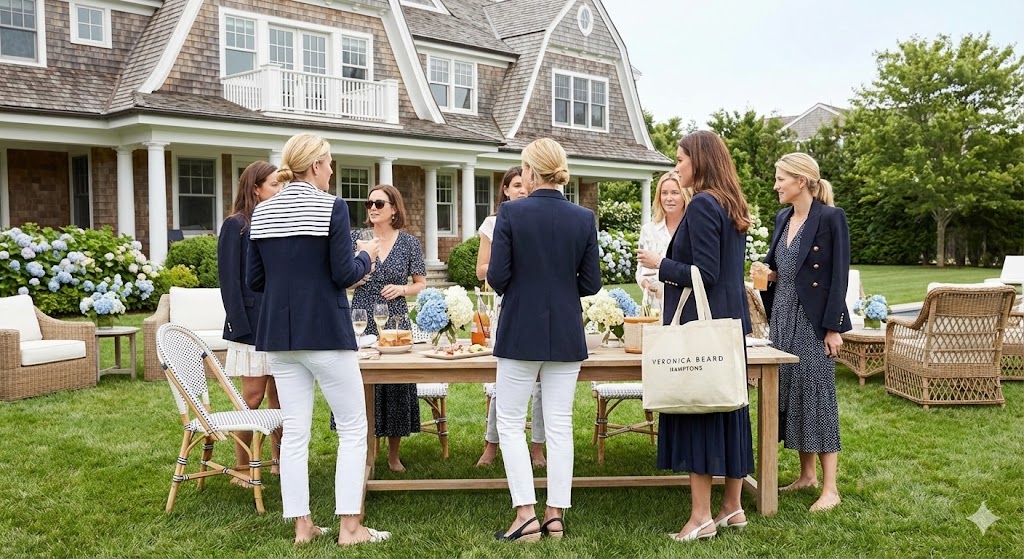
This is precisely the customer Veronica Beard was built to serve. Furthermore, this is the customer who has made two sisters-in-law very wealthy indeed. Moreover, the fact that this store exists here, on this street, in this particular village, tells you everything you need to understand about what the brand actually sells.
It is not blazers. Nor is it denim. Instead, it is the resolution of a very specific anxiety: the feeling that your life requires you to be in four places at once, and that each place demands a different version of yourself.
The Genesis: Wall Street Meets Seventh Avenue
The founding story of Veronica Beard operates like a parable about complementary assets. Veronica Miele Beard grew up in North Caldwell, New Jersey, and subsequently built a career on Wall Street that culminated in a partner and COO position at Coatue Management, the technology hedge fund launched by Philippe Laffont. During those years, she learned risk assessment, organic business development, and the particular discipline of building something from nothing.
Veronica Swanson Beard, meanwhile, followed a different path entirely. Raised between San Francisco and Naples, Florida, she trained at Parsons before working for Oscar de la Renta, Narciso Rodriguez, and Alberta Ferretti. Consequently, she understood fabrication, silhouette, and the ineffable quality that separates clothes that sell from clothes that merely exist.
The Meeting That Changed Everything
The two Veronicas met at a wedding in 2002, then married brothers. As a result, the family dinners that followed functioned as informal strategy sessions. “We had a lot of bad ideas before the good idea,” Swanson Beard has admitted. Nevertheless, the conversation always returned to the same problem: Why was it so difficult for professional women to get dressed in the morning?
Men had solved this problem centuries ago. Suit. Tie. Done. The uniform communicated competence without requiring thought. Women, however, faced what sociologist Pierre Bourdieu might call a “double bind of distinction.” In other words, they needed to signal professional seriousness while simultaneously differentiating themselves from both the male norm and other women competing for the same recognition.
In 2010, the two Veronicas launched with a single product: the Dickey jacket. Essentially, it was a one-button blazer engineered with an interior zipper that accepted interchangeable inserts. Therefore, one jacket could function as five different outfits. The finance mind had met the fashion mind, and together they had produced something genuinely useful.
The Mythology Machine
The brand’s origin story has been refined into a kind of corporate mantra. Specifically, the Veronicas call their signature jacket “the Wonder Woman cape,” a reference that accomplishes multiple tasks simultaneously. First, it signals empowerment without political freight. Additionally, it acknowledges the performance aspect of professional dress. Moreover, it nods to the superhero transformation that their customer performs every morning, becoming whoever the day requires her to be.
“We used remnant fabrics from Ralph Lauren and Loro Piana for the first collection,” Miele Beard has recalled. “We were climbing up ladders in New Jersey warehouses, getting bolts of deadstock fabric.” This narrative of scrappy beginning serves an important function. It establishes authenticity while simultaneously demonstrating the founders’ taste level. Indeed, even at zero budget, they chose quality.
Strategic Positioning and Explosive Growth
The stock market crash of 2008 had informed their strategic positioning. Consequently, they deliberately targeted the contemporary price point, below true luxury but above mass market, while maintaining designer-level fabrication and quality. This calculation proved remarkably prescient. By 2018, revenues exceeded $100 million. Subsequently, by 2024, the brand was projecting $250 million in sales. Currently, market sources suggest the company is approaching $400 million in annual revenues.
The Four Capitals of Veronica Beard: Decoding the Hidden Currency
To understand what Veronica Beard actually provides its customers, it helps to examine the brand through Bourdieu’s framework of capital forms. What appears to be a simple transaction, money exchanged for clothing, is actually a more complex exchange involving multiple forms of value. Therefore, each form of capital deserves careful analysis.
Economic Capital: The Architecture of Access
The price structure of Veronica Beard tells a careful story. For instance, the signature Miller Dickey jacket retails for $695 to $798, depending on fabric. This positions it below Chanel (where comparable blazers exceed $5,000) but significantly above Theory or J.Crew. Meanwhile, the interchangeable dickeys range from $175 for the hoodie dickey to $275 for cashmere versions. At the top end, premium offerings like the Ellette Luxe Cashmere Dickey Jacket reach $1,998.
This architecture creates multiple entry points. Initially, a woman can enter the brand with a $175 accessory, understand the system, and gradually graduate to fuller investment. Furthermore, the price ceiling remains accessible enough that purchase does not require spousal consultation or financial justification. Notably, the brand explicitly avoids the “investment piece” framing that characterizes true luxury. These are not items you agonize over. Rather, they are items you acquire because they solve problems.
The economic capital required for meaningful participation in the Veronica Beard ecosystem is substantial but not exclusionary. A full wardrobe, including multiple jackets, denim, dresses, and accessories, might represent $5,000 to $10,000. Essentially, this is the cost of entry for a woman earning $200,000 or more annually, or for a household with combined income north of $400,000. In other words, precisely the demographic that populates the Hamptons year-round.
Cultural Capital: What You Must Know
The cultural knowledge required to consume Veronica Beard properly operates on multiple levels. At the most basic, you must understand why a $695 blazer differs from a $150 one. Specifically, you must recognize fabrication quality, construction details, and the way a properly darted waist creates silhouette without requiring alteration.
At a deeper level, however, you must understand the dickey concept itself. The interchangeable insert is not immediately intuitive. Consequently, it requires demonstration, which is why the brand invests heavily in trunk shows and in-store events. The Veronicas themselves attend hundreds of these appearances annually. This educational function serves commercial purposes, certainly, but it also creates cultural gatekeeping. As a result, those who understand the system gain entry to a community of understanding.
Furthermore, the brand’s aesthetic references require decoding. The “East Coast meets West Coast” positioning that Swanson Beard describes draws on bi-coastal cultural codes. On one hand, the tailoring reads as New York serious. On the other hand, the ease reads as California casual. Combining these signals successfully requires understanding both vocabularies.
The Insider Distinction
What distinguishes insider consumption from outsider consumption is subtle but real. For example, the insider knows that the hood dickey transforms a formal blazer into weekend wear. Additionally, the insider understands that the Miller jacket pairs with the brand’s own denim in ways that third-party alternatives cannot replicate. Most importantly, the insider has attended a trunk show, perhaps met one of the Veronicas, and can reference that encounter casually.
Social Capital: Who You Become
The celebrity ecosystem surrounding Veronica Beard functions as a form of social endorsement. Jennifer Lopez, Gwyneth Paltrow, Sarah Jessica Parker, Gisele Bündchen, Kerry Washington, Angela Bassett, Martha Stewart, and Meghan Markle have all worn the brand. Additionally, Kate Middleton announced the end of her cancer treatment in a Veronica Beard dress. Meanwhile, Selena Gomez wears the brand on “Only Murders in the Building.”
This celebrity adoption, importantly, did not happen through paid placement. “JLo showed up with it, Sarah Jessica Parker wore it,” Miele Beard has recalled. “This was so early that we couldn’t have gotten to them. We were like, ‘Oh my God, they actually bought it.'” The organic nature of this adoption carries additional weight. Essentially, these women chose the brand because it solved their problems, not because they were compensated.
What ownership of Veronica Beard signals, then, is membership in a community of competent professional women who prioritize functionality without abandoning style. It is the uniform of the woman who does not have time for fashion drama but refuses to surrender aesthetic standards. The brand explicitly targets what it calls “the multifaceted, multitasking woman who makes it happen.”
Institutional Validation
The social capital extends beyond celebrity association. Andrew Rosen, the legendary investor who co-founded Theory and has backed Alice + Olivia and Rag & Bone, is among the brand’s investors. This institutional endorsement signals to insiders that serious fashion money considers Veronica Beard a legitimate bet. Additionally, John Howard and Lew Frankfort participate in the investor consortium, further validating the business model.
Symbolic Capital: What Ownership Says
The symbolic positioning of Veronica Beard occupies a carefully constructed middle ground. The brand is neither aspirational luxury nor democratic basics. Instead, it signals taste without ostentation. Moreover, it communicates success without requiring display.
In Bourdieu’s terms, Veronica Beard helps resolve a tension that afflicts the professional-managerial class. This demographic has economic capital sufficient for luxury consumption but habitus training that discourages overt display. For instance, carrying a Birkin bag to a board meeting might read as frivolous. Conversely, wearing Veronica Beard to the same meeting reads as appropriately serious.
The brand’s aesthetic philosophy reinforces this positioning. The Veronicas describe their design vocabulary as “cool classics.” Importantly, pieces are intended to be worn repeatedly, styled differently each time. This directly contradicts the fashion industry’s traditional model of planned obsolescence. You are not supposed to replace your Veronica Beard jacket every season. Instead, you are supposed to build a wardrobe.
What this signals symbolically is financial security without financial anxiety. The woman who owns multiple Veronica Beard jackets has resources, yes, but she also has discipline. She is not chasing trends. Rather, she has figured out what works for her life and committed to it. This is the symbolic capital of the optimized existence.
Why Veronica Beard Chose the Hamptons, And What It Reveals
The brand’s Hamptons presence tells a story about strategic positioning. The Southampton store opened first, in May 2021, at 84B Main Street. At 2,562 square feet, it was the brand’s largest location at the time, thereby signaling intent. Subsequently, the East Hampton store followed at 66 Newtown Lane, marking the brand’s 35th retail location globally.
Design Philosophy and Store Experience
Both locations feature interiors designed by Carolina de Neufville, the brand’s go-to designer. The East Hampton store showcases coffered wood wallpaper, vintage pieces, and floral textiles. The aesthetic reads as “coastal charm,” which is to say it reads as Hamptons. This is not the stark minimalism of a Madison Avenue flagship. On the contrary, it is the warmth of a house you might actually want to inhabit.
The store hours reveal demographic assumptions. Both locations operate Monday through Saturday from 10 AM to 6 PM, Sunday from 11 AM to 5 PM (Southampton) or 6 PM (East Hampton). These are not the hours of a store serving tourists. Rather, they are the hours of a store serving residents and seasonal residents who structure their days around activities, not shopping.
Events and Community Building
The in-store events calendar further clarifies the positioning. For example, the East Hampton location hosts trunk shows featuring jewelry from Sylvia Toledano, home textiles from Julia Amory, games from The Mahjong Line, and loungewear from Glampwear. These are not random partnerships. Instead, they represent adjacent categories that the Veronica Beard customer might consume. Consequently, the store functions as a lifestyle hub, not merely a retail transaction point.
Furthermore, the Southampton location has partnered with FPI Art Initiative to host exhibitions featuring Hamptons-based women artists. Ten percent of proceeds from these events benefit the Mack Art Foundation, a nonprofit supporting emerging artists from outside the New York area. This philanthropic positioning accomplishes multiple goals. First, it demonstrates values alignment. Second, it creates press coverage. Third, it provides content for the brand’s extensive social media presence.
Playing the Field: Competition and Distinction
The Hamptons retail landscape has transformed dramatically in recent years. What was once a summer phenomenon has become a year-round fashion destination. Business of Fashion analysis documents this shift, noting that brands including Staud, Khaite, Gucci, and Me + Em have established permanent presence alongside Veronica Beard.
Competitive Positioning
The competitive positioning requires careful consideration. Veronica Beard occupies the designer contemporary tier, below the global houses (Gucci, Prada, Chanel) but above the lifestyle brands (Goop, Aerin Lauder’s enterprises). Its most direct competitors include Theory, Alice + Olivia, and Reiss, all of which serve the professional woman seeking quality at accessible price points.
What distinguishes Veronica Beard within this competitive set is its explicit acknowledgment of time poverty. The brand does not require its customer to care deeply about fashion. Instead, it requires her to care about getting dressed efficiently and appropriately. This is a fundamentally different value proposition than competitors who still operate on the assumption that their customer wants to engage with trends, collections, and seasonal narratives.
The Easy Answers Philosophy
“Sometimes designers get super artistic, and that’s great for the fashion industry,” Swanson Beard has observed. “But if you leave NYC or leave LA, there’s a lot of women with a lot of disposable income who really are looking for easy answers.” This insight drives the brand’s expansion strategy, which has prioritized markets like Charlotte, Denver, and Houston alongside the obvious coastal targets.
The Hamptons represent something specific within this strategy. The customer here is not looking for easy answers because she lacks sophistication. On the contrary, she is looking for easy answers because she has concluded, correctly, that optimization is itself a form of sophistication. She has read the efficiency literature. Accordingly, she understands that cognitive load spent on wardrobe decisions is cognitive load unavailable for consequential decisions.
The Veronica Beard Investment: Strategic Acquisition or Consumption?
The practical information for visitors to Veronica Beard’s Hamptons locations is straightforward. The East Hampton store at 66 Newtown Lane is open daily, reachable at 631-463-0175. Meanwhile, the Southampton store at 84B Main Street operates on similar hours, reachable at 631-935-0514. Generally, weekday visits offer quieter shopping experiences, while weekends bring local traffic and summer visitors.
The Clienteling Approach
The staff at both locations are trained in what the brand calls “clienteling,” a personal shopping approach that emphasizes relationship building over transaction optimization. Specifically, they will remember your sizes, your preferences, and your upcoming events requiring outfits. This is retail as concierge service, and it reflects the brand’s understanding that its customer’s time is her most constrained resource.
The Core Promise
The Veronica Beard customer in the Hamptons is not engaged in consumption as leisure activity. Rather, she is engaged in consumption as problem-solving. The brand’s continued success depends on never forgetting this distinction. The moment Veronica Beard becomes about fashion for fashion’s sake, it will lose the professional women who built it.
What the brand really sells, in the end, is the permission to stop thinking about clothes. The Dickey jacket system, the curated sets, the denim-to-dinner versatility are all designed to remove decisions from a life already saturated with them. In Bourdieu’s framework, this is the ultimate symbolic capital of the professional class: the appearance of effortlessness achieved through systematic optimization.
The two Veronicas, with eight children between them and lives of considerable complexity, built a brand on the premise that they understood this customer because they were this customer. Fourteen years later, with 45 stores globally and revenues approaching half a billion dollars, that premise has proven remarkably durable. The Hamptons stores exist because the customers who summer there, who raise families there, who close deals over lobster rolls at Duryea’s and cocktails at Navy Beach, need what Veronica Beard provides.
Not clothes. Clarity.
Continue Your Luxury Education
- Best Hamptons Fashion Boutiques You Must Visit – Explore the complete East End shopping landscape from Southampton to Montauk
- Work Dresses: The Hamptons Executive’s Guide – How to dress for the boardroom and the beach in a single day
Stay Connected with Social Life Magazine
Author

Written by
Recent Posts

Unlocking the Berkshires
Dalia Forman Design
Alberto Luzzi
How to Pick a Homecoming Dress for Your Body Type and Feel Amazing in It
How to Prepare a Home for Sale When Major Repairs Are Not Affordable
Categories
- Art
- Articles
- Business of Luxury
- Celebrities
- Culture
- Entertainment
- Events
- Faces of Summer 2026
- Fashion
- Fashion & Style
- Featured
- Finance
- Food, Spirits, Wine
- Hamptons
- Hamptons Celebrities
- Health
- Health & Beauty
- Lifestyle
- Luxury Lifestyle
- Press
- Profiles
- Real Estate
- Technology
- The Chronicles
- Travel
- Uncategorized
- Weddings