
The Scene at Topping Rose House
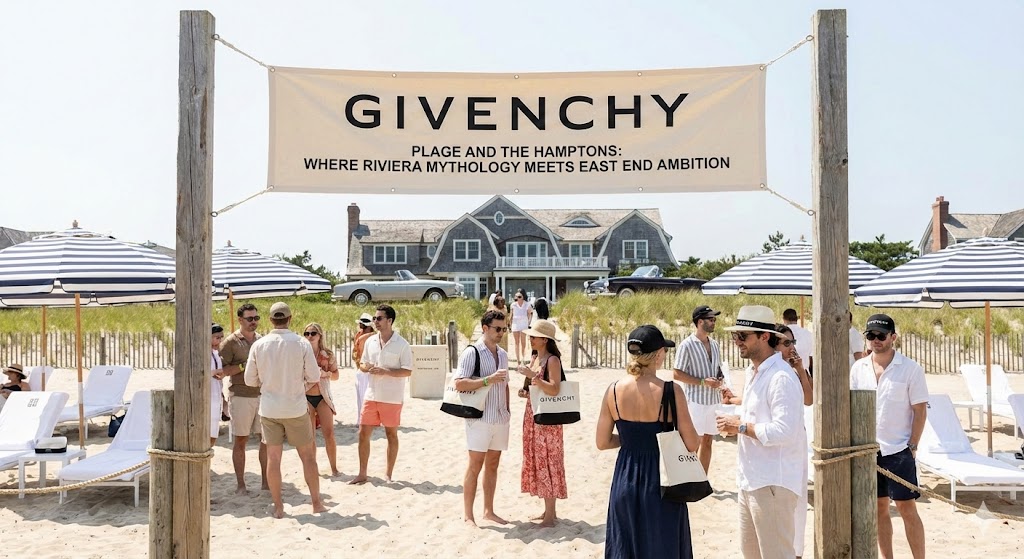
The installation appeared without warning on the grounds of Topping Rose House in early July 2023. Pink umbrellas the color of Mediterranean sunsets. Raffia bags arranged like offerings on a seaside altar. Linen separates in shades Jean-Georges Vongerichten might have approved had he glanced up from his adjacent kitchen. This was Givenchy Plage Hamptons, the French house’s first public retail activation in the United States, and it operated for precisely fourteen days before vanishing like a rumor.
The brevity was strategic. Furthermore, the location communicated something specific about whom the house intended to seduce. Not the logo-driven crowds on East Hampton’s Main Street. Rather, the quieter money that gravitates toward Bridgehampton’s understated chic. Consequently, what Givenchy understood, what the entire Givenchy Plage Hamptons activation telegraphed, was that scarcity manufactures desire more efficiently than availability ever could.
Christie Brinkley attended the private lunch. Rachel Zoe examined the merchandise. Molly Sims posed for photographs that would circulate through fashion media for weeks afterward. Yet the real transaction happening beneath the Jean-Georges cuisine and coastal-inspired cocktails had nothing to do with jogging pants priced at $860. It concerned something far more valuable: the conversion of cultural memory into contemporary status.
The Givenchy Genesis: From Beauvais to Global Empire
Hubert James Marcel Taffin de Givenchy entered the world in 1927 as the younger son of a marquis. His father, Lucien, an aviator, died when Hubert was three years old. Consequently, the boy was raised by women with impeccable taste and Gobelins tapestry connections. His maternal grandfather had directed France’s historic Beauvais and Gobelins factories. Furthermore, Givenchy stood six feet six inches tall by adulthood, a physical presence that would later distinguish him among the compact figures of Parisian fashion.
At seventeen, he moved to Paris to apprentice with Jacques Fath. Subsequently, he trained under Robert Piguet, Lucien Lelong, and Elsa Schiaparelli. In 1952, at twenty-four, he opened his own house with a debut collection that revolutionized expectations. The “séparables” concept presented elegant blouses and flowing skirts as individual pieces. Vogue declared it “a wonderful first collection.” Moreover, the Bettina blouse, named for his model Bettina Graziani, became an instant sensation.
One year later, Givenchy met Audrey Hepburn. She arrived expecting to meet Katharine Hepburn. He had prepared for a different actress entirely. Nevertheless, their partnership would define both careers for forty years. His designs for her in “Sabrina,” “Breakfast at Tiffany’s,” “Funny Face,” and “Charade” established a visual vocabulary for sophisticated femininity that persists today. In addition, the little black dress she wore as Holly Golightly sold at Christie’s in 2006 for over $900,000, with proceeds benefiting charity.
The Mythology Machine
The brand’s origin story emphasizes aristocratic heritage, early independence, and artistic mentorship under Cristóbal Balenciaga. However, the narrative carefully obscures certain realities. LVMH acquired the house in 1988 for approximately $45 million. Hubert de Givenchy departed in 1995, reportedly not entirely by choice. Subsequently, a parade of British designers including John Galliano, Alexander McQueen, and Julien MacDonald reimagined the codes. Riccardo Tisci introduced gothic romanticism from 2005 to 2017. Clare Waight Keller created Meghan Markle’s wedding dress. Matthew M. Williams, the California-bred designer who conceived Givenchy Plage Hamptons, arrived in 2020 and departed in late 2023. Sarah Burton now leads the house.
This designer carousel matters because it reveals how LVMH operates heritage brands. The founding mythology provides legitimacy. The rotating creative directors provide relevance. Together, they manufacture the impression of continuity while enabling constant reinvention. Therefore, when the Plage collection invokes Hubert de Givenchy’s seaside estate Le Clos Fiorentina, it borrows prestige from a man who hadn’t designed for the house in nearly three decades.
Givenchy’s Four Capitals: Decoding Luxury’s Hidden Currency
The French sociologist Pierre Bourdieu spent his career examining how taste functions as a mechanism of social distinction. His framework illuminates what Givenchy Plage Hamptons actually sold beneath the raffia and linen.
Economic Capital
The price architecture of Givenchy Plage positioned it within LVMH’s broader tier structure. Jogging pants cost $860. Cotton shorts ran $750. The reversible Bob hat in raffia listed at $500. Meanwhile, the Voyou bag in its straw basket variation anchored the collection at approximately $2,000 depending on configuration. These figures place Givenchy below Hermès and Louis Vuitton in the conglomerate hierarchy but above contemporary brands like Kenzo.
Entry-level pieces like bucket hats and printed T-shirts offered accessible price points. However, the real economic barrier wasn’t cost but availability. The fourteen-day window at Topping Rose House meant that simply encountering the merchandise required either local knowledge or fortunate timing. Subsequently, this artificial scarcity enhanced perceived value far beyond the retail prices.
Cultural Capital
What must you know to properly consume Givenchy Plage? The collection demanded cultural literacy on multiple registers. First, an understanding of Hubert de Givenchy’s beachwear history, which began at his 1952 debut when he collaborated with an American swimwear brand. Second, familiarity with Le Clos Fiorentina, his Saint-Jean-Cap-Ferrat estate where pearly pink façades inspired the collection’s distinctive palette. Third, recognition of archival prints from 1955 reinterpreted on kaftans, sarongs, and canvas sneakers.
Those lacking this knowledge could still purchase the merchandise. Nevertheless, they would miss the conversation embedded in every piece. The trompe l’oeil pearl prints. The G-Links and Love Locks hardware referencing Matthew Williams’s signature motifs. The Marshmallow wedge shoes beloved by Bella Hadid and Zendaya. Moreover, this information asymmetry separates the truly initiated from the merely wealthy.
Social Capital
The private lunch at Topping Rose House functioned as a membership screening mechanism. Givenchy President of the Americas Valerie Leon attended personally. The guest list included fashion editors, celebrity stylists, and influencers with combined Instagram followings in the millions. Furthermore, being photographed at the event signaled access to a network that extends from Hamptons summer houses to Paris Fashion Week front rows.
Purchasing a Voyou bag in Bridgehampton connected buyers to this social ecosystem. They became, however tangentially, participants in the same world as Jessica Wang and Sai de Silva. Consequently, the bag served as a membership card to spaces that don’t advertise their entrance requirements. The country clubs you can’t apply to join. The parties announced through DMs rather than invitations.
Symbolic Capital
Givenchy occupies a particular position within the luxury hierarchy. It lacks the absolute prestige of Hermès. It can’t match Louis Vuitton’s ubiquity or Chanel’s intergenerational recognition. However, it offers something valuable: sophistication without obviousness. The 4G logo exists but doesn’t scream. In addition, the brand attracts people who want to demonstrate refined taste without appearing to try.
For newly wealthy Hamptons visitors, this positioning resolves a specific anxiety. They possess economic capital but worry their cultural capital hasn’t caught up. A Givenchy Plage kaftan says: I know enough to choose this instead of something louder. I understand the references. Moreover, I’m comfortable enough with my status that I don’t need to announce it.
Why Givenchy Chose Topping Rose House
The Hamptons luxury field operates according to invisible geography. East Hampton’s Main Street houses Louis Vuitton, Gucci, and Prada in permanent flagships. Bernard Arnault himself purchased the Vuitton building for $22 million at $4,400 per square foot. Southampton attracts the established wealth of old money and hedge funds. However, Bridgehampton occupies middle ground. It’s quieter, more agricultural, home to the Hamptons’ first full-service luxury hotel rather than its flashiest boutiques.
Givenchy’s choice of Topping Rose House signaled distance from the Main Street scramble. The 1842 Greek Revival mansion provides historical legitimacy. Jean-Georges Vongerichten’s restaurant provides culinary credibility. Furthermore, the address on Bridgehampton-Sag Harbor Turnpike positions visitors between two villages without committing to either. The brand borrowed prestige from the property while lending prestige in return.
The pop-up format itself communicated impermanence and exclusivity. Unlike permanent boutiques that suggest desperation for traffic, a two-week activation implies confidence. We came, we showed you what we have, and now we’re leaving. Additionally, it offered experiential marketing that can’t be replicated online. You had to be physically present during those specific fourteen days in early July 2023 to participate.
Playing the Field: Givenchy Versus the Competition
Understanding Givenchy’s Hamptons positioning requires mapping the broader competitive landscape. Chanel operates a permanent boutique in East Hampton with seasonal pop-ups expanding its footprint. Louis Vuitton dominates the corner of Main and Newtown with Arnault’s personal real estate investment. Hermès maintains Southampton presence through authorized retailers like London Jewelers. Meanwhile, Zimmermann, Brunello Cucinelli, and The Row compete for the quiet luxury segment that increasingly drives market growth.
Givenchy’s temporary activation differentiated through format rather than location. Where competitors invest in permanent infrastructure, Givenchy created an event. This approach suits a brand navigating creative director transitions and seeking to recapture cultural relevance. Furthermore, it allowed testing East End appetite without committing to the overhead of a seasonal lease.
The Plage collection specifically targeted the beachwear gap in Givenchy’s portfolio. While competitors offered comprehensive resort collections, Givenchy had largely ceded this territory since the founder’s active years. Therefore, Matthew Williams’s archival research served both creative and commercial purposes. It provided design inspiration and it justified premium pricing through heritage authentication.
The Givenchy Investment: Cultural Arbitrage or Conspicuous Consumption?
The Givenchy Plage Hamptons pop-up at Topping Rose House operated July 1-14, 2023, coinciding with the Hamptons’ peak Independence Day season. The installation transformed sections of the property into an immersive brand environment featuring the capsule collection of ready-to-wear and accessories. Visitors could shop during hotel operating hours, and the private launch lunch occurred on July 3.
What type of customer did this activation serve best? Those seeking distinction through knowledge rather than logos. Buyers comfortable paying $570 for a cropped T-shirt because they understand the archival print it references. Guests who recognize that the pearly pink shade evokes Saint-Jean-Cap-Ferrat rather than “Pepto” or “Barbie-core,” as one local publication dismissively suggested. Moreover, people who want to own a piece of a story rather than simply a product.
Pierre Bourdieu would recognize this transaction immediately. The economic exchange obscures a cultural exchange. Customers don’t merely purchase linen separates. They purchase evidence of taste, membership in a community of the initiated, and connection to a mythology that extends from Audrey Hepburn to Meghan Markle. Furthermore, they purchase the ability to reference these associations in future social encounters. The $860 jogging pants aren’t sweatpants. They’re conversation pieces. They’re credentials.
Whether this constitutes wise investment depends entirely on your definition of returns. The merchandise will depreciate on the secondary market. Givenchy resale values trail far behind Hermès and Chanel. Nevertheless, the social access and cultural credibility purchased alongside the merchandise may appreciate in ways that resist quantification. Only you can calculate whether that exchange benefits your particular portfolio of capitals.
Continue Your Luxury Education
- Best Hamptons Fashion Boutiques You Must Visit – Discover where fashion editors shop when they escape to the East End.
- 10 Luxury Fashion Trends Defining The Hamptons Style in 2025 – From quiet luxury to circular fashion, the movements shaping the season.
Stay Connected with Social Life Magazine
Author

Written by
Recent Posts
Unlocking the Berkshires
Dalia Forman Design
Alberto Luzzi
How to Pick a Homecoming Dress for Your Body Type and Feel Amazing in It
How to Prepare a Home for Sale When Major Repairs Are Not Affordable
Categories
- Art
- Articles
- Business of Luxury
- Celebrities
- Culture
- Entertainment
- Events
- Faces of Summer 2026
- Fashion
- Fashion & Style
- Featured
- Finance
- Food, Spirits, Wine
- Hamptons
- Hamptons Celebrities
- Health
- Health & Beauty
- Lifestyle
- Luxury Lifestyle
- Press
- Profiles
- Real Estate
- Technology
- The Chronicles
- Travel
- Uncategorized
- Weddings