
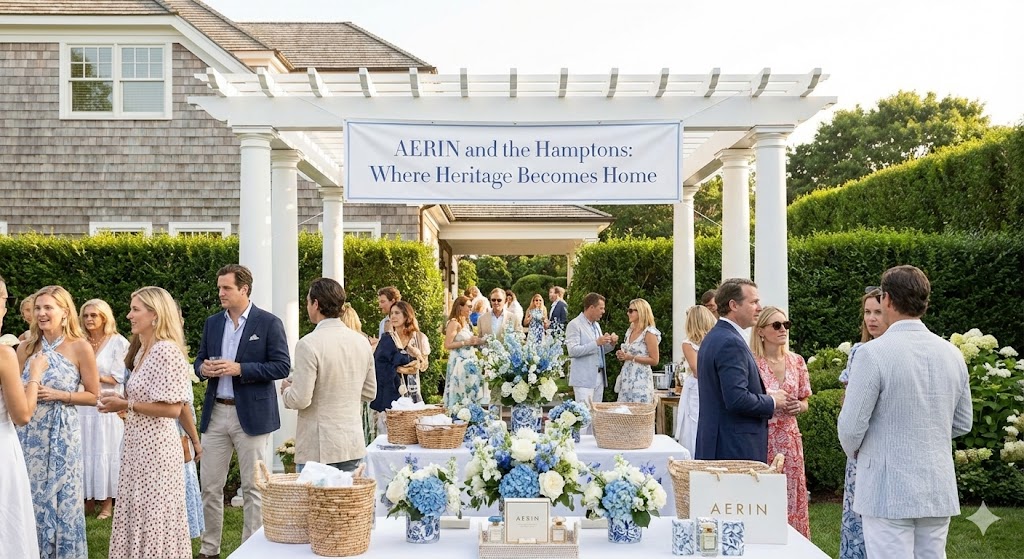
The woman browsing the shagreen-textured frames at 83 Main Street in Southampton does not appear to be shopping. Instead, she appears to be remembering. Indeed, this is intentional. AERIN Hamptons operates on a frequency most luxury brands cannot access: the frequency of inherited taste, of summers past, of grandmother’s vanity table still fragrant with Youth-Dew.
Inside this jewel-box boutique designed by legendary French interior designer Jacques Grange, the merchandise—fragrances, picture frames, jewelry, home accessories—tells a story that money alone cannot purchase. Furthermore, it tells the story of a granddaughter who inherited not just an estate but an entire vocabulary of living well.
Pierre Bourdieu spent his career dissecting how taste functions as a weapon of class distinction. Accordingly, he would have recognized AERIN instantly. This is not a brand selling products. Consequently, it is selling the resolution of a very specific anxiety: the fear that your success is visible but your sensibility is not.
The AERIN Genesis: From Queens Kitchen to Global Empire
Every dynasty begins with a kitchen. For the Lauders, it was a cramped apartment in Queens during the late 1920s. There, Estée Lauder—then Josephine Esther Mentzer—learned to formulate face creams from her Hungarian chemist uncle. Essentially, she cooked beauty on a stovetop. Subsequently, she sold it woman to woman, jar by jar, with a handshake and a free sample.
By 1946, Estée and her husband Joseph had formalized what would become The Estée Lauder Companies. Notably, the founding mythology is deceptively simple: four products (Cleansing Oil, Skin Lotion, Super Rich All-purpose Creme, Creme Pack), one department store account at Saks Fifth Avenue, and an unwavering belief that American women deserved prestige beauty. Today, the company commands a market capitalization exceeding $34 billion.
Aerin Rebecca Lauder Zinterhofer was born into this empire in 1970. Nevertheless, inheritance operates differently in the beauty industry. In fact, you cannot simply receive the throne. Rather, you must prove you understand its weight. Accordingly, she worked at the family company during and after her University of Pennsylvania education, spending 25 years learning the architecture of desire before launching her eponymous brand in 2012.
The Mythology Machine
AERIN’s founding story performs a clever inversion of the typical luxury origin myth. Traditionally, most prestige brands emphasize the founder’s struggles, the garret apartment, the years of rejection. By contrast, Aerin Lauder emphasizes the opposite: effortlessness, heritage, the ease of someone who has never known scarcity.
Importantly, this is strategic. The brand’s entire premise rests on Bourdieu’s concept of misrecognition—the way economic motivations disguise themselves as aesthetic ones. “Beauty is my heritage,” Aerin has stated, “but home and accessories are my passion.” Essentially, the implicit message is clear: she could have done anything, yet she chose this. Therefore, you are not buying products; you are buying the curated choices of someone who never needed to sell you anything.
The Four Capitals: Decoding AERIN’s Hidden Currency
Bourdieu identified four forms of capital that structure social position. Remarkably, AERIN deploys all four with surgical precision. Moreover, understanding this architecture reveals what the brand actually sells—and why certain customers pay premium prices for objects that appear, superficially, modest.
Economic Capital: The Price of Entry
AERIN’s price architecture tells a specific story. Specifically, fragrances range from $35 rollerballs to $275 for Premier Collection parfums. Similarly, home accessories span from $25 decorative pieces through Williams Sonoma collaborations up to $1,995 for outdoor furniture. In essence, this is accessible luxury with an aspirational ceiling.
Crucially, the price points remain digestible enough for the mass affluent while retaining exclusivity signals. For instance, you can enter the AERIN universe with a travel-sized Mediterranean Honeysuckle. Meanwhile, you can furnish an entire Hamptons guesthouse with her collaboration pieces. Ultimately, the economic gradient creates a pathway: today’s fragrance customer becomes tomorrow’s furniture buyer.
Cultural Capital: What You Must Know
Here lies AERIN’s true competitive advantage. Fundamentally, the brand assumes significant cultural capital in its customers. Reference points include Rose de Grasse (requiring knowledge of Provençal perfume heritage), shagreen textures (requiring familiarity with Art Deco luxury materials), and pieces that echo “grandmother’s blue and white porcelain collection” (requiring multi-generational wealth markers).
Consequently, the uninitiated cannot properly consume AERIN. Certainly, they might purchase a candle. However, they will miss the layered meanings: the way the Ikat Jasmine fragrance references South Asian textile traditions, how the bamboo-detailed accessories nod to chinoiserie without becoming costumey, and why the Mediterranean Honeysuckle transports you to a specific memory of the Italian coast even if you’ve never been.
This is Bourdieu’s embodied cultural capital made manifest. Indeed, the brand educates subtly through its presentation, its store environments, its founder’s public persona. Nevertheless, it also excludes those who haven’t done the homework.
Social Capital: The Network Effect
Purchasing AERIN signals membership in a specific social network. Notably, the brand’s celebrity ecosystem includes not flash-and-dash influencers but women of established position: Sofia Coppola, Mary Kate and Ashley Olsen, and the quiet aristocracy of Palm Beach and Southampton who require no introduction because introductions would be gauche.
Furthermore, Jacques Grange designed the Southampton store. His client roster reads like a Burke’s Peerage of taste: Yves Saint Laurent, Princess Caroline of Monaco, Valentino, François Pinault. Consequently, shopping at AERIN positions you within this constellation. In effect, you become adjacent to the adjacency of greatness.
Symbolic Capital: What Ownership Declares
AERIN resolves luxury’s central tension: how to signal wealth without appearing to try. Specifically, the brand occupies what Bourdieu would call the position of “legitimate taste”—it cannot be accused of vulgarity because it is literally descended from American beauty royalty, yet it cannot be accused of stuffiness because its aesthetic is “effortless.”
Accordingly, ownership declares that you have solved the puzzle. Clearly, you are not logo-obsessed (no monograms scream from AERIN products). Likewise, you are not anonymous either (the design language is recognizable to those who know). Subsequently, you have achieved the impossible: visibility through discretion.
Why AERIN Chose the Hamptons—And What It Reveals
The Hamptons functions as what Bourdieu would call a “field”—a competitive arena where luxury brands vie for position and meaning. Strategically, AERIN entered this field in 2013 with the Southampton boutique at 83 Main Street, then added the East Hampton location at 7 Newtown Lane in 2018.
Notably, both locations are strategic. Southampton attracts old money, families whose surnames appear on hospital wings and museum galleries. In contrast, East Hampton draws a more creative-class affluence: film directors, art world figures, media executives. By holding territory in both villages, AERIN claims fluency in multiple dialects of wealth.
The Design Language
The Southampton store, designed by Jacques Grange, channels what Aerin describes as “bohemian luxurious” energy. Meanwhile, the East Hampton location, created with architect Daniel Romualdez (who also designed her Aspen home and the family’s post-Hurricane Sandy beach pavilion), delivers a “surf-inspired interior” mixing vintage wicker chairs with shell and coral-textured lighting from her own product line.
Essentially, both spaces function as three-dimensional mood boards. They demonstrate how AERIN products should be combined, layered, lived with. Additionally, they offer what online retail cannot: the sensory experience of fragrance, texture, weight. Ultimately, the stores sell a lifestyle by literally constructing one.
The Hereditary Claim
AERIN’s Hamptons presence carries additional symbolic weight. Significantly, Estée Lauder herself owned the 1930s Greek Revival house in Wainscott that Aerin inherited and now occupies with her husband Eric Zinterhofer and their sons. There, Estée hosted birthday celebrations on July 1st. Moreover, she took her granddaughters for frankfurters and milkshakes at local diners.
“My family and I have a special connection to the Hamptons,” Aerin has said, “and opening a store in a place which possesses such a rich personal history is a special opportunity.” Crucially, this is not marketing language—it is territorial declaration. Therefore, when you shop at AERIN Hamptons, you are not visiting a brand; you are entering someone’s home—someone whose family has summered here for generations.
Playing the Field: AERIN Versus the Competition
The Hamptons luxury landscape has grown crowded. Indeed, global houses like Louis Vuitton, Chanel, and Hermès operate seasonal flagships. Similarly, contemporary designers like The Row hold positions in Amagansett. Additionally, lifestyle competitors include Goop in Sag Harbor and Serena & Lily nearby.
However, AERIN differentiates through authenticity claims no competitor can match. Fundamentally, the global houses are French; their Hamptons presence is colonial expansion. The Row, however brilliant, was founded by women who grew up as child stars, not beauty dynasty heiresses. Conversely, Goop sells wellness with an edge of controversy; AERIN sells heritage with no edges at all.
Most critically, AERIN operates on what luxury scholars call the “quiet luxury” frequency. Notably, no logos demand attention. Likewise, no seasonal drops create artificial scarcity. Instead, the products simply exist, beautiful and available, as if they had always been here—because in some sense, they have.
The Old Money / New Money Resolution
AERIN serves both populations by refusing to acknowledge the distinction exists. For old money customers, the brand validates their existing taste infrastructure: yes, blue and white porcelain arrangements are correct; yes, fresh flowers from the garden belong in every room; yes, fragrance should reference memory and place.
For new money customers—the tech founders, the private equity principals, the medspa queens who have arrived but not yet settled—AERIN provides a curriculum. First, buy the candle. Then, add the frames. Finally, incorporate the tabletop accessories. Subsequently, your Hamptons rental will begin to look less like a real estate transaction and more like a home.
The AERIN Investment: Cultural Arbitrage or Legitimate Taste?
The Southampton boutique operates year-round at 83 Main Street (phone: 631-353-3773). Similarly, the East Hampton location at 7 Newtown Lane maintains comparable hours. Together, both stores offer what the website describes as “curated selections of one-of-a-kind jewelry and luxury beauty products” alongside the broader home and accessories collections.
Importantly, visitors should approach with intentionality. These are not browsing environments but educational experiences. Specifically, the staff—knowledgeable without being aggressive—will guide you through the fragrance wardrobe concept, explain the shagreen process, and discuss which frames might complement your grandmother’s photographs.
Ultimately, what AERIN actually sells is permission. It grants permission to care about beautiful objects. It offers permission to invest in the texture of daily life. Moreover, it provides permission to believe that aesthetic choices matter, that the frames holding your family photographs deserve consideration, and that the way your entry hall smells when guests arrive is not superficial but essential.
Bourdieu would note the irony: by purchasing AERIN Hamptons products, you are essentially buying the right to appear as if you never needed to buy anything at all. In essence, you are purchasing effortlessness. Nevertheless, in a world where effort is visible everywhere—in the striving branding, the desperate logos, the try-hard collaborations—that effortlessness has become the ultimate luxury.
The woman at 83 Main Street has finished browsing. Quietly, she has purchased a single frame—shagreen-textured, sized for a photograph she will select later. Remarkably, the frame costs less than dinner at Sant Ambroeus. Furthermore, it will communicate more than a Hermès scarf about who she is and where she belongs.
This is the AERIN proposition: not wealth displayed, but taste deployed. Indeed, the Hamptons understood.
Continue Your Luxury Education
- Best Hamptons Fashion Boutiques You Must Visit – Discover where fashion editors shop when they want authenticity over hype.
- 10 Luxury Fashion Trends Defining Hamptons Style – From quiet luxury to the preloved market, understand what’s driving elite wardrobes.
Stay Connected with Social Life Magazine
Author

Written by
Recent Posts

Unlocking the Berkshires
Dalia Forman Design
Alberto Luzzi
How to Pick a Homecoming Dress for Your Body Type and Feel Amazing in It
How to Prepare a Home for Sale When Major Repairs Are Not Affordable
Categories
- Art
- Articles
- Business of Luxury
- Celebrities
- Culture
- Entertainment
- Events
- Faces of Summer 2026
- Fashion
- Fashion & Style
- Featured
- Finance
- Food, Spirits, Wine
- Hamptons
- Hamptons Celebrities
- Health
- Health & Beauty
- Lifestyle
- Luxury Lifestyle
- Press
- Profiles
- Real Estate
- Technology
- The Chronicles
- Travel
- Uncategorized
- Weddings