
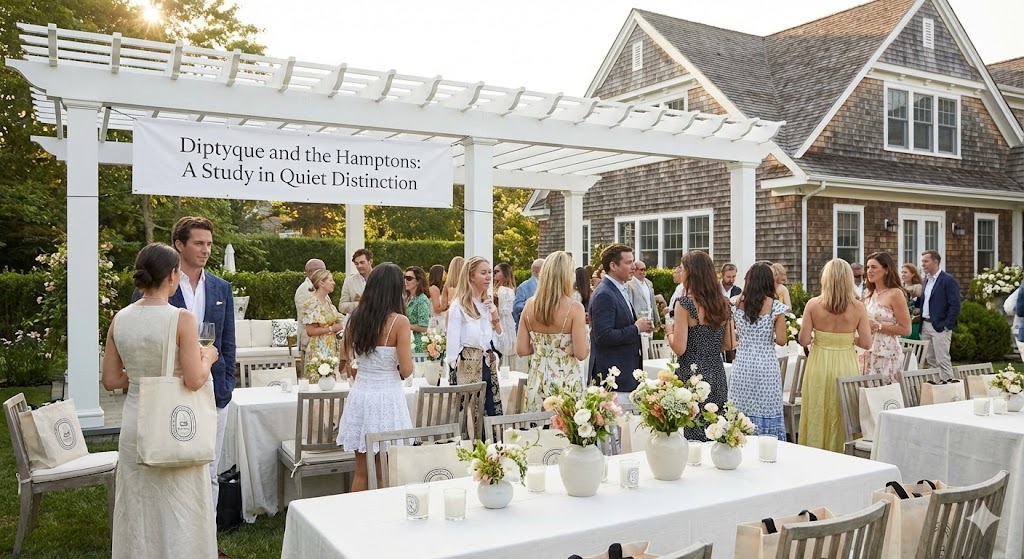
The Scent of Insider Knowledge at 11 Newtown Lane
The woman lifting the black glass vessel to her nose at 11 Newtown Lane doesn’t need the sales associate’s help. She already knows. She knows that Baies rhymes with “hey,” not “bays.” She knows the blackcurrant and Bulgarian rose blend will fill her Amagansett living room within minutes of lighting. Furthermore, she knows that the empty vessel will remain on her Carrara marble console long after the 60-hour burn time expires, because Diptyque Hamptons customers understand that the candle is never just a candle.
This is the quiet game of cultural capital that Pierre Bourdieu spent his career anatomizing. The French sociologist argued that taste functions as a social weapon, distinguishing those who possess legitimate knowledge from those who merely possess money. Diptyque’s East Hampton boutique, which opened in summer 2023 as the brand’s first location east of Manhattan, represents a masterclass in this distinction. Moreover, the 640-square-foot space offers something no amount of wealth can purchase directly: proof that you already knew.
The Bletchley Park Genesis: From Codebreaking to Candlemaking
The origin story reads like wartime fiction. Desmond Knox-Leet, a British painter who worked at Bletchley Park during World War II deciphering Nazi codes alongside Alan Turing, eventually settled in Paris. There he befriended Christiane Gautrot, an interior designer, and Yves Coueslant, a theater set designer. In 1961, the trio opened a small boutique at 34 Boulevard Saint-Germain, selling fabrics they had designed together and curiosities collected from their travels.
The name itself demands cultural literacy. “Diptyque” derives from the Greek “diptych,” a two-paneled painting hinged together like a medieval altar piece. Knox-Leet recognized that the storefront’s symmetrical windows flanking a central door resembled this ancient form. Consequently, the name encoded an art-historical reference that casual observers would miss entirely. This established the brand’s founding principle: insider knowledge as entry fee.
By 1963, the founders introduced their first three scented candles—Aubépine (Hawthorn), Cannelle (Cinnamon), and Thé (Tea)—transforming the humble candle from utilitarian object to decorative statement. Then in 1968, Knox-Leet himself composed L’Eau, Diptyque’s first eau de toilette. Inspired by a 16th-century English potpourri recipe and pomander traditions, the unisex fragrance broke conventions at a time when gendered scenting remained absolute. The codebreaker had created another cipher, this one written in cinnamon, clove, and geranium.
The Mythology Machine
The brand emphasizes certain elements while strategically obscuring others. You’ll read extensively about artistic sensibilities and travel inspirations. Nevertheless, you won’t find prominent mention that London-based private equity firm Manzanita Capital acquired Diptyque in 2005 for an undisclosed sum. The founders’ bohemian bazaar now operates as a sophisticated luxury enterprise with 124 boutiques worldwide, up from 70 in 2018. This tension between artisanal origin and corporate expansion mirrors luxury’s central paradox: mass-producing the handmade.
Diptyque’s Four Capitals: Decoding Luxury’s Hidden Currency
Economic Capital
The price architecture speaks volumes about accessibility thresholds. A standard 190g candle retails for $78, burning approximately 60 hours. The 600g ceramic vessels command $175. Meanwhile, City Candles—available only one week annually outside their namesake locations—reach $86. These prices position Diptyque precisely: expensive enough to signal discernment, accessible enough to avoid plutocratic isolation.
Resale value remains modest because consumption destroys the product. However, the empty vessels circulate as decorative objects, pencil holders, and makeup brush containers. This afterlife extends brand visibility without additional purchase, functioning as what economists call “earned media” in physical form. The global luxury candle market, valued at $603 million in 2024 and projected to reach $1.18 billion by 2030, demonstrates the category’s investment potential.
Cultural Capital
What must you know to properly consume Diptyque? First, pronunciation. Mispronouncing “Diptyque” (dip-TEEK) or “Baies” (bay) immediately identifies the uninitiated. Second, the signature label’s cryptographic design—fragrance names arranged in ovals that require circular reading—demands familiarity. Third, burning etiquette: allowing the entire surface to liquify during initial burn, trimming wicks to precise lengths, extinguishing with a snuffer rather than breath.
This embodied knowledge separates genuine enthusiasts from gift recipients. Additionally, the brand rewards those who recognize connections across collections. Baies candles pair with L’Ombre dans l’Eau eau de toilette. Philosykos fragrance extends into the candle’s fig-tree meditation. Understanding these relationships requires sustained engagement that casual purchasers never develop.
Social Capital
The celebrity roster functions as both endorsement and social positioning. Victoria Beckham burns Figuier candles in her flagship store, telling The Cut that customers constantly comment on the scent. Meghan Markle favored Diptyque candles for her pre-royal lifestyle blog The Tig. Beyoncé’s home reportedly smells of Opoponax, which she describes as “warm and sweet.” Meanwhile, Elizabeth Olsen uses only Philosykos, explaining to Harper’s Bazaar that traditional perfumes give her headaches.
This social network operates through recognition rather than aspiration. Spotting a Diptyque candle in someone’s home signals shared cultural values. Subsequently, it creates implicit permission for conversation, much like recognizing the same obscure novel on a bookshelf. The brand becomes a membership card for a club that never advertises.
Symbolic Capital
Where does Diptyque sit in luxury’s prestige hierarchy? Above mass-market Yankee Candle, obviously. Above Bath & Body Works, certainly. Yet also distinct from newer competitors like Byredo (which Manzanita Capital also owned until Puig’s 2022 acquisition) or Le Labo. Furthermore, Diptyque occupies the position Bourdieu termed “legitimate taste”—neither aggressively logo-branded nor self-consciously minimalist.
The black-and-white label, hand-drawn by Knox-Leet until his death in 1993, avoids contemporary design trends entirely. This aesthetic restraint communicates confidence. The brand doesn’t need to announce itself because those who matter already know. For new money seeking legitimacy, Diptyque offers a safe passage that neither oversignals wealth nor undersignals refinement.
Why Diptyque Chose the Hamptons—And What It Reveals
The East Hampton location at 11 Newtown Lane positions Diptyque among formidable neighbors: Gucci, Golden Goose, Aerin, Zimmermann, Brunello Cucinelli, Tenet, James Perse, Tod’s, Cartier, and Prada all occupy the same immediate retail cluster. This proximity creates what real estate professionals call “agglomeration effects”—luxury brands benefit from adjacency to other luxury brands, as shoppers expect to find them together.
“We feel right at home on Newtown Lane,” Jennifer Sabarots, Vice President of Retail Americas, stated in the announcement. “The area’s residents and visitors share our luxurious yet laidback aesthetic.” This description—”luxurious yet laidback”—captures the Hamptons habitus precisely. Ostentatious display violates local norms. The preferred mode involves quiet signals legible only to insiders.
The 640-square-foot footprint with 20 feet of storefront suggests strategic restraint. Unlike Louis Vuitton’s $22 million East Hampton building purchase at $4,400 per square foot, Diptyque operates within modest boundaries. This aligns with the brand’s positioning: present but never overwhelming, available but never desperate. The boutique remains open year-round, signaling commitment beyond seasonal tourism.
Playing the Field: Diptyque vs. the Competition
The Hamptons luxury fragrance landscape includes direct competitors at varying price points. Jo Malone offers accessible luxury with straightforward scent profiles and customizable layering. Le Labo provides industrial-chic aesthetics with personalized labeling. Aerin Lauder’s eponymous brand, with its own East Hampton presence, targets the hostess-gift market with rose-inflected collections.
Diptyque differentiates through temporal positioning. The brand predates all competitors by decades, establishing heritage claims that newer entrants cannot match. Additionally, the product range extends beyond personal fragrance into comprehensive home scenting—candles, diffusers, room sprays—creating ecosystem lock-in that fragrance-only brands lack.
For old money seeking distinction from new money, Diptyque offers plausible deniability. The products are sufficiently established to avoid trend-chasing accusations, yet sufficiently sophisticated to demonstrate active curation. For new money seeking legitimate taste, the brand provides safe harbor—unlikely to trigger eye-rolls from established families while clearly signaling aesthetic awareness.
The Diptyque Investment: Cultural Arbitrage or Ambient Atmosphere?
Visitors to Diptyque East Hampton at 11 Newtown Lane will find the full fragrance portfolio alongside seasonal collections and gift sets. Hours extend through the weekend, accommodating both local residents and summer visitors. The experience emphasizes consultation over transaction—staff guide customers through scent families rather than pushing bestsellers.
What type of customer does this store serve best? Those with existing Diptyque familiarity will appreciate the complete collection unavailable at department store counters. Those seeking hostess gifts find elegant, universally acceptable options. Those furnishing newly purchased Hamptons properties can establish immediate olfactory identity. However, those seeking aggressive status signaling should look elsewhere—Diptyque whispers rather than shouts.
The cultural literacy required for meaningful engagement extends beyond mere purchase. Understanding how candle scents interact with room size, how seasonal shifts affect fragrance perception, how different vessels (clear glass, colored glass, ceramic) communicate different intentions—this knowledge accumulates through experience rather than instruction. Diptyque rewards the already-initiated while welcoming newcomers willing to learn.
Bourdieu would recognize this instantly. The codebreaker’s candle company sells what economic transactions cannot directly purchase: proof of prior knowledge, membership in unstated communities, the quiet confidence of those who knew before knowing became necessary. The flame illuminates more than it consumes.
Continue Your Luxury Education
- Luxury Audience Engagement: Elite Tactics for High-End Brands – Discover how premium brands cultivate devoted followings through experiential marketing and personalized service.
- How AI Is Reshaping Luxury Brand Marketing – Explore the technological transformation redefining how heritage houses connect with affluent consumers.
- Stylish Branded Content in Luxury Print Magazines – Learn why tactile media continues commanding attention among high-net-worth audiences.
Stay Connected with Social Life Magazine
Author

Written by
Recent Posts
Unlocking the Berkshires
Dalia Forman Design
Alberto Luzzi
How to Pick a Homecoming Dress for Your Body Type and Feel Amazing in It
How to Prepare a Home for Sale When Major Repairs Are Not Affordable
Categories
- Art
- Articles
- Business of Luxury
- Celebrities
- Culture
- Entertainment
- Events
- Faces of Summer 2026
- Fashion
- Fashion & Style
- Featured
- Finance
- Food, Spirits, Wine
- Hamptons
- Hamptons Celebrities
- Health
- Health & Beauty
- Lifestyle
- Luxury Lifestyle
- Press
- Profiles
- Real Estate
- Technology
- The Chronicles
- Travel
- Uncategorized
- Weddings