
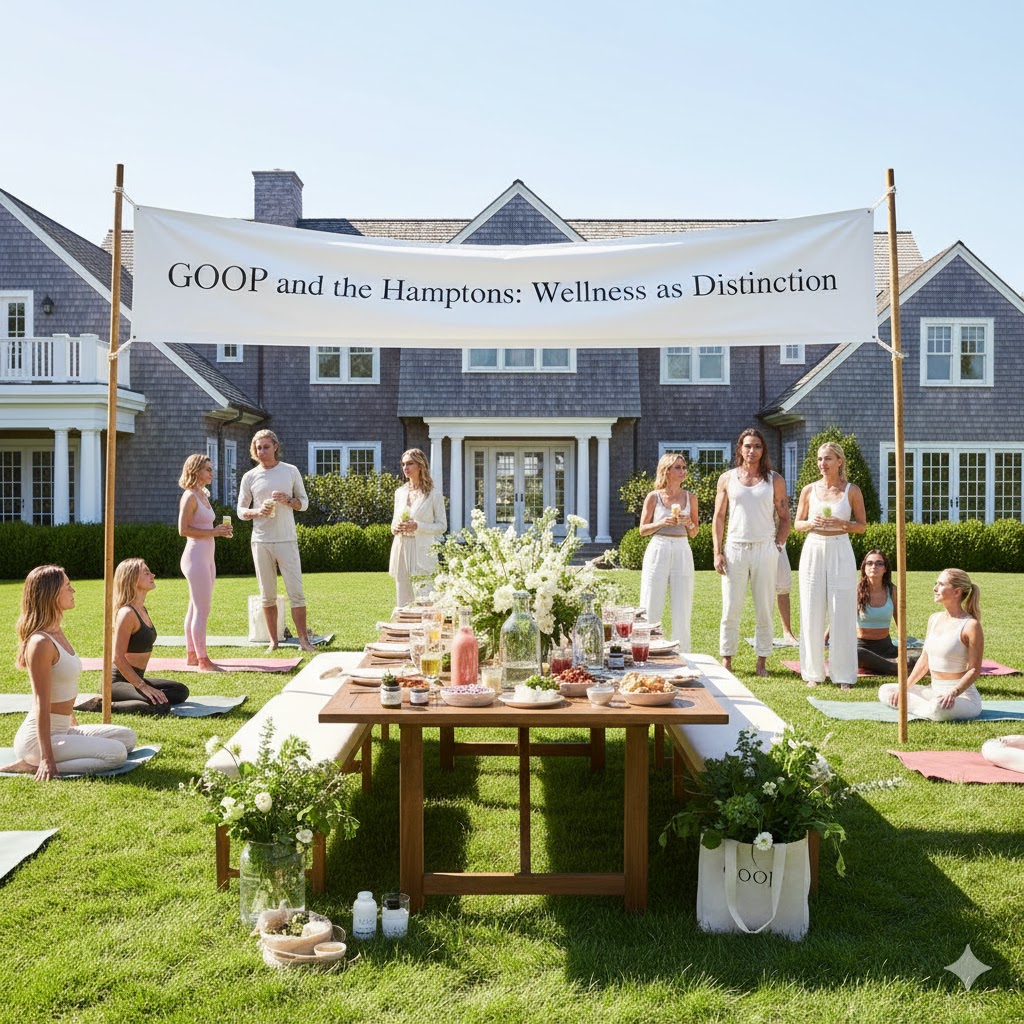
The cottage at 4 Bay Street sits where whaling fortunes once docked. Through its windows, you see a freestanding Kohler bathtub filled not with water but with bath products. This is Goop Sag Harbor, Gwyneth Paltrow’s lifestyle outpost, where a $60 vitamin powder promises to make you glow from within. The question isn’t whether you need it. The question is what believing you need it says about who you’re becoming.
The Goop Genesis: From Kitchen Newsletter to Wellness Empire
In September 2008, Gwyneth Paltrow sat in her London kitchen and typed the first issue of what would become a cultural phenomenon. The newsletter contained recipes for turkey ragù and banana nut muffins. Harmless enough. She called it Goop because branding executive Peter Arnell told her successful internet companies have double Os in their names. The letters G and P were already hers. The slogan promised to “Nourish the Inner Aspect.”
Within a year, 150,000 subscribers were reading lifestyle advice from an Oscar-winning actress. By 2011, the newsletter had incorporated into a company. Moreover, Paltrow hired Lisa Gersh, former CEO of Martha Stewart Living Omnimedia, to professionalize the operation. This was not a hobby anymore. The company began selling products, not just recommending them.
The numbers tell a particular story. In 2016, Goop raised $15 million in Series B funding. Two years later came $50 million more, bringing total investment to $82 million and valuation to $250 million. By 2024, revenue had grown 10% year-over-year, with beauty products alone increasing 42%. Consequently, the enterprise now employs over 200 people and operates stores in Los Angeles, New York, and London, alongside the Sag Harbor outpost.
The Mythology Machine
What Goop tells about itself matters as much as what it sells. The founding myth positions Paltrow as a woman who simply wanted to share what she was “genuinely loving” with friends. This framing transforms commercial enterprise into intimate recommendation. Subsequently, the brand narrative emphasizes Paltrow’s personal struggles with wellness, positioning her not as celebrity selling products but as fellow seeker sharing discoveries.
The name itself performs this function. “Goop” sounds homemade, slightly silly, like something a friend might call her obsessive research into supplements. It deflects the commercial intent lurking beneath. As a result, the brand maintains an amateur authenticity even as it operates with venture-capital precision. This tension between artisanal presentation and corporate reality defines everything Goop does.
Goop’s Four Capitals: Decoding Wellness Luxury
Understanding what Goop actually sells requires looking beyond products to the forms of value it trades in. Bourdieu identified four types of capital that determine social position. Each illuminates a different dimension of the Goop phenomenon.
Economic Capital
The price architecture reveals careful positioning. Entry points exist around $25 for vitamin D sprays and lip balms. Mid-range products cluster between $60 and $90, including the GOOPGLOW Morning Skin Superpowder and various supplement protocols. Premium offerings reach $150 for the Youth-Boost Peptide Serum. Additionally, vitamin protocols can run $90 per month.
These prices occupy a strategic middle ground. They exceed drugstore alternatives by factors of five or ten. However, they remain accessible to aspirational consumers in ways that Hermès or Chanel never will. A woman who cannot afford a Birkin can still purchase the GOOPGLOW Microderm Instant Glow Exfoliator. Therefore, Goop democratizes luxury signaling while maintaining sufficient premium to confer status.
Investment piece logic doesn’t quite apply here. Unlike a Cartier watch, these products get consumed and repurchased. Consequently, the economic relationship becomes subscription-like, requiring ongoing expenditure to maintain group membership.
Cultural Capital
This is where Goop gets interesting. The brand requires specific knowledge to consume properly. You must understand what “clean beauty” means, why parabens are concerning, what adaptogens do. Furthermore, you need familiarity with terms like “gut-skin axis,” “circadian rhythms,” and “cellular regeneration.”
The cultural capital required divides into embodied, objectified, and institutionalized forms. Embodied capital means knowing how to take supplements correctly, how to layer serums, how to speak knowledgeably about ingredients. Objectified capital shows up in the products themselves, which announce membership in the wellness cognoscenti. Institutionalized capital comes from association with the Goop brand’s accumulated legitimacy.
Crucially, Goop educates its consumers through content. The website publishes articles explaining why you need particular products. Thus, the brand creates the very knowledge system that makes its products meaningful. This circular logic ensures consumers become invested in the worldview that justifies their purchases.
Social Capital
Carrying a Goop product says something about your network. The brand’s celebrity ecosystem includes wellness practitioners, functional medicine doctors, and alternative health advocates featured on the Goop podcast and at In Goop Health summits. By extension, consumers affiliate themselves with this network.
The social spaces Goop grants entry to are not physical clubs but conversational communities. At a Hamptons dinner party, mentioning your supplement protocol signals membership in a particular tribe. Similarly, the products function as social lubricants among women who share wellness concerns. Hence, Goop purchases buy access to a community of practice.
Paltrow herself remains central to this social capital. Her continued visibility, her personal use of products, her willingness to discuss intimate health topics creates parasocial connection. Consumers feel they know her, and by extension, know each other.
Symbolic Capital
In the hierarchy of lifestyle brands, Goop occupies a peculiar position. It is simultaneously admired and mocked, aspirational and controversial. The jade egg lawsuit, the vaginal steaming recommendations, the $145,000 settlement with California regulators for unsubstantiated health claims: all of this is known. Nevertheless, the brand thrives.
This apparent contradiction reveals something important. Goop’s symbolic capital derives partly from its willingness to be controversial. The brand positions itself as brave enough to explore practices that mainstream medicine dismisses. Accordingly, purchasing Goop signals open-mindedness, willingness to question authorities, alignment with alternative epistemologies.
For consumers caught between old money skepticism and new money credulity, Goop offers resolution. It looks expensive enough for the wealthy but claims to offer genuine health benefits. It promises that indulgence is actually self-care. Therein lies its symbolic power.
Why Goop Chose Sag Harbor and What It Reveals
The location at 4 Bay Street deserves analysis. Goop could have opened in East Hampton, with its concentration of global luxury brands. Instead, Paltrow chose Sag Harbor, a 2.3-square-mile village known for whaling history and creative community. This decision reveals strategic sophistication.
Sag Harbor’s demographics differ from Southampton or East Hampton. The village attracts writers, artists, and intellectuals alongside finance money. Herman Melville mentioned it in Moby Dick. John Steinbeck wrote here. As a result, the village carries cultural credibility that pure wealth cannot purchase. Moreover, median home prices in the village core exceed seven figures, ensuring appropriate affluence.
The store itself occupies a converted cottage designed by Kate McCollough and Max Zinser. They “washed the interior in crisp white and light grey” and included locally sourced antiques. A Kohler bathtub sits by the fireplace, filled with bath products rather than water. The aesthetic reads as Hamptons home, not retail store. Thus, shopping becomes visiting a friend’s house.
This “pop-up turned permanent outpost” strategy reveals Goop’s market-testing approach. The brand returned to Sag Harbor for multiple summers before committing to year-round presence. Consequently, they confirmed demand before investing in permanence. The store now operates Monday through Saturday 10am-6pm, Sundays until 5pm.
The Field of Wellness Retail
Sag Harbor’s Main Street features boutiques selling cashmere and vintage furniture. Goop slots into this ecosystem without disruption. The store neighbors Bay Street Theater and looks out toward the harbor where yachts now dock where whaling ships once anchored. Furthermore, the surrounding retail environment includes other lifestyle brands targeting similar demographics.
Unlike East Hampton, where Louis Vuitton and Gucci compete for attention, Sag Harbor offers quieter status signaling. The village’s creative-class associations provide cover for consumption. Buying Goop supplements in Sag Harbor feels like participating in local wellness culture rather than engaging in conspicuous consumption. Accordingly, the location choice reflects sophisticated understanding of how different Hamptons villages encode different forms of status.
Playing the Field: Goop Versus the Competition
The wellness-lifestyle category has exploded since Paltrow pioneered it. Kourtney Kardashian’s Poosh launched in 2019. Jessica Alba’s Honest Company went public at $1.4 billion valuation. Kate Moss introduced Cosmoss. Meghan Markle recently unveiled American Riviera Orchard. Furthermore, celebrity beauty brands from Hailey Bieber’s Rhode to Rihanna’s Fenty Skin compete for the same consumers.
Goop differentiates through several mechanisms. First, longevity confers legitimacy. The brand has operated since 2008, predating most competitors by a decade. Second, controversy functions as differentiation. The jade egg scandal, whatever its merits, made Goop unforgettable. Third, content depth distinguishes Goop from pure product plays. The editorial operation, podcast, and documentary series create engagement beyond transactions.
Against traditional luxury brands, Goop competes on different terrain entirely. A Chanel shopper seeks heritage, craftsmanship, and recognizable status markers. A Goop shopper seeks optimization, wellbeing, and insider knowledge. These desires occasionally overlap but operate through different logics. Therefore, Goop faces limited direct competition from legacy luxury houses.
The New Money / Old Money Resolution
Here is where Goop performs its most interesting cultural work. Old money traditionally distrusts wellness enthusiasm as nouveau riche anxiety. New money often lacks the cultural fluency to navigate established luxury codes. Goop offers both groups something valuable.
For old money, Goop provides acceptable wellness access. The brand’s California origins, clean aesthetic, and celebrity association distance it from supplement-store desperation. Additionally, the prices remain low enough to feel unserious, a experiment rather than investment. For new money, Goop teaches wellness vocabulary and provides instant community membership. Subsequently, both groups can find what they need without compromising their self-image.
The Goop Verdict: Cultural Arbitrage in a Cottage
Visiting the Goop Sag Harbor store reveals several things simultaneously. You will find clean beauty products, vitamin protocols, and the occasional cashmere sweater. The staff will discuss your skin concerns with apparent sincerity. The space will feel more residential than retail. Hours run 10am-6pm Monday through Saturday, 10am-5pm Sunday, at 4 Bay Street.
The customer best served here is someone already invested in wellness discourse, someone who reads ingredient lists and considers gut health. Alternatively, the curious can find entry points through the more accessible products. Furthermore, the location provides legitimate excuse for anyone who feels self-conscious about wellness shopping. You were simply strolling Bay Street and stopped in.
What Goop actually sells, Bourdieu would note, is not supplements or serums but distinction itself. The brand converts economic capital into cultural and symbolic capital through the medium of wellness products. Accordingly, consumers purchase not just things but membership in a community of practice, access to a knowledge system, and resolution of anxieties about health, status, and belonging.
The cottage at 4 Bay Street will continue anchoring Goop’s Hamptons presence. Summer crowds will browse among the bath products. Locals will pick up their preferred vitamin protocols. And the whaling village that once processed valuable oil will continue processing another form of extraction: turning wellness anxiety into commercial value, one $60 superpowder at a time.
Continue Your Luxury Education
- Best Hamptons Fashion Boutiques You Must Visit – Discover the insider-favored shops that drive the East End’s $2 billion luxury economy.
- 10 Luxury Fashion Trends Defining Hamptons Style in 2025 – From quiet luxury to sustainable fashion, understand the codes that matter this season.
Stay Connected with Social Life Magazine
- Feature Your Brand in Social Life – Partner with the Hamptons’ luxury lifestyle authority since 2000.
- Experience Polo Hamptons – The premier summer event for luxury brand activation and deal flow.
- Subscribe to Our Newsletter – Weekly insider access to East End culture and commerce.
- Print Subscription – Get Social Life Magazine delivered.
- Support Our Journalism ($5) – Help us continue independent luxury coverage.
Author

Written by
Recent Posts

AI for personal finance: where PennyGuard fits

How to Pick a Homecoming Dress for Your Body Type (and Feel Amazing in It)

World Cup Injury Attorney for Vancouver Events
What a 3-Carat Engagement Ring Actually Costs in 2026: The Real Numbers
The Skincare Habits That Make a Real Difference Over Time
Categories
- Art
- Articles
- Business of Luxury
- Celebrities
- Culture
- Entertainment
- Events
- Faces of Summer 2026
- Fashion
- Fashion & Style
- Featured
- Finance
- Food, Spirits, Wine
- Hamptons
- Hamptons Celebrities
- Health
- Health & Beauty
- Lifestyle
- Luxury Lifestyle
- Press
- Profiles
- Real Estate
- Technology
- The Chronicles
- Travel
- Uncategorized
- Weddings