
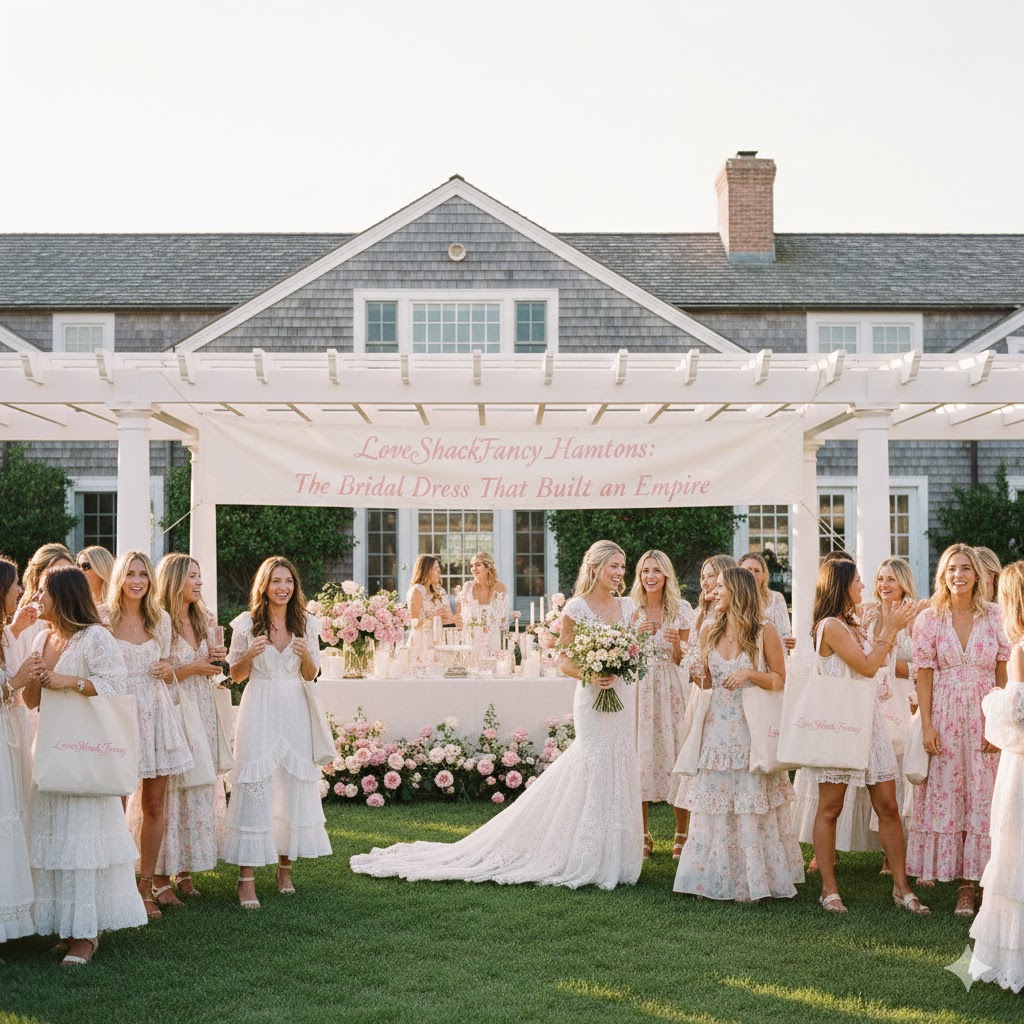
The pink awning on Madison Street catches afternoon light like a confection. Inside, floral wallpaper cascades from ceiling to floor while fresh peonies burst from antique vessels on every surface. A mother adjusts a tulle skirt on her twelve-year-old daughter. Both are already wearing matching LoveShackFancy dresses. They arrived that way.
This is the Sag Harbor flagship. Moreover, this is precisely the scene the brand’s founder Rebecca Hessel Cohen imagined when she designed her first dress for a Bridgehampton wedding over a decade ago. Today, LoveShackFancy operates two Hamptons locations with combined square footage that rivals some boutique hotels. The question isn’t why this brand thrives in the East End. The question is what purchasing a $595 floral maxi dress actually accomplishes for the woman carrying it to the register.
Pierre Bourdieu, the French sociologist who spent his career dissecting how taste functions as social weaponry, would recognize LoveShackFancy instantly. Furthermore, he would understand that this brand sells something far more valuable than cotton and lace. It sells legitimate femininity.
The LoveShackFancy Genesis: From Bridgehampton Backyard to Global Empire
The founding story reads like aspirational fiction. Rebecca Hessel Cohen, a senior fashion and beauty editor at Cosmopolitan, couldn’t find bridesmaid dresses that matched her vision for her 2010 wedding. The ceremony would take place in her mother’s Bridgehampton backyard. The aesthetic was “Great Expectations meets The Great Gatsby.” Consequently, she designed the dresses herself.
Cohen worked with a seamstress in Manhattan’s Garment District to create hand-dyed silk halter gowns in soft pastels. The bridesmaids looked like ethereal apparitions against the apple orchard backdrop. Subsequently, friends started asking where they could buy similar pieces.
The name itself carries matrilineal significance. Cohen’s mother, formerly creative director at Seventeen magazine, had planned to launch a prop-styling business from their Hamptons home called Love Shack Fancy. She never did. When Cohen needed a brand name, nothing else felt right. “It originated from my mom’s ultimate Love Shack Fancy house,” she later explained.
The Mythology Machine
Every luxury brand cultivates origin mythology. LoveShackFancy’s is notably specific to the Hamptons. The wedding happened in Bridgehampton. The first trunk shows occurred at beach clubs and summer parties. The first celebrity endorsement came when Gwyneth Paltrow’s stylist discovered Cohen’s pieces at her in-laws’ rented Hamptons house. Additionally, Paltrow wore them “all over the Hamptons that summer.”
This geographic specificity functions as cultural capital. The brand didn’t emerge from a corporate incubator. It emerged from a backyard garden party where the light filtered through climbing roses. Therefore, purchasing LoveShackFancy means purchasing proximity to that original moment of romantic creation.
Cohen officially launched in 2013 and opened her first retail store in Sag Harbor in 2018. The location was a converted 1780s farmhouse on Main Street. Today the brand operates 21 stores worldwide with 450 retail partners including Sephora, Net-A-Porter, Harrods, and Revolve. The company remains family-owned. Cohen’s husband Todd, a real estate developer, handles retail expansion and beauty business operations.
LoveShackFancy’s Four Capitals: Decoding Luxury’s Hidden Currency
Bourdieu identified four forms of capital that determine social position. LoveShackFancy demonstrates mastery of all four.
Economic Capital
The price architecture creates deliberate tiers of entry. A ruffle mini skirt starts around $245. The signature maxi dresses range from $395 to $795. Special occasion gowns featuring beading and embroidery climb past $1,195. Home goods offer lower entry points: wallpaper at $140 per roll, bedding from $75 to $300.
Meanwhile, collaborations extend the brand’s economic reach. The Gap partnership brought LoveShackFancy prints to a mass audience. American Girl offers miniature dress-and-accessory sets for $176. Stanley tumblers in signature florals retail for $40. These collaborations don’t dilute the brand. Instead, they create aspiration ladders. The teenager drinking from a LoveShackFancy Stanley envisions the day she’ll wear the dress.
According to Business of Fashion, the brand has achieved remarkable growth trajectory. Net sales grew approximately 125% from 2020 to 2021. Furthermore, online sales reached $38.5 million in 2024 with an average order value between $425 and $450.
Cultural Capital
Cultural capital comes in three forms: embodied, objectified, and institutionalized. LoveShackFancy deploys all three strategically.
Embodied capital means knowing how to consume the brand properly. The LoveShackFancy customer understands vintage silhouettes. She recognizes the difference between prairie dress and Victorian inspiration. She knows that “cottagecore” is a recent term for an aesthetic Cohen was creating long before Instagram existed.
Objectified capital manifests in the garments themselves. Each piece references specific design history: French country textiles, English garden parties, Victorian lace traditions. The woman who wears LoveShackFancy communicates cultural knowledge through her clothing choices. Additionally, she signals familiarity with European design heritage without appearing try-hard about it.
Institutionalized capital accumulates through recognition. Cohen received the WWD Award for Best Performing Fashion Company. She’s been profiled on the cover of the New York Times Style section. The brand has shown at Paris Fashion Week from the Ritz hotel. These credentials validate consumer choice. You’re not just buying a pretty dress. You’re buying a dress from an award-winning designer featured in the Times.
Social Capital
The celebrity endorsement ecosystem functions as social capital transfer. Jennifer Lopez shutting down the Sag Harbor store with her stepdaughter becomes news. Paris Hilton, Nicky Hilton Rothschild, Jessica Alba, Angelina Jolie, Kate Hudson, and Miranda Kerr have all worn the brand. When you purchase LoveShackFancy, you join this network by association.
The brand’s physical spaces amplify this effect. Walking into the Sag Harbor flagship means walking into a world where celebrities shop alongside you. The Southampton store on Main Street positions customers within the same retail ecosystem as Hamptons power players. “We’ve just been making so much money throughout these last few weeks,” one sales associate told WWD after Lopez’s visit. “She’s just another customer.”
That casual dismissal is itself a form of social capital. The brand attracts celebrities so regularly that individual sightings barely register.
Symbolic Capital
Symbolic capital converts the other three forms into prestige. LoveShackFancy resolves a specific tension in contemporary femininity: the desire to be romantic without being naive, pretty without being vapid, maximalist without being tacky.
The brand positions itself as permission to embrace femininity fully. “Unabashed femininity was and will be always at the forefront of who we are,” Cohen has stated. In an era when fashion often trends toward minimalism or irony, LoveShackFancy offers earnest beauty. This earnestness becomes a form of confidence. The woman wearing a pink ruffle dress covered in roses is announcing that she doesn’t need to play it safe.
Critics dismissed the brand early on. Cohen recalls being told the feminine prints would never sell and the name was “horrible.” Her persistence transformed skepticism into symbolic victory. The brand’s success proves that its aesthetic—dismissed by some as too much—has legitimate cultural value.
Why LoveShackFancy Chose the Hamptons—And What It Reveals
LoveShackFancy operates two Hamptons locations. The Sag Harbor flagship sits at 3 Madison Street in a 2,250-square-foot, two-story space. The Southampton boutique occupies 11 Main Street. Both locations anchor the brand’s origin narrative.
The Sag Harbor store opened in 2018 and was the brand’s first retail location anywhere. When LoveShackFancy expanded and outgrew that original space, Cohen relocated to a larger Madison Street location in 2022 while keeping the Southampton outpost that opened in 2021. This geographic commitment signals something important: the Hamptons isn’t just a market. It’s home.
Store Design as World-Building
Interior designer Rigos Mills created the Sag Harbor flagship to tell multiple stories across three rooms. The first room features hand-painted trellis motifs sanded to appear centuries old. Beadboard ceilings were deliberately left patched rather than replaced. The second room, called the “Garden Room,” features coffered low ceilings and walls covered in fresh flowers. The third room deploys LoveShackFancy wallpaper and a restored antique mantle found in the basement during renovation.
This isn’t retail space. It’s immersive theater. Furthermore, the experience extends beyond shopping. Both Hamptons locations host trunk shows, charity events, and community gatherings. The stores function as social venues where the LoveShackFancy customer can fully inhabit the brand world.
Real Estate as Symbolic Capital
Location choice in the Hamptons carries enormous symbolic weight. Sag Harbor represents artistic credibility and village charm. Southampton signals established wealth and social register. By claiming both territories, LoveShackFancy positions itself as a bridge between the creative class and old money.
Cohen herself embodies this duality. She grew up spending summers in her family’s Bridgehampton home. She now owns property in Sagaponack. Her husband develops real estate. The brand exists at the intersection of creative vision and real estate savvy—precisely the combination that defines Hamptons success.
Playing the Field: LoveShackFancy vs. the Competition
The Hamptons luxury retail landscape includes direct competitors. Zimmermann offers similar romantic femininity at comparable price points. Dôen brings vintage-inspired silhouettes with sustainability positioning. The Row provides ultra-minimalist counterpoint at significantly higher prices. Free People and Reformation compete for the bohemian customer at lower price tiers.
LoveShackFancy differentiates through maximalism and commitment. Where competitors hedge toward neutrals or understated elegance, Cohen goes full pink. The brand owns its aesthetic so completely that it has become a design category. Customers describe spaces and events as “very LoveShackFancy” whether or not the brand is actually involved.
The Collaboration Strategy
Strategic partnerships extend brand presence without diluting positioning. The Gap collaboration brought LoveShackFancy prints to a mass market audience. Pottery Barn partnerships put the aesthetic in children’s bedrooms and teen dorm rooms. Stanley tumblers and Hunter rain boots carry floral prints into everyday utility. Sephora launched the brand’s fragrance line in 2023 with three scents: Forever in Love, Moondance, and Bohème.
Each collaboration creates a new entry point. The Pottery Barn customer who buys a LoveShackFancy quilt might eventually purchase a dress. The teenager wearing floral rain boots is being cultivated as a future core customer. This ladder strategy builds lifetime value while maintaining the main line’s pricing integrity.
Generational Appeal
“What we see is that’s the consumer we have in mind for beauty, too,” brand president Stacy Lilien told WWD about their multigenerational appeal. Grandmothers buy LoveShackFancy for graduation gifts. Mothers and daughters purchase matching outfits. Young professionals splurge on special occasion dresses. The brand has essentially unlimited customer lifetime value because it captures customers young and holds them indefinitely.
This generational span also provides defense against fashion cycle risk. Trends come and go. LoveShackFancy’s commitment to romantic femininity transcends seasonal shifts. The brand isn’t chasing what’s current. It’s defining what timeless femininity looks like for customers who want permission to be pretty.
The LoveShackFancy Investment: Cultural Arbitrage or Conscious Choice?
The Sag Harbor flagship at 3 Madison Street opens Monday through Saturday from 10am to 5pm and Sunday from 11am to 5pm. The Southampton location at 11 Main Street maintains similar hours. Both stores carry the complete brand offering: women’s clothing, girls’ clothing, accessories, home décor, and beauty products including the Sephora-distributed fragrance line.
The stores serve different customer profiles. Sag Harbor draws the creative and artistic Hamptons crowd alongside tourists walking the harbor village. Southampton attracts the established wealth corridor of Gin Lane and First Neck Lane. Visiting both reveals how LoveShackFancy calibrates its presentation while maintaining core aesthetic consistency.
What LoveShackFancy Actually Sells
Bourdieu would observe that LoveShackFancy sells misrecognition. The customer believes she’s purchasing beautiful clothing that makes her feel romantic and feminine. She is. But she’s also purchasing legitimate femininity—a social position that says pretty is serious, that romanticism is sophisticated, that maximalism is confident.
The brand resolves a contemporary tension. Modern feminism sometimes treats traditional femininity with suspicion. LoveShackFancy reclaims it. Wearing the brand becomes a statement: I choose this aesthetic freely. My romanticism is not weakness. My love of florals and ruffles and pink is not immature.
This positioning proves especially powerful in the Hamptons context. Here, understated wealth competes with new money display. The quiet luxury movement favors beige minimalism. LoveShackFancy offers an alternative: visible feminine beauty that signals confidence rather than insecurity. The woman in the pink ruffle dress isn’t trying to fit in. She’s announcing that she doesn’t have to.
The Future of Romantic Distinction
Cohen continues expanding the brand across categories. Fragrance launched in 2023. Home goods grow increasingly comprehensive. Collaborations multiply across lifestyle categories. The brand recently announced partnerships with Victoria’s Secret PINK and Santa Margherita Rosé.
In the Hamptons specifically, LoveShackFancy has achieved something remarkable: local authenticity. Unlike global brands that plant Hamptons flags as summer marketing exercises, LoveShackFancy emerged from this geography. Cohen’s wedding happened here. Her childhood summers happened here. Her children grow up here. The brand isn’t visiting the Hamptons. It is of the Hamptons.
That authenticity converts into the rarest form of luxury capital: belonging. When you shop at LoveShackFancy in Sag Harbor or Southampton, you’re not just buying a dress. You’re participating in a local institution. You might run into Jennifer Lopez. You might see Rebecca Cohen herself stopping by to check the store. You’ll certainly encounter other customers who understand exactly what you’re there for.
In the end, LoveShackFancy sells what every luxury brand promises but few deliver: a world you can actually enter. The pink awning isn’t a storefront. It’s a doorway. And what lies beyond is something worth more than any single dress—a version of femininity that feels chosen, confident, and completely, unabashedly itself.
Continue Your Luxury Education
- Best Hamptons Fashion Boutiques You Must Visit – Discover the insider-approved shopping destinations that define East End style, from Sag Harbor galleries to Amagansett minimalism.
- 10 Luxury Fashion Trends Defining The Hamptons Style in 2025 – Explore how quiet luxury, sport-luxury fusion, and circular fashion are reshaping how the East End elite dress.
Stay Connected with Social Life Magazine
Author

Written by
Recent Posts
Unlocking the Berkshires
Dalia Forman Design
Alberto Luzzi
How to Pick a Homecoming Dress for Your Body Type and Feel Amazing in It
How to Prepare a Home for Sale When Major Repairs Are Not Affordable
Categories
- Art
- Articles
- Business of Luxury
- Celebrities
- Culture
- Entertainment
- Events
- Faces of Summer 2026
- Fashion
- Fashion & Style
- Featured
- Finance
- Food, Spirits, Wine
- Hamptons
- Hamptons Celebrities
- Health
- Health & Beauty
- Lifestyle
- Luxury Lifestyle
- Press
- Profiles
- Real Estate
- Technology
- The Chronicles
- Travel
- Uncategorized
- Weddings