
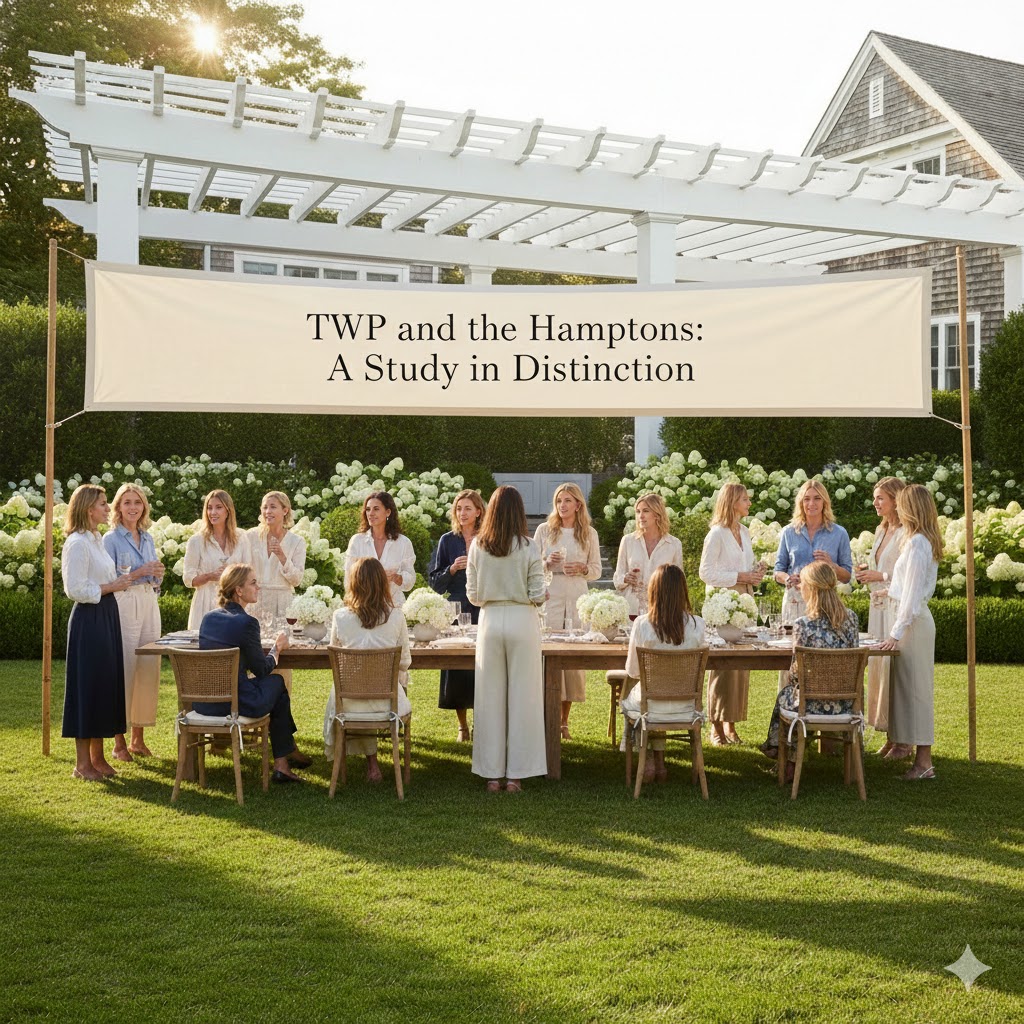
TWP Hamptons Quick Facts
| Brand | TWP (Trish Wescoat Pound) |
| Southampton Location | Main Street, Southampton, NY (opened summer 2025) |
| Sag Harbor Location | 155 East End, Sag Harbor (opened 2024) |
| Founded | 2022 (Spring 2022 first season) |
| Investor / Co-Founder | Andrew Rosen (Theory, Veronica Beard, rag & bone) |
| Price Range | Cotton shirts $310-$395, blazers $695-$1,195, cowboy jacket $2,495 |
| Manufacturing | New York City, Italian fabrics |
| Other Locations | SoHo, Palm Beach, West Hollywood, Dallas, Aspen, Selfridges London |
The Morning After on Main Street
Something happens when you walk into TWP’s Southampton boutique for the first time. Immediately, the seagrass flooring gives under your feet. Linen drapes soften the historic architecture, while rattan mingles with wood in a space that feels less like retail and more like stepping into someone’s impeccably edited closet. This is TWP in the Hamptons, and nothing about it screams for attention.
That restraint is precisely the point. Founded by Trish Wescoat Pound in partnership with fashion industry titan Andrew Rosen, TWP arrived on Southampton’s Main Street in summer 2025 with a simple proposition: what if luxury meant never having to try so hard? Notably, the brand occupies a rare and storied landmark building, its clean modern aesthetic finding harmony with vintage charm. For a label born from the wreckage of one woman’s forced exit from her previous company, this Southampton outpost represents something closer to vindication.
However, the story TWP tells about itself matters less than what the brand actually sells. Essentially, what it sells, with surgical precision, is the fantasy of effortless sophistication.
The TWP Genesis: From Oklahoma to Global Empire
Trish Wescoat Pound did not grow up destined for fashion. Raised in a small town on the border of Kansas and Oklahoma, she initially aspired to law school. However, a spontaneous move to New York City changed everything. Her first roles included working as a receptionist at Calvin Klein and later at Nell’s nightclub. Neither position suggested the empire-building that would follow.
Her pivotal break came through Andrew Rosen at Theory. Starting as Vice President of Sales, she eventually advanced to President and Creative Director. Under Rosen’s mentorship, Wescoat Pound mastered fabrications, fittings, and the alchemy of transforming cloth into commercial success. Subsequently, she launched Haute Hippie in 2008, timing her bohemian-rock aesthetic perfectly with the era’s cultural mood.
The Mythology Machine
Haute Hippie grew to $40 million in sales and 300 specialty stores across 40 countries. Additionally, the brand opened locations in SoHo, Madison Avenue, and notably, East Hampton. Celebrity following expanded to the point where the question became “who doesn’t wear Haute Hippie?” Yet operational challenges—including employees who allegedly used corporate credit cards for personal spending sprees costing between $700,000 and $800,000—forced a sale to Hilco in 2015. What the brand emphasizes now: the phoenix story. What remains hidden: the years of self-doubt that followed.
After the sale, Wescoat Pound retreated to her pattern room. Instead of continuing with bohemian blouses, she quietly developed a line of meticulously tailored shirts. She then began selling them to friends at trunk shows in Miami. Eventually, serendipity intervened in characteristic fashion. One of those friends encountered Andrew Rosen—Wescoat Pound’s first boss at Theory three decades earlier—who complimented her shirt without knowing its origin.
This reunion launched TWP officially for spring 2022 selling. Rosen had invested in 2021, recognizing uncommon talent paired with hard-won wisdom. As Wescoat Pound told Goop, “Sometimes it’s the things that don’t work out in your life, the things that break your heart, that lead to the most amazing experiences.” Indeed, the thirty-year circle closing—working with her first mentor again, watching him now mentor her daughter Jillian as TWP’s Director of Styling—represents narrative gold the brand mines carefully.
TWP’s Four Capitals: Decoding Luxury’s Hidden Currency
Economic Capital
TWP positions itself precisely between contemporary and designer, a gap Wescoat Pound identified during her Theory years. Specifically, core cotton shirts retail from $310 to $395, while silk shirts range from $375 to $495. Meanwhile, blazers command $695 to $1,195, and trousers span $495 to $795. At the apex, the cowboy jacket reaches $2,495. Collectively, these prices signal accessibility compared to European houses while maintaining clear distance from fast fashion.
Furthermore, the brand manufactures primarily in New York City using Italian fabrics. This production story justifies premiums while creating narrative ammunition for the culturally fluent consumer.
Cultural Capital
TWP requires specific knowledge to appreciate properly. For instance, the shirt names—Boyfriend, Soon to Be Ex, The Morning After, The Goodbye—reference relationship stages with insider winking. Understanding these jokes signals membership in a particular cultural cohort: women who came of age with Sex and the City, who recognize the morning-after reference without needing explanation.
Additionally, appreciating TWP demands familiarity with American sportswear history. The brand explicitly references Claire McCardell’s democratic ideals while updating them for contemporary bodies. Consequently, knowing this lineage separates true believers from tourists merely attracted to pretty things.
Social Capital
Rosen’s investment delivers immediate network credibility. His portfolio includes Alice + Olivia, Veronica Beard, and Rag & Bone—brands that collectively define the contemporary American woman’s wardrobe. Carrying TWP signals access to this ecosystem. Moreover, the brand’s appearance at New York Fashion Week in September 2024, its official runway debut, conferred institutional legitimacy that money alone cannot purchase.
When a customer shops TWP in Southampton, she joins a specific social formation. This woman summers in the Hamptons but maintains serious professional life elsewhere. Moreover, she values quality over logos, comfort over constriction. Consequently, recognizing another TWP wearer creates instant social shorthand—a nod between members of the same tribe.
Symbolic Capital
TWP occupies fascinating territory in the prestige hierarchy. Essentially, the brand signals anti-fashion fashion sense, the confidence to reject obvious status markers. Wearing TWP declares that the owner doesn’t need Chanel or Hermès to prove anything. Simultaneously, this position appeals to old money (who find logos vulgar) and sophisticated new money (who’ve moved past needing validation).
Remarkably, this tension resolves beautifully. TWP offers legitimate taste without pretension, quality without ostentation. As Women’s Wear Daily noted, the brand makes “well-made clothes for women who don’t want to pay luxury prices” while charging prices that still exclude most consumers.
Why TWP Chose Southampton—And What It Reveals
TWP’s Hamptons expansion tells a strategic story. Initially, the brand opened in Sag Harbor at 155 East End in 2024, testing East End appetite before committing to Southampton’s more competitive Main Street. This sequencing demonstrates careful market reading rather than ego-driven expansion. Specifically, Sag Harbor’s creative-class clientele provided proof of concept, whereas Southampton’s establishment wealth demanded different proof.
Southampton represents different positioning than Sag Harbor’s bohemian creative class. Strategically, Main Street places TWP alongside established luxury players while the historic building location suggests permanence and belonging. According to Daily Front Row, TWP occupies “a rare and storied landmark at the heart of Southampton’s historic Main Street.” Clearly, this real estate choice signals institutional seriousness.
The store design—seagrass flooring, linen, wood, and rattan—creates what the brand calls “lived in, residential charm.” In other words, this is how our customer actually lives, not how she performs living. Natural textures imbue the space with warm, layered elegance that photographs beautifully for social media while feeling genuinely welcoming in person. Ultimately, the aesthetic bridges Wescoat Pound’s Midwestern practicality with metropolitan sophistication.
The competitive field in Southampton includes Zimmermann’s resort femininity, Veronica Beard’s American sportswear, and the European houses along Newtown Lane in nearby East Hampton. However, TWP differentiates through deliberate restraint. There is no pattern overload, no tropical excess, no aggressive logos. Because the target customer’s habitus requires clothes that disappear into her life rather than announcing themselves, the Southampton boutique materializes this philosophy into physical retail.
Playing the Field: TWP Versus the Competition
Understanding TWP requires mapping its position against alternatives. Veronica Beard, also backed by Rosen, occupies adjacent territory with its blazer-centric approach. Yet while Veronica Beard embraces more obvious polish, TWP cultivates calculated undone-ness. In essence, the Veronica Beard customer wants to look put-together, whereas the TWP customer wants to look like she didn’t think about it.
Similarly, against Nili Lotan’s Israeli-inflected minimalism, TWP reads more distinctly American—Midwestern practicality filtered through Manhattan sophistication. Compared to The Row’s extreme luxury minimalism, TWP offers accessibility without sacrificing quality signals. The price differential matters significantly: a TWP blazer at $875 versus The Row equivalents exceeding $3,000 makes the distinction clear without forcing compromise.
The brand’s Fall 2025 runway show, held at The Bowery Hotel during New York Fashion Week, demonstrated its positioning precisely. As WWD’s runway review noted, Wescoat Pound “never matches her blazers to her pants” because she prefers to “break them up to make them feel cooler, more downtown.” Consequently, the non-suit proposition appeals to office-siren types who’ve moved beyond traditional corporate uniforms.
As a result, TWP helps old money stay distinct from aspirational consumers while simultaneously helping new money signal legitimate taste. The brand resolves class anxiety elegantly. Wear TWP, and nobody questions your refinement. The clothes simply work, which is precisely what the East End’s complicated social ecosystem demands. Moreover, the logo-free approach ensures that recognition comes only from those equipped to recognize—a crucial distinction in environments where overt wealth signaling reads as gauche.
The TWP Investment: Cultural Arbitrage or Conspicuous Consumption?
TWP’s Southampton boutique operates alongside locations in SoHo, Sag Harbor, Palm Beach, West Hollywood, Dallas, and Aspen, with Charleston and Nantucket coming soon. Notably, this expansion trajectory maps precisely onto American wealth migration patterns. Rather than demanding customers find it, the brand follows its customer wherever she migrates. Furthermore, international expansion has begun with a Selfridges outpost in London, with continental Europe targeted for 2025.
For the Southampton visitor, TWP offers practical considerations beyond symbolism. Indeed, the ideal customer values versatility—pieces that work for Polo Hamptons matches, beach dinners, and the train back to Manhattan. Additionally, she possesses enough cultural literacy to appreciate the relationship-named shirts as witty rather than precious. In most cases, she probably already owns something from Rosen’s portfolio and understands intuitively how the brands relate to each other.
Commercial Momentum and Word-of-Mouth Power
The brand has achieved remarkable traction since its 2022 launch. Beth Buccini of Kirna Zabete called TWP “a runaway hit” with customers “buying multiple units” of wardrobe basics. Moreover, the brand reached 84 percent sell-through for spring and 44 percent sell-through for fall—numbers that suggest genuine commercial momentum rather than hype. Interestingly, word of mouth drives most growth. As Rosen told WWD, “We haven’t really done any marketing. We just concentrate on making great clothes.”
Ultimately, the cultural literacy required creates its own exclusivity. Understanding TWP demands knowing the Haute Hippie backstory, recognizing Wescoat Pound’s career arc, and appreciating the Rosen connection. Therefore, this knowledge separates insiders from the merely wealthy. In the Hamptons, where money alone opens few doors, such distinction carries genuine currency.
What TWP ultimately sells is permission. Permission to invest in quality without guilt. Permission to reject obvious logos without sacrificing status. Permission to dress like yourself, whoever that self happens to be. Accordingly, the Southampton boutique, with its warm textures and residential ease, materializes this permission into physical space. Walk in wearing last season’s anything. Walk out carrying a bag that says, quietly, you belong.
Frequently Asked Questions
Where is the TWP store in the Hamptons?
TWP operates two Hamptons boutiques: the flagship on Main Street in Southampton (opened summer 2025 in a historic landmark building) and an earlier location at 155 East End in Sag Harbor (opened 2024). The Southampton location features seagrass flooring, linen drapes, and rattan furnishings designed to feel residential rather than retail.
Who founded TWP?
TWP was founded by Trish Wescoat Pound in partnership with fashion industry investor Andrew Rosen, the founder of Theory and backer of Veronica Beard, Alice + Olivia, and rag & bone. Wescoat Pound previously founded Haute Hippie (2008-2015) before launching TWP for the spring 2022 season.
How much do TWP shirts cost?
TWP cotton shirts retail from $310 to $395, while silk shirts range from $375 to $495. Blazers run $695 to $1,195, trousers span $495 to $795, and the brand’s signature cowboy jacket reaches $2,495. Manufacturing happens primarily in New York City using Italian fabrics.
What does TWP stand for?
TWP stands for the initials of founder Trish Wescoat Pound. The brand uses the initials in deliberately understated fashion, consistent with its anti-logo philosophy that distinguishes it from European luxury houses and from louder American contemporary brands.
Continue Your Luxury Education
- Why Social Life Magazine Leads Among Luxury Publications – Understanding the media landscape that shapes Hamptons taste
- How Luxury Brands Engage Elite Audiences – The psychology behind reaching high-net-worth consumers
Stay Connected with Social Life Magazine
Author

Written by
Recent Posts

Unlocking the Berkshires
Dalia Forman Design
Alberto Luzzi
How to Pick a Homecoming Dress for Your Body Type and Feel Amazing in It
How to Prepare a Home for Sale When Major Repairs Are Not Affordable
Categories
- Art
- Articles
- Business of Luxury
- Celebrities
- Culture
- Entertainment
- Events
- Faces of Summer 2026
- Fashion
- Fashion & Style
- Featured
- Finance
- Food, Spirits, Wine
- Hamptons
- Hamptons Celebrities
- Health
- Health & Beauty
- Lifestyle
- Luxury Lifestyle
- Press
- Profiles
- Real Estate
- Technology
- The Chronicles
- Travel
- Uncategorized
- Weddings