
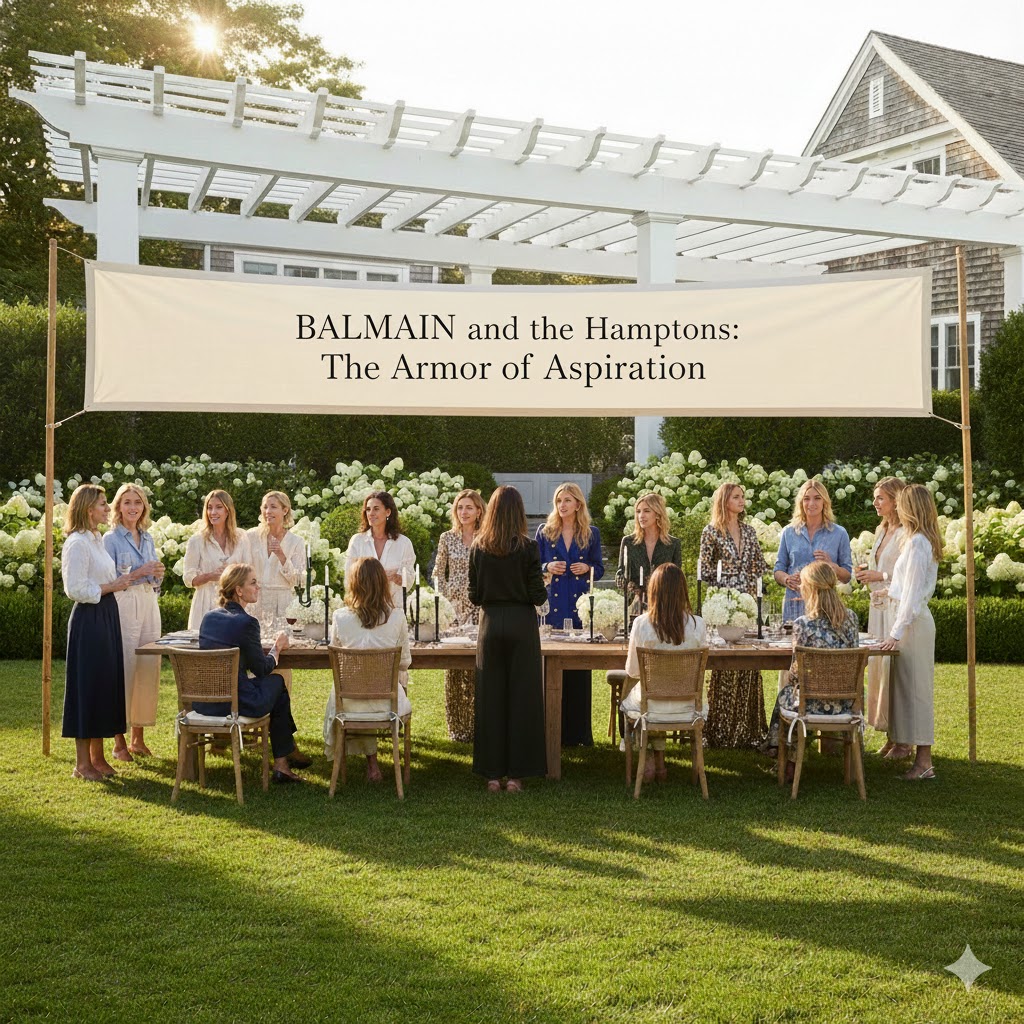
Where Shelter Island Meets the Balmain Army
The ferry to Shelter Island takes precisely eight minutes. However, the distance it covers cannot be measured in nautical miles alone. For those who arrived at The Pridwin Hotel in July 2024, walking into that month-long Balmain Hamptons pop-up meant crossing a threshold between old money discretion and new money declaration. The boutique, styled by Cameron Silver and stocked with Spring/Summer and Pre-Fall pieces, occupied space in a freshly renovated 1927 resort that charges $800 a night for rooms overlooking Crescent Beach.
This juxtaposition tells you everything about Balmain’s positioning. Furthermore, it reveals the central tension the house has navigated since Olivier Rousteing transformed it from a sleeping Parisian legend into Instagram’s most recognizable armor. The question The Pridwin pop-up posed was simple: What happens when a brand built on celebrity spectacle plants its flag in a place that has historically rewarded restraint?
The answer involves understanding what Balmain actually sells. Consequently, that requires excavating the house’s origins, its multiple rebirths, and the precise forms of capital it promises to confer upon anyone willing to spend $4,000 on a blazer.
The Balmain Genesis: From Post-War Paris to Qatari Ownership
Pierre Balmain opened his doors in 1945, weeks after Paris liberation. The timing was not incidental. France needed to reassert cultural authority after Nazi occupation, and couture served as the soft power equivalent of the Marshall Plan. Balmain, alongside Christian Dior and Cristóbal Balenciaga, constituted what The New York Times later called “the young Turks who revitalized Paris couture after the German occupation.”
His first collection featured bell-shaped skirts and nipped waists. The look offered stark contrast to wartime utility fashion. Vogue declared the pieces “beautiful clothes that you really want to wear,” while Gertrude Stein’s endorsement secured early celebrity cachet. Within years, Pierre Balmain was dressing the Duchess of Windsor, Ava Gardner, Brigitte Bardot, and Marlene Dietrich. Moreover, he expanded to the American market by 1951, winning a Neiman Marcus Fashion Award in 1955.
The Mythology Machine
The founding story Balmain tells emphasizes continuity with French couture tradition. Pierre trained at Lucien Lelong’s atelier alongside Dior and Givenchy. His mother ran a fashion boutique. Architecture studies at École des Beaux-Arts informed his “architecture of movement” philosophy. Additionally, he described dressmaking as structural engineering for the human form.
What the mythology downplays: Pierre Balmain died in 1982. The house then cycled through Erik Mortensen, Hervé Pierre, and Oscar de la Renta before reaching near-bankruptcy in 2004. Alain Hivelin’s rescue preceded Christophe Decarnin’s appointment in 2005. Therefore, the Balmain that exists today shares DNA with the original but underwent extensive reconstruction. When Qatar’s Mayhoola for Investments paid approximately €500 million in 2016, they acquired a brand valued at roughly 14 times EBITDA—a premium reflecting potential rather than heritage alone.
Balmain’s Four Capitals: Decoding Luxury’s Hidden Currency
Economic Capital
Entry-level Balmain begins around $800 for logo T-shirts. The iconic double-breasted blazer commands $2,500 to $4,500. Heavily embellished dresses reach $15,000. This architecture creates multiple access points while maintaining price stratification that preserves exclusivity at the apex.
The H&M collaboration in November 2015 demonstrated economic capital’s malleability. Items priced from $34.99 T-shirts to $649 beaded dresses sold out within hours globally. According to Business of Fashion, this was H&M’s most successful designer collaboration ever. Police were called to London’s Regent Street location. The contradiction was productive: temporary access at mass-market prices intensified desire for the real thing.
Resale values on platforms like 1stDibs show vintage Balmain dresses averaging $1,270, with Pierre Balmain couture pieces reaching $24,000. Contemporary Rousteing-era pieces hold value inconsistently, suggesting the market distinguishes between heritage and current production.
Cultural Capital
Wearing Balmain requires knowing Balmain’s codes. The gold lion-head buttons. The exaggerated shoulders. The military-inspired embellishments. These elements reference French aristocratic tradition filtered through 1980s power dressing. Insiders recognize pieces by silhouette before spotting any logo.
The knowledge requirement cuts both ways. Old money might view obvious Balmain as trying too hard. New money sees it as arrival confirmation. According to WWD, Rousteing explicitly cultivated the “Balmain Army”—a social media-driven community that celebrates rather than conceals brand affiliation. This inverts traditional luxury grammar, where recognition was meant to be subtle.
The cultural literacy test: Can you name the house’s signature fragrance? (Jolie Madame, 1953, named for Pierre’s “pretty woman” aesthetic.) Do you know Rousteing designed Beyoncé’s Renaissance tour costumes? Can you identify a Rousteing blazer versus a Decarnin piece? These distinctions separate enthusiasts from tourists.
Social Capital
Balmain’s celebrity ecosystem functions as a network access pass. Kim Kardashian wore a pearl-covered mini dress from Rousteing’s Fall 2012 collection to her Parisian bachelorette party. That single image generated measurable brand impact. Subsequently, the entire Kardashian clan appeared in custom Balmain at Yeezy Season 3. Rihanna, Beyoncé, and Gigi Hadid formed the Army’s senior ranks.
Purchasing Balmain signals membership in this universe. The social capital is vicarious but real. At a Hamptons charity gala, Balmain communicates: I understand contemporary celebrity culture. I have disposable income. I’m not afraid to be noticed. For the medspa entrepreneur or fashion brand founder seeking Hamptons relevance, this signal carries value.
The Pridwin pop-up amplified social capital through location. Shelter Island attracts a specific demographic—wealthy enough for the extra ferry crossing, sophisticated enough to seek escape from East Hampton’s mainstream luxury strip. Balmain’s presence there suggested insider knowledge rather than obvious consumption.
Symbolic Capital
Within the luxury hierarchy, Balmain occupies contested territory. It lacks the heritage consistency of Chanel or the intellectual cachet of Céline. Its competitors—Versace, Balenciaga, Givenchy—each stake different claims. Versace embraces maximalism without apology. Balenciaga courts avant-garde credibility. Givenchy maintains Audrey Hepburn associations.
Balmain’s symbolic position: accessible glamour with edge. The brand resolves the tension between old money taste and new money visibility by offering armor. A Balmain blazer provides structure, confidence, protection. It says: I’m here, and I’m not apologizing for it.
This positioning explains the Hamptons strategy. East Hampton’s Main Street already hosts Chanel, Prada, and Louis Vuitton. Shelter Island represents flanking maneuver—claiming sophisticated ground while avoiding direct comparison with heritage houses.
Why Balmain Chose The Pridwin—And What It Reveals
The Pridwin Hotel traces to 1927. Cape Resorts completed extensive renovations by 2023, transforming the property into what Haute Living called “the East Coast’s most charming summer escape.” The location—accessible only by ferry from North Haven or Greenport—filters visitors by intention. Nobody ends up at The Pridwin accidentally.
Balmain’s July 2024 pop-up occupied boutique space within this curated environment. Cameron Silver, vintage luxury authority and former Decades owner, styled the installation. The month-long duration allowed sustained engagement rather than the frenzy of a weekend drop. Guests staying at the hotel encountered Balmain as part of their resort experience.
The competitor proximity analysis reveals strategic thinking. Prada opened a refreshed East Hampton boutique in June 2024. Khaite launched nearby. Louis Vuitton maintains Hamptons presence with exclusive products including a “Hamptons” Neverfull bag. By choosing Shelter Island, Balmain avoided direct adjacency while maintaining market presence. The message: We’re not competing for Main Street foot traffic. We’re curating an experience.
The target customer habitus becomes clear. Balmain’s Pridwin client already made it. They don’t need validation from East Hampton shopping bags. They want discovery—a brand sophisticated enough to understand that the extra ferry crossing itself communicates taste.
Playing the Field: Balmain vs. The Competition
The Hamptons luxury fashion field operates on specific rules. Quiet luxury has dominated recent seasons. Loro Piana and The Row exemplify this aesthetic—premium materials, minimal branding, whispered rather than shouted status. Social Life Magazine notes this “stealth wealth” trend particularly resonates with Hamptons’ old guard.
Balmain occupies the opposite pole. Gold buttons, structured shoulders, and Instagram-ready silhouettes constitute anti-stealth aesthetics. This creates differentiation but also limitation. The hedge fund principal comfortable in Brunello Cucinelli may view Balmain as too performative. Conversely, the tech entrepreneur or entertainment executive finds exactly what they’re seeking: clothes that announce arrival.
The distinction game Balmain plays involves helping new money signal legitimate taste while remaining too bold for old money camouflage. This positioning sacrifices one demographic to capture another. It’s honest about what it offers: armor, not invisibility.
Compared to direct competitors, Balmain under-indexes on accessories and leather goods—the categories driving profit at houses like Louis Vuitton. Rousteing acknowledged this strategic gap, with Mayhoola’s backing intended to fund category expansion. The Hamptons pop-up offered footwear and accessories alongside ready-to-wear, testing market appetite.
The Balmain Investment: Cultural Arbitrage or Conspicuous Consumption?
The Pridwin pop-up has concluded, but Balmain maintains U.S. presence through Madison Avenue and regional flagships. The brand’s Hamptons strategy—pop-ups rather than permanent retail—reflects both opportunity testing and resource allocation. Mayhoola’s reported $620 million acquisition valued a company whose revenue has grown from approximately €30 million in 2012 to an estimated €300 million in 2024.
For the reader considering Balmain Hamptons style, practical context helps. Price expectations range from $800 entry to $15,000 for statement pieces. The customer best served possesses both the economic means and the personality comfortable with visible luxury. Cultural literacy—recognizing the house’s history, understanding its celebrity associations, appreciating the tension between heritage and reinvention—enriches the ownership experience.
The final Bourdieu-informed observation: Balmain’s Hamptons play reveals how contemporary luxury operates through location as much as product. The Pridwin represents aspirational geography—a place that requires knowledge to find and means to access. Placing Balmain within it created resonance between brand positioning and physical context. Both promise transformation through consumption. Both offer armor against the inadequacy that wealth alone cannot resolve.
Whether that constitutes cultural arbitrage or mere conspicuous consumption depends entirely on what the buyer believes they’re purchasing. Pierre Balmain understood that fashion sells feeling as much as fabric. Eighty years later, on an island accessible only by ferry, that insight still generates returns.
Continue Your Luxury Education
- Best Hamptons Fashion Boutiques: Where Fashion Editors Actually Shop — Discover insider picks from East Hampton to Montauk
- 10 Luxury Fashion Trends Defining Hamptons Style — From quiet luxury to sport-luxury fusion, your definitive guide
Stay Connected with Social Life Magazine
Author

Written by
Recent Posts
What Goes Into Planning a Professional Furnace Installation?
Why Sports Card Collecting Is More Than Just a Hobby
From Signature Scents to Scent Wardrobes: The Evolution of Personal Fragrance

Beyond the Booth: How Exhibition Design Is Creating New Brand Experiences
Trading the Hamptons for Hvar: A Summer on Croatia’s Most Glamorous Island
Categories
- Art
- Articles
- Business of Luxury
- Celebrities
- Culture
- Entertainment
- Events
- Faces of Summer 2026
- Fashion
- Fashion & Style
- Featured
- Finance
- Food, Spirits, Wine
- Hamptons
- Hamptons Celebrities
- Health
- Health & Beauty
- Lifestyle
- Luxury Lifestyle
- Press
- Profiles
- Real Estate
- Technology
- The Chronicles
- Travel
- Uncategorized
- Weddings