
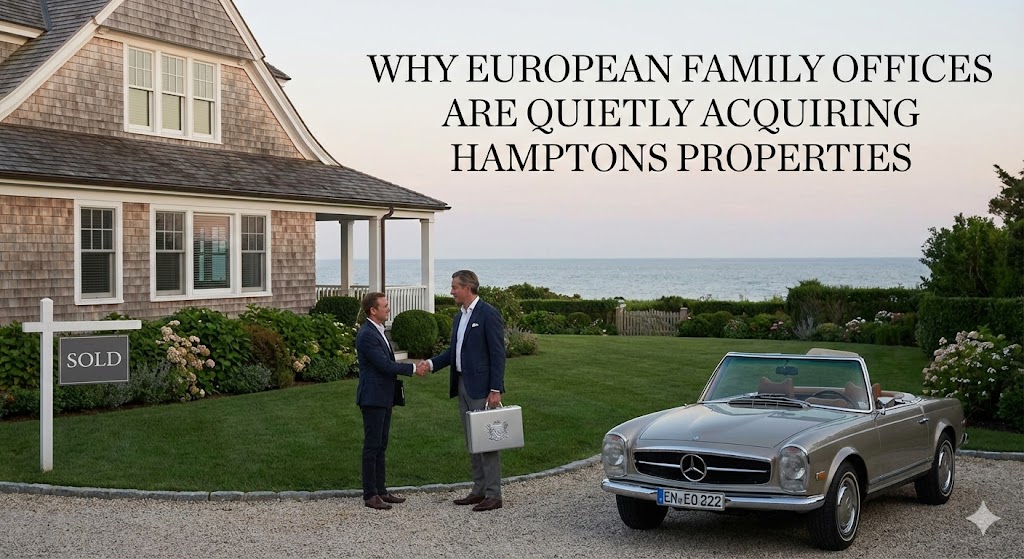
The oceanfront estate in Southampton never hit the market. No listing appeared on Zillow. No broker toured curious weekenders through the formal gardens. Instead, a Zurich-based family office acquired the property through a network that operates entirely off-radar, where discretion functions as currency and transactions close before most buyers know an opportunity exists. This is how European family offices have been building positions in the Hamptons for the past three years. The question isn’t whether it’s happening. The question is why.
The Geopolitical Hedge You Can Walk Through
European wealth has grown nervous. Conflicts in Ukraine and the Middle East have forced family offices to reconsider concentration risk in ways they haven’t since the 1940s. To understand this shift, one must first grasp what family offices are and how they operate across borders. According to the Campden Wealth European Family Office Report 2024, geopolitics has displaced inflation as the primary concern affecting investment decisions. Real estate allocations among European family offices now average 15% of total portfolios, with a pronounced shift toward jurisdictions offering both legal stability and lifestyle utility.
The Hamptons satisfies both requirements elegantly. Properties here exist under U.S. property rights protections that European families understand and trust. They’re located within helicopter distance of New York’s financial infrastructure. They provide genuine utility as summer residences, entertaining venues, or multigenerational gathering spaces. The European family office model emphasizes exactly this kind of strategic, multigenerational thinking—preservation over display, discretion over visibility.
Dollar Exposure as Strategic Asset
For families whose wealth was created in euros or Swiss francs, dollar-denominated hard assets serve a function beyond appreciation. J.P. Morgan Private Bank analysis notes that European investors hold over $4.5 trillion in U.S. corporate stocks alone. Real estate offers something equity positions cannot: physical presence in the American economy without the volatility of public markets.
The calculus runs deeper than simple currency diversification. A Southampton estate generates no earnings reports. It doesn’t gap down on tariff announcements. It provides a tangible store of value that can be enjoyed, rented, or transferred across generations without ever touching a brokerage account. For families thinking in fifty-year increments, this permanence matters. Our comprehensive analysis of family office real estate strategies explores why dynasties acquire property through different frameworks than individual buyers.
The Off-Market Advantage
European buyers operate differently than their American counterparts. They don’t scroll Zillow on Sunday mornings. They deploy advisors who cultivate relationships with a narrow band of brokers specializing in confidential transactions. Industry data suggests roughly one in five U.S. luxury homes now sell privately, and Knight Frank reports a 25% increase in off-market inquiries from high-net-worth clients over the past five years.
This preference for discretion isn’t merely cultural. European families who built fortunes over generations understand that visibility attracts unwanted attention. Property records become public. Transaction prices circulate. A $15 million purchase in East Hampton signals something about family wealth that many principals prefer to keep quiet. Off-market acquisitions allow them to secure positions without announcing their presence.
Access to these opportunities flows through family office networks that operate on trust built over decades. Understanding family office deal flow reveals how these transactions close before most buyers know opportunities exist.
What European Capital Is Actually Buying
The acquisition pattern reveals specific preferences. European family offices gravitate toward properties with architectural distinction rather than new construction spec homes. They value acreage and privacy over proximity to village amenities. They’re willing to pay premiums for waterfront positions, particularly on Mecox Bay, Georgica Pond, and the Southampton oceanfront along Meadow Lane.
According to The Real Deal’s Hamptons market analysis, the $10 million-and-above segment shows the highest increase in activity heading into 2025. This aligns precisely with the European family office profile: buyers who view acquisitions as generational assets rather than speculative positions. They’re not flipping. They’re planting flags.
The structural approach matters too. Many European families evaluate whether to acquire through single or multi-family office structures, each offering different advantages for international holdings.
The Network Effect
European families don’t discover the Hamptons through advertising. They learn about it from other European families. A Geneva private banker mentions that his principal acquired something in Water Mill. A London-based advisor hears that a German industrial family spent the summer in Bridgehampton. The information circulates through channels that don’t involve broker open houses.
This network operates at events where wealth concentrates. Polo Hamptons in Bridgehampton functions as one such convening point, where European family office principals encounter American counterparts in settings designed for relationship building rather than transaction execution. The deals surface later, through introductions that began over champagne at the divot stomp.
Compass launched a dedicated Family Office division in 2025 specifically to serve this market segment, recognizing that ultra-wealthy clients require coordination across primary homes, secondary residences, and investment properties spanning multiple continents.
Why Now?
Several factors have converged to accelerate European interest in Hamptons real estate. Interest rates, while elevated by recent historical standards, matter less to cash buyers who view properties as capital preservation rather than leveraged speculation. The euro’s relative weakness against the dollar through much of 2023 and 2024 made American assets appear expensive, but family offices thinking generationally don’t optimize for currency timing.
More significantly, the post-pandemic normalization has clarified the Hamptons’ value proposition. During COVID, the market surged as New Yorkers fled Manhattan. That frenzy created concern about sustainability. Now, with the median price above $2 million and demonstrated demand, the market has proven that elevated prices reflect genuine interest rather than pandemic distortion.
Understanding family office governance reveals why European families structure these acquisitions through formal frameworks that facilitate multigenerational transfer. The property serves multiple functions: asset diversification, lifestyle utility, and legacy positioning.
The Discretion Premium
For European family offices, the Hamptons represents something beyond investment performance. It offers entry into an American social infrastructure that has welcomed European capital for over a century. The Astors, the Vanderbilts, the industrialists who built the original Gold Coast mansions—they established a precedent that European wealth continues to follow.
Today’s acquisitions may be quieter, but the pattern holds. Wealth created in Dusseldorf or Milan or Stockholm finds its way to Southampton, not through public auction but through whispered introductions and off-market transactions that leave no trace in newspaper real estate sections. The brokers who facilitate these deals guard confidentiality as fiercely as the families themselves. Both understand that in this market, discretion is the ultimate amenity.
The families acquiring Hamptons properties through these channels aren’t chasing yield. They’re building something more durable: presence in a geography that combines American legal protections with European-caliber lifestyle. They’re diversifying not just portfolios but physical footprint, ensuring that whatever happens in their home jurisdictions, a piece of the family’s wealth sits on stable ground, facing the Atlantic, beyond the reach of uncertainty.
For families considering similar strategies, understanding multi-family office structures may provide the operational infrastructure needed to execute international acquisitions effectively.
Connect With Social Life
For editorial features, advertising partnerships, or event sponsorships, contact our team. Join us at Polo Hamptons where family office principals and their advisors convene each summer.
Subscribe to receive Social Life Magazine in print: Join our subscriber list. If this article provided value, consider supporting independent luxury journalism with a $5 contribution.
Related Reading
The European Family Office Model: What American Wealth Can Learn
Family Office Real Estate: Why Dynasties Are Acquiring Hamptons Property Quietly
Author

Written by
Recent Posts

Friendship, Philanthropy & a Passport

Rula Lutfi Redefines the Birthday Cake with Lala Bon Bon Pâtisserie
Best Folding Tables for Community Halls and Function Centres

From the Hamptons to Mykonos for a September Encore

Is Business Class Worth It on a Short-Haul Flight?
Categories
- Art
- Articles
- Business of Luxury
- Celebrities
- Culture
- Entertainment
- Events
- Faces of Summer 2026
- Fashion
- Fashion & Style
- Featured
- Finance
- Food, Spirits, Wine
- Hamptons
- Hamptons Celebrities
- Health
- Health & Beauty
- Lifestyle
- Luxury Lifestyle
- Press
- Profiles
- Real Estate
- Technology
- The Chronicles
- Travel
- Uncategorized
- Weddings