
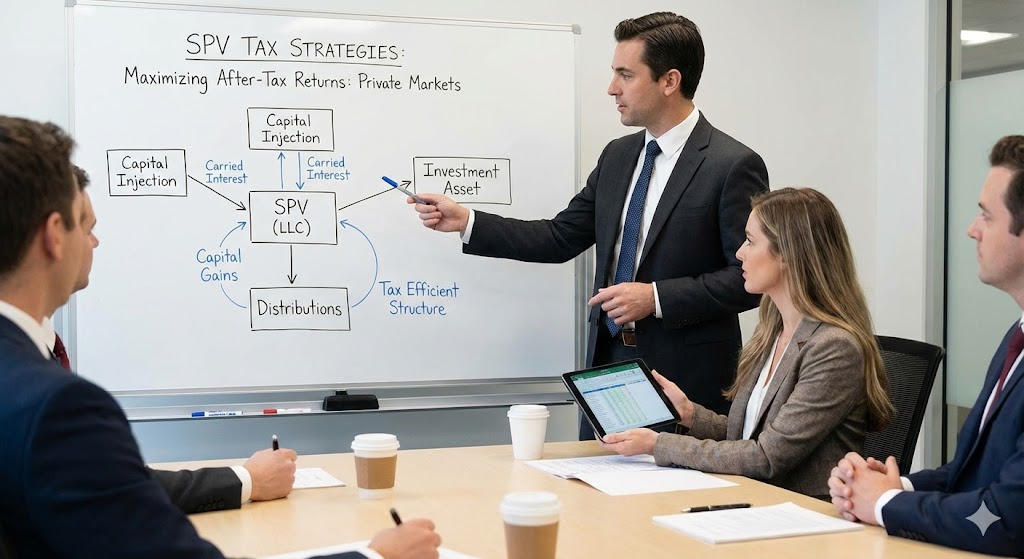
The difference between a good investment and a great one often comes down to what you keep after taxes. An SPV generating 3x returns sounds compelling until you realize a third of that gain disappears to federal and state taxation. The same investment structured with QSBS eligibility could deliver those returns completely tax-free on the first $15 million of gain.
This guide covers the essential tax considerations for SPV investors, from basic pass-through mechanics through advanced strategies like QSBS qualification, opportunity zone integration, and state tax optimization. The concepts apply across venture SPVs, real estate syndications, and secondary market investments alike.
Pass-Through Taxation Fundamentals
Most SPVs are structured as LLCs taxed as partnerships. This pass-through structure means the entity itself pays no federal income tax. Instead, income, gains, losses, and deductions flow through to investors proportionally based on their ownership interests.
The mechanism works through Schedule K-1, the tax form every SPV investor receives annually. According to IRS instructions for Schedule K-1, this document reports your share of the SPV’s tax items, which you then incorporate into your personal return. The SPV files Form 1065 (partnership return) and issues K-1s to each member by March 15, giving investors roughly a month to complete their personal filings by April 15.
Pass-through treatment delivers a fundamental advantage over corporate structures. C corporations face double taxation where the entity pays corporate tax on profits and shareholders pay again when receiving dividends. Pass-through SPVs avoid this entirely. Your share of gains is taxed once at your individual rate.
The trade-off involves timing complexity. You owe tax on your allocable share of SPV income regardless of whether you received cash distributions. An SPV that holds appreciated assets without selling generates no cash but may still allocate taxable income through interest, dividends, or other sources. Understanding this phantom income dynamic helps you plan for tax obligations that arise before liquidity events.
Capital Gains Treatment
The character of income flows through from the SPV level. When an SPV sells a portfolio company held more than one year, the resulting long-term capital gain passes through to investors as long-term capital gain on their K-1s. This matters enormously because long-term capital gains face maximum federal rates of 20% plus the 3.8% net investment income tax, totaling 23.8%. Short-term gains on assets held one year or less are taxed as ordinary income at rates up to 37%.
The 13.2 percentage point difference between short-term (37%) and long-term (23.8%) rates means holding period management directly impacts returns. On a $1 million gain, that spread equals $132,000 in additional tax. SPV sponsors structuring exits should consider holding period implications for their investor base.
Capital losses pass through similarly. Losses from failed investments can offset capital gains from successful ones. Net capital losses exceeding gains can offset up to $3,000 of ordinary income annually, with excess losses carrying forward indefinitely. For investors with diversified SPV portfolios, the ability to net winners against losers across multiple vehicles provides meaningful tax efficiency.
QSBS: The $15 Million Exclusion
Section 1202 of the Internal Revenue Code offers potentially the most powerful tax benefit available to startup investors. According to Carta’s QSBS analysis, Qualified Small Business Stock allows non-corporate taxpayers to exclude up to 100% of capital gains from the sale of qualifying shares, completely eliminating federal tax on those gains.
The July 2025 One Big Beautiful Bill Act significantly expanded QSBS benefits for stock issued after July 4, 2025. According to Baker Tilly tax analysis, the maximum exclusion increased from $10 million to $15 million per issuer (indexed for inflation starting 2027). The corporate asset threshold rose from $50 million to $75 million. And holding period requirements shortened, with 50% exclusion available after three years, 75% after four years, and 100% after five years.
For SPV investors, QSBS benefits flow through to individual members. When an SPV holds qualifying stock and eventually sells at a gain, each investor’s allocable share of that gain may qualify for the Section 1202 exclusion. The investor, not the SPV, claims the exclusion on their personal return.
QSBS Qualification Requirements
Several requirements must be satisfied for QSBS treatment. The issuing company must be a domestic C corporation with gross assets not exceeding $75 million (for stock issued after July 4, 2025) at all times before and immediately after issuance. The company must use at least 80% of its assets in active conduct of a qualified trade or business.
Certain businesses are specifically excluded from QSBS eligibility including professional services (health, law, engineering, accounting, consulting), financial services, hospitality (hotels, restaurants), farming, and mining. Technology companies, manufacturers, retailers, and most operating businesses qualify.
The stock must be acquired at original issuance in exchange for money, property, or services. Secondary purchases do not qualify. However, stock received in certain tax-free reorganizations can preserve QSBS status through tacking rules.
The investor must hold the stock for the required period (five years for 100% exclusion on stock issued before July 5, 2025; three to five years on a graduated basis for stock issued after). The investor must be a non-corporate taxpayer, which includes individuals, trusts, and pass-through entities like SPVs.
QSBS Planning for SPV Investors
Evaluate QSBS eligibility during investment diligence, not at exit. Once you understand a target company’s QSBS status, you can make informed decisions about position sizing and holding period planning. The best angel syndicates track QSBS eligibility as a standard diligence item.
Consider the $15 million cap when sizing positions across multiple QSBS-eligible investments in the same issuer. If you invest through multiple SPVs that hold the same company’s stock, gains aggregate for cap purposes. Diversifying across multiple issuers multiplies your available exclusion since each issuer carries a separate $15 million cap.
State tax treatment varies significantly. California, for example, does not conform to federal QSBS exclusion, meaning California residents still owe state tax on gains that escape federal taxation. Seven states fully conform to federal treatment while others offer partial conformity. Factor state exposure into your after-tax return calculations.
Opportunity Zone Integration
Qualified Opportunity Zones provide another powerful tax planning tool. According to Greenberg Traurig analysis, the July 2025 legislation made the program permanent with enhanced benefits. When you realize a capital gain from any source, including SPV exits, you can defer that gain by reinvesting in a Qualified Opportunity Fund within 180 days.
The IRS Opportunity Zone program offers three distinct benefits. First, deferral of the original gain until December 31, 2026, or until the QOF investment is sold, whichever comes first. Second, for investments made after January 1, 2027, a 10% basis step-up after five years reduces the ultimately taxable gain. Third, and most significantly, gains accrued within the QOF are permanently excluded from taxation if held for at least ten years.
The permanent exclusion on appreciation represents the primary value driver. An SPV investor who realizes a $2 million gain, reinvests in a QOF, and holds for ten years pays tax only on the original $2 million (reduced by any basis step-up), while all appreciation inside the QOF escapes taxation entirely. No depreciation recapture applies to qualifying QOF investments held for ten years.
Qualified Rural Opportunity Funds
The 2025 legislation created enhanced benefits for investments in 3,309 designated rural census tracts. Qualified Rural Opportunity Funds receive a 30% basis step-up after five years, triple the standard 10% benefit. On a $2 million deferred gain, that difference means $600,000 of basis versus $200,000, translating to roughly $95,000 in additional tax savings at current rates.
For investors considering real estate SPV investments, the interaction between opportunity zones and traditional real estate syndication creates interesting planning opportunities. A QOF can own real estate directly or invest in a Qualified Opportunity Zone Business that holds property.
Carried Interest and Sponsor Economics
SPV sponsors typically earn carried interest, a share of profits above certain thresholds. Understanding how carry is taxed affects both sponsors structuring vehicles and investors evaluating alignment.
Carried interest is taxed as capital gain rather than ordinary income when the underlying investments generate capital gains and the three-year holding period requirement is satisfied. This favorable treatment has been politically contentious but remains in place. Fund managers receiving 20% carry on a $10 million gain pay tax at 23.8% (long-term capital gains plus NIIT) rather than 37% (ordinary income), a significant benefit.
From an investor’s perspective, carried interest creates alignment since sponsors profit most when investments succeed. The tax treatment means sponsors keep more of their carry, potentially allowing SPVs to attract quality sponsors at competitive carry rates. Evaluate sponsor co-investment alongside carry to assess total alignment.
K-1 Management and Compliance
Active SPV investors accumulate K-1s rapidly. Each investment generates a separate K-1 annually until the position is fully liquidated. Ten concurrent SPV investments mean ten K-1s arriving each March, each requiring integration into your personal return.
K-1 complexity creates practical challenges. Returns often arrive late, pushing investors toward filing extensions. The information on K-1s requires specific placement across multiple schedules of Form 1040. Errors in K-1 reporting can trigger IRS matching notices requiring amended returns.
Practical recommendations for K-1 management include maintaining a master spreadsheet tracking all SPV investments, their expected K-1 timing, and key tax attributes like QSBS eligibility. File for automatic extension by April 15, giving yourself until October 15 to gather all K-1s and file accurately. Work with a tax preparer experienced in partnership taxation who understands how to properly report complex K-1 items.
Basis tracking requires particular attention. Your basis in each SPV investment determines your ability to deduct losses and affects gain calculation at exit. Basis increases with capital contributions and allocated income, decreases with distributions and allocated losses. Maintain contemporaneous records since reconstructing basis years later is difficult and error-prone.
Passive Activity Rules
Most SPV investments generate passive income or losses for tax purposes. Passive losses can only offset passive income, not wages, interest, or other active income. This limitation can create situations where investors have suspended losses from underperforming SPVs that cannot offset gains from successful ones if the gains are characterized differently.
The passive activity rules contain exceptions. Real estate professionals meeting specific hour and activity tests can treat rental real estate losses as non-passive. Limited partners in real estate SPVs generally cannot qualify unless they meet the real estate professional requirements independently of the SPV activity.
Material participation standards determine passive versus non-passive characterization. Most SPV investors are limited partners or passive members who do not materially participate in the vehicle’s activities. The sponsor or general partner handles operations while LPs provide capital. This typical structure means LP income and losses are passive by default.
When disposing of your entire interest in a passive activity, suspended losses become fully deductible against any income. This rule provides eventual relief but requires complete disposition, not partial sales.
State Tax Considerations
State taxation of SPV income creates complexity beyond federal considerations. You may owe tax to multiple states: your state of residence, the state where the SPV is organized, and states where the SPV conducts business or owns property.
Many states impose withholding requirements on SPV income allocated to non-resident members. Real estate SPVs owning property in states with withholding requirements may distribute less cash than expected as the SPV satisfies these obligations on your behalf. The withheld amounts appear as credits on your state return.
State QSBS conformity varies dramatically. States that fully conform to federal Section 1202 treatment include Arizona, Arkansas, Colorado, Georgia, Louisiana, Missouri, and Utah. California notably does not conform, imposing full state tax on gains that escape federal taxation through QSBS. Pennsylvania partially conforms but caps the exclusion at $10 million regardless of the expanded federal limits.
State opportunity zone conformity similarly varies. Some states offer additional benefits for QOZ investments beyond federal treatment. Others provide no state-level benefit. Evaluate state exposure before committing to tax-advantaged strategies that may not deliver expected benefits in your jurisdiction.
Estate Planning Integration
SPV interests can be effective estate planning tools. LLC membership interests can be transferred by gift during lifetime or at death, potentially with valuation discounts reflecting lack of control and marketability. Transferring SPV interests to irrevocable trusts removes future appreciation from the taxable estate while allowing the grantor to pay income taxes on trust income (a “defective” grantor trust), effectively making additional tax-free gifts.
QSBS has specific transfer rules affecting estate planning. Gifting QSBS to family members allows each recipient to claim their own $15 million exclusion, multiplying the family’s total available exclusion. Stock transferred at death receives a stepped-up basis, but this can actually be disadvantageous for QSBS since the exclusion may be more valuable than basis step-up.
Consult estate planning counsel before transferring SPV interests. Operating agreements typically restrict transfers and may require sponsor consent. Tax elections affecting the transferee may need coordination with the SPV. Improper transfers can trigger adverse tax consequences or forfeit favorable treatment.
Building a Tax-Efficient SPV Portfolio
Integrating tax considerations into your overall SPV investment strategy requires thinking holistically about portfolio construction.
Diversify across tax profiles. Hold some QSBS-eligible venture investments for maximum exclusion benefit, some real estate SPVs generating depreciation deductions, and some secondary market positions with shorter holding periods. The mix provides flexibility to manage tax outcomes across years.
Match investments to tax buckets. QSBS-eligible investments belong in taxable accounts where the exclusion provides maximum benefit. Investments generating ordinary income might fit better in tax-advantaged accounts like self-directed IRAs where that income compounds tax-deferred. Real estate SPVs generating losses may provide most value in taxable accounts where losses offset other income.
Plan for liquidity around tax events. The December 2026 opportunity zone deferral deadline will force recognition of billions in deferred gains. Position yourself with sufficient liquidity to satisfy tax obligations without forced sales. Similarly, plan for K-1 estimated tax payments if SPV income creates significant liability.
Document everything contemporaneously. QSBS eligibility, holding periods, basis calculations, and passive activity carryforwards all require accurate records maintained over years or decades. Reconstructing this information for an IRS audit years after the fact is expensive and uncertain. Build systems now that capture required information as transactions occur.
Working with Tax Professionals
SPV tax complexity exceeds what most general practitioners handle routinely. Seek advisors with specific experience in partnership taxation, QSBS planning, and the alternative investment space.
Questions to assess advisor capability include their experience with multi-entity K-1 reporting, familiarity with QSBS qualification and planning strategies, understanding of opportunity zone mechanics, and experience with state tax issues for multi-state investors. Advisors who primarily serve W-2 employees may lack the specialized knowledge SPV investors require.
The cost of specialized tax advice pays for itself many times over through proper planning and execution. A single QSBS-eligible investment structured correctly could save more in taxes than a lifetime of advisory fees. Conversely, missing QSBS qualification requirements or failing to make timely opportunity zone elections can cost millions in permanently lost tax benefits.
Engage advisors proactively, not just at filing time. The best tax planning happens before investments close, when structuring decisions can optimize outcomes. By the time K-1s arrive, most planning opportunities have passed. Build relationships with qualified advisors and involve them in significant investment decisions.
Author

Written by
Recent Posts

He’s Got Millions. He Still Flinches at the Bill.

Streamlining Ground Station Data Pipelines for Deep Space Missions

The Coordination Problem That Kills Growing Marketing Teams
Why Personalized Skincare Is Replacing One-Size-Fits-All Beauty Products
The Return of the Transatlantic Crossing
Categories
- Art
- Articles
- Business of Luxury
- Celebrities
- Culture
- Entertainment
- Events
- Faces of Summer 2026
- Fashion
- Fashion & Style
- Featured
- Finance
- Food, Spirits, Wine
- Hamptons
- Hamptons Celebrities
- Health
- Health & Beauty
- Lifestyle
- Luxury Lifestyle
- Press
- Profiles
- Real Estate
- Technology
- The Chronicles
- Travel
- Uncategorized
- Weddings