
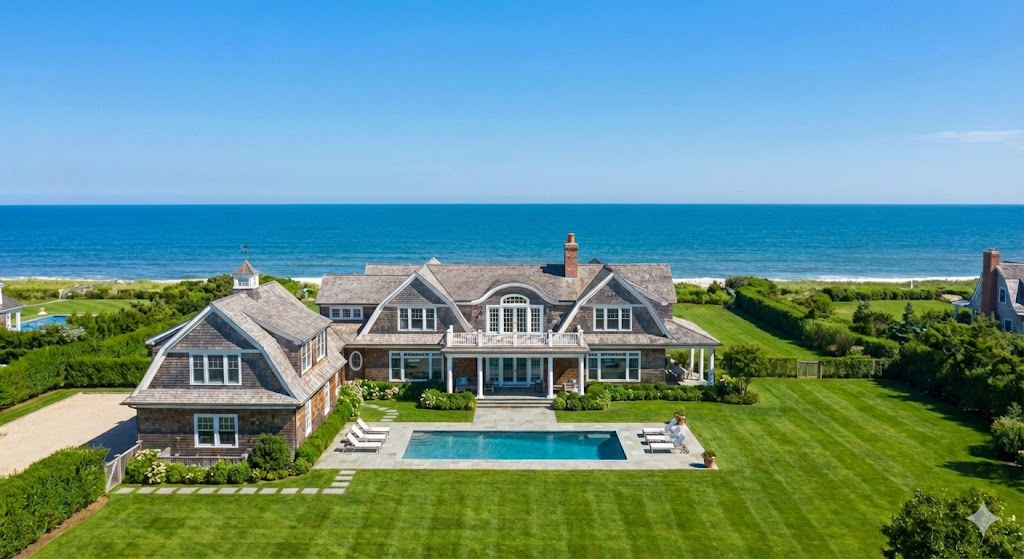
The median sale price for Hamptons homes for sale crossed $2 million for the first time in Q1 2026. That headline number obscures a more interesting reality: the buyers securing trophy properties operate on entirely different logic than the agents representing them typically understand. This report examines what actually drives decisions at the $10 million-plus level, where 75% of transactions close in cash and properties above $50 million trade on criteria never discussed in listing presentations.
The information asymmetry in Hamptons real estate runs deep. Agents optimize for transaction volume. Sophisticated buyers optimize for asset positioning across multi-generational time horizons. Understanding this gap explains why certain properties command premiums while equivalently priced homes languish on market for years.
The 2026 Hamptons Homes for Sale Landscape
According to Douglas Elliman’s market analysis, the Hamptons saw 423 homes sold in Q1 2026, an 85.5% increase from 228 transactions during the same period last year. The surge wasn’t distributed evenly. Properties in the $2 million to $5 million range saw the largest volume gains, while inventory at both extremes, sub-$1 million and above $20 million, moved on different dynamics entirely.
Listing inventory rose 10% last quarter, from 1,080 to approximately 1,200 properties. This increase drove bidding wars down from 15% to 11% of transactions. Yet the numbers mask micro-market variations that matter more than aggregate trends for serious buyers.
The luxury segment, properties above $10 million, saw record sales increases of 24% year-over-year. This concentration of activity at the top reflects changing wealth demographics rather than broad market strength. Tech fortunes, private equity carries, and crypto liquidity events created buyer categories with price sensitivities that differ fundamentally from traditional Hamptons purchasers.
What $50 Million Buyers Actually Evaluate
The conversation at elite price points starts with land, not structures. Zoning restrictions make existing lots more valuable than completed homes in many cases. Teardown properties command premiums based on land value, building envelope rights, and proximity to protected parcels that guarantee permanent privacy.
Sophisticated buyers evaluate properties through what family office advisors call the “fifty-year lens.” Will this address retain prestige across generational transfers? Does the land configuration allow for compound development as family needs evolve? What environmental factors, particularly flood zones and erosion patterns, affect long-term viability?
The shift from seasonal lifestyle purchases to year-round livability has accelerated dramatically. According to Corcoran Group analysis, today’s buyers prioritize home offices, wellness spaces, and infrastructure supporting extended or permanent residence. The pandemic normalized working from the Hamptons; current buyers assume this capability rather than treating it as optional.
The Cash Buyer Advantage
At price points above $10 million, cash transactions dominate because sophisticated buyers understand leverage differently than financed purchasers. Instead of borrowing against property, they finance opportunities through other mechanisms, maintaining optionality while eliminating transaction friction.
Cash buyers win competitive situations regardless of offer price because sellers value certainty over marginal premium. A $48 million cash offer with two-week close typically beats $52 million financed with standard contingencies. This dynamic advantages buyers who structure their capital correctly before entering the market.
East Hampton Homes for Sale: Village vs. Town Dynamics
East Hampton real estate operates as two distinct markets wearing the same address. The village, with its walkable Main Street, historic character, and proximity to Main Beach, commands substantial premiums over town properties with identical square footage and acreage. Understanding this distinction separates informed buyers from those who overpay for comparable attributes.
The median sold price in East Hampton stands at $1.65 million, with properties averaging $850 per square foot. These aggregates obscure dramatic variation. East Hampton houses for sale on Further Lane or Lily Pond Lane trade at multiples of these benchmarks, while properties in Springs or northwest sections of the town offer entry points below $1 million.
East Hampton homes for sale currently spend an average of 170 days on market, 47.5% longer than the same period last year. This extended timeline creates opportunity for patient buyers willing to negotiate on properties that haven’t attracted early action. The premium inventory, however, turnkey homes in prime locations, still moves within weeks of proper pricing.
Strategic Opportunities in East Hampton
East Hampton North represents the most significant value arbitrage in the current market. Properties carry the East Hampton address while pricing 25-35% below village equivalents. The trade-off involves distance from Main Street and beaches, but infrastructure improvements and changing lifestyle preferences have narrowed this gap considerably.
For buyers focused on land value and development potential, East Hampton’s northwestern sections offer larger parcels at accessible price points. The calculus for building custom works differently here: lower land basis means renovation or construction budgets can accommodate features that make financial sense only at lower cost bases.
Sag Harbor Real Estate: The Year-Round Value Play
Sag Harbor homes for sale attract a distinct buyer profile. The village’s year-round vibrancy, with restaurants, galleries, and retail operating beyond summer season, creates demand patterns that differ from purely seasonal markets. This stability translates to pricing that has proven stickier during corrections and more resilient during uncertainty.
The median listing price in Sag Harbor real estate currently sits around $2.79 million, with average sale prices reaching $3.7 million. Properties range from village cottages under $1 million to waterfront estates approaching $20 million. The harbor itself, with full-service marinas and direct bay access, adds premium to water-proximate properties that pure ocean locations cannot replicate.
Sag Harbor excelled in Q2 2026, with significant increases in transaction volume, number of sales, and median prices outperforming broader Hamptons metrics. This relative strength reflects the village’s appeal to buyers seeking community character alongside luxury amenities, a combination increasingly rare in markets dominated by spec-built estates.
Sag Harbor for Strategic Buyers
North Haven, accessible from Sag Harbor, offers waterfront living with wooded seclusion that appeals to buyers prioritizing privacy over social proximity. Properties here feature private docks, expansive acreage, and architectural integration with natural surroundings that trophy-focused developments cannot match.
The whaling-era history embedded in Sag Harbor architecture creates preservation dynamics that sophisticated buyers leverage. Historic properties in the village core carry restrictions that protect character, preventing the teardown-and-rebuild cycle that has transformed other Hamptons neighborhoods. This permanence appeals to buyers thinking in generational timeframes.
Hamptons New York Houses: The Micro-Market Map
Properties east of Shinnecock Canal average $3.42 million. West of the canal, that number drops to $1.6 million. This geographic divide represents the most significant price discontinuity in the market for Hamptons New York houses, yet properties on either side may sit only miles apart.
Bridgehampton and Sagaponack lead price appreciation, averaging $9.5 million for single-family homes. The concentration of new construction, proximity to ocean beaches, and association with contemporary architecture has positioned these areas as destinations for buyers seeking modern estates rather than traditional Hamptons character.
Sagaponack remains among the priciest zip codes nationally, with median sales prices around $7.4 million. The combination of agricultural preservation, oceanfront access, and extreme privacy creates permanent supply constraints that support valuations even during broader market corrections.
Value Entry Points for Hamptons House Purchases
East Quogue, with median prices around $874,000, offers the most accessible entry point while maintaining Hamptons address recognition. The area has attracted buyers who previously would have looked to North Fork, seeking ocean proximity without South Fork pricing.
Hampton Bays and Westhampton Beach provide middle-market options for a Hamptons house between $1.2 million and $2.5 million with beach access and increasingly developed dining and retail scenes. These areas benefit from proximity to Manhattan while suffering less from the traffic congestion that plagues eastern villages during peak season.
What Your Agent Probably Won’t Tell You
Turnkey properties command premiums disproportionate to renovation costs. Buyers at price points above $5 million increasingly refuse to manage construction projects, paying 20-30% premiums for move-in condition. Sellers who invest in pre-sale updates capture returns that dwarf renovation expenses.
The off-market inventory in Hamptons real estate runs deeper than public listings suggest. Trophy properties at the highest price points frequently trade through private networks, never appearing on MLS. Access to these opportunities requires relationships with principals and advisors, not just listing agents working from published inventory.
Environmental due diligence has become critical. Flood zone designations affect insurance costs, resale values, and in some cases, ability to finance. Properties in FEMA-designated zones face carrying costs that compound over holding periods. Sophisticated buyers commission independent assessments rather than relying on disclosure documents prepared by sellers.
The rental income potential of Hamptons properties has shifted post-pandemic. According to McKinsey research on luxury second-home markets, landlords who purchased during COVID’s low-rate window now flood the rental market with inventory, suppressing yields for owners counting on seasonal income to offset carrying costs. Buyers modeling purchase decisions on rental assumptions should stress-test against current market rates, not historical benchmarks.
Making Strategic Decisions on Hamptons Homes for Sale
The 2026 market for Hamptons homes for sale rewards buyers who operate with institutional-grade analysis rather than lifestyle-driven emotion. The surface metrics, record median prices, rising inventory, extended days on market, matter less than understanding micro-market dynamics, seller motivations, and the structural factors that determine which properties appreciate across generational holding periods.
For serious buyers, the information advantage comes from understanding what sophisticated sellers won’t advertise: which properties trade privately, which neighborhoods face environmental headwinds, which price points offer arbitrage between perceived and actual value. This knowledge separates asset acquisition from home buying.
Social Life Magazine has covered Hamptons real estate for over two decades, building relationships across the market’s most significant transactions. Our perspective combines market data with the kind of qualitative understanding that only comes from deep community integration. For luxury brand partnerships, real estate advertising inquiries, and editorial opportunities, contact our team.
Connect with Social Life Magazine:
- Contact our advertising team for luxury brand partnerships, real estate advertising, and sponsored content opportunities
- Experience Polo Hamptons 2026, where real estate conversations happen among principals, not brokers
- Subscribe to our newsletter for market intelligence and lifestyle coverage that matters to serious buyers
- Support independent coverage with a $5 contribution
Related Reading:
Author

Written by
Recent Posts

The First Decision After a Collision Can Be the Most Important One
Two Weeks in Rome and Beyond: Turkish Airlines Itineraries from Boston, Chicago and Onward to India

Top 10 Hair Transplant Clinics in Turkey 2026

Artist Alley to Online Store: How Convention Artists Can Keep Selling After the Event
When an 18-Wheeler Crash Leaves Lasting Consequences
Categories
- Art
- Articles
- Business of Luxury
- Celebrities
- Culture
- Entertainment
- Events
- Faces of Summer 2026
- Fashion
- Fashion & Style
- Featured
- Finance
- Food, Spirits, Wine
- Hamptons
- Hamptons Celebrities
- Health
- Health & Beauty
- Lifestyle
- Luxury Lifestyle
- Press
- Profiles
- Real Estate
- Technology
- The Chronicles
- Travel
- Uncategorized
- Weddings