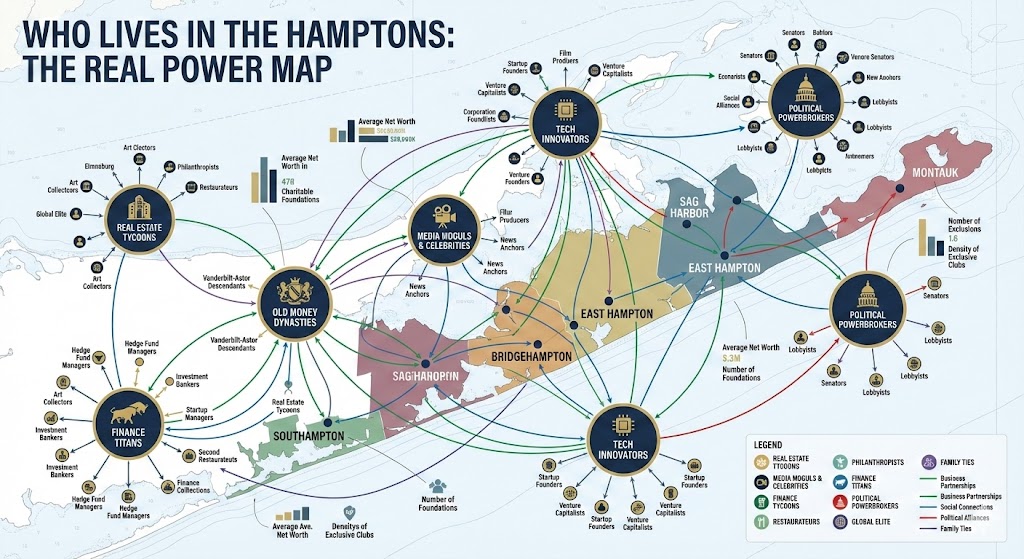
The question of who lives in the Hamptons reveals more about American power structures than any Forbes list. Behind the hedgerows of Southampton’s Meadow Lane, around the shores of East Hampton’s Georgica Pond, and along the oceanfront stretches of Sagaponack, the geography of wealth follows patterns that insiders understand intuitively. This is the map that matters.
Understanding where different categories of wealth concentrate isn’t social gossip. It’s strategic intelligence. The neighborhoods you choose, the events you attend, and the connections you make depend on grasping these power dynamics. Consider this your orientation to the social capital geography of America’s most significant summer community.
The Hamptons Map: Understanding the Territory
Before examining who lives where, understanding the Hamptons map itself matters. The region comprises a string of villages and hamlets stretching roughly 35 miles along Long Island’s South Fork, from Westhampton Beach in the west to Montauk at the eastern tip. Each area developed distinct character, attracted different demographics, and now commands vastly different price points.
The simplest geographic divide: properties east of Shinnecock Canal average $3.42 million, while those west average $1.6 million. But this aggregate obscures the micro-markets that actually determine status. A $5 million house in the wrong location signals differently than a $3 million house on the right street.
For those seeking a visual reference, a detailed map of the Hamptons NY reveals how the Atlantic Ocean forms the southern boundary while Peconic Bay and various harbors define the northern edge. The villages nestle between, connected by Route 27, the Montauk Highway, which becomes the region’s main artery and its infamous summer bottleneck.
Southampton: Where Finance Rules
Southampton represents old money attempting to coexist with new billions. The village itself maintains traditional Hamptons character, with white churches, historic estates, and a Main Street that hasn’t succumbed entirely to luxury retail. But the real story unfolds along the oceanfront.
Meadow Lane: Billionaires Row
Ask anyone in finance who lives in the Hamptons NY at the highest level, and the answer is Meadow Lane. This five-mile oceanfront stretch in Southampton has earned the “Billionaires Row” designation through concentration of wealth that rivals any address globally.
Current and recent residents include Ken Griffin of Citadel, who purchased Calvin Klein’s minimalist compound for $84 million in 2020. Leon Black of Apollo Global Management owns a four-lot compound stretching from ocean to bay. The late David Koch’s estate, “Aspen East,” remains one of the lane’s most significant properties. Robert Kraft of the New England Patriots paid $43 million for his Meadow Lane residence in 2021.
The street operates on its own social physics. Helicopter traffic is constant during summer months, with residents commuting to Manhattan in 35 minutes rather than suffering the four-hour Friday drive. Private staffing agencies maintain Southampton offices specifically to service Meadow Lane households. The concentration of wealth is so absolute that local zoning decisions effectively require the lane’s unofficial approval.
What Meadow Lane signals: established finance wealth, particularly hedge funds and private equity. Owners here tend toward year-round staff, significant security infrastructure, and the kind of privacy that comes from neighbors who have equal interest in discretion.
Southampton Village Estate Section
Behind the oceanfront, Southampton Village’s estate section attracts a mix of entertainment and finance wealth. Kelly Ripa and Mark Consuelos purchased here in 2004 for $2.35 million, a figure that seems quaint against current valuations. Howard Stern maintains an oceanfront estate where he broadcasts year-round, having made Southampton his primary residence.
The village section offers something Meadow Lane cannot: walkability to Southampton’s dining and retail. For residents who actually want to participate in Hamptons social life rather than observe it from behind gates, this location makes sense.
East Hampton: The Celebrity Concentration
If Southampton belongs to finance, East Hampton belongs to entertainment, media, and the creative industries. The distinction isn’t absolute, many finance figures own in East Hampton, but the cultural center of gravity differs. This is where you’ll find the highest concentration of recognizable names.
Georgica Pond: The A-List Address
The area surrounding Georgica Pond contains perhaps the highest concentration of genuine A-list celebrity homeowners in the Hamptons. Beyoncé and Jay-Z purchased their “Pond House” estate for $26 million in 2017. The 12,000-square-foot home sits next to 17 acres of meadow preserve, offering the combination of scale and privacy that attracts power couples. Beyoncé recorded portions of her self-titled album here, meaning Georgica Pond acoustics have reached millions of listeners.
Steven Spielberg and Kate Capshaw maintain a significant presence on Georgica Pond as well. Martha Stewart, whose relationship with the Hamptons spans decades, owns property in the area. Tom Ford purchased the historic Lasata estate, the childhood summer home of Jacqueline Kennedy Onassis, establishing another connection between old Hamptons history and contemporary cultural power.
The pond itself creates natural privacy. Properties facing the water enjoy buffer from public access that oceanfront homes, with their beach easements, cannot match. This makes Georgica Pond particularly attractive to celebrities seeking genuine seclusion rather than just expensive real estate.
East Hampton Village and Further Lane
Jerry Seinfeld purchased Billy Joel’s 12-acre East Hampton estate in 2000 for $32 million, then a record. The property includes a 22-car garage for his Porsche collection and, reportedly, a baseball diamond he added to the grounds. Seinfeld represents a category of Hamptons resident: the entertainer who chose East Hampton for genuine lifestyle reasons and stayed year after year.
Further Lane, stretching along the ocean in East Hampton, contains some of the region’s most significant properties. Barry Rosenstein’s $147 million purchase set the single-property record. Sylvester Stallone purchased an 11,664-square-foot estate in East Hampton’s estate section for $35 million in late 2024, reportedly for his adult daughters, signaling entertainment wealth’s continued migration to the area.
Robert Downey Jr. owns the famous “Windmill Cottage,” a historic 1885 property featuring the replica windmill that has become an East Hampton landmark. Neil Patrick Harris and David Burtka own a 13.5-acre estate with tennis court, pool, and cabana. The property’s proximity to protected conservation land provides permanent privacy insurance.
Jimmy Fallon maintains a farmhouse in Sagaponack, the village within Southampton town that borders East Hampton. Alec Baldwin and Hilaria Baldwin have been East Hampton fixtures for nearly four decades, their recently renovated home accommodating their large family.
Bridgehampton and Sagaponack: New Money’s Arrival
Bridgehampton and Sagaponack have become destinations for buyers seeking modern architecture and new construction rather than traditional Hamptons character. Average single-family home prices in this area reach $9.5 million, among the highest in the region.
Sagaponack consistently ranks among America’s most expensive zip codes, with median sales prices around $7.4 million. The agricultural preservation that protects surrounding potato fields creates permanent supply constraints. You cannot build more Sagaponack; the farms surrounding existing estates are protected in perpetuity.
Jennifer Lopez owns an 8,000-plus-square-foot estate in Water Mill, a hamlet within Southampton that borders Bridgehampton. The $10 million property on Bay Lane sits on its own cul-de-sac, providing the privacy that celebrity ownership requires.
The Bridgehampton area attracts a different profile than traditional Hamptons neighborhoods: tech wealth, younger finance principals, and buyers who want contemporary estates with modern amenities rather than historic renovation projects.
Sag Harbor: The Creative Class
Sag Harbor has historically attracted writers, artists, and creative industry figures who prioritize the village’s year-round character over pure oceanfront prestige. The whaling-era architecture, walkable downtown, and working harbor create atmosphere that newer developments cannot replicate.
Christie Brinkley has maintained presence in Sag Harbor for decades. Julie Andrews is considered a local. The village attracts figures who want community integration rather than compound isolation, a distinct preference that separates Sag Harbor buyers from those seeking Meadow Lane privacy.
The creative concentration has made Sag Harbor real estate particularly resilient. While purely seasonal markets fluctuate with economic cycles, Sag Harbor’s year-round appeal provides demand stability that pure summer destinations lack.
Montauk: Young Money and Surf Culture
Montauk, “The End,” operates on entirely different energy than the western Hamptons villages. The surf culture, Surf Lodge nightlife scene, and more casual atmosphere attract younger celebrities, models, and actors who find Southampton formality unappealing.
Ralph Lauren purchased a $16 million oceanfront property in Montauk in 2019, a four-bedroom home previously owned by playwright Edward Albee. The purchase signaled that even fashion industry royalty saw value in Montauk’s more relaxed positioning.
Robert De Niro owns Montauk property inherited from his father. The area attracts those who prioritize ocean access and authenticity over social positioning, a genuine alternative to the hedge-fund-and-hedgerow atmosphere further west.
The Social Contract That Protects Privacy
Understanding who lives in the Hamptons requires understanding why they stay. The answer lies in a social contract that locals and visitors maintain, distinguishing the Hamptons from other celebrity destinations.
No paparazzi culture exists. Unlike Los Angeles or New York City, photographers don’t stake out Hamptons restaurants or beaches. The occasional iPhone snapshot happens, but aggressive photography is socially unacceptable in ways enforced by community pressure rather than law.
Celebrities can participate in normal activities. Farm stand shopping, restaurant dining, beach access: these happen without the performance anxiety that accompanies public appearances elsewhere. The privacy makes the Hamptons sustainable for long-term residence rather than brief escapes.
Private events replace public nightlife. The parties that matter happen in compounds, not clubs. Charity galas provide structured social opportunities where attendance signals commitment rather than celebrity-seeking. The Samuel Waxman Cancer Research Foundation, Watermill Center benefits, and hospital fundraisers reliably draw A-list attendance because the format respects the privacy bargain.
What the Power Map Reveals
The geography of who lives in the Hamptons NY follows wealth-type rather than wealth-amount alone. Finance concentrates in Southampton’s oceanfront. Entertainment clusters around East Hampton’s Georgica Pond. Creative industries gravitate toward Sag Harbor’s village character. Young money flows to Montauk’s casual scene.
These patterns matter for anyone seeking to understand or access Hamptons social structures. The events you attend, the restaurants where you’re recognized, and the neighborhoods where you rent or purchase all signal which world you’re entering. Showing up to a Meadow Lane gathering expecting Montauk energy, or vice versa, marks you as someone who doesn’t understand the territory.
Social Life Magazine has mapped these dynamics for over two decades, building relationships across every significant Hamptons community. Our coverage reflects insider understanding that only comes from genuine presence, not drive-by journalism.
Access insider Hamptons intelligence:
- Subscribe to our newsletter for exclusive coverage of Hamptons events, real estate, and the people who matter
- Feature inquiries for residents: Contact our editorial team about profile opportunities and event coverage
- Join us at Polo Hamptons 2026, where the Hamptons’ most significant community gathers
- Support independent coverage with a $5 contribution
Related Reading: