
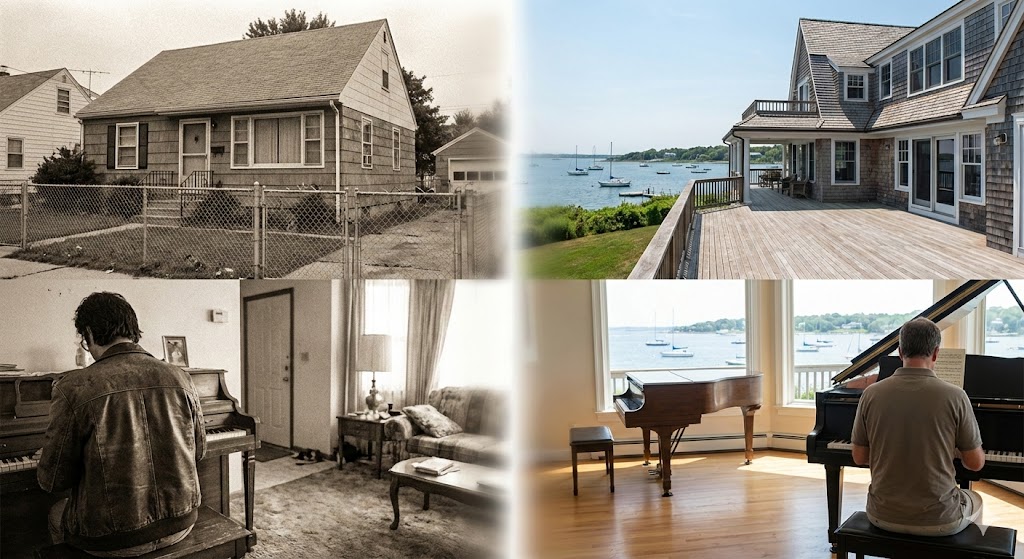

Billy Joel was eight years old when his father walked out of their Hicksville house and never came back. Howard Joel, a classically trained pianist who had survived the Holocaust and liberated Dachau, told his young son something no child should hear: “Life is a cesspool.” Then he moved to Vienna, started a new family, and left Billy to figure out what that meant.
Sixty years later, Billy Joel Hamptons properties include an 18th-century home in Sag Harbor, a horse farm in East Hampton, and enough Long Island real estate to prove that the kid from the poor side of the poor side of town made it. However, every oceanfront view and marina-facing window tells the same story. This is what happens when a broken boy spends his whole life trying to build something that can’t be taken away.
The Wound: A Holocaust Survivor’s Shadow Over Hicksville
Howard Joel was born Helmut in Nuremberg, Germany, in 1923. His family owned the second-largest mail-order textile company in the country. Subsequently, the Nazis forced them to sell everything for a fraction of its worth. The new owners converted the factory to produce something else: the striped pajamas worn by concentration camp prisoners.
The Joel family escaped to Switzerland with forged documents, eventually reaching America via Cuba. Howard enlisted in the U.S. Army and found himself, impossibly, attacking his own hometown under General Patton. He helped liberate Dachau in its first week. According to his son Alexander, the trauma “deeply traumatized him” in ways he never discussed.
This was the man who married Rosalind Nyman in New York and had a son named William Martin Joel in the Bronx in 1949. He moved his family to a nondescript house in Hicksville, where he became a dark, distant presence. And one night, he hit his eight-year-old son so hard for adding rock riffs to Beethoven’s “Moonlight Sonata” that he knocked him unconscious.
“I got whacked so hard he knocked me out. I was unconscious for like a minute,” Joel recalled in his HBO documentary. “And I remember waking up going, ‘Well, that got his attention.'”
The Chip: Piano Lessons Behind the Ballet School
After Howard left, Rosalind worked any job she could find. Bookkeeper. Secretary. Whatever paid rent. Meanwhile, Billy and his sister Judy went hungry sometimes. They were, as Joel later described it, “the poor people on the poor people’s block” in a suburb built for upward mobility.

Rosalind insisted on piano lessons anyway. She scraped together money Billy didn’t think they had because she believed in him. “Mom said anything you set your mind to do, you can do,” Joel said. “I credit my mom with sticking with me. She never gave up. She was a believer.”
The problem was the location. Billy’s piano teacher taught behind a ballet school. In 1950s Long Island, that was social suicide. Real boys played sports and acted tough. Walking past tutus to learn Chopin? That made you a target.
Naturally, Billy got beaten up constantly. One kid named Vinny targeted him specifically because “Yo, Joel, you killed Jesus.” The fact that Billy wasn’t even raised Jewish didn’t matter. The name Joel was enough.
So Billy did what any kid trying to survive would do. Fighting back became his answer. The boxing gym became his sanctuary. For three years, the amateur Golden Gloves circuit gave him purpose, and he competed as a welterweight with a 22-2 record. Consequently, Billy discovered that the same hands that played Beethoven could also break faces.
“I missed having a father very much,” Joel told Rolling Stone. “I went out and did crazy things to discover what my masculinity was. Stupid stuff.”
His nose got broken in that 24th fight. The cartilage never healed right. One nostril is still smaller than the other. He considered surgery once but worried it might change his voice. Instead, he kept the crooked nose as a reminder: he could take a punch.
The Rise: From Furniture Polish to Piano Man
By 17, Billy was playing piano bars until 3 a.m. to help his mother pay rent. He missed his high school English exam because he overslept after a gig. Rather than go to summer school, he dropped out entirely. “If I’m not going to Columbia University, I’m going to Columbia Records,” he said. “You don’t need a high school diploma over there.”
What followed was a decade of disaster. Bad bands. Worse contracts. A debut album mastered so poorly his voice sounded like helium. He signed away his publishing rights for almost nothing and spent years trying to escape the deal.
Then came the affair that nearly killed him.
Rock Bottom in a Laundromat
In his early twenties, Joel was living with his bandmate Jon Small, Small’s wife Elizabeth, and their son. He fell in love with Elizabeth. When Jon found out, Attila broke up, Billy lost his best friend, and Elizabeth cut off both men.
“I had no place to live. I was sleeping in laundromats,” Joel recalled. “I was depressed, I think, to the point of almost being psychotic.”
He wrote a song called “Tomorrow Is Today” that he later described as “more of a suicide note.” Subsequently, he swallowed a bottle of sleeping pills his sister had given him. He was in a coma for days.
When he woke up, his first thought was to try again. This time, he looked in his closet and saw two options: bleach and furniture polish. Both had skull and crossbones. The furniture polish said “lemon-scented.” He figured it would taste better.
Jon Small, the friend he’d betrayed, drove him to the hospital and saved his life.
“I didn’t die, obviously,” Joel told The Times. “I just farted furniture polish.”
He checked himself into a psychiatric observation ward. There, surrounded by people he initially thought had “real problems,” he had an epiphany. “I got out of the observation ward, and I thought to myself, ‘You can utilize all those emotions to channel that stuff into music.'”
The Tell: Still the Kid From Hicksville

The success that followed is the part everyone knows. “Piano Man” in 1973. “The Stranger” becoming Columbia’s best-selling album ever. Six Grammys. 150 million records sold. Madison Square Garden residency. Rock and Roll Hall of Fame.
Nevertheless, the wound never fully closed.
In 1973, Billy flew to Vienna to find his father. He showed up at Howard’s apartment and met a five-year-old boy named Alexander, his half-brother, who seemed to be having the happy childhood Billy never had. That encounter inspired “Vienna,” a song about slowing down that was really about reconciling with a ghost.
Howard Joel died in 2011. Billy dedicated “Vienna” to him at a show the following year. Forgiveness isn’t the same as healing.
There are patterns that repeat. Four marriages. Alcoholism that sent him to rehab twice. Depression that never fully lifted. In 2025, he was diagnosed with normal pressure hydrocephalus, a brain disorder that forced him to cancel all concerts. Howard Stern had dinner with him recently and reported that Billy wanted everyone to know he’s “not dying.”
Still fighting. Still taking punches. Still the kid from Hicksville who learned that the only way to survive is to get back up.
Billy Joel Hamptons: The Long Way Home
Billy Joel’s Hamptons presence tells you everything about what he’s been trying to build.
His Sag Harbor home sits on Bay Street, right across from a public marina, in a building that used to be a bait shop. He bought it in 2002 for $1.85 million and has spent years fighting with the local architectural board to renovate it. The house was built in the 1700s. It has four bedrooms, an elevator, and a piano room on the ground floor. Buoys hang off the side.
In 2024, he added a $10.7 million horse farm in East Hampton. Five bedrooms. Long gated driveway. Neighbors include Beyoncé, Jay-Z, and Alec Baldwin. His Centre Island estate near Oyster Bay spans 26 acres with 2,000 feet of private shoreline. He named it “MiddleSea,” a pun on middle C, the first key piano students learn.
Think about that. A kid who couldn’t afford to eat some nights now owns so much Long Island waterfront that he complains nobody will buy his $49 million mansion because the property taxes are $567,686 a year.
However, he never left. Every property is within an hour of Hicksville. The Centre Island estate is close enough that he used to dredge oysters there as a teenager. He goes back to Hicksville High School to give commencement speeches. In 1992, they finally gave him his diploma, 25 years late.
“I don’t feel like a rock star,” he told Playboy. “Rock stars to me are still Paul McCartney and Mick Jagger. I just feel like the guy from Hicksville, only I was able to get out. But it still takes me by surprise when people come up and do those ‘Oh, Billy Joel!’ things.”
The Sanctuary That Can Never Be Taken Away
Most celebrities buy in the Hamptons for status. Billy Joel bought because the water looks like escape and the land feels like proof.
Consider what he came from. Grandfather Karl built an empire in Germany that the Nazis stole. A traumatized father came home from war and took it out on his family. Rosalind worked herself to exhaustion so her son could take piano lessons. And Billy himself hit bottom so hard he drank furniture polish because bleach seemed too harsh.
Now he owns the kind of property that can’t be confiscated. He has shoreline that no one can force him to sell. He has piano rooms in every house because no one will ever knock him unconscious for playing what he wants to play.
This summer, if you’re in Sag Harbor, you might see him walking near the marina. Just a guy in his mid-seventies with a crooked nose and sad eyes, looking out at the water. Worth hundreds of millions. Still feeling like the poor kid who didn’t belong.
The Billy Joel Hamptons story isn’t about wealth. It’s about a boy who lost his father, fought his way through poverty, survived his own suicide attempts, and built something so solid that not even the ghosts can take it away.
Maybe the Hamptons isn’t where Billy Joel goes to be famous. Maybe it’s where he finally feels safe.
Get the Inside Story
Feature Your Hamptons Brand or Property: Contact Social Life Magazine — We connect luxury brands with the audiences that matter.
Polo Hamptons VIP Experiences & Brand Partnerships: Explore Polo Hamptons — Where celebrities, tastemakers, and brands converge.
Join the Hamptons Insider List: Get Our Newsletter — Celebrity origin stories, real estate moves, and party intel before anyone else.
Social Life Magazine Subscription: Subscribe Now — 23 years of Hamptons authority, delivered to your door.
Support Independent Hamptons Coverage: Donate $5 — Keep the real stories coming.
Related Stories
Read more celebrity Hamptons origin stories at Social Life Magazine, including coverage of Howard Stern, Jerry Seinfeld, Paul Simon, Steven Spielberg and the Long Island icons who shaped East End culture.
Author

Written by
Recent Posts
Studio Mayfair Marks New York Fashion Week With Intimate Cocktail Event at Sushi By Bou FiDi
What Goes Into Planning a Professional Furnace Installation?
Why Sports Card Collecting Is More Than Just a Hobby
From Signature Scents to Scent Wardrobes: The Evolution of Personal Fragrance

Beyond the Booth: How Exhibition Design Is Creating New Brand Experiences
Categories
- Art
- Articles
- Business of Luxury
- Celebrities
- Culture
- Entertainment
- Events
- Faces of Summer 2026
- Fashion
- Fashion & Style
- Featured
- Finance
- Food, Spirits, Wine
- Hamptons
- Hamptons Celebrities
- Health
- Health & Beauty
- Lifestyle
- Luxury Lifestyle
- Press
- Profiles
- Real Estate
- Technology
- The Chronicles
- Travel
- Uncategorized
- Weddings