

Howard Stern was ten years old, sitting in his family’s basement in Roosevelt, Long Island, when his father Ben pressed record on a tape machine. What followed wasn’t a birthday message or a family memory. It was an interrogation. Ben quizzed young Howard about foreign affairs, the United Nations, the separation of church and state. When the boy stumbled over answers he couldn’t possibly know, Ben’s voice cut through the static: “I told you not to be stupid, you moron.”
That tape still exists. Howard Stern Hamptons life now includes a 16,000-square-foot oceanfront mansion in Southampton, a wine cellar, a bowling alley, and enough space to never hear that word again. However, after 30 years of psychotherapy, he’ll tell you the truth. The moron never really left. He just learned to make millions by letting everyone else hear what it sounds like to be seen.
The Wound: Roosevelt’s Last White Kid
Ben Stern grew up in crushing poverty, the child of Jewish immigrants from Poland and Austria-Hungary. Consequently, that experience calcified into something hard and sharp. He became a radio engineer, co-owned a recording studio in Manhattan, and moved his family to Roosevelt, New York, in 1955. On paper, it looked like the American dream. In reality, it became Howard’s nightmare.
Roosevelt underwent blockbusting in the early 1960s. Specifically, real estate agents convinced white families that property values would collapse as Black families moved in. As a result, most white residents fled. Ben and Ray Stern, both staunch liberals, refused to leave on principle. Unfortunately, their son paid the price.
“This town was a horrible place to live,” Stern told Rolling Stone. “It was a nightmare.”
By high school, Howard was one of a handful of white kids remaining. The bullying was constant, and he got beaten up regularly. Moreover, one of his few Black friends was attacked for associating with him. Meanwhile, teachers looked the other way. Home offered no refuge either, as Ben remained emotionally distant, quick to anger, and generous with criticism.
The Basement Studio That Started Everything
Despite the coldness, Ben gave Howard something that changed his trajectory. Recognizing his son’s interest in radio, he set up a microphone, tape machine, and turntable in the family basement. There, young Howard created elaborate fake radio shows, complete with different characters, prank calls, and commercials.
Additionally, he performed “The Perverted Marionette Show” for friends, puppet performances his parents weren’t privy to that lived up to the name. Even then, Howard understood something fundamental. Ultimately, the only way to survive was to be impossible to ignore.
“I was just a little guy,” Stern recalled. “Wherever I went, if there was a piano, I’d wander over and play it. And it enchanted people.” The basement became his sanctuary. On tape, he could be anyone. Off tape, he was still the moron.
The Chip: Making Pain Into Provocation
Ben’s voice followed Howard everywhere. “You fucking asshole, you are a piece of shit.” That was the counterpoint to his mother Ray’s constant reassurance that he was special. The contradiction drove him mad.

Ray had her own trauma. Her mother died when she was nine, and subsequently, she was sent to live with distant relatives in the Midwest without even being told about the death. Depression haunted her for years, and sometimes she threatened to kill herself. In response, young Howard tried to comfort her without understanding what was wrong. Naturally, he made her laugh. Thus, comedy became his currency for connection.
“I will never have a lot of self-esteem,” Stern admitted to Rolling Stone. “I don’t feel very good about myself. The way I was raised and my father always telling me I was a piece of shit, I think I’ll go to my grave not feeling very positive about myself.”
In 1969, the Sterns finally moved to Rockville Centre, a largely white community. For 15-year-old Howard, it was like landing on another planet. Roosevelt had rejected him, and now Rockville Centre felt equally foreign. Consequently, the outsider status became permanent.
Boston University and the Birth of Howard Stern
At Boston University’s School of Communications, Stern finally found his calling. College radio gave him a platform, while Transcendental Meditation, which his parents had introduced him to, helped him quit smoking and manage his obsessive tendencies. Furthermore, he met his first wife, Alison Berns, whom he credits in characteristically Stern fashion for letting him “finger her” on their first date.
The path to fame was brutal. Hartford. Detroit. Washington. These were small stations where management constantly told him to tone it down. Eventually, New York came calling, where WNBC hired him in 1982 and fired him in 1985 for “conceptual differences.” The shock jock persona crystallized during these years. After all, if they were going to call him inappropriate anyway, he’d give them inappropriate.
The lesson from Roosevelt stuck. The only defense against being invisible is being impossible to ignore.
The Rise: King of All Media, Slave to Old Wounds
By the late 1980s, Howard Stern was the most famous radio personality in America. “The Howard Stern Show” reached 20 million listeners across 60 markets. Notably, the FCC fined him repeatedly, and religious groups protested. Yet none of it mattered. The audience kept growing.
“Private Parts” became a bestselling autobiography in 1993 and a hit film in 1997. Subsequently, Stern ran for Governor of New York in 1994 before withdrawing over financial disclosure requirements. Later, he moved to Sirius satellite radio in 2006 for a reported $500 million contract, escaping FCC regulations entirely. Meanwhile, America’s Got Talent made him a household name for a new generation.
Throughout it all, something was wrong.
“I was completely closed off from my feelings,” Stern told Good Morning America. “My first marriage was ending, and I was very confused by that. I was totally neurotic and sort of consumed with work. I took work as the most important thing and the only thing.”
The Therapist Who Changed Everything
When his marriage to Alison collapsed in 2001, Stern started psychotherapy. During the first session, he did his radio shtick. Impressions of his parents. Jokes about his childhood. However, the psychiatrist stopped him cold.
“None of this is funny,” the doctor said. “It sounds very sad. And yet you’re laughing at it.”
Nobody had ever said that to Howard Stern. For the first time in his life, someone was actually listening. Not to the persona. To the person underneath. He’s been in psychoanalysis multiple times per week for over 20 years now.
“I’d never been given lessons on how to be a man,” Stern explained. “I didn’t really have that level of communication with my own father.”
The Tell: The Moron Who Rescued Cats
The transformation wasn’t subtle. The Howard Stern of the 1990s, who built an empire on strippers and shock value, evolved into something unexpected. Today, Stern is considered one of the best interviewers in media. Specifically, celebrities seek out his show because he asks the questions they actually want to answer.
“I said, ‘What would it be like to really hear what someone has to say?'” Stern reflected. “And it has led to some incredible conversation.”
In 2008, he married model Beth Ostrosky. Together, they’ve become passionate animal rescuers, fostering hundreds of cats through the North Shore Animal League. Surprisingly, the guy who made millions from crude humor now paints watercolors and photographs shelter animals for adoption campaigns.
Interestingly, his relationship with Ben improved before his father’s death in 2022 at age 99. They found common ground as adults, developing mutual respect for what they’d each survived. Nevertheless, the wound never fully healed. Ray Stern, now in her late 90s, lives in a care facility that Howard pays for. Notably, he still does impressions of both parents on his show, still mining that material, still processing.
“The shit I did was fucking crazy,” Stern admitted about his earlier career. He credits therapy for his evolution. Critics call it a sellout. He calls it growing up.
Howard Stern Hamptons: The Moron’s Revenge
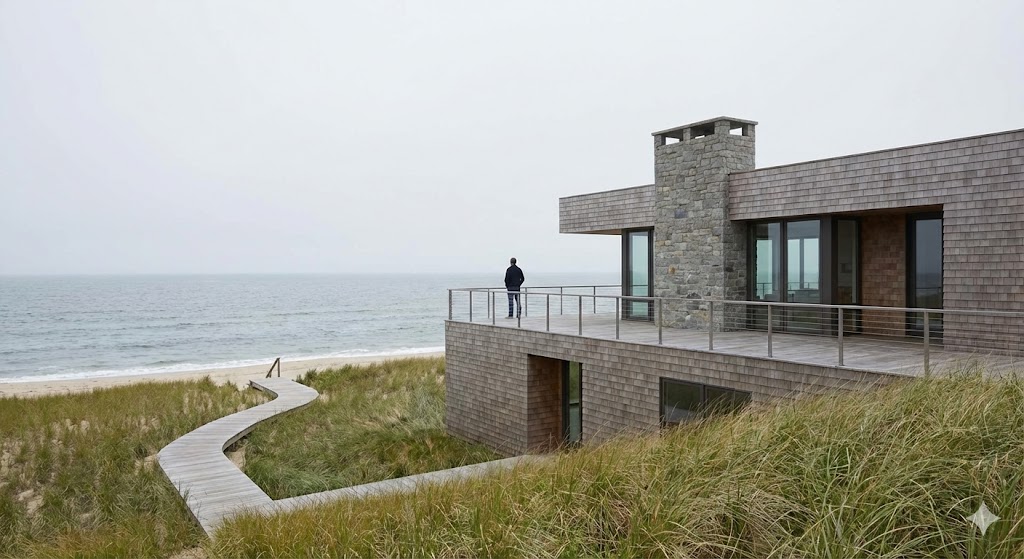
In 2005, Howard Stern paid $20 million for a 4.35-acre oceanfront estate in Southampton. The three-level mansion spans 16,000 square feet with eight bedrooms and twelve bathrooms. Additionally, amenities include a bowling alley, wine cellar with tasting room, pool with cabana, and a 1,500-square-foot master bedroom with private balcony and his-and-hers bathrooms.
Consider where he started. Initially, there was a cramped house on Conlon Road in Roosevelt, where he dreaded leaving because someone might beat him up. There were parents who stayed on principle while their son suffered the consequences. Above all, there was a father who called him a moron and took him to exactly one baseball game, which he described as “a horrible day.”
Now he owns one of the most prestigious addresses in the Hamptons. During the pandemic, he broadcast his Sirius show from his Southampton home studio. Remarkably, the basement setup his father built in Roosevelt became a multimillion-dollar operation with ocean views.
Howard Stern Hamptons neighbors include the elite of American wealth and celebrity. Nevertheless, he’s never really been part of the scene. The party circuit doesn’t interest him. Instead, he practices TM, rescues cats, and goes to therapy. Remarkably, the outsider status remains, now by choice.
The Southampton Sanctuary
Stern also owns a $21 million penthouse in Manhattan and a $52 million estate in Palm Beach, where he’s spent millions on renovations including a 1,000-square-foot closet for Beth. Ironically, the man who grew up watching his parents get robbed at knifepoint five times in their modest Long Island home now employs serious security details.
However, the Southampton house represents something specific. It’s on Long Island, where he was once the last white kid, where his father built that basement studio, where he learned that the only way to survive being called a moron is to become impossible to ignore. Essentially, every mile of shoreline connects back to that origin.
Howard Stern could live anywhere. Yet he chose to stay close to where it all started. Perhaps that’s the point. Ultimately, the Southampton mansion isn’t an escape from Roosevelt. Instead, it’s an answer to it.
Still That Scared Kid Somewhere
In May 2025, Stern announced he wasn’t retiring from Sirius. At 71, he’s still broadcasting, still interviewing, still processing. Presumably, the $500 million contract that expires this fall will be renewed. After all, the audience remains massive.
However, listen closely to any interview where he discusses his childhood, and you’ll hear it. The sadness underneath the bravado. The little boy who just wanted his father to listen. The teenager who got beaten up for existing. Essentially, this is the man who spent decades making millions from shock value because negative attention felt better than no attention at all.
The Howard Stern Hamptons story isn’t about a radio host who made it big. Rather, it’s about a kid from Roosevelt who was told he was stupid, worthless, a moron, and responded by becoming the most listened-to broadcaster in American history. Certainly, the 16,000-square-foot mansion is beautiful. More importantly, it’s also proof.
Somewhere in that oceanfront estate, there’s a basement of sorts. There’s a microphone. And there’s a scared kid pressing record, trying to create something that might finally be good enough.
Maybe the Hamptons isn’t where Howard Stern goes to escape his father’s voice. Maybe it’s where he finally learned it was wrong.
Get the Inside Story
Feature Your Hamptons Brand or Property: Contact Social Life Magazine — We connect luxury brands with the audiences that matter.
Polo Hamptons VIP Experiences & Brand Partnerships: Explore Polo Hamptons — Where icons, tastemakers, and brands converge.
Join the Hamptons Insider List: Get Our Newsletter — Celebrity origin stories, real estate moves, and East End intel before anyone else.
Social Life Magazine Subscription: Subscribe Now — 23 years of Hamptons authority, delivered to your door.
Support Independent Hamptons Coverage: Donate $5 — Keep the real stories coming.
Related Stories
Read more celebrity Hamptons origin stories at Social Life Magazine, including coverage of Billy Joel, Jerry Seinfeld, Paul Simon, Steven Spielberg and the Long Island icons who shaped East End culture.
Author

Written by
Recent Posts

Victoria Justice Kicks Off Halloween Early with Love Zombie Bash in Hollywood

Planning an Arizona Road Trip? Practical Details to Handle Before You Leave

Short Homecoming Dresses That Feel Polished, Not Overdone
Men’s Health After 40: Important Changes to Pay Attention To
What You Need to Know About Spray Tanning
Categories
- Art
- Articles
- Business of Luxury
- Celebrities
- Culture
- Entertainment
- Events
- Faces of Summer 2026
- Fashion
- Fashion & Style
- Featured
- Finance
- Food, Spirits, Wine
- Hamptons
- Hamptons Celebrities
- Health
- Health & Beauty
- Lifestyle
- Luxury Lifestyle
- Press
- Profiles
- Real Estate
- Technology
- The Chronicles
- Travel
- Uncategorized
- Weddings