
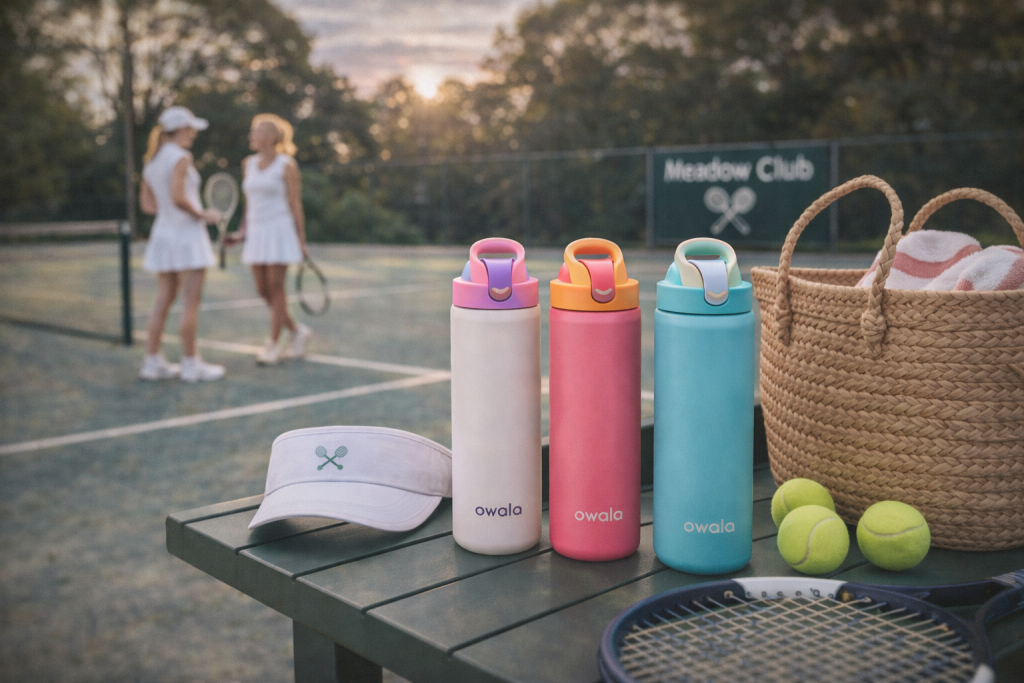
Walk into any Hamptons tennis club this season, and you’ll notice something curious. The Stanley cups that dominated poolside two summers ago have quietly disappeared. In their place: colorful Owala Hamptons FreeSip bottles tucked into Goyard totes and propped against court benches. However, this isn’t just another trending accessory. It’s a case study in how functional design beats branding when the product actually works better.
The Utah-based company launched in March 2020—possibly the worst timing imaginable for a new consumer product. Yet Owala became the fastest-growing water bottle brand in America for three consecutive years. Moreover, it achieved this by solving a problem competitors ignored: people drink water differently.
The FreeSip Innovation That Changed Everything
Steve Sorensen, CEO and co-founder of parent company Trove Brands, noticed something while watching customers at retail stores. His company already dominated the protein shaker market with BlenderBottle. Consequently, he observed fitness enthusiasts repurposing those shakers as everyday water bottles.
“We took a long hard look and found that most water bottles are either overkill or underwhelming,” the company explains. “Do you really need a water bottle built for climbing Mt. Everest for your desk at work?”
The Straw People vs. The Spout People
Sorensen’s research revealed a fundamental divide among hydration consumers. Some preferred sipping through straws. Others wanted to chug from wide-mouth openings. No bottle accommodated both. Subsequently, he prototyped the patented FreeSip spout—a design offering both options in a single lid.
TIME recognized the Owala FreeSip as one of the Best Inventions of 2023. Additionally, the design solved the leaking problem that plagued Stanley cups, converting frustrated customers by the thousands.
Why Owala Hamptons Overtook Stanley
The Stanley cup’s meteoric rise created its own vulnerabilities. At $45-65 per tumbler, the price point invited scrutiny. Furthermore, viral videos of leaking lids and lead concerns eroded trust among quality-conscious consumers.
Owala FreeSip bottles retail between $24-38, positioning them as accessible luxury. For Owala Hamptons devotees, this price point removes the preciousness that made Stanleys feel like investments requiring protection. You can throw an Owala in a beach bag without anxiety.
The Aesthetic Advantage
Owala’s color strategy distinguishes it from competitors pursuing safe neutrals. Limited-edition drops feature combinations like hot pink with pastel green, creating collectibility without artificial scarcity. Consequently, some rare bottles resell for hundreds of dollars, fueling a secondary market among enthusiasts.
“Water bottles are becoming a fashion accessory more than just a way to get water,” explains Michael Sorensen, current CEO of Trove Brands. The company has secured licensing deals with Disney, NASA, and designer Joanna Gaines—transforming hydration vessels into statement pieces.
The Emotional Support Water Bottle Phenomenon
Something unexpected happened during Owala’s pandemic-era launch. Users began describing their bottles as “emotional support” accessories. TikTok videos featuring captions like “my child” and “forever my fave emotional support bottle” accumulated millions of views.
“We all know how dark things got during those several years,” Sorensen told Fortune. “Owala coming on scene as a bright spot and as a little bucket of joy actually really helped a lot.” The phenomenon created customer loyalty beyond typical consumer goods attachment.
The Reddit Community Factor
Fan Susie So loved her bottle so much she founded a Reddit community for fellow enthusiasts. That community now exceeds 22,000 members who share hauls, trade rare colors, and obsess over upcoming releases. Moreover, this organic community-building provided marketing leverage competitors couldn’t replicate.
Owala mastered FOMO (fear of missing out) as strategy. Limited batches sell out within an hour of dropping. The aftermarket immediately activates. Furthermore, the company hosts website scavenger hunts and giveaways that reward engaged customers—transforming hydration into gamification.
Owala Hamptons: The Cross-Generational Appeal
Most consumer products succeed by targeting specific demographics. Owala achieved something rarer: simultaneous adoption across generations. The same bottle appears in Meadow Club locker rooms and Southampton High School cafeterias.
For mothers, Owala delivers genuine functionality. The triple-layer insulation keeps water cold for 24 hours—essential during August tennis lessons. Additionally, the leak-proof design eliminates the purse disasters Stanley users reported. The practical benefits matter more than the aesthetic ones.
The Gen Z Connection
For younger consumers, Owala represents self-expression. The color combinations allow personality signaling without requiring luxury brand expenditure. Subsequently, teenage daughters and tennis-playing mothers can bond over shared appreciation without one group feeling they’ve adopted the other’s accessory.
This dynamic proves particularly valuable in Hamptons social contexts where overt logos read as gauche. An Owala communicates awareness without trying too hard—the definition of effective status signaling in communities that prize understatement.
The BlenderBottle Legacy Behind the Brand
Understanding Owala requires understanding its pedigree. Kim and Steve Sorensen founded Trove Brands in their Utah living room in 2000, creating the BlenderBall wire whisk that revolutionized protein shakers. BlenderBottle became the category leader, selling in over 100,000 retail locations across 100+ countries.
This heritage explains Owala’s execution quality. The company understood hydration products before launching. Moreover, they possessed manufacturing relationships, distribution networks, and retail expertise competitors typically spend years building.
The Failed First Launch
Owala’s origin story includes a crucial failure. The FreeSip technology initially launched as “BlenderBottle Hydration” in 2019. It flopped completely. Steve Sorensen watched customers walk past the display to purchase competitors.
The lesson: even superior products require distinct brand identity. Consequently, the team rebuilt everything—name, colors, voice, positioning—creating Owala as an independent entity. The failure taught them that functional innovation alone cannot overcome branding missteps.
The Marketing Voice That Wins
Owala’s launch campaign read: “Water bottles designed exclusively for people who drink water.” The statement is so obvious it borders on absurd. That absurdity generated exactly the engagement the company wanted.
“We rolled out with it, and it invited all kinds of trolls,” Michael Sorensen recalls. “Our social media team’s tongue-in-cheek responses just fueled the fire.” When commenters complained about the vague messaging, the brand responded: “You’re right. We just fired our marketing team.”
The Retargeting Brilliance
Perhaps the cleverest element: Owala’s retargeting ads. Visitors who viewed bottles but didn’t purchase received follow-up advertisements simply reading: “Hey, it’s me again. Just hanging out in your feed. #buyme”
This self-aware approach resonated with consumers exhausted by aggressive marketing. The brand felt like a friend making requests rather than a corporation demanding attention. Subsequently, conversion rates exceeded industry benchmarks for competing hydration brands.
The Hamptons Wellness Context
Hydration has become central to Hamptons wellness culture. Aestheticians recommend specific water intake for skin health. Personal trainers track hydration metrics. Nutritionists prescribe water schedules alongside meal plans.
Owala Hamptons adoption reflects this broader trend. The bottle becomes part of a visible wellness practice—proof of self-care visible to fellow club members. Furthermore, the 24-hour cold retention means ice survives a full day of activities, from morning Pilates through evening cocktails.
What Comes Next
Industry observers suggest Owala’s challenge now involves sustaining momentum beyond trend status. The company continues innovating with new sizes, accessories, and limited editions. However, the hydration category has historically cycled through favored brands quickly.
For Owala Hamptons enthusiasts, the calculation remains simple. A $30 bottle that actually works, looks good, and doesn’t leak deserves loyalty regardless of what comes next. Moreover, when your teenage daughter wants the same accessory you’re carrying—without either party feeling embarrassed—you’ve found something worth keeping.
Connect With Social Life Magazine
Feature Inquiries & Advertising: Contact our editorial team
Polo Hamptons 2026: Tickets, cabanas, and corporate sponsorships
Never Miss an Issue: Subscribe to exclusive invites and specials
Print Subscription: Receive Social Life Magazine delivered to your door
Support Our Journalism: Contribute $5 to independent Hamptons coverage
Related Articles
Explore more luxury lifestyle content at Social Life Magazine.
Author

Written by
Recent Posts
Is Business Class Worth It on a Short-Haul Flight?
Failure to Disclose Finances in Divorce
Columbus Car Accident Attorney: Protecting Your Rights After a Georgia Crash
Does Workers’ Comp Cover Lost Wages? A Guide for Oregon Workers
Understanding Social Security Disability Benefits in Oklahoma
Categories
- Art
- Articles
- Business of Luxury
- Celebrities
- Culture
- Entertainment
- Events
- Faces of Summer 2026
- Fashion
- Fashion & Style
- Featured
- Finance
- Food, Spirits, Wine
- Hamptons
- Hamptons Celebrities
- Health
- Health & Beauty
- Lifestyle
- Luxury Lifestyle
- Press
- Profiles
- Real Estate
- Technology
- The Chronicles
- Travel
- Uncategorized
- Weddings