
Here’s an uncomfortable truth about your bathroom habits. The toilet paper industry cuts down nearly 2 million trees daily. American consumers, representing just 5% of global population, consume 30% of the world’s paper supply. The brands scoring highest in softness typically score lowest in sustainability, with beloved household names earning F grades from the National Resources Defense Council for sourcing almost entirely from forest fiber.
Reel Paper has built a $14 million venture-backed business on the premise that this tradeoff is false. Their 100% bamboo toilet paper delivers on softness and strength while eliminating tree pulp entirely. The B Corp certified company has earned praise from sustainability advocates and comfort-focused consumers alike, proving that eco-friendly doesn’t mean sacrificing quality.
Why Bamboo Changes the Equation
Bamboo is not a tree. This simple botanical fact underpins Reel’s entire value proposition. As a grass, bamboo grows extraordinarily fast, regenerating from the same root structure when harvested. You can harvest bamboo every three years compared to the decades required for softwood forests to regenerate.
CEO David VanHimbergen explains the appeal: bamboo’s longer fibers make it ideal for balancing softness and strength, the two qualities consumers actually care about. The fibers create a premium feel without the virgin wood pulp that devastates Canadian boreal forests.
Reel’s bamboo toilet paper needs approximately 90% less land per sheet to produce compared to traditional options. For environmentally-conscious Hamptons homeowners managing multiple properties, this math matters. Every roll represents a choice that scales across households, guest rooms, and rental properties.
The Product That Actually Delivers
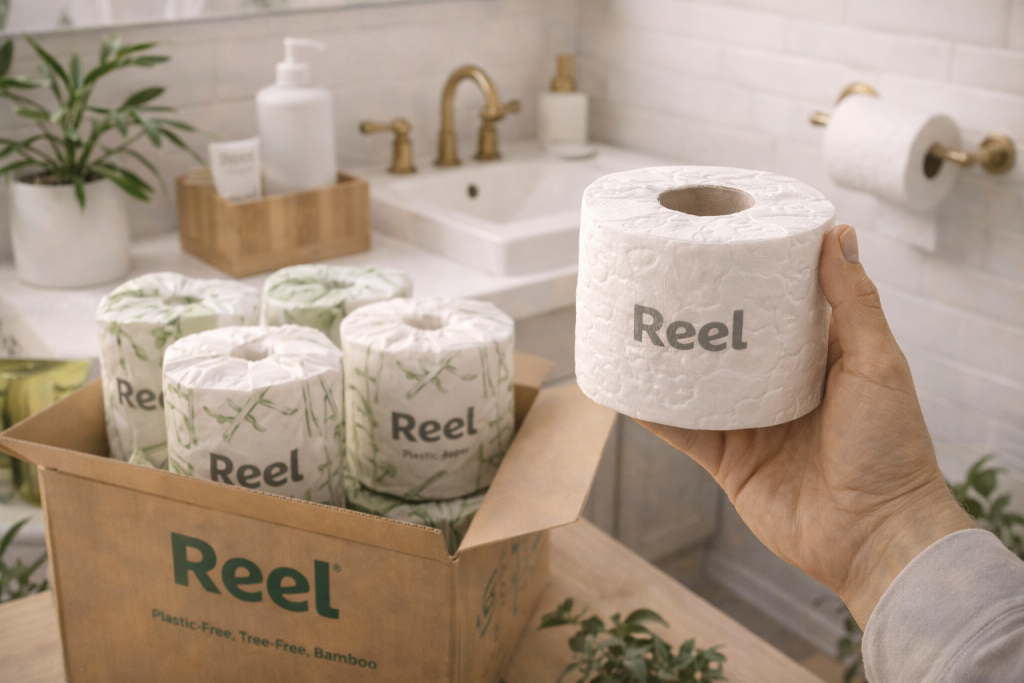
Reel’s premium bamboo toilet paper comes as 3-ply, ultra-soft sheets in 24-roll boxes priced at $36.99 for subscriptions or $43.99 for one-time purchases with free shipping. Each roll contains 300 sheets, compared to 192 sheets for leading competitors at similar price points. The per-roll economics actually favor Reel once you account for sheet count.
The product is tree-free, fragrance-free, chlorine-free, and uses zero plastic. No inks or dyes. Individually wrapped rolls and shipping materials are biodegradable, recyclable, and plastic-free. Even the tape. The company has earned “ready biodegradable” certification, meaning the paper breaks down via microorganisms in aerobic environments within defined timeframes.
For septic systems, which many Hamptons properties rely on, Reel’s bamboo toilet paper performs excellently. The water bottle test shows it breaks down as fast if not faster than most competitors. The longer bamboo fibers that create strength also enable proper breakdown, avoiding the clogs that plague some eco-alternatives.
The Funding Behind the Mission
Reel Paper has raised $14 million from investors including Bluestein Ventures, Squared Circles, Montage Ventures, Great Oaks Venture Capital, Trousdale Ventures, and Mandell Ventures. Co-founder Andrew Bluestein sees potential for major players like Kimberly-Clark or Procter & Gamble to eventually acquire sustainable startups disrupting their core categories.
The company ships bamboo from China to the US, burning fossil fuels in transit. To address this environmental cost, Reel purchases carbon offsets. The partnership with One Tree Planted uses profits to support reforestation projects worldwide, adding regenerative impact beyond carbon neutrality.
Co-founders Livio Bisterzo and Derin Oyekan have also partnered with SOIL to provide sanctuary toilets and waste removal for communities in Haiti. The business model embeds impact at multiple levels rather than treating sustainability as marketing afterthought.
How Reel Compares to Alternatives
The sustainable toilet paper market has expanded significantly, with bamboo and recycled options from brands including Who Gives a Crap, Cloud Paper, Cheeky Panda, and Betterway. NRDC’s latest Issue with Tissue report gives Reel a B grade, placing it among the better performers alongside Amazon Aware, Caboo, and PlantPaper.
Independent testing consistently rates Reel among the softest bamboo options available. The 3-ply construction provides strength that single-ply alternatives lack, reducing the tendency to use more sheets per visit that undermines the environmental math of thinner products.
The subscription model ensures households never run out while providing cost savings. The recurring delivery eliminates grocery store trips, a convenience factor that resonates with busy Hamptons weekenders managing multiple priorities. You can cancel anytime with no commitment.
Beyond Toilet Paper
As of June 2024, Reel expanded into bamboo paper towels, applying the same sourcing and manufacturing principles to another household staple. The paper towels cost the same as the recycled alternative, surprising given bamboo typically commands premium pricing.
The company positions itself not merely as a paper brand but as a lifestyle upgrade. Their messaging emphasizes community, connection to earth, and responsibility to future generations. The design-forward packaging looks intentional rather than apologetic, sitting comfortably in well-designed bathrooms rather than hiding under sinks.
For Hamptons homeowners who have invested in aesthetic coherence throughout their properties, Reel addresses the toilet paper problem that defeats many sustainability efforts. The product is beautiful enough to leave visible, functional enough to satisfy guests, and responsible enough to align with environmental values.
The Bigger Picture on Sustainable Home Goods
Toilet paper represents a small change with large cumulative impact due to frequency of use. VanHimbergen frames the opportunity precisely: “It’s a small change that, as people can transition to something more sustainable, can have meaningful impact because of the frequency of usage.”
Consumer demand for environmentally cleaner products continues rising, making startups like Reel increasingly attractive to investors and potential acquirers. The traditional paper giants have begun responding: Procter & Gamble launched Charmin Ultra Bamboo, earning its first non-F grade on NRDC’s scorecard, while Kimberly-Clark announced intentions to eliminate natural forest fiber from its entire product line.
For households ready to make the switch, Reel offers fabric booklets allowing you to feel the product before committing to a full box. The company’s FSC certification ensures bamboo doesn’t come from areas deforested specifically for cultivation. These details matter for consumers who have learned to question greenwashing claims.
Explore sustainable home solutions through Social Life Magazine. Experience luxury lifestyle events at Polo Hamptons. Subscribe to our print edition for eco-luxury content, join our email list for weekly updates, or support independent journalism with a $5 contribution.
Related: Cozy Earth: Oprah’s Favorite Sustainable Bedding Brand | EcoFlow: The Power Stations Redefining Off-Grid Living
Author

Written by
Recent Posts
What Goes Into Planning a Professional Furnace Installation?
Why Sports Card Collecting Is More Than Just a Hobby
From Signature Scents to Scent Wardrobes: The Evolution of Personal Fragrance

Beyond the Booth: How Exhibition Design Is Creating New Brand Experiences

Trading the Hamptons for Hvar: A Summer on Croatia’s Most Glamorous Island
Categories
- Art
- Articles
- Business of Luxury
- Celebrities
- Culture
- Entertainment
- Events
- Faces of Summer 2026
- Fashion
- Fashion & Style
- Featured
- Finance
- Food, Spirits, Wine
- Hamptons
- Hamptons Celebrities
- Health
- Health & Beauty
- Lifestyle
- Luxury Lifestyle
- Press
- Profiles
- Real Estate
- Technology
- The Chronicles
- Travel
- Uncategorized
- Weddings