
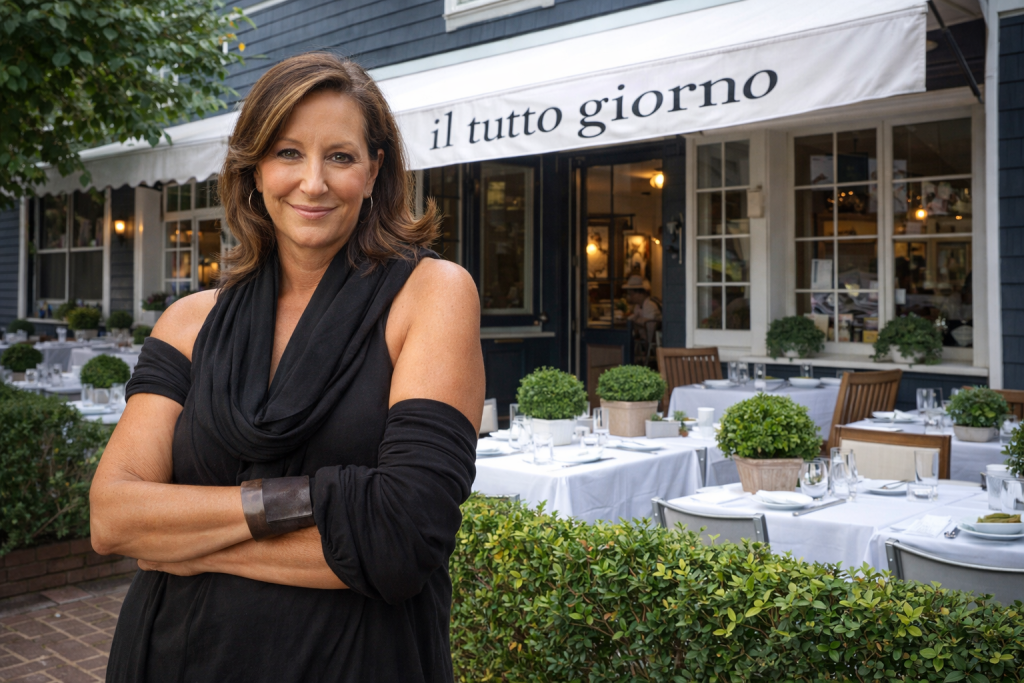
Donna Karan’s net worth stands at an estimated $600 million in 2025, making her one of the wealthiest self-made women in fashion history. But the Donna Karan net worth story doesn’t begin in a Manhattan showroom or on a Paris runway. It begins in a Forest Hills apartment where a three-year-old girl watched her father leave for work one morning and never come home.
Gabriel “Gabby” Faske was a tailor. Her mother Helen, known as “Queenie,” was a model who worked in Chester Weinberg’s showroom. Fashion was in the blood. But then Gabby died, and three-year-old Donna was left with an absence she would spend the rest of her life trying to fill.
The girl who lost her father became the woman who dressed millions of others. The wound became the wardrobe.
The Wound: A Father She Never Knew
Donna Faske was born on October 2, 1948, in the Forest Hills neighborhood of Queens, New York. Her familyHer father was a tailor and haberdasher who died when she was only three. Her mother had to abandon her modeling career to raise Donna and her older sister Gail in Woodmere, on Long Island’s South Shore.
The absence defined everything. A father who worked with fabric, who created things with his hands, who understood the alchemy of cloth and body—gone before she could know him. “I dressed to fill a void,” Karan has said in various interviews. The little girl from Queens would spend decades creating clothes that made other women feel complete.
She passed her time in the high school art department, more interested in creating than studying. She participated in volleyball, softball, and basketball. But fashion was calling. By 14, she had lied about her age to get a job selling clothes at a local boutique. The daughter of a tailor was finding her own way to the needle and thread.
The Chip: Dropping Out to Drop In
Donna graduated from Hewlett High School in 1966 and enrolled at Parsons School of Design. But formal education couldn’t contain her. She dropped out after landing a summer job as an assistant to Anne Klein, the sportswear designer revolutionizing how American women dressed.
Anne Klein became everything—mentor, mother figure, boss. “Anna became my mentor and taught me the main thing: never forget you—the artist—even when designing toothbrushes and hospital gowns,” Karan later said.
By 1971, Donna was associate designer. By 1973, she was participating in the legendary Battle of Versailles Fashion Show, where American designers took on the French establishment. When Anne Klein died of cancer in 1974, 26-year-old Donna Karan inherited an empire.
According to McKinsey research on fashion industry leadership, inheriting a design house at such a young age is extraordinarily rare. Most designers spend decades before getting such opportunities. Karan got hers because Klein trusted her absolutely.
The Rise: Seven Easy Pieces That Changed Everything
Donna ran Anne Klein for ten years, winning Coty American Fashion Critics Awards in 1977 and 1982 with her partner Louis Dell’Olio. But she had her own vision. In 1984, with her second husband Stephan Weiss and backing from Takihyo Corporation, she launched Donna Karan New York.
Her first collection, “Seven Easy Pieces,” debuted in 1985. The concept was revolutionary: a bodysuit, a skirt, pants, a blouse, a jacket, a coat, and “something fancy”—all interchangeable, all designed to work together, all meant for real women with real bodies and real jobs.
The Council of Fashion Designers of America named her Designer of the Year. Women who had been forcing themselves into men’s power suits suddenly had clothes that were feminine, comfortable, and professional. The daughter of a tailor had figured out what working women actually needed.
From DKNY to LVMH
In 1988, Karan launched DKNY—a younger, more accessible line inspired by her daughter Gabby. The bridge line exploded. By the early 1990s, DKNY accounted for nearly 80% of the company’s sales. The brand expanded into menswear, fragrances, accessories, and home goods.
In 1996, Donna Karan International went public. In 2001, LVMH acquired the company for $243 million in stock plus $400 million for the Donna Karan trademark. Karan and Weiss reportedly netted $450 million from the sale.
The girl who dropped out of Parsons had built a billion-dollar brand.
The Tell: Still Filling the Void
Stephan Weiss died of lung cancer in 2001, the same year the company was sold. The loss devastated Karan. She set up a showroom in her husband’s former studio and channeled her grief into Urban Zen, a lifestyle brand and foundation focused on wellness, cultural preservation, and integrative healthcare.
She’d lost her father at three. She’d lost her husband in her fifties. The wound kept reopening. And she kept responding by creating—clothes, foundations, communities of healing.
“Delete the negative; accentuate the positive,” she has said. It sounds like a fashion philosophy. It’s actually a survival strategy.
The Hamptons Connection: East End Style
Donna Karan has been a fixture in the Hamptons for decades. Her black-and-neutral aesthetic helped define East Hampton sophistication. She also owns property in Turks and Caicos, including “The Sanctuary,” a retreat valued at approximately $39 million.
But her Hamptons presence isn’t just about real estate. It’s about lifestyle—the same mix of elegance and ease that defined her clothing. Karan understood that the women who bought her clothes also summered on the East End, and she dressed them for both the boardroom and the beach.
Donna Karan Net Worth Breakdown
The Donna Karan net worth of $600 million comes from multiple sources:
Company Sale: The 2001 sale to LVMH reportedly netted Karan and her husband approximately $450 million.
Royalties and Licensing: Ongoing income from the use of her name and trademarks.
Urban Zen: Her lifestyle brand and foundation, launched in 2007, includes fashion, home goods, and wellness products.
Real Estate: Properties including her Turks and Caicos estate valued at $39 million, plus Hamptons and Manhattan holdings.
Investments: Diversified portfolio built over decades of success.
The Queen of Seventh Avenue
They called her “The Queen of Seventh Avenue.” She won CFDA Designer of the Year awards in 1985, 1990, and 1996, plus Menswear Designer of the Year in 1992. She received the CFDA Lifetime Achievement Award in 2004. Forbes listed her among the 100 Most Powerful Women.
But the titles and awards miss the deeper story. Donna Karan didn’t just make clothes. She solved a problem that millions of women didn’t know how to articulate: how do you dress for a world that wasn’t designed for you?
Her answer was Seven Easy Pieces, the bodysuit, clothes that wrapped and sculpted and moved with the body instead of against it. The tailor’s daughter understood fabric the way her father had—but she understood women’s bodies in ways the industry never had before.
What Donna Karan’s Net Worth Reveals
The Donna Karan net worth story is about absence becoming abundance. A three-year-old who lost her father became a woman who gave millions of others a way to feel whole. A dropout who couldn’t sit through a draping exam built a brand worth billions. A grieving widow channeled loss into wellness and cultural preservation.
She told an interviewer once that she designs for herself first—clothes she would actually wear, problems she actually has. That honesty translated into a $600 million fortune because it turned out millions of other women had the same problems.
Donna Karan’s net worth is $600 million. But what she really built is proof that the emptiest spaces can become the fullest lives, if you have the courage to fill them yourself.
Experience the Hamptons
Get Featured: Contact Social Life Magazine for advertising and features.
Polo Hamptons: Get tickets and sponsorship information.
Support Independent Journalism: Donate $5.
Related Articles:
- Pharell Williams Net Worth 2025: The Boy Who Saw Colors in the Projects
- Vera Wang Net Worth 2025: From Top Failures to Fashion Empire
- Betsey Johnson Net Worth 2025: A Fortune Built on Cartwheels and Chaos
- Calvin Klein Net Worth 2025: The Bronx Boy Who Built a $75m Hamptons Fortress
- Tory Burch Net Worth 2025: Tomboy Builds a Billion Dollar Empire
- Reed Krakoff Net Worth 2025: Architect of American Luxury
Author

Written by
Recent Posts

Studio Mayfair Marks New York Fashion Week With Intimate Cocktail Event at Sushi By Bou FiDi
What Goes Into Planning a Professional Furnace Installation?
Why Sports Card Collecting Is More Than Just a Hobby
From Signature Scents to Scent Wardrobes: The Evolution of Personal Fragrance

Beyond the Booth: How Exhibition Design Is Creating New Brand Experiences
Categories
- Art
- Articles
- Business of Luxury
- Celebrities
- Culture
- Entertainment
- Events
- Faces of Summer 2026
- Fashion
- Fashion & Style
- Featured
- Finance
- Food, Spirits, Wine
- Hamptons
- Hamptons Celebrities
- Health
- Health & Beauty
- Lifestyle
- Luxury Lifestyle
- Press
- Profiles
- Real Estate
- Technology
- The Chronicles
- Travel
- Uncategorized
- Weddings