Jimmy Fallon was five years old, riding his bike in circles in the backyard because his parents wouldn’t let him leave the property. Meanwhile, the basketball hoop sat in the middle of the lawn so he couldn’t accidentally wander toward traffic. Even more telling, his father recorded SNL episodes and used a car key to scratch dirty words off his Rodney Dangerfield album. As a result, his mother drove him to school until his senior year of high school.
This kid—wrapped in bubble wrap, obsessed with a show he could only watch in edited form—wrote something in his journal that would define everything that followed. Specifically, if he didn’t make it onto Saturday Night Live by age 25, he would kill himself. There was no backup plan, no friends, no girlfriend, no second option. Instead, there was just one wish, thrown into every birthday candle, every fountain coin, every shooting star he ever saw.
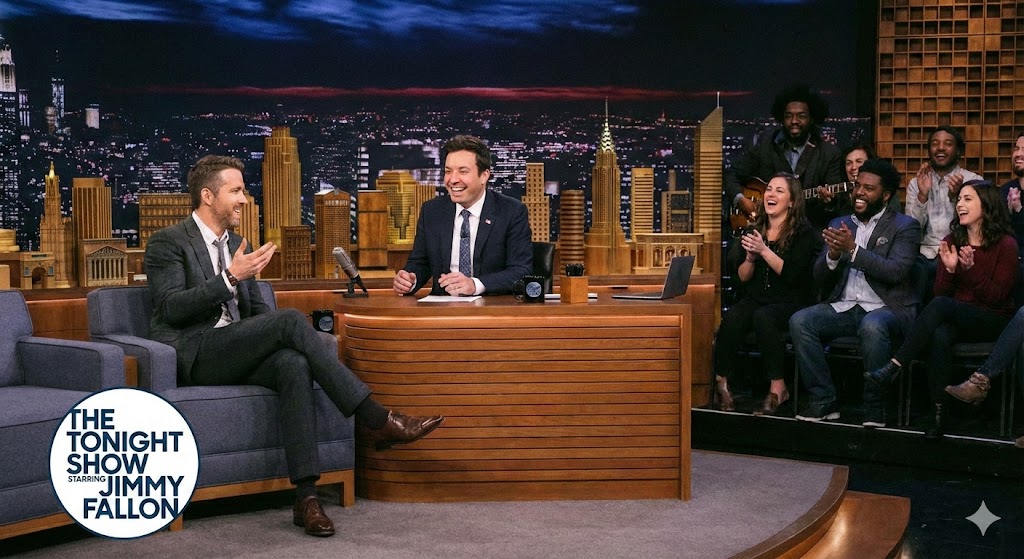
Jimmy Fallon’s net worth now stands at approximately $70 million. Currently, he earns $16 million annually hosting The Tonight Show, owns a farmhouse compound in Sagaponack valued at over $10 million, and runs Electric Hot Dog, the production company behind That’s My Jam and Password. Remarkably, the kid who couldn’t leave his backyard now broadcasts to millions nightly from 30 Rock. However, the wound that made him never really healed.
The Wound: A Fenced-In Childhood in Saugerties
James Thomas Fallon was born September 19, 1974, in Brooklyn’s Bay Ridge neighborhood to Gloria and James Fallon Sr. Shortly after, his father—a Vietnam veteran who’d sung in doo-wop groups on street corners as a teenager—took a job as a machine repairman for IBM in Kingston, New York. Consequently, the family moved to nearby Saugerties, a small town in the Hudson Valley where the streets were quiet and the neighbors minded their own business.
What happened next would shape everything. Gloria and James Sr. became what family members later described as “very overprotective.” As a result, Jimmy and his older sister Gloria weren’t allowed to leave the house except for school and church. Instead of riding through the neighborhood like other kids, they rode their bicycles in the backyard—not the street, not the sidewalk, the backyard—in tight circles.
Protection That Became a Prison
The protection extended to everything. When Jimmy wanted to watch Saturday Night Live, his father would record episodes, splice out the inappropriate parts, and let him watch the sanitized version the next day. Similarly, the Rodney Dangerfield album Jimmy loved? His father literally scratched out the dirty words with a car key so the record would skip over them. In essence, everything was curated, everything was controlled, everything was safe.
But here’s what the protection created: a child who couldn’t explore outward had to become so compelling that the world would come to him.
The Chip: A Death Wish Disguised as a Dream
By his teenage years, Jimmy Fallon had developed what can only be described as a pathological obsession with Saturday Night Live. Naturally, he watched it religiously—or at least, he watched his father’s edited versions religiously. Additionally, he memorized sketches, studied timing, and recorded The Dr. Demento Show on a reel-to-reel recorder, absorbing comedy and music through the static of late-night radio.
Eventually, the obsession crystallized into something darker. In his journal, teenage Jimmy wrote that if he didn’t make it onto SNL by age 25, he would kill himself. Importantly, this wasn’t youthful melodrama. Rather, this was a kid with no other plan for his life, no social circle to speak of, no romantic relationships, no fallback. There was just the blue glow of television and a dream that felt like oxygen.
The Only Way Out
Think about what that means. Essentially, a child so isolated, so tightly wound by parental protection, so desperate for connection with something outside his fenced-in world, tied his entire reason for living to a single outcome. If I can’t make them laugh, what’s the point of being here?
Along the way, he won a young comedian’s contest in high school doing a Pee-wee Herman impression. Later, at The College of Saint Rose, he started as a computer science major—his father worked at IBM, after all—before switching to communications. Although he was an average student, he would take buses from his aunt’s house to perform stand-up sets at Caroline’s Comedy Club in Times Square on weekends. Ultimately, he dropped out one semester before graduating to pursue comedy full-time.
By then, the wish wasn’t just a wish anymore. It was a mission.
The Rise: From Backyard to 30 Rock
At 21, Jimmy Fallon moved to Los Angeles and studied with the Groundlings, the improv troupe that had launched careers from Phil Hartman to Kristen Wiig. Then, in 1997, at age 23, he auditioned for Saturday Night Live. Unfortunately, he was rejected.
The rejection could have destroyed him—after all, he was now just two years away from his self-imposed deadline. Instead, he landed a small role in a WB pilot and made sure his contract included a clause: if SNL called, he could walk. Meanwhile, his manager sent videotapes to Marci Klein and Ayala Cohen, producers for the show. Eventually, the second audition came.
The Audition That Changed Everything
At the “notoriously difficult audition,” multiple people warned him that creator Lorne Michaels almost never laughed. Moreover, the comic before him had an arsenal of props. By contrast, Jimmy had nothing but impressions—Jerry Seinfeld, Chris Rock, Adam Sandler. Strategically, he rushed through his original characters to get to the musical bits, which he felt were stronger. Remarkably, Michaels laughed. Tina Fey, then head writer, was in the room. “He’s one of two people I’ve ever seen who was completely ready to be on the show,” she later said. “If there had been a show to do that night, he could have done it.”
At 23—two years before his deadline—Jimmy Fallon joined the cast of Saturday Night Live. Finally, the backyard kid had made it.
Building an Empire
What followed was a six-year run that made him famous: Weekend Update with Tina Fey, the Barry Gibb Talk Show with Justin Timberlake, impressions that entered the cultural lexicon. Subsequently, there was a film career (Taxi, Fever Pitch), then Late Night with Jimmy Fallon in 2009, then the crown jewel in 2014: The Tonight Show.
Today, Jimmy Fallon’s net worth of $70 million reflects more than just a hosting salary. Specifically, his $16 million annual paycheck from NBC makes him one of the highest-paid personalities in late-night television. Additionally, Electric Hot Dog, his production company, produces That’s My Jam and Password, adding executive producer fees and backend participation. Furthermore, he’s written seven books, mostly for children, and recently extended his Tonight Show contract through 2028.
The Tell: Still Making Mom Laugh
Gloria Fallon died on November 4, 2017, at the age of 68. Jimmy was at her bedside in NYU Langone Medical Center when she passed.
When he returned to The Tonight Show a week later, what he said revealed everything about who he still is underneath the $70 million and the fame and the Hamptons compound:
“She was the best audience. She was the one I was always trying to make laugh.”
The Hand Squeeze
Then he told a story that crystallized everything. When Jimmy was little, his mother would walk him and his sister to the store. During these walks, she would squeeze his hand three times: I love you. In response, he would squeeze back four times: I love you too. Remarkably, they kept this ritual their entire lives.
“Last week I was in the hospital,” he said, his voice breaking. “I grabbed her hand and I squeezed, ‘I love you.’ And I just knew we were in trouble.”
Finally, he ended by squeezing his hand three times in the air. “Mom, I’ll never stop trying to make you laugh.”
That’s the tell. Every night, broadcasting to millions, Jimmy Fallon is still that kid in the backyard, trying to be so funny that his overprotective mother would let him out into the world. Although she’s gone now, the performance never stops. The need never stops.
The Hamptons Connection: A Playground for the Protected Kid
In 2011, Jimmy Fallon paid $5.7 million for a 2.2-acre property in Sagaponack—a small village in the Hamptons where the median home price hovers around $6 million and the neighbors include hedge fund managers and fellow celebrities.
But here’s what makes the property significant: it’s not a sleek modern mansion or an oceanfront showpiece. Instead, it’s an 1850s farmhouse that used to be a horse farm. The main house features six bedrooms and five and a half bathrooms. Additionally, there are two guest cottages, a barn, and an apple orchard. Most tellingly, there’s an indoor slide that connects the playroom to the living room.
The Opposite of Everything He Was Denied
Today, the property is valued at over $10 million. Together, Jimmy and his wife Nancy Juvonen have transformed it into something that looks nothing like typical Hamptons minimalism. For instance, there’s a games room with vintage arcade machines and pinball. Similarly, there’s a playroom with a jumbo popcorn machine. Even more whimsically, there’s a secret karaoke room hidden behind what looks like a regular door.
Look at what Jimmy Fallon built and you see the wound healing—or trying to. Essentially, this is a home where children can play, where sliding down a tunnel from one floor to another is encouraged, where the boundaries are playful rather than protective. As a result, his daughters Winnie and Frances have the kind of childhood he never had: loose, whimsical, full of permission.
Consider the symbolism. The kid who rode his bike in circles in the backyard now owns 2.2 acres. Meanwhile, the boy whose father scratched dirty words off records now has his own karaoke room where anything goes. And that child who wasn’t allowed to leave his property? He now retreats to one of the most exclusive zip codes in America—by choice.
The Fortune Behind the Laugh
Jimmy Fallon’s net worth breaks down across multiple revenue streams that demonstrate the business acumen hidden beneath the affable surface:
First, The Tonight Show contract pays $16 million annually, with his most recent extension running through 2028. Consequently, that alone represents over $170 million in earnings during his tenure as host, not accounting for raises and renegotiations.
Second, Electric Hot Dog, his production company, produces Password (which earned Keke Palmer an Emmy nomination) and That’s My Jam (also Emmy-nominated). Typically, executive producer fees range from $250,000 to $500,000 per season, plus backend participation in licensing and international format rights.
Third, his children’s books—including Your Baby’s First Word Will Be DADA and Everything Is Mama—add publishing royalties. Moreover, his 2023 Christmas single “Wrap Me Up” with Meghan Trainor was a streaming hit. Earlier in his career, he appeared in films (Almost Famous, Fever Pitch, Taxi) and released two comedy albums.
Finally, there’s real estate. Beyond the Sagaponack compound, Fallon and Nancy previously owned a massive triplex in Manhattan’s Gramercy Park—five units combined into a 4,950-square-foot space—which they listed for $15 million in 2021.
What the Money Can’t Buy
In September 2023, Rolling Stone published a report alleging a toxic work environment on The Tonight Show. According to former employees, there was yelling, erratic behavior, and a culture of fear. Subsequently, Fallon apologized to his staff, reportedly telling them, “I want this show to be fun. It should be inclusive for everybody.”
The contrast was jarring. After all, America’s most affable late-night host, the one who breaks during sketches because he’s laughing too hard, the one who high-fives audience members during credits—was allegedly creating an environment where employees felt dread?
However, if you understand the wound, it makes a certain kind of sense. When your entire identity is built on making people laugh, when you tied your reason for living to a single outcome at age 15, when you never developed the social skills that come from normal childhood friendships—the pressure to perform doesn’t stop when the cameras turn off. Instead, it just redirects.
In other words, the backyard kid is still trying to control everything so he doesn’t get hurt. The only difference is now he has $70 million and a staff of people depending on him.
Still That Kid
Late at night in Saugerties, Jimmy Fallon’s parents used to set their alarm for 12:30 a.m. They would wake up, brew tea, and sit down to watch their son host The Tonight Show. Because they couldn’t stay up that late normally, they simply interrupted their sleep. When Jimmy begged them to watch on DVR instead, they waved him off. Devotedly, they saw every episode live.
Gloria is gone now. James Sr. is still around. Nevertheless, the show goes on.
Every night, Jimmy Fallon walks onto that stage at 30 Rock with a $16 million salary and a $70 million fortune and a compound in the Hamptons and more success than that kid in Saugerties ever could have imagined. Yet every night, somewhere underneath the mugging and the games and the celebrity guests, there’s still a boy riding his bike in circles, waiting for permission to leave the yard.
Ultimately, he never got permission. He just became so undeniable that the yard expanded to include the entire country.
The Promise He Keeps Every Night
The wish came true. The death deadline passed. The mother who was his best audience is watching from somewhere else now.
Maybe that’s why he still can’t stop performing. It might also explain why the slide in the Hamptons house leads down, not up. And it’s certainly why Jimmy Fallon, at 50 years old with more money than he could ever spend, still seems like he’s trying to prove something to someone who isn’t there anymore.
The Tonight Show isn’t just a job. It’s a nightly promise kept to a kid who almost didn’t make it. Mom, I’ll never stop trying to make you laugh.
For more insider stories on Hamptons celebrities and exclusive coverage of the East End’s most fascinating residents, explore our archive. Want to see where the stories happen? Join us at Polo Hamptons for an unforgettable afternoon of sport, style, and social connection. Contact us for features, partnerships, and advertising inquiries.
Related Reading: