
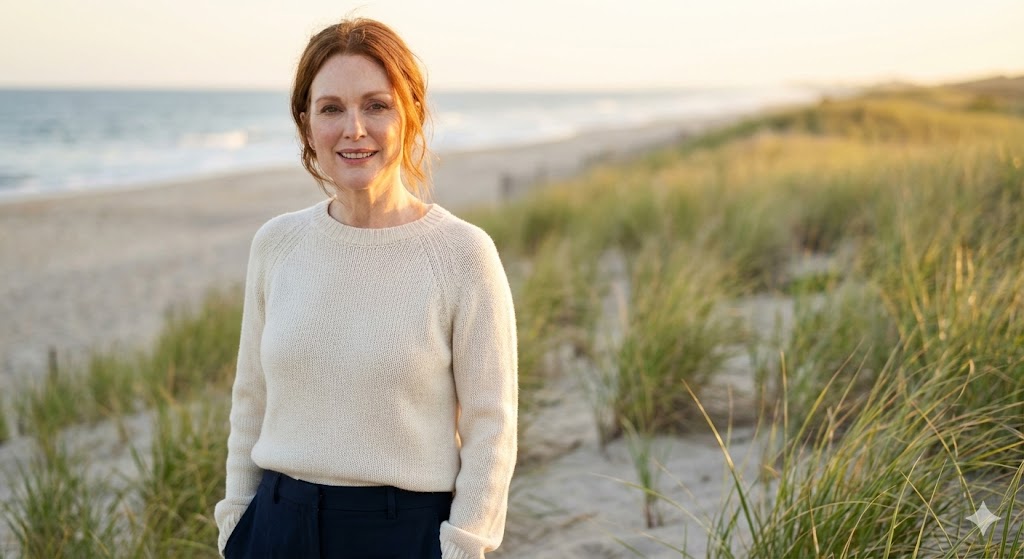
The kids in the alley behind the house in Omaha had a name for her: Freckleface Strawberry. She was seven years old, pale-skinned and red-haired in a sea of tanned blonde children, and they made sure she knew she didn’t belong. “I hated my freckles, and I hated that name,” she would later recall. “I hated it in the way that only a 7-year-old could hate it.”
But here’s the thing about that seven-year-old: she wouldn’t be in Omaha for long. By the time she turned eighteen, she would have lived in twenty-three different places and attended nine different schools. Her father was a paratrooper, then a helicopter pilot, then a military judge. Home was wherever the Army sent them next.
Today, Julianne Moore’s net worth stands at approximately $55 million. She’s won an Academy Award, two Emmy Awards, two Golden Globes, and a BAFTA. She’s the only actress besides Juliette Binoche to win Best Actress at Cannes, Venice, and Berlin. The New York Times named her one of the 25 greatest actors of the 21st century. And yet, she still admits there’s a part of her that would rather be “a tanned blonde.”
Some wounds don’t heal. They just become fuel.
The Wound: Nowhere to Call Home
Julie Anne Smith was born December 3, 1960, at Fort Bragg, North Carolina. Her father, Peter Moore Smith, was a paratrooper in the U.S. Army during Vietnam who would eventually rise to colonel and become a military judge. Her mother, Anne Love Smith, was a Scottish immigrant who had arrived in America at age ten—a psychologist and social worker who never quite lost her outsider status.
The family moved constantly. Alabama, Georgia, Texas, Panama, Nebraska, Alaska, New York, Virginia. Twenty-three relocations before Julie turned eighteen. Nine different schools. Every time she started to make friends, to find her footing, to understand the social codes of wherever she was, the orders came and they packed up again.
The Permanent Outsider
“I never had the feeling of coming from one particular place,” Moore has said. Meanwhile, she watched other kids define themselves by their hometowns, their childhood friends, their local traditions. They had roots. She had moving boxes.
The constant displacement created a fundamental insecurity. “I was an insecure child who struggled to make friends,” she admitted. However, it also gave her something else: the ability to observe. When you’re always the new kid, you learn to read rooms quickly. You study how people behave, what makes them tick, how they signal belonging or rejection.
Decades later, she would realize this was actor training. “For me, I think what I saw was that people believed that identity was solid and somehow about where you were from,” she told Willie Geist. “It’s like, ‘You are this.’ We define ourselves by the town we’re from, where we grow up, where we go to school, who we are friends with and it feels like that’s somehow you—and it’s not, because it’s changeable, it’s mutable.”
Two Percent of the Population
Being the new kid was hard enough. Being the new kid with flaming red hair and a face full of freckles was worse. “My red hair made me feel like an outsider growing up,” Moore has said. “Redheads are two percent of the global population. Nobody wants to feel like they’re in the minority, particularly as a young child.”
In Omaha, those kids in the alley crystallized everything she felt about herself into a cruel nickname: Freckleface Strawberry. In every new school, she was the pale, spotted oddity among tanned American kids who seemed to belong effortlessly to places she was just passing through.
“When I was growing up in the U.S., it felt as if no one had freckles,” she recalled. “I just wanted to look like every other tanned American kid. I hated being the one that couldn’t go to the beach or who had to wear long sleeves.”
She destroyed her eyebrows trying to fit in. “As a teenager and as a young adult I kept plucking them, bleaching them, doing all sorts of things to them, so they are really completely gone,” she confessed.
The Chip: Finding Herself in Frankfurt
When Moore was sixteen, the family landed in Frankfurt, Germany. Her father was stationed there, and she enrolled in the Frankfurt American High School. Something shifted. Perhaps it was being in a community of other military kids who understood transience. Perhaps it was simply being old enough to stop fighting who she was.
At that high school, she discovered acting. An English teacher saw something in her and encouraged her to pursue it seriously. For the first time, her ability to observe people, to study behavior, to adapt to new environments—all the survival skills she’d developed as a perpetual outsider—became assets rather than coping mechanisms.
Boston and the Reinvention
Her parents supported her dream but insisted on a college degree. She enrolled at Boston University’s School of Performing Arts, finally staying in one place long enough to put down something resembling roots. She earned her Bachelor of Fine Arts in 1983 and moved to New York.
There was just one problem: there was already an actress named Julie Smith in the Screen Actors Guild. Every variation of her name seemed taken. So Julie Anne Smith combined her first two names and took her father’s middle name as her surname. Julianne Moore was born—a name as constructed as the identity she’d been building her whole life.
She worked as a waitress, did off-Broadway theater, played Ophelia in “Hamlet” at the Guthrie Theater. Consequently, when she landed a role on the soap opera “As the World Turns” in 1985, playing dual half-sisters Frannie and Sabrina, it seemed like a break. She won a Daytime Emmy for Outstanding Ingénue in 1988.
But soap operas weren’t the goal. Neither were the forgettable TV movies that followed. Moore kept working, kept observing, kept waiting for the roles that would let her show what the perpetual outsider had learned about human behavior.
The Rise: From Short Cuts to Still Alice
Robert Altman’s “Short Cuts” in 1993 changed everything. Subsequently, “Vanya on 42nd Street” and “Safe” established her as an actress who could disappear into emotionally troubled women. These weren’t glamorous roles. They were the kind of parts that required understanding damage from the inside.
Steven Spielberg cast her in “The Lost World: Jurassic Park” without even an audition—he’d seen what she could do in “The Fugitive.” Then came Paul Thomas Anderson, a young unknown director, asking her to play a porn star with maternal instincts in “Boogie Nights.” Despite misgivings, she said yes.
The Nominations Pile Up
The Academy Award nominations started accumulating. “Boogie Nights.” “The End of the Affair.” “Far From Heaven.” “The Hours.” Four nominations without a win. Hollywood’s best character actress, always the bridesmaid.
She kept working. “The Big Lebowski.” “Magnolia.” “Children of Men.” “The Kids Are All Right.” Then came “Game Change” in 2012, where she transformed into Sarah Palin and won a Golden Globe, an Emmy, and a SAG Award. The industry that once told her to “try to look prettier” was finally seeing what she could do.
In 2014, she played a linguistics professor diagnosed with early-onset Alzheimer’s in “Still Alice.” The role required her to portray the gradual dissolution of identity—something she understood intimately from a childhood spent never quite belonging anywhere.
She won the Golden Globe. The BAFTA. The SAG Award. And finally, after five nominations, the Academy Award for Best Actress. At 54, the freckle-faced outsider stood on the Oscar stage.
The Tell: What the Wound Became
In 2007, Moore published a children’s book called “Freckleface Strawberry.” It was about a seven-year-old girl who hates her freckles but learns to love them. The book became a New York Times bestseller and spawned six sequels and a Broadway musical.
She wrote it for her own children—Caleb and Liv, both redheads like their mother—when her son started disliking aspects of his appearance. But really, she was writing to the girl in Omaha who cried when the kids in the alley called her names.
The Voice That Never Leaves
“Now I feel very identified with my hair and freckles,” Moore has said. Then she adds, with characteristic honesty: “But there’s still a part of me that would rather be a tanned blonde.”
This is the tell. After all the awards, after the $55 million fortune, after being named one of the greatest actors of the 21st century, the wound remains. It doesn’t control her anymore. But it’s still there, like a scar that aches when the weather changes.
Her mother Anne died suddenly in 2009 from an embolism. Moore had been incredibly close to her—the Scottish immigrant who understood what it meant to never quite belong. “It’s hard to talk about grief,” she said in a recent interview, her eyes welling. “It’s forever, that’s the thing.”
In 2011, Moore claimed British citizenship in her mother’s honor. Another identity, freely chosen rather than assigned by military orders.
The Hamptons Connection: Choosing Stillness
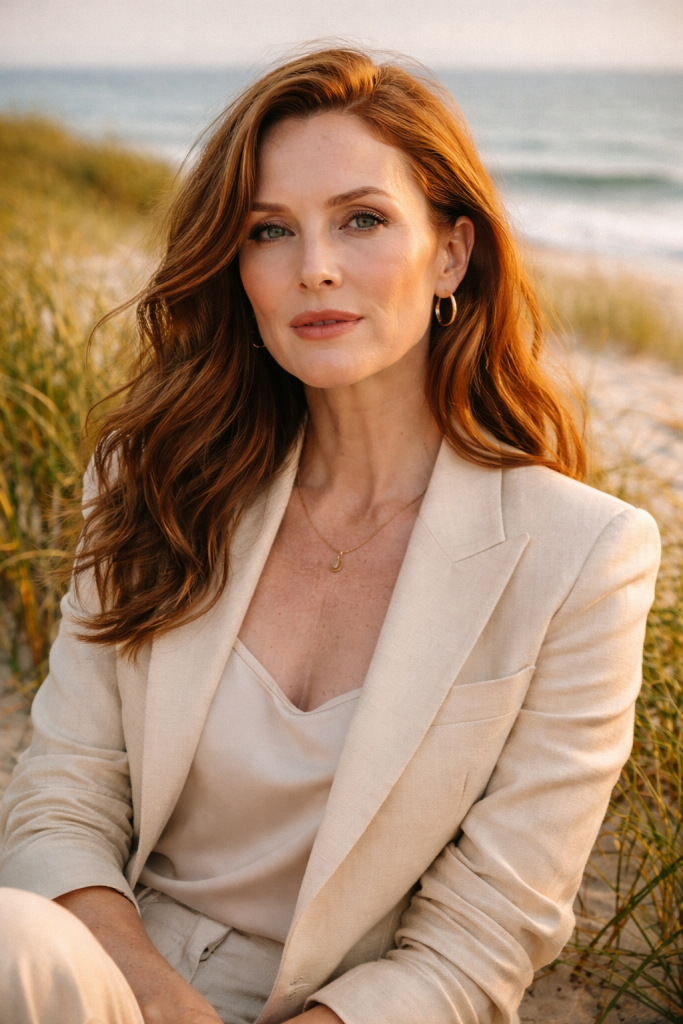
Julianne Moore’s relationship with the Hamptons represents something profound: the perpetual nomad finally choosing a place. In 2007, she and husband Bart Freundlich—the director she met on the set of “The Myth of Fingerprints” in 1996—purchased a modest cottage in Montauk for just over $1 million.
The property was deliberately understated. A 1,000-square-foot cottage overlooking Fort Pond. Three bedrooms, one bathroom. Wide-plank floors, a brick fireplace, a screened porch. A saltwater pool and cabana added later. Privacy provided by trees and plantings.
The Opposite of Transience
For someone who’d lived in twenty-three places before turning eighteen, this was revolutionary: a place to return to. A place that stayed the same. The cottage’s simplicity was deliberate—no mcmansion excess, just the essentials of a summer home.
“I wanted my children to have a sense of identity based around being in one place,” Moore has said about raising Caleb and Liv primarily in New York. The Montauk cottage extended that philosophy. Her kids would have what she never did: a consistent landscape of memory.
In 2015, she listed the property for $3.5 million after a disturbing incident—she found a drunk stranger asleep on her couch. The couple purchased a more secure, gated home elsewhere in Montauk. The original cottage finally sold in 2021 for $2.85 million, ending an era.
But the Hamptons connection endures. Moore and Freundlich remain fixtures of the East End, often spotted at local restaurants and beaches. She premiered “Still Alice” at Guild Hall in East Hampton as the closing film of the Hamptons International Film Festival—the perfect venue for the role that would finally win her Oscar.
The Fortune Behind the Face
Julianne Moore’s net worth of $55 million reflects a career built on range rather than blockbusters, critical acclaim rather than box office dominance. The money comes from multiple sources that she’s cultivated over four decades.
First, her film work spans everything from indie darlings to franchise tentpoles. “The Hunger Games: Mockingjay” films brought mainstream paychecks. “Kingsman: The Golden Circle” added action movie money. But the consistent work in mid-budget dramas—”Gloria Bell,” “May December,” “The Room Next Door”—proves she’s never chased only the highest bidder.
Second, her television work has been strategically brilliant. “Game Change” and “Lisey’s Story” brought prestige TV money alongside critical acclaim. Furthermore, her producing credits on projects like “Sharper” and “Mary & George” add additional revenue streams.
Third, the children’s books have proven surprisingly lucrative. The “Freckleface Strawberry” series—eight books and counting—generates royalties and has been adapted into a Broadway musical. “My Mom Is a Foreigner, But Not to Me,” based on her experience with her Scottish mother, adds another title to her author portfolio.
Finally, real estate has played a role. Beyond the Montauk cottage, Moore and Freundlich have owned a West Village townhouse that sold for approximately $15 million. Their primary residence remains in New York City’s West Village, where she’s maintained a home base for decades.
Still That Girl, Still Proving Them Wrong
In February 2025, Moore learned that “Freckleface Strawberry” had been removed from Department of Defense schools as part of a book review process. The irony was staggering: a book about a child learning to embrace her differences, written by a proud graduate of Pentagon schools in Frankfurt, pulled from the shelves of military base libraries where kids like her—perpetual outsiders in transient families—might find comfort in its pages.
“It is galling for me to realize that kids like me, growing up with a parent in the service and attending a @dodea_edu school will not have access to a book written by someone whose life experience is so similar to their own,” she wrote on Instagram.
The Cosmic Irony
Consider what Julianne Moore has become. The girl who was told to “try to look prettier” is now one of the most photographed women in Hollywood. The child who moved twenty-three times has homes in Manhattan and the Hamptons. The outsider who never belonged anywhere now belongs to the permanent firmament of American film.
But she hasn’t forgotten. That’s the crucial thing. She still remembers the alley in Omaha and the cruel nickname. She still understands what it means to feel like two percent of the population. And she’s used that understanding to play women who exist on the margins—the troubled, the damaged, the ones who don’t fit neatly into categories.
“I think I overcame being a child who moved around by observing people,” she has said. “That’s what I do for a living now.”
The wound became the gift. The perpetual outsider became the actress who could slip inside anyone’s skin. Julianne Moore’s net worth isn’t just $55 million in accumulated earnings. It’s the value of turning displacement into empathy, rejection into observation, and a cruel childhood nickname into a bestselling book that teaches kids to love themselves.
Freckleface Strawberry won. She just had to move twenty-three times to get there.
For more insider stories on Hamptons celebrities and exclusive coverage of the East End’s most fascinating residents, explore our archive. Want to experience where the stars play? Join us at Polo Hamptons for an unforgettable afternoon of sport, style, and social connection. Contact us for features, partnerships, and advertising inquiries.
Related Reading:
Author

Written by
Recent Posts

How to Pick a Homecoming Dress for Your Body Type (and Feel Amazing in It)

World Cup Injury Attorney for Vancouver Events
What a 3-Carat Engagement Ring Actually Costs in 2026: The Real Numbers
The Skincare Habits That Make a Real Difference Over Time
Hamptons-Ready Beauty: Polished Makeup for Long Summer Days
Categories
- Art
- Articles
- Business of Luxury
- Celebrities
- Culture
- Entertainment
- Events
- Faces of Summer 2026
- Fashion
- Fashion & Style
- Featured
- Finance
- Food, Spirits, Wine
- Hamptons
- Hamptons Celebrities
- Health
- Health & Beauty
- Lifestyle
- Luxury Lifestyle
- Press
- Profiles
- Real Estate
- Technology
- The Chronicles
- Travel
- Uncategorized
- Weddings