

The rejection letters arrived one by one. Yale. No. Juilliard. No. NYU. No. Every graduate playwriting program in the country had just told a 22-year-old Sacramento girl with big dreams that she wasn’t good enough. Sitting in her Barnard dorm room in 2006, Greta Gerwig did something unexpected. She reread her application. She still believed in it.
Years later, she would tell a podcast host: “I think they made a mistake.”
Today, Greta Gerwig has a net worth estimated at $16 million. Furthermore, she became the first solo female director to cross the billion-dollar mark with Barbie. She’s earned four Academy Award nominations. Consequently, every program that rejected her has spent nearly two decades watching her prove them wrong. The girl who couldn’t get into grad school now sits at cinema’s highest table.
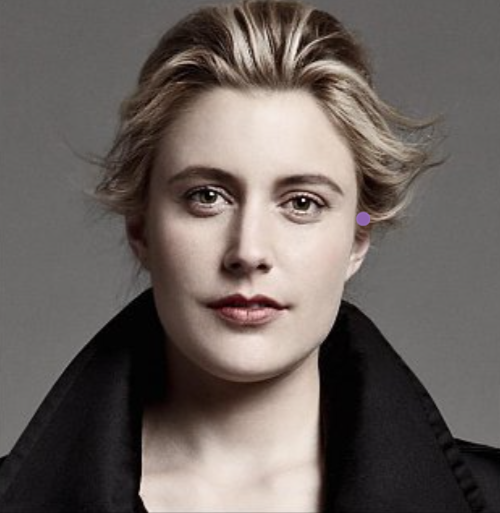
The Wound: Sacramento and the Ache to Escape
Greta Celeste Gerwig was born August 4, 1983, in Sacramento, California, to parents who represented the opposite of Hollywood glamour. Her father, Gordon, worked in the small business loans department at a credit union. Her mother, Christine, was an OB-GYN nurse. Accordingly, they lived in the River Park neighborhood, a place where, as Gerwig later described it, “you can always see the horizon.”
That horizon became an obsession. Growing up in California’s state capital, four hundred miles north of Los Angeles, meant absorbing a particular kind of restlessness. As Joan Didion, Sacramento’s most famous literary daughter, once noted: “Anybody who talks about California hedonism has never spent a Christmas in Sacramento.” Gerwig chose that quote as the epigraph for Lady Bird, her autobiographical love letter and breakup note to her hometown.
She attended St. Francis High School, an all-girls Catholic institution where she threw herself into theater productions. However, the costs of competitive fencing forced her to quit. Dance remained an outlet until it too became financially impractical. Therefore, performance became her escape route, even as the bill kept coming due.
The Intense Child
Gerwig has described herself as “an intense child,” a self-assessment that appears repeatedly in profiles. According to Sactown Magazine, her mother Christine would walk her two miles to McKinley Park as a preschooler because she believed children should make friends outside their own backyard. It was early training in leaving the familiar behind.
Her parents appear in Frances Ha as her character’s parents, shot at their actual Sacramento home. They flew to New York for Gerwig’s premiere of Lady Bird, where Christine sat next to her daughter and audibly agreed when a character onscreen described the mother-daughter relationship as “two strong personalities.” Indeed, the wound and the healing exist in the same frame.

The Wound: Sacramento and the Ache to Escape
Greta Celeste Gerwig was born August 4, 1983, in Sacramento, California, to parents who represented the opposite of Hollywood glamour. Her father, Gordon, worked in the small business loans department at a credit union. Her mother, Christine, was an OB-GYN nurse. Accordingly, they lived in the River Park neighborhood, a place where, as Gerwig later described it, “you can always see the horizon.”
That horizon became an obsession. Growing up in California’s state capital, four hundred miles north of Los Angeles, meant absorbing a particular kind of restlessness. As Joan Didion, Sacramento’s most famous literary daughter, once noted: “Anybody who talks about California hedonism has never spent a Christmas in Sacramento.” Gerwig chose that quote as the epigraph for Lady Bird, her autobiographical love letter and breakup note to her hometown.
She attended St. Francis High School, an all-girls Catholic institution where she threw herself into theater productions. However, the costs of competitive fencing forced her to quit. Dance remained an outlet until it too became financially impractical. Therefore, performance became her escape route, even as the bill kept coming due.
The Intense Child
Gerwig has described herself as “an intense child,” a self-assessment that appears repeatedly in profiles. According to Sactown Magazine, her mother Christine would walk her two miles to McKinley Park as a preschooler because she believed children should make friends outside their own backyard. It was early training in leaving the familiar behind.
Her parents appear in Frances Ha as her character’s parents, shot at their actual Sacramento home. They flew to New York for Gerwig’s premiere of Lady Bird, where Christine sat next to her daughter and audibly agreed when a character onscreen described the mother-daughter relationship as “two strong personalities.” Indeed, the wound and the healing exist in the same frame.

The Wound: Sacramento and the Ache to Escape
Greta Celeste Gerwig was born August 4, 1983, in Sacramento, California, to parents who represented the opposite of Hollywood glamour. Her father, Gordon, worked in the small business loans department at a credit union. Her mother, Christine, was an OB-GYN nurse. Accordingly, they lived in the River Park neighborhood, a place where, as Gerwig later described it, “you can always see the horizon.”
That horizon became an obsession. Growing up in California’s state capital, four hundred miles north of Los Angeles, meant absorbing a particular kind of restlessness. As Joan Didion, Sacramento’s most famous literary daughter, once noted: “Anybody who talks about California hedonism has never spent a Christmas in Sacramento.” Gerwig chose that quote as the epigraph for Lady Bird, her autobiographical love letter and breakup note to her hometown.
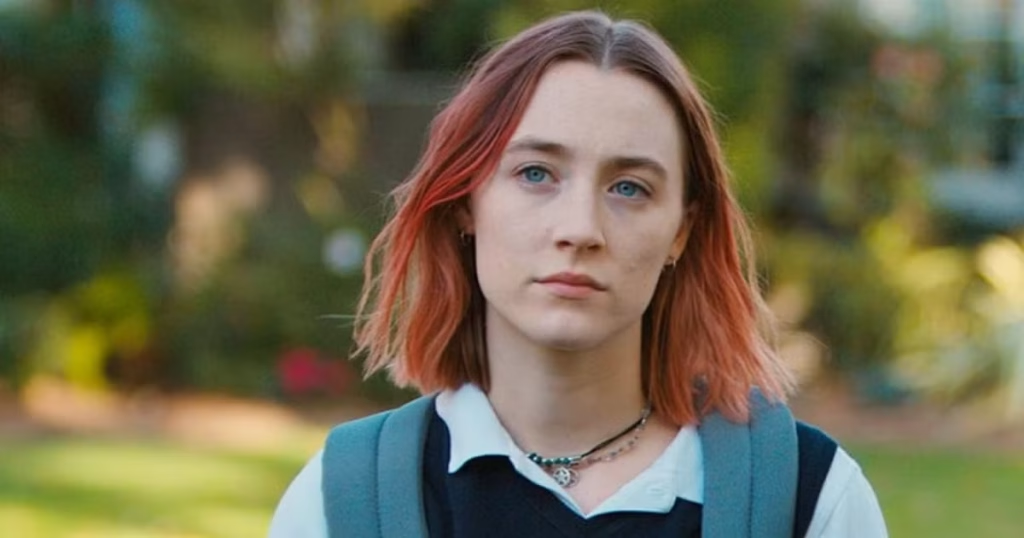
She attended St. Francis High School, an all-girls Catholic institution where she threw herself into theater productions. However, the costs of competitive fencing forced her to quit. Dance remained an outlet until it too became financially impractical. Therefore, performance became her escape route, even as the bill kept coming due.
The Intense Child
Gerwig has described herself as “an intense child,” a self-assessment that appears repeatedly in profiles. According to Sactown Magazine, her mother Christine would walk her two miles to McKinley Park as a preschooler because she believed children should make friends outside their own backyard. It was early training in leaving the familiar behind.
Her parents appear in Frances Ha as her character’s parents, shot at their actual Sacramento home. They flew to New York for Gerwig’s premiere of Lady Bird, where Christine sat next to her daughter and audibly agreed when a character onscreen described the mother-daughter relationship as “two strong personalities.” Indeed, the wound and the healing exist in the same frame.
The Chip: Rejected, Then Reinvented
Gerwig arrived at Barnard College intending to study musical theater. Instead, she graduated with degrees in English and philosophy while performing in the Columbia University Varsity Show with her dorm-mate Kate McKinnon, who would later star in Barbie. After graduation, the playwriting MFA rejections arrived.
“I really thought highly of myself,” she told the Employee of the Month podcast years later. “I applied as a playwright to Yale, Juilliard and NYU and just got like a universal ‘No thanks.'” Most people would internalize such rejection. Meanwhile, Gerwig’s response was characteristic: she concluded the programs had made an error.
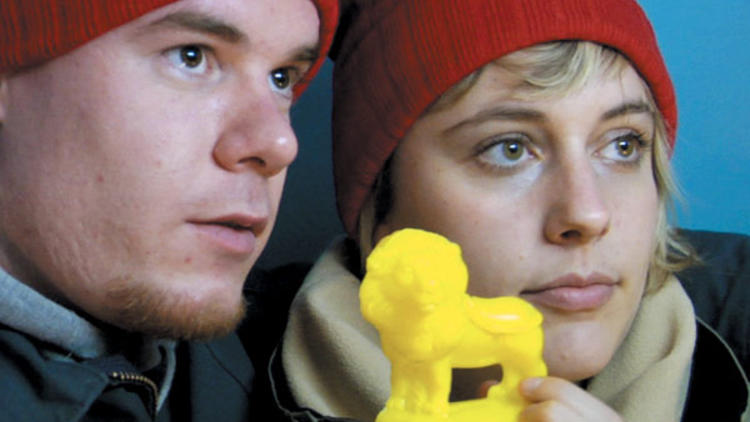
Consequently, she pivoted to acting, specifically to the DIY world of mumblecore filmmaking. Director Joe Swanberg cast her while she was still at Barnard. Subsequently, she co-wrote and co-directed Nights and Weekends (2008) with Swanberg while working as a nanny and SAT tutor to pay rent. Of this period, she admitted: “I was really depressed. I was 25 and thinking, ‘This is supposed to be the best time and I’m miserable.'”
The Mumblecore Muse Who Resented the Label
Mumblecore, the micro-budget indie movement defined by improvised dialogue and handheld cameras, gave Gerwig her start. Nevertheless, she chafed at the association. “Because of the improvisational quality of those movies and the fact that everyone was nonprofessional,” she explained to Financial Times, “I have had an uphill battle just to say ‘I know how to act.'”
The breakthrough came when Noah Baumbach cast her in Greenberg (2010). She stole the film from Ben Stiller and launched a creative partnership that would define both their careers. However, the romance that developed complicated the narrative. When they collaborated on Frances Ha, press framed Gerwig as Baumbach’s “muse” rather than his co-writer. The distinction mattered to her enormously.
The Rise: Solo Director to Billion-Dollar Auteur
Greta Gerwig net worth estimates now reach $16 million according to Celebrity Net Worth, built across a career that spans acting, writing, and directing. The trajectory from mumblecore gigs paid in pizza to billion-dollar studio tentpoles represents one of cinema’s most improbable ascents.
Her solo directorial debut, Lady Bird (2017), grossed $78 million against a $10 million budget. More significantly, it earned five Academy Award nominations including Best Picture, Best Director, and Best Original Screenplay. Gerwig became only the fifth woman in Oscar history to receive a Best Director nomination. The film set a Rotten Tomatoes record for consecutive positive reviews.
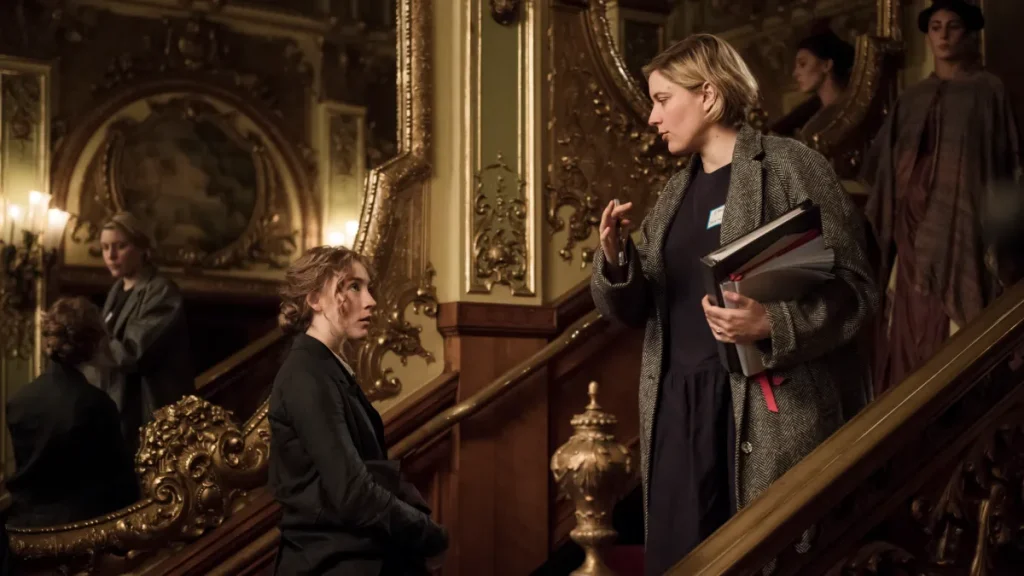
She followed with Little Women (2019), earning six Academy Award nominations and winning Best Costume Design. Both films explored mother-daughter relationships and female artistic ambition, themes Gerwig called underrepresented in cinema. Then came the project that changed everything.
Barbie: The Billion-Dollar Gamble
In July 2023, Barbie opened to $162 million domestically in its first weekend, setting a 2023 record and shattering the previous first-weekend record for a female-directed film. Ultimately, the movie grossed over $1.4 billion worldwide, making Gerwig the first solo female director to reach that milestone.
The film earned eight Academy Award nominations including Best Picture. Nevertheless, Gerwig was notably snubbed for Best Director, prompting widespread industry discussion. Asked about the omission, she remained characteristically self-assured: “A friend’s mom said to me, ‘I can’t believe you didn’t get nominated.’ I said, ‘But I did. I got an Oscar nomination.'”
Her next project is even more ambitious. According to various reports, Netflix hired Gerwig to write and direct two film adaptations of C.S. Lewis’s Chronicles of Narnia. Her talent agent noted she’s “looking to move beyond small-scale dramas” and become “a big studio director.” Accordingly, that ambition has already been realized.
The Tell: Sacramento in Every Story
The original hurt shows up in recurring patterns. Gerwig’s protagonists are ambitious young women stuck in places that feel too small. They yearn for New York or Paris or anywhere that isn’t home. They fight with their mothers while secretly becoming them.
In Lady Bird, the title character lies about being from San Francisco when asked at college. Gerwig built the entire movie around that moment of denial, “that feeling of deep shame that comes from denying who you are.” “One of the very first things I wrote was that scene,” she told The Writing Studio, “to build a movie around it so that when she rejects her home, the audience feels personally betrayed.”

Similarly, Frances Ha follows a dancer in her late twenties who hasn’t quite figured out adulthood. Little Women centers on Jo March, the writer who escapes a small Massachusetts town for New York. Even Barbie features a protagonist who must leave a perfect pink world to discover who she really is.
The Location Connection: From River Park to Manhattan
Gerwig and Baumbach married at New York City Hall in December 2023 after twelve years together and two children. They live in Manhattan, not far from Greenwich Village, where profiles have photographed them at restaurants like the Marlton Hotel. He’s 55, she’s 42. Their creative partnership extends into their home life.
Her parents still live in the River Park neighborhood of Sacramento. Gerwig returns regularly, having long since made peace with the place she once ached to escape. “It took time to realize that Sacramento gave me what home should give you,” she told Sactown Magazine, “which is roots and wings.”
The film Lady Bird was shot entirely in Sacramento, though the house used as the McPherson residence was actually in Van Nuys to accommodate production logistics. Nevertheless, the emotional geography remained authentic. Every street, every school, every conversation with her mother translated into material.
The Paradox: The Escape Artist Who Keeps Coming Home
Greta Gerwig at 42 has achieved what the gatekeepers said was impossible. Four Academy Award nominations. A billion-dollar film. A Time 100 designation as one of the world’s most influential people. The playwriting programs that rejected her now surely use her work as curriculum.
And somewhere inside her, a 22-year-old still sits in a Barnard dorm room, reading those rejection letters, deciding they must be wrong. That certainty, that refusal to accept other people’s definitions, built everything that followed. Success doesn’t erase the sting of being told no. Money doesn’t heal the wound of being underestimated.
That’s the engine of every Gerwig film. The protagonist wants desperately to leave, and in leaving, finally understands what home meant. The mansion is beautiful. In conclusion, it’s also a bandage. The Sacramento girl who wanted out became the filmmaker who keeps making movies about wanting out. At $16 million and climbing, she’s proof that sometimes they really did make a mistake.
More From Social Life Magazine
For exclusive profiles of filmmakers, artists, and cultural figures shaping the Hamptons and beyond, contact us about features, advertising, and partnerships. Secure your tickets and sponsorships for our signature summer events at Polo Hamptons.
Subscribe to our print edition for the complete luxury lifestyle experience. Your support keeps independent arts journalism alive.
- Noah Baumbach Net Worth 2025: From Park Slope Divorce to $16 Million Director
- Greta Gerwig Net Worth 2025: From Rejection to Top Female Director
- Wes Anderson Net Worth 2025: Divorced Kid to Award Winner
- Paul Rudd Net Worth 2025: From Outsider to Movie Star
- Brook Shields Net Worth 2025: Actress With No Childhood
- Kate Hudson Net Worth 2025: The Daughter Who Became Her Own Kind Of Famous
- Brian Glazer Net Worth: Dyslexic Kid Builds Film Production Empire
Author

Written by
Recent Posts
The Renegade Housewives of Pop Art: A Memoir of the 1960s
Nicole Miller
Unlocking the Berkshires
Dalia Forman Design
Alberto Luzzi
Categories
- Art
- Articles
- Business of Luxury
- Celebrities
- Culture
- Entertainment
- Events
- Faces of Summer 2026
- Fashion
- Fashion & Style
- Featured
- Finance
- Food, Spirits, Wine
- Hamptons
- Hamptons Celebrities
- Health
- Health & Beauty
- Lifestyle
- Luxury Lifestyle
- Press
- Profiles
- Real Estate
- Technology
- The Chronicles
- Travel
- Uncategorized
- Weddings