
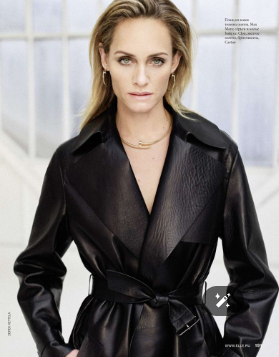
She was 25 years old, appearing on her thirteenth American Vogue cover, when she realized the math wouldn’t work forever. Every model knew the trajectory. Peak years. Declining rates. Inevitable replacement by younger faces. The industry discarded talent with ruthless efficiency.
Most models ignored this reality until forced to confront it. Amber Valletta started planning her exit before anyone suggested she needed one.
Today, at 51, her net worth sits at approximately $16 million. The number reflects three distinct careers: supermodel, working actress, sustainability advocate. Each transition happened on her terms, before necessity demanded it. That’s the reinvention engine at work.

The Myth of the ’90s Supermodel
By the mid-1990s, Amber Valletta and her frequent collaborator Shalom Harlow represented a specific aesthetic: the “waif” look that succeeded the more dramatic glamour of the original supermodels. Together, they hosted MTV’s “House of Style” from 1995 to 1996, bridging fashion and mainstream youth culture.
Valletta appeared 17 times on American Vogue’s cover, second only to Claudia Schiffer’s sixteen in her era. She worked with every designer who mattered: Giorgio Armani, Chanel, Louis Vuitton, Prada, Versace. She signed multimillion-dollar contracts with Calvin Klein and Elizabeth Arden.
All of this was supposed to be enough. It wasn’t.
The Before Nobody Discussed
Born in Tulsa, Oklahoma in 1974, Valletta grew up far from fashion capitals. Her mother enrolled her in modeling school at the Linda Layman Agency when she was 15. By 1993, she had landed her first Vogue cover at age 18.
But the clean narrative obscured harder truths. Valletta struggled with drug and alcohol addiction throughout her peak modeling years. In 2014, she publicly discussed her recovery, which began in earnest on August 19, 2010. The transparency cost nothing commercially and created authenticity that later career pivots would leverage.

The First Pivot: Acting
In 2000, Valletta appeared in Robert Zemeckis’s supernatural thriller “What Lies Beneath” opposite Harrison Ford and Michelle Pfeiffer. The role was small but demonstrated range beyond standing still while photographers clicked.
She followed with increasingly substantial parts: “Hitch” (2005) opposite Will Smith, where she played the romantic lead Allegra Cole. “Transporter 2” (2005). “Gamer” (2009). “The Spy Next Door” (2010). Television work in “Revenge,” “Legends,” and “Blood & Oil.”
The Acting Economics
Hollywood doesn’t pay models-turned-actresses what it pays established stars. But residuals compound. Union protections ensure ongoing income. Each streaming rerun generates additional checks. A 2005 film still generates revenue in 2025.
More importantly, acting extended her visibility window. Instead of fading into obscurity by her late thirties, she remained on screens through her forties and into her fifties. Visibility maintains brand value, which preserves modeling income even as primary career focus shifts.
The Second Pivot: Sustainable Fashion
In 2014, Valletta launched Master & Muse, a sustainable fashion platform. The timing was early. Sustainability wasn’t yet a marketing requirement. Most brands ignored environmental impact entirely.
That early positioning created credibility that late adopters couldn’t replicate. When sustainable fashion became mainstream commercial positioning, Valletta was already established as a voice. Speaking fees, consulting opportunities, and brand partnerships followed.
The Advocacy Premium
Valletta’s environmental work extends beyond fashion. She served as Oceana’s spokesperson, raising awareness about mercury contamination in seafood. She endorsed Barack Obama in 2012, positioning herself in progressive political circles that aligned with sustainability advocacy.
These aren’t random causes. Each builds a coherent brand identity: conscious consumption, mindful choices, values-driven decisions. That identity attracts brand partnerships that pure modeling never could have.
The Legacy Architecture
At 51, Valletta’s portfolio reflects deliberate diversification:
Ongoing modeling income: She still books high-fashion campaigns. In 2017, she closed the Versace Autumn/Winter show. She has appeared in recent campaigns for Prada, Mango, and Blumarine. The rates reflect legacy value rather than novelty.
Acting residuals: Twenty-five years of film and television work generates ongoing income through streaming, syndication, and international distribution.
Sustainability consulting: Brands seeking credible sustainability messaging pay premium rates for association with established advocates.
Real estate appreciation: Her former Santa Monica home, purchased in 2001 for $1.65 million, sold in 2016 for nearly $5 million. Her Pacific Palisades property has similarly appreciated.
What the $16 Million Represents
Valletta’s net worth is moderate by supermodel standards. She didn’t build a cosmetics empire like Cindy Crawford or a television empire like Tyra Banks. But the comparison misses the point.
She maintained relevance across three decades without exhausting herself chasing maximum revenue in any single category. The wealth is comfortable. The optionality is complete. The work continues to be interesting rather than desperate.
The Hamptons Connection
Valletta’s primary residence remains California, but fashion industry connections and occasional East Coast appearances keep her adjacent to Hamptons social circuits. Her sustainability advocacy resonates with environmentally conscious Hamptons residents concerned about coastal development and conservation.
For Social Life readers, she represents something specific: the pivot executed before crisis demands it. The Hamptons are filled with former professionals who waited too long to transition. Valletta didn’t make that mistake.

The Investment Philosophy
Valletta’s approach to career management offers clear patterns:
Diversify before you must. Acting training began while modeling income was still strong. Sustainability positioning happened before it was fashionable.
Authenticity compounds. Her public discussion of addiction created trust that pure glamour couldn’t. That trust translates to commercial opportunities.
Values attract values-aligned capital. Sustainability advocacy attracts brands and partners who share those priorities, creating mutually reinforcing relationships.
Visibility is fuel, not destination. Each career phase generated visibility that powered the next transition. Modeling enabled acting. Acting maintained profile. Profile enabled advocacy. Advocacy generates income.
The Cherokee Connection
Valletta is a citizen of the Cherokee Nation, with Portuguese, Italian, English, and Cherokee ancestry. That heritage adds dimension to her advocacy work and creates connection with indigenous communities increasingly central to environmental conversations.
The identity isn’t marketing. It’s genuine. But genuine identity, properly leveraged, creates commercial and cultural positioning that manufactured personas cannot match.
The Calculation That Worked
Most ’90s supermodels faced a binary choice: maximize income during peak years, then manage decline. Or diversify early, accepting lower peak income for extended relevance.
Valletta chose diversification. Her $16 million fortune might have been larger had she pursued every booking during her modeling prime. But her career might have ended a decade ago instead of continuing into her fifties.
The woman who saw the math at 25 and started planning accordingly now operates with options her more famous peers don’t possess. That’s the reinvention engine’s ultimate product: not maximum wealth, but maximum control.
At 51, she still works. But she works on things that interest her, with people she respects, on terms she sets. Try buying that on any balance sheet.
Related Articles
- Tatjana Patitz Net Worth 2025: The Mysterious Muse
- Tyra Banks Net Worth 2025: The Original Reinvention Engine
- Karlie Kloss Net Worth 2025: The Long-Game Player
For features, advertising, and partnership inquiries, visit sociallifemagazine.com/contact. For exclusive events, see polohamptons.com. Support our journalism with a $5 contribution.
Author

Written by
Recent Posts
What an Auto Accident Lawyer Can Recover After a Serious Wreck
What Ginger and Turmeric Shots Do for Your Body When Taken Daily
What Should You Know About Getting a Cold Sore Prescription Online?
Porch Enclosures That Let Outdoor Living Last Longer
What Your E1 Visa Lawyer Verifies in Substantial Trade Records
Categories
- Art
- Articles
- Business of Luxury
- Celebrities
- Culture
- Entertainment
- Events
- Faces of Summer 2026
- Fashion
- Fashion & Style
- Featured
- Finance
- Food, Spirits, Wine
- Hamptons
- Hamptons Celebrities
- Health
- Health & Beauty
- Lifestyle
- Luxury Lifestyle
- Press
- Profiles
- Real Estate
- Technology
- The Chronicles
- Travel
- Uncategorized
- Weddings